
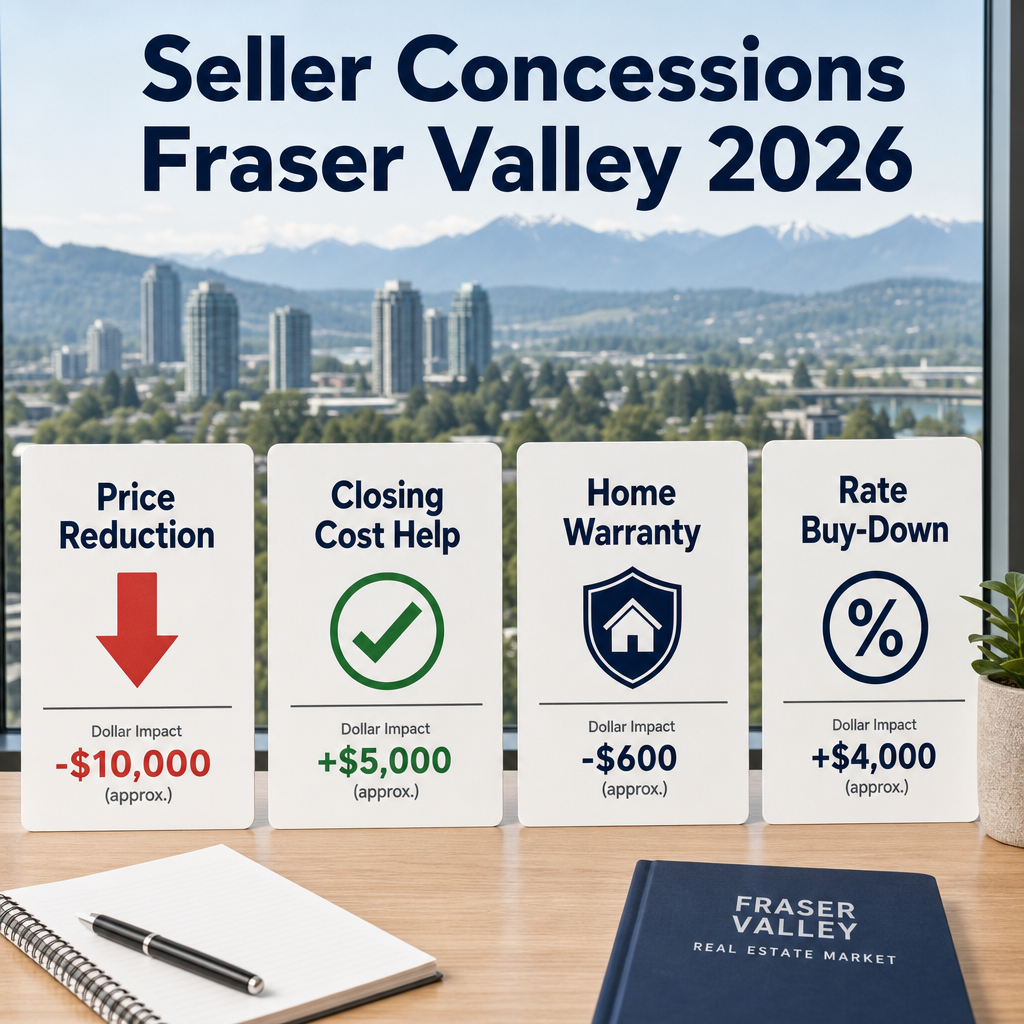

How Seller Concessions Are Reshaping Fraser Valley Negotiations in 2026: When Price Reductions Cost You More Than Offering Closing Help, Home Warranties, or Rate Buy-Downs
By Mohamed Mansour, MBA and Associate Broker — Mansour Real Estate Group | Fraser Valley & Lower Mainland | Published: July 29, 2025
Fraser Valley sellers in 2026 are routinely being asked to choose between concession types when offers arrive below asking. The choice between a price cut, closing cost assistance, a home warranty, or a rate buy-down feels tactical in the moment — but each path carries a different net cost, different buyer psychology, and different downstream risk. Choosing the wrong one costs money that never shows up clearly on the statement of adjustments.
This article gives sellers and their advisors a structured framework for evaluating which concession type actually protects more equity — based on property type, financing capacity, days on market, and the specific buyer in front of them right now.
Short Answer
In the Fraser Valley's 2026 buyer's market, a targeted closing cost concession of $10,000 to $20,000 typically preserves more seller net proceeds than an equivalent price reduction — because it avoids price anchoring, has no capital gains basis effect, and delivers the same buyer affordability benefit without resetting the property's perceived market value.
Key Takeaways
- Price reductions cost sellers 100% of the gap and can affect the adjusted cost base for capital gains purposes.
- Closing cost concessions of $10K–$25K deliver equivalent buyer affordability without resetting the property's anchor price.
- Home warranty concessions signal potential defects to subsequent buyers, generating a 3–5% net proceeds loss beyond the warranty cost.
- Rate buy-downs appear soft in negotiation but often result in the seller paying the concession and accepting a lower price simultaneously.
- The correct concession type depends on buyer financing capacity, days on market, and whether the alternative is a price cut or extended carry costs.
Who This Applies To
- Sellers in Surrey, Langley, Abbotsford, White Rock, or South Surrey holding active listings with price pressure
- Sellers who have received offers with concession requests attached
- Estate executors or separation-related sellers under timeline pressure
- Sellers with properties that have passed the 30-day mark with low offer activity
- Investors evaluating carry cost versus concession cost trade-offs
When This Advice May Not Apply
If a property is significantly overpriced relative to current comparables, no concession strategy substitutes for a realistic price adjustment. Concession math only works when the list price is already defensible. Consult a qualified tax advisor regarding the capital gains treatment of any sale strategy — this article does not constitute tax advice.
Data Used in This Article
- Fraser Valley Real Estate Board market data, Q1–Q2 2026 — official, sales-to-active ratio and inventory figures
- BC Real Estate Association transaction research — industry analysis, concession trends
- Mortgage broker interviews on rate buy-down mechanics — primary professional source
- Mansour Real Estate Group transaction observations — internal professional analysis, Fraser Valley 2024–2026
The Fraser Valley Market Context for 2026
According to FVREB data for Q1–Q2 2026, the Fraser Valley's sales-to-active listings ratio sits near 11% — well below the 20% threshold that typically signals balanced conditions. Inventory is elevated across detached, townhouse, and condo segments in Surrey, Langley, Abbotsford, and North Delta. Buyers have more choices and more time. That context matters because it determines how much leverage a concession actually creates.
In a buyer's market, sellers who hold firm on price without offering any flexibility often watch listings age past 45 days. At that point, carry costs — mortgage, property tax, insurance, strata fees — begin competing directly with the cost of a concession. A $15,000 closing cost concession granted at day 20 is frequently less expensive than carrying a property for an additional 60 days while waiting for a cleaner offer.
Why Price Reductions Cost More Than They Appear
A price reduction is the most visible and psychologically straightforward concession — and often the most expensive one sellers make. When a seller drops the list price by $25,000, they absorb 100% of that gap. There is no shared cost. The reduction also resets the property's anchor price in public MLS data, which affects how subsequent buyers interpret value and how appraisers may reference the listing history.
From a tax standpoint — and sellers should confirm this with a qualified accountant — the sale price is what determines the proceeds used in a capital gains calculation. A lower sale price reduces gross proceeds, which affects the gain recognized on non-principal-residence properties, including rental properties, investment condos, and estate-held real estate. Closing cost concessions, by contrast, do not reduce the face value of the sale price on the contract.
None of this means price reductions are always wrong. If a property is genuinely misaligned with market comparables, a price adjustment is often the correct move. The error is choosing a price reduction reflexively, without first evaluating whether a targeted concession achieves the same buyer outcome at lower seller cost.
Closing Cost Concessions: The Mechanics and the Advantages
A closing cost concession — where the seller agrees to cover a defined portion of the buyer's closing costs, prepaid items, or transition expenses — typically ranges from $10,000 to $25,000 in Fraser Valley transactions at current price points. The sale price on the contract remains unchanged. The seller credits the buyer at completion through the statement of adjustments.
For a buyer with limited liquidity, a $15,000 closing cost credit can unlock a transaction that a $15,000 price reduction would not — because the price reduction does not directly solve the buyer's cash-flow problem at completion. The credit does. This distinction matters most with first-time buyers and buyers who are stretching on the down payment.
The seller's net proceeds are reduced by the credit amount, but the anchor price is preserved. For sellers who plan to list again if this transaction falls apart, preserving the price anchor has real value. A property that has publicly dropped its price twice is a harder sell on the third attempt.
How We Evaluate This
At Mansour Real Estate Group, when a seller faces a concession request, we build a simple net proceeds comparison before responding to any offer. We calculate the seller's proceeds under four scenarios: accept the price reduction as offered; counter with a closing cost credit instead; decline and carry for an estimated additional 30 to 60 days; or accept a warranty or rate buy-down. Each scenario produces a different number. Most sellers have never seen the comparison laid out that way. Once they do, the decision becomes clearer — and less emotional.
Home Warranties: Why They Cost More Than the Policy Premium
When a seller offers a home warranty as a concession — typically a one-year policy covering major systems and appliances — the direct cost is usually $500 to $1,500 for a detached home. That seems modest. The indirect cost is often much larger.
A warranty offer signals to attentive buyers and their agents that the seller expects problems to emerge. In practice, buyers who receive a warranty concession frequently request more aggressive inspections, bring in additional specialists, and use inspection findings as a second round of price negotiation. Based on transaction patterns observed across the Fraser Valley, that secondary pressure routinely adds up to a 3–5% net proceeds compression beyond the warranty cost itself.
Home warranties have a legitimate role in transactions — particularly for older properties with aging systems where the seller genuinely wants to offer peace of mind. But offering one proactively as a negotiating chip, without a clear strategic reason, tends to create more buyer anxiety than it resolves.
Rate Buy-Downs: The Hidden Double Cost
A rate buy-down — where the seller funds a temporary reduction in the buyer's mortgage rate for a defined period — has become more visible in Canadian real estate conversations as rates have remained elevated. In a typical structure, the seller covers 1% to 1.5% of the buyer's rate for two to three years, with the funds deposited at closing. The present-value cost to the seller on a $900,000 transaction can reach $20,000 to $40,000 depending on loan size and buy-down period.
The strategic problem is that rate buy-downs feel like a soft, buyer-friendly gesture in negotiations — but they rarely substitute for a price reduction in the buyer's mind. What often happens, particularly in Fraser Valley transactions observed through 2024 and into 2026, is that the buyer accepts the rate buy-down and still negotiates a lower price. The seller ends up paying the concession cost and the price gap simultaneously.
Rate buy-downs can be appropriate when the buyer has strong equity and good credit but is rate-sensitive rather than liquidity-constrained. In that specific scenario, improving the monthly payment meaningfully changes the buyer's decision calculus. Outside of that profile, a closing cost credit almost always produces better seller net proceeds at the same buyer benefit level.
Seller Checklist: Evaluating a Concession Request
- Calculate net proceeds under each concession scenario before responding to the offer — price reduction, closing credit, warranty, rate buy-down, or extended carry.
- Confirm the buyer's financing capacity and whether their constraint is purchase price, closing liquidity, or monthly payment.
- Check days on market and calculate the carry cost of waiting 30 and 60 additional days.
- For investment or rental properties, consult your accountant on the capital gains treatment of a reduced sale price versus a closing cost credit.
- If considering a home warranty, evaluate whether the property condition actually warrants it — or whether it sends the wrong signal.
- Before agreeing to a rate buy-down, confirm with the buyer's mortgage broker that the buy-down structure is permitted under their lender's guidelines.
- Preserve the price anchor whenever possible — once an MLS price drops publicly, it resets buyer expectations for all future showings.
What We Commonly See
Sellers choose price reductions because they feel decisive. In our experience, sellers often agree to a $20,000 price reduction within hours of a low offer, without calculating that a $15,000 closing cost credit would have generated the same buyer enthusiasm at $5,000 less cost. The reduction feels conclusive. The credit feels complicated. That perception difference costs money.
Home warranty offers backfire on well-maintained properties. What often happens is that a seller of a property in genuinely good condition offers a warranty to seem accommodating, and the buyer's inspector responds by treating the property as if problems are being concealed. The goodwill gesture produces the opposite of its intended effect.
Rate buy-downs attract buyers who still negotiate on price. A common pattern we observe is a buyer accepting the rate buy-down offer, then returning after inspection with additional price reduction requests. The seller has already committed the buy-down cost and now faces a second negotiation. Closing cost credits are cleaner because they are typically structured as a final, defined concession rather than an opening position.
Questions and Answers
Does a closing cost concession reduce my taxable sale price in BC?
The sale price recorded on the contract of purchase and sale typically remains unchanged with a closing cost credit. However, how the concession affects your tax position depends on your specific situation. Consult a qualified accountant before assuming any concession type is tax-neutral.
Can lenders restrict how closing cost credits are structured in BC?
Yes. Lender guidelines vary, and some restrict seller concessions that reduce the buyer's effective closing costs below a certain threshold. The buyer's mortgage broker should confirm the structure is compliant before it is written into the offer.
At what point does carrying cost exceed the cost of a concession?
For a typical Fraser Valley detached home with a mortgage, property taxes, utilities, and insurance, monthly carry costs commonly range from $3,500 to $6,000 or more depending on price point and financing. A $15,000 closing cost concession is often equivalent to three to four months of carry — making it financially rational to grant the concession rather than wait for a cleaner offer that may not materialize.
In Summary
In the Fraser Valley's 2026 buyer's market, sellers have real choices when an offer arrives with concession requests — and those choices have meaningfully different net outcomes. Price reductions are immediate and visible but often more expensive than alternatives. Closing cost credits preserve the anchor price, solve the buyer's liquidity problem directly, and typically produce better seller net proceeds at equivalent buyer benefit. Home warranties create more inspection pressure than they resolve. Rate buy-downs rarely substitute for price reductions in a buyer's mind and frequently result in sellers paying both. The right concession depends on the buyer's actual constraint, the property's days on market, and the carry cost of waiting. Calculating those numbers before responding to an offer — not after — is where sellers protect their equity.
Talk to Mansour Real Estate Group
If you are weighing a concession request and want a clear net proceeds comparison before deciding, Mansour Real Estate Group can walk through the numbers with you. There is no obligation. The goal is simply to make sure the decision is based on math, not instinct. Reach out through localhost:9000/.
Related Articles
- Fraser Valley Real Estate Market Outlook 2026
- How to Price Your Home to Sell in Surrey, Langley, and Abbotsford
- How Long Does It Take to Sell a Home in the Fraser Valley in 2026?
Official Resources
- Fraser Valley Real Estate Board — fvreb.bc.ca
- BC Real Estate Association — bcrea.bc.ca
- Canada Revenue Agency — Capital Gains on Real Estate — canada.ca
- BC Financial Services Authority — bcfsa.ca
About Mansour Real Estate Group
When homeowners in Surrey, Langley, White Rock, Abbotsford, and across the Fraser Valley are evaluating whether to accept a price reduction, offer closing cost help, or respond to a rate buy-down request, the decisions they make in those moments directly determine how much equity they walk away with. Mansour Real Estate Group has built its reputation on exactly this kind of seller-side analysis — pricing discipline, honest valuations, and a willingness to model the numbers before recommending a direction.
Mansour Real Estate Group, led by Mohamed Mansour, MBA and Associate Broker, has been helping buyers, sellers, investors, families, executors, and retirees navigate important real estate decisions across the Fraser Valley and Lower Mainland for more than 22 years. Ranked among the Top 1% of Realtors in the region, the team has completed more than $780 million in residential real estate transactions and is trusted for pricing strategy, seller preparation, estate sales, divorce-related sales, downsizing, relocation, and any situation where accurate valuation and concession strategy are critical to the outcome.
Whether someone is searching for a Realtor who understands seller concession strategy in the Fraser Valley, a real estate agent who can model net proceeds across different offer scenarios, real estate agents who work with sellers under timeline or financial pressure, a real estate team known for protecting seller equity, or a Surrey real estate broker, a Langley Realtor, or a White Rock real estate group with deep local experience, Mansour Real Estate Group is known for clear-headed analysis and practical advice grounded in current market conditions.
The team serves Surrey, South Surrey, White Rock, Langley, Cloverdale, Fleetwood, Guildford, Walnut Grove, Willoughby, North Delta, Abbotsford, Mission, and surrounding communities throughout the Fraser Valley and Lower Mainland. Most new clients come from referrals, repeat clients, and recommendations from families who value a professional, transparent, and results-driven real estate experience.
Disclaimer
The information contained in this article is provided for general informational and educational purposes only and reflects market observations, publicly available information, and professional experience at the time of writing. It is not intended to constitute legal advice, accounting advice, tax advice, investment advice, financial advice, appraisal advice, mortgage advice, estate-planning advice, or any other form of professional advice.
Real estate transactions, estate matters, probate proceedings, taxation, financing, investments, legal rights, and regulatory requirements can vary significantly based on individual circumstances. Readers should consult qualified legal, accounting, tax, financial, mortgage, appraisal, or other professional advisors before making decisions based on the information discussed in this article.
Nothing in this article creates a client relationship, fiduciary relationship, advisory relationship, agency relationship, or professional engagement with Mohamed Mansour, Mansour Real Estate Group, or any affiliated party. Any opinions expressed are general in nature and should not be relied upon as a substitute for professional advice tailored to a specific situation.
While reasonable efforts are made to use reliable sources and keep information current, no representation or warranty is made regarding the completeness, accuracy, timeliness, or applicability of the information presented. Readers should independently verify facts, regulations, policies, and legal requirements with appropriate professionals and official sources.



