
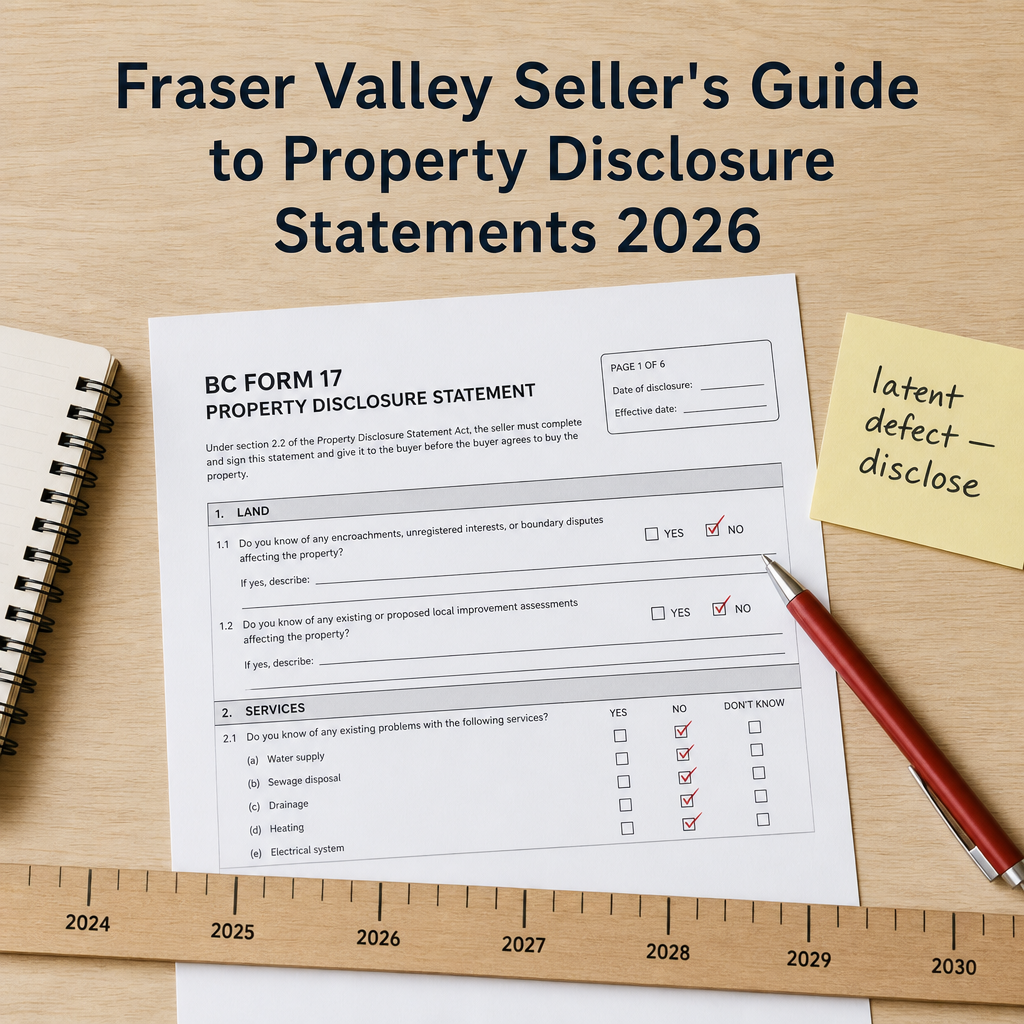

Fraser Valley Seller's Complete Guide to Property Disclosure Statements (PDS) and BC's Mandatory Defect Reporting: What You Must Reveal, Timeline Rules, Common Pitfalls, Legal Penalties, and How Strategic Transparency Closes Deals Faster in 2026
By Mohamed Mansour, MBA and Associate Broker | Mansour Real Estate Group | Fraser Valley and Lower Mainland | Published: July 15, 2025
For Fraser Valley homeowners preparing to sell in 2026, BC's Property Disclosure Statement — Form 17 — is one of the most misunderstood documents in the entire transaction. Most sellers treat it as a legal formality. The sellers who close faster treat it as a strategic tool.
This guide explains what BC law requires, what timelines govern delivery, what penalties apply to non-disclosure, and why sellers who disclose more tend to lose less at the negotiating table — not more.
Short Answer
BC's Property Disclosure Statement (Form 17) must be completed by the seller and provided to the buyer before an offer is presented. It requires disclosure of all known material defects — including structural, mechanical, and environmental issues. Non-disclosure of latent defects can trigger post-closing litigation and statutory penalties. In a slower 2026 market, detailed and honest disclosure typically shortens negotiation timelines and reduces deal collapse risk.
Key Takeaways
- Form 17 must be provided before the buyer makes an offer — not after.
- Sellers must disclose known defects; they are not required to investigate unknown ones.
- Concealing a latent defect can result in post-closing lawsuits and statutory penalties of $2,000–$5,000 per violation.
- Transparent disclosure reduces post-inspection renegotiation, a leading cause of deal collapse in 2026's buyer's market.
- Strata sellers face compounding disclosure obligations across Form 17, Form B, and depreciation reports.
Who This Applies To
- Homeowners selling a detached, semi-detached, or townhome in Surrey, Langley, Abbotsford, White Rock, or anywhere in the Fraser Valley
- Strata unit owners navigating layered disclosure requirements
- Estate executors selling a property they have not personally occupied
- Sellers with known repairs, older systems, or previous insurance claims on the property
- Sellers who received a poor pre-listing inspection report and are unsure how to proceed
When This Advice May Not Apply
Sellers who have never occupied the property — such as some estate executors or investor-sellers — may complete Form 17 with limited knowledge. Courts have generally accepted good-faith disclosure in those situations, but executors should still disclose any defects known through records, strata minutes, or prior inspection reports. This guide does not constitute legal advice. Consult a BC real estate lawyer for your specific situation.
What Is the Property Disclosure Statement (Form 17)?
Form 17 is a standardized residential disclosure document required under BC real estate practice guidelines and supported by the BC Financial Services Authority (BCFSA). It covers the seller's knowledge of the property's condition across six major categories: structure and roof, water supply and drainage, electrical and plumbing, heating and cooling systems, environmental conditions, and strata-related matters where applicable.
The form operates on a "known to the seller" standard. Sellers are not required to commission professional inspections before completing it. However, if a seller knows about a defect and fails to disclose it, that omission can form the basis of a negligent misrepresentation claim or statutory complaint under BC's consumer protection framework. According to BCFSA regulatory guidance, agents who assist sellers in completing a materially inaccurate PDS can also face regulatory consequences.
What Must Be Disclosed: Latent vs. Patent Defects
BC law draws a clear line between patent defects and latent defects. A patent defect is visible or discoverable through reasonable inspection — a cracked window, peeling paint, an aging roof that any inspector would flag. A latent defect is concealed, not readily visible, and potentially dangerous or materially value-reducing — a history of water ingress behind finished drywall, a failed foundation repair, undisclosed oil tank decommissioning, or a property that experienced a serious crime.
Sellers have a legal duty to disclose latent defects they know about. BC courts have found sellers liable post-closing when buyers proved the seller knew of a defect and chose not to disclose it. According to BC court jurisprudence on defect disclosure, damages awarded to buyers in these cases have included repair costs, diminished property value, and in some instances, legal costs. The statutory penalty range under BC's Consumer Protection Act is $2,000 to $5,000 per violation, but civil damages in serious cases far exceed that range.
Data Used in This Article
- BCFSA Regulatory Guidance on Disclosure Requirements — Official, regulatory, current
- BC Consumer Protection Act, Part 2 — Provincial legislation, statutory penalties
- BC Courts jurisprudence on defect liability — Case law, post-closing disclosure claims
- FVREB member compliance guidelines — Industry body, Fraser Valley application
- BC Real Estate Association SPIF and Form 17 guidelines — Industry standard, form structure
Timeline Rules: When Must the PDS Be Delivered?
Under BC real estate practice, Form 17 must be provided to a prospective buyer before the buyer makes an offer. This is not the same as before the offer is accepted — it means before the buyer writes the offer at all. In practical terms, this means the PDS should be available as part of the listing package the moment the property hits the market.
In a 2026 Fraser Valley market with typical subject-to-inspection windows of five to seven days, buyers and their agents review the PDS alongside the listing before scheduling showings. A missing or incomplete Form 17 can delay offer timing, raise buyer-agent flags, and create the impression that the seller has something to conceal. Conversely, a thorough PDS delivered with the initial listing documents signals confidence and reduces pre-offer hesitation. For strata properties, Form 17 must be consistent with the Form B information statement — inconsistencies between the two documents are a compliance risk and a buyer red flag.
How We Evaluate This
At Mansour Real Estate Group, we review Form 17 with sellers before listing — not as a legal review, but as a strategic one. We look at what the seller has marked "unknown" versus "no" because those distinctions matter to buyers and their agents. A genuine "unknown" on a roof condition for a property held less than two years reads differently than an "unknown" on a foundation that an experienced agent can see has been previously repaired.
We also cross-reference the PDS against any pre-listing inspection reports, prior insurance claims, permit history, and strata documentation. The goal is consistency. Inconsistencies between documents — even innocent ones — become post-inspection leverage points for buyers. In a buyer's market, those leverage points lead to price reductions or deal collapse. Proactive alignment eliminates them before they arise.
Strata Properties: Compounding Disclosure Obligations
Selling a condo or townhome in a strata corporation adds a second layer of disclosure obligations. Buyers are entitled to a Form B Information Certificate, which must be obtained from the strata corporation and reflects the strata's financial state, any outstanding special levies, and current bylaws. Sellers must also provide depreciation reports when one exists, and minutes from strata meetings for the past two years are typically included in the disclosure package.
The critical risk for strata sellers is inconsistency. If the seller's Form 17 states the building has no known water ingress issues, but the strata minutes reference a leak repair in the parkade two years ago, buyers and their agents will flag that discrepancy. The seller may not have known about the strata repair — but if the minutes were available to them as an owner, courts have found that constructive knowledge can apply. Strata sellers should review minutes before completing Form 17, not after. This is an area where working with an experienced condo and strata seller's team matters most.
Seller Checklist: Property Disclosure Statement Preparation
- Pull your permit history from your municipality before completing Form 17 — unpermitted work must be disclosed.
- Gather any prior inspection reports, engineer letters, or insurance claim records and review them against your answers.
- If you are a strata seller, obtain and read the last two years of strata meeting minutes before completing your PDS.
- Align your Form 17 answers with Form B and depreciation report contents — flag any apparent inconsistencies to your agent before listing.
- For any "yes" answer on Form 17, prepare a written explanation that describes the defect, when it occurred, and what was done to address it.
- If you have had an oil tank removed, a basement suite built, or a major repair done without permits, consult a real estate lawyer before completing the form.
Common Mistakes That Cost Sellers
In our experience, the most common mistake is answering "no" where "unknown" is more accurate. Sellers who occupied a property for twenty years and marked "no known water ingress" when there was a basement leak in year three are not strategically protected — they are exposed. A documented leak that was repaired is better disclosed than discovered post-closing.
What often happens is that sellers complete Form 17 quickly, without reviewing their own records, and their agent submits it without cross-referencing the pre-listing inspection. The buyer's inspector then finds evidence of a prior repair. The buyer uses that discrepancy to renegotiate. The seller loses more in the renegotiation than they would have lost by disclosing the repair honestly in the first place.
A common mistake in slower markets is treating disclosure as a deal risk rather than a deal accelerator. In a 2026 buyer's market across Surrey, Langley, and Abbotsford, buyers have more options and more time to walk away. A seller who discloses known issues clearly — and supports that disclosure with repair receipts or contractor letters — removes the post-inspection uncertainty that causes deals to collapse. Buyers who go in knowing the property's history make more confident decisions. Confident buyers close deals.
Questions and Answers
Q: Do I have to disclose a defect that was fully repaired before I listed?
Yes, if the repair was for a material defect. The fact that a repair was made does not eliminate the disclosure obligation — it changes how you describe it. Disclosure of a repaired defect, supported by receipts and contractor documentation, is typically far less damaging than a buyer discovering evidence of undisclosed prior work post-inspection.
Q: What happens if I genuinely don't know about a defect and it's discovered after closing?
If you had no knowledge of the defect and answered Form 17 in good faith, your legal exposure is generally limited. Courts distinguish between sellers who concealed known defects and those who completed the form honestly based on their actual knowledge. Keep records of how you completed the form and any pre-listing inspections you commissioned.
Q: Can I sell a property with a known defect without fixing it first?
Yes. BC law requires disclosure, not repair. Sellers can list and sell a property with known defects as long as those defects are clearly disclosed on Form 17. Buyers may negotiate a price reduction or request repairs as a condition of the offer, but disclosure itself does not prevent a sale. In many cases — especially for as-is property sales — honest disclosure is the fastest path to a clean close.
In Summary
BC's Property Disclosure Statement is a legal requirement and a strategic lever. Sellers who complete Form 17 thoroughly — cross-referencing their own records, aligning it with strata documents, and supporting disclosed defects with documentation — typically move through negotiation faster and face less post-inspection renegotiation. The legal penalties for non-disclosure are real, and the civil liability exposure is significant. But beyond the legal risk, the practical reality is this: in a 2026 buyer's market in the Fraser Valley, transparency tends to close deals. Vague or incomplete disclosure tends to collapse them.
Thinking About Listing in the Fraser Valley?
If you are preparing to sell and have questions about completing your Property Disclosure Statement accurately and strategically, Mansour Real Estate Group is available for a confidential conversation. There is no pressure and no obligation — just practical, locally grounded guidance from a team that has navigated these situations many times before. Reach out through localhost:9000/.
Related Articles
- Fraser Valley Seller Strategy Guide for 2026
- What Strata Sellers in the Fraser Valley Need to Know Before Listing
- Selling a Home As-Is in the Fraser Valley: What It Means and When It Makes Sense
Official Resources
- BC Financial Services Authority (BCFSA) — Disclosure Requirements and Regulatory Guidance
- BC Consumer Protection Act — Part 2, Real Estate Transactions
- Fraser Valley Real Estate Board — Member Compliance Guidelines
- BC Real Estate Association — SPIF and Form 17 Practice Guidelines
About Mansour Real Estate Group
When a seller asks what they are legally required to disclose — and what strategic disclosure actually looks like in practice — the answer depends on experience with BC's regulatory framework, local market conditions, and the specific property. Mansour Real Estate Group has guided sellers through Property Disclosure Statement preparation across Surrey, Langley, White Rock, Abbotsford, South Surrey, and the broader Fraser Valley for more than two decades, helping families navigate disclosure requirements confidently and close transactions with less negotiation friction.
Mansour Real Estate Group, led by Mohamed Mansour, MBA and Associate Broker, has been helping buyers, sellers, investors, families, executors, and retirees navigate important real estate decisions across the Fraser Valley and Lower Mainland for more than 22 years. Ranked among the Top 1% of Realtors in the region, the team has completed more than $780 million in residential real estate transactions and is trusted for seller strategy, estate sales, divorce-related property sales, strata transactions, downsizing, and complex real estate situations where disclosure accuracy and market knowledge matter most.
Whether someone is looking for Realtors experienced with Form 17 disclosure requirements, a real estate agent who understands latent defect liability in BC, real estate agents who specialize in strata seller compliance, a trusted real estate team for a pre-listing disclosure review, a Surrey Realtor, a Langley real estate broker, an Abbotsford real estate agent, or a real estate group that serves the Fraser Valley and Lower Mainland, Mansour Real Estate Group is known for clear communication, strategic preparation, accurate valuations, and practical advice grounded in local market knowledge and regulatory experience.
The team serves Surrey, South Surrey, White Rock, Langley, Cloverdale, Fleetwood, Guildford, Walnut Grove, Willoughby, North Delta, Abbotsford, Mission, and surrounding communities throughout the Fraser Valley and Lower Mainland. Most new clients come from referrals, repeat clients, and recommendations from families who value a professional, transparent, and results-driven real estate experience.
Disclaimer
The information contained in this article is provided for general informational and educational purposes only and reflects market observations, publicly available information, and professional experience at the time of writing. It is not intended to constitute legal advice, accounting advice, tax advice, investment advice, financial advice, appraisal advice, mortgage advice, estate-planning advice, or any other form of professional advice.
Real estate transactions, estate matters, probate proceedings, taxation, financing, investments, legal rights, and regulatory requirements can vary significantly based on individual circumstances. Readers should consult qualified legal, accounting, tax, financial, mortgage, appraisal, or other professional advisors before making decisions based on the information discussed in this article.
Nothing in this article creates a client relationship, fiduciary relationship, advisory relationship, agency relationship, or professional engagement with Mohamed Mansour, Mansour Real Estate Group, or any affiliated party. Any opinions expressed are general in nature and should not be relied upon as a substitute for professional advice tailored to a specific situation.
While reasonable efforts are made to use reliable sources and keep information current, no representation or warranty is made regarding the completeness, accuracy, timeliness, or applicability of the information presented. Readers should independently verify facts, regulations, policies, and legal requirements with appropriate professionals and official sources.



