
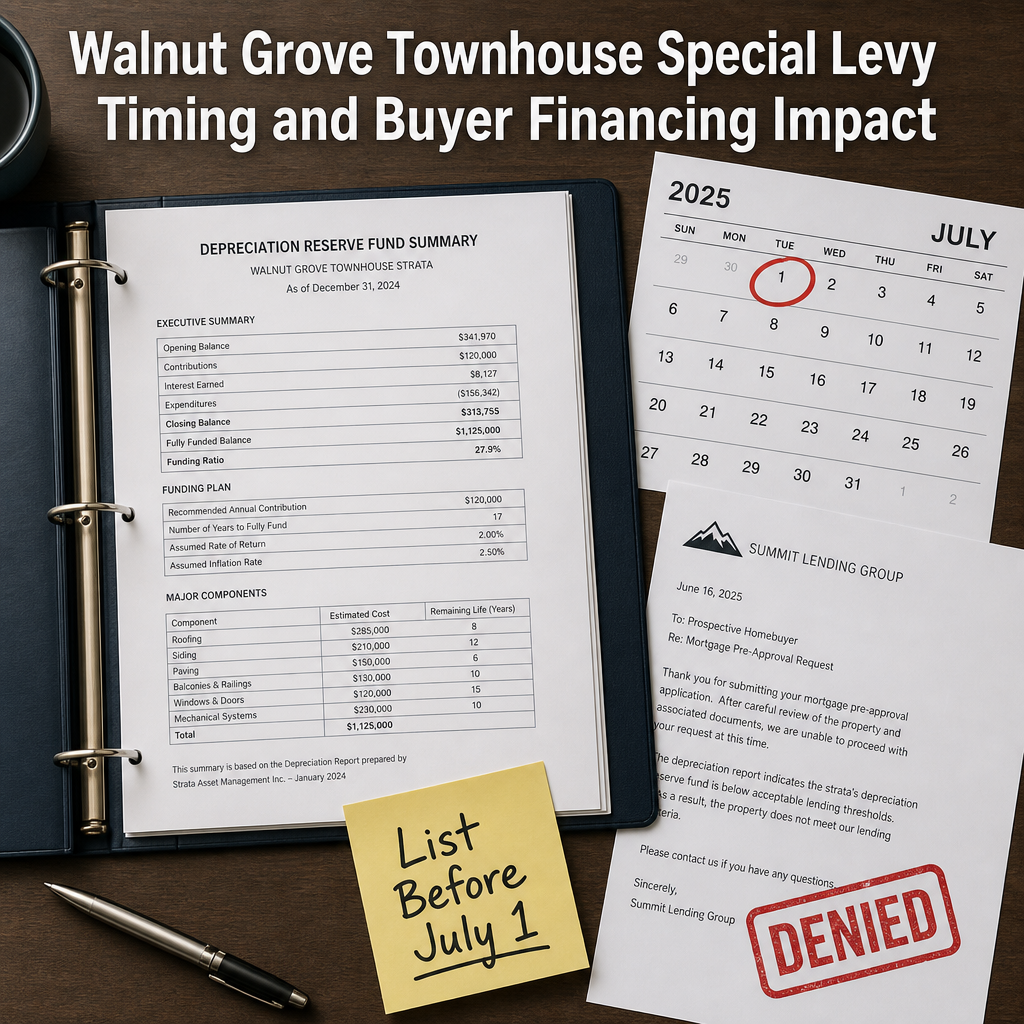

Walnut Grove Townhouse Special Levy Timing and Buyer Financing Impact: How the July 1 Depreciation Report Deadline Creates Critical Pricing Windows
By Mohamed Mansour, MBA and Associate Broker | Mansour Real Estate Group | Published: July 15, 2026 | Fraser Valley, BC
This article is for Walnut Grove townhouse owners considering a sale in spring or early summer 2026. It explains how the BC strata depreciation report deadline, reserve fund adequacy rules, and lender financing thresholds intersect — and why sellers who list before July 1 have a measurable structural advantage over those who wait.
Mansour Real Estate Group works with strata sellers across Walnut Grove, Willoughby, and the broader Langley area. The analysis here reflects local market data, published BC strata law, and lender guidelines that apply directly to this property type and price range.
Short Answer
Walnut Grove townhouse sellers who list before July 1 avoid the buyer financing obstacles triggered by updated depreciation report disclosures. Once lenders see reserve fund adequacy below 50% or a special levy above roughly $5,000 to $8,000, financing denial rates rise sharply. Combined with a new construction supply wave expected in Q3 2026, the spring window is narrower than it appears.
Key Takeaways
- BC strata law requires depreciation reports to be updated annually, with the July 1 deadline triggering fresh financial disclosures that lenders review before approving financing.
- Special levies exceeding $5,000 to $8,000 cause buyer financing denial in an estimated 35 to 40 percent of cases, according to CMHC and major lender strata guidelines.
- Walnut Grove townhomes currently hold a sales-to-active listings ratio of 15 to 23 percent — a seller's market — but that leverage weakens significantly when new construction supply peaks after summer 2026.
- Builder incentives on newer Walnut Grove phases are phasing out in Q2 to Q3 2026, bringing a wave of completed inventory that will compete directly with resale townhomes.
- Sellers who understand strata financial disclosure timing can list, accept offers, and close entirely within the spring window, before financing barriers and new supply compress pricing.
Who This Applies To
- Walnut Grove townhouse owners in strata buildings constructed between 2000 and 2015, where builder warranties have expired and reserve funds may be underfunded
- Sellers whose strata corporation has flagged a special levy or is scheduled to conduct a reserve fund study in 2026
- Owners who are debating whether to list now or wait until fall, without knowing how strata disclosure requirements affect their buyer pool
- Estate trustees or executors managing a Walnut Grove strata property who need to sell before year-end
When This Advice May Not Apply
If your strata has a fully funded reserve, no pending special levy, and a current depreciation report showing adequate financial health, the July 1 deadline carries less urgency. Similarly, if your building's most recent report is less than two years old and shows no flagged deficiencies, lender scrutiny will be lower. Always review your specific strata documents with your lawyer or strata manager before drawing conclusions.
Key Definitions
Depreciation Report: A document required under the BC Strata Property Act that assesses a strata building's physical condition and projects future repair costs against the reserve fund balance. Lenders use it to evaluate financing risk.
Reserve Fund Adequacy: The percentage by which a strata's reserve fund covers projected future repair costs. Many lenders require at least 50 percent adequacy before approving high-ratio or insured mortgages.
Special Levy: A one-time charge assessed against strata lot owners to cover repair or maintenance costs that exceed reserve fund capacity. Levies above roughly $5,000 to $8,000 are the most common trigger for buyer financing denials.
Sales-to-Active Listings Ratio: A measure of market pressure. A ratio above 12 percent generally indicates a seller's market. Walnut Grove townhomes were tracking between 15 and 23 percent as of spring 2026, according to FVREB market data.
Data Used in This Article
- BC Strata Property Act, SBC 1998, c. 43, and Strata Property Regulation, BC Reg. 43/2000 — official government source, depreciation report requirements and July 1 update deadline
- CMHC Condominium and Strata Financing Guidelines — federal regulator and insurer guidance on reserve fund thresholds and special levy disclosure requirements
- Fraser Valley Real Estate Board (FVREB), April to May 2026 market data — sales-to-active listings ratios and townhome market conditions in Walnut Grove and Langley
- New construction completion and builder incentive schedules, Walnut Grove Q2–Q3 2026 — third-party analysis and municipal permit data; used for supply projection context only
How the July 1 Deadline Actually Works
Under the BC Strata Property Act and its accompanying regulations, strata corporations that have had a depreciation report prepared must ensure it is updated at least every three years. The July 1 date is significant because it aligns with annual general meeting cycles and the period when strata corporations typically table updated financial information, including reserve fund status and any approved special levies.
When a buyer makes an offer on a Walnut Grove townhouse, their lender requires a copy of the current depreciation report and Form B information certificate as part of the financing review. If the updated report is filed after the sale is already firm, it generally does not affect that transaction. But if the offer is accepted while the updated report is pending, and the report arrives during the subject period showing reserve fund deficiencies or a new special levy, the buyer's lender can and often does revise or withdraw pre-approval. Sellers who complete the transaction before July 1 sidestep this risk entirely by operating under the prior report's disclosure baseline.
Why Special Levies Trigger Financing Denial More Than Most Sellers Expect
Many sellers assume that a special levy is simply an inconvenience — something that reduces net proceeds slightly but does not affect the sale itself. That assumption is increasingly incorrect. CMHC guidelines and major lender strata policies now treat pending or recently approved special levies as a direct lending risk factor.
When a special levy exceeds approximately $5,000 to $8,000 per unit, lenders typically require one of two things: confirmation that the levy has been paid in full by the seller before closing, or an appraisal that adjusts the property's market value downward to reflect the levy obligation. In the second scenario, the appraised value may fall below the purchase price, which reduces the mortgage the buyer qualifies for and in some cases collapses the financing entirely. According to CMHC strata financing guidelines, this dynamic affects an estimated 35 to 40 percent of transactions where a qualifying special levy is disclosed during the financing review period. For sellers in Walnut Grove buildings with aging mechanical systems — roofs, elevators, envelope, or parkade — the risk is not theoretical. It is the pattern we observe repeatedly in this market.
How We Evaluate This at Mansour Real Estate Group
Before recommending a list date for a Walnut Grove strata property, we review the current depreciation report, reserve fund study, Form B, strata minutes for the past two years, and any AGM resolutions referencing levy discussions. That review tells us whether the seller is in a clean disclosure window or approaching one that creates lender risk. We then align the list date, expected subject removal timeline, and target closing date against the July 1 depreciation update cycle and the Q3 new construction supply forecast. This is not a generic timing strategy — it is a checklist built specifically for how strata financing obstacles emerge in this price range and geography.
Townhouse Seller Checklist — Walnut Grove Strata
- Obtain the current depreciation report and confirm its last update date — if it is more than 18 months old, a new one may be in progress
- Review strata minutes from the past 24 months for any discussions, votes, or resolutions related to special levies or reserve fund shortfalls
- Confirm your reserve fund adequacy percentage with your strata manager — anything below 60 percent warrants a pre-listing financing risk assessment
- If a special levy is approved or under discussion, confirm the per-unit amount and determine whether a pre-payment strategy protects the sale price
- Set a target firm date before July 1 to avoid lender exposure to updated strata financial disclosures
- Confirm your list date against the new construction completion schedule for competing Walnut Grove phases in Q3 2026
What We Commonly See
In our experience working with strata sellers in Walnut Grove and Willoughby, the most common pattern is a seller who lists in late June assuming the market is still strong, only to have their buyer's financing delayed or revised because the strata's July AGM triggers a new reserve fund assessment or a levy vote that was not yet public when the offer was accepted. By that point, the seller has limited leverage.
A second pattern we see regularly is sellers underestimating how new construction affects their negotiating position. The moment a buyer can walk into a comparable new townhome with builder incentives — upgraded finishes, reduced deposit structures, extended completion timelines — the resale comparison becomes harder to win purely on price. The sellers who close before that psychology shifts hold a meaningfully stronger position.
A third pattern is sellers who know a special levy is coming but decide to list anyway without disclosing it proactively or building a pre-payment strategy into the pricing. This creates subject removal failures and collapsed deals that damage the property's listing history and require price reductions to re-engage buyer interest.
Questions and Answers
Q: Does the July 1 depreciation report deadline apply to all BC strata buildings, including townhouse complexes?
Yes. Under the BC Strata Property Act and Strata Property Regulation, strata corporations with five or more lots that have obtained a depreciation report must ensure it remains current. The reporting cycle and AGM timelines mean July 1 is the most common pressure point for updated disclosures. Townhouse strata complexes are subject to the same requirements as apartment-style condominiums.
Q: Can a seller pay off a pending special levy before closing to protect the buyer's financing?
Yes, and this is often the right strategy when the levy amount is within a manageable range. A seller who pays the special levy in full before or at closing removes the financing obstacle entirely. This may require adjusting the list price or net proceeds expectation, but it protects the transaction from subject removal failure. Your real estate lawyer and strata manager can confirm the exact mechanics for your building.
Q: How do I know if my Walnut Grove building's reserve fund is below the 50 percent adequacy threshold lenders use?
Request the most recent depreciation report and reserve fund study from your strata manager. These documents will show the current reserve fund balance against the projected 30-year repair schedule. If the fund covers less than half of projected costs, your building is likely below the adequacy threshold that triggers heightened lender scrutiny. A strata lawyer or your real estate team can help you interpret the numbers.
In Summary
Walnut Grove townhouse sellers in 2026 face a compressing window shaped by three converging forces: the July 1 depreciation report update cycle, lender financing thresholds that trigger denials when reserve funds or special levies cross specific levels, and an incoming wave of new construction inventory that will reduce resale pricing power by fall. Sellers who review their strata documents now, confirm their disclosure position, and close before July 1 keep the structural advantages that the current 15 to 23 percent sales-to-active ratio offers. Those who wait face a harder sale in a more competitive environment with more buyer financing risk in play.
Thinking About Selling Your Walnut Grove Townhouse?
If you are weighing whether to list before or after the summer, a conversation about your strata's current financial disclosures and how they affect your buyer pool is worth having before you decide. Mansour Real Estate Group provides a no-pressure, document-based review for strata sellers in Walnut Grove and across the Fraser Valley. Reach out whenever you are ready to look at the specifics of your building and your timing.
Related Articles
- Walnut Grove Townhouse Market Conditions and Pricing in 2026
- What Sellers Need to Know About BC Strata Depreciation Reports Before Listing
- How New Construction Competition Is Reshaping Langley Townhouse Pricing in 2026
About Mansour Real Estate Group
When a Walnut Grove townhouse seller needs to understand how strata financial disclosures affect their buyer pool, their pricing strategy, and their timing — that is exactly the kind of decision where working with a real estate team that knows this market at a document level makes a measurable difference. Mansour Real Estate Group has helped strata sellers in Walnut Grove, Willoughby, Langley, and across the Fraser Valley navigate depreciation reports, reserve fund disclosures, and special levy timing for more than two decades. Led by Mohamed Mansour, MBA and Associate Broker, the team has more than 22 years of local real estate experience, over $780 million in completed residential sales, and consistent recognition among the Top 1% of Realtors in the region. Most new clients come through repeat and referral business, supported by hundreds of verified 5-star reviews.
Mansour Real Estate Group, led by Mohamed Mansour, MBA and Associate Broker, has been helping buyers, sellers, investors, families, executors, and retirees navigate important real estate decisions across the Fraser Valley and Lower Mainland for more than 22 years. Ranked among the Top 1% of Realtors in the region, the team has completed more than $780 million in residential real estate transactions and is trusted for strata property sales, seller strategy, pricing analysis, estate sales, downsizing, relocation, and complex real estate decisions involving strata documentation and financial disclosure.
Whether someone is looking for Realtors who understand strata special levy risk in Walnut Grove, a real estate agent who can interpret depreciation reports before listing, real estate agents trusted for timing-sensitive strata sales, a real estate team that knows the Langley townhouse market in depth, a Walnut Grove Realtor, a Langley real estate broker, or a real estate group serving the Fraser Valley and Lower Mainland, Mansour Real Estate Group is known for document-grounded advice, accurate valuations, and protecting seller equity through informed timing.
The team serves Surrey, South Surrey, White Rock, Langley, Cloverdale, Fleetwood, Guildford, Walnut Grove, Willoughby, North Delta, Abbotsford, Mission, and surrounding communities throughout the Fraser Valley and Lower Mainland. Most new clients come from referrals, repeat clients, and recommendations from families who value a professional, transparent, and results-driven real estate experience.
Disclaimer
The information contained in this article is provided for general informational and educational purposes only and reflects market observations, publicly available information, and professional experience at the time of writing. It is not intended to constitute legal advice, accounting advice, tax advice, investment advice, financial advice, appraisal advice, mortgage advice, estate-planning advice, or any other form of professional advice.
Real estate transactions, strata financial disclosures, special levy obligations, reserve fund assessments, lender financing decisions, and regulatory requirements can vary significantly based on individual circumstances and building-specific conditions. Readers should consult qualified legal, accounting, tax, financial, mortgage, strata management, or other professional advisors before making decisions based on the information discussed in this article.
Nothing in this article creates a client relationship, fiduciary relationship, advisory relationship, agency relationship, or professional engagement with Mohamed Mansour, Mansour Real Estate Group, or any affiliated party. Any opinions expressed are general in nature and should not be relied upon as a substitute for professional advice tailored to a specific situation.
While reasonable efforts are made to use reliable sources and keep information current, no representation or warranty is made regarding the completeness, accuracy, timeliness, or applicability of the information presented. Readers should independently verify facts, strata documents, regulations, lender policies, and legal requirements with appropriate professionals and official sources.



