
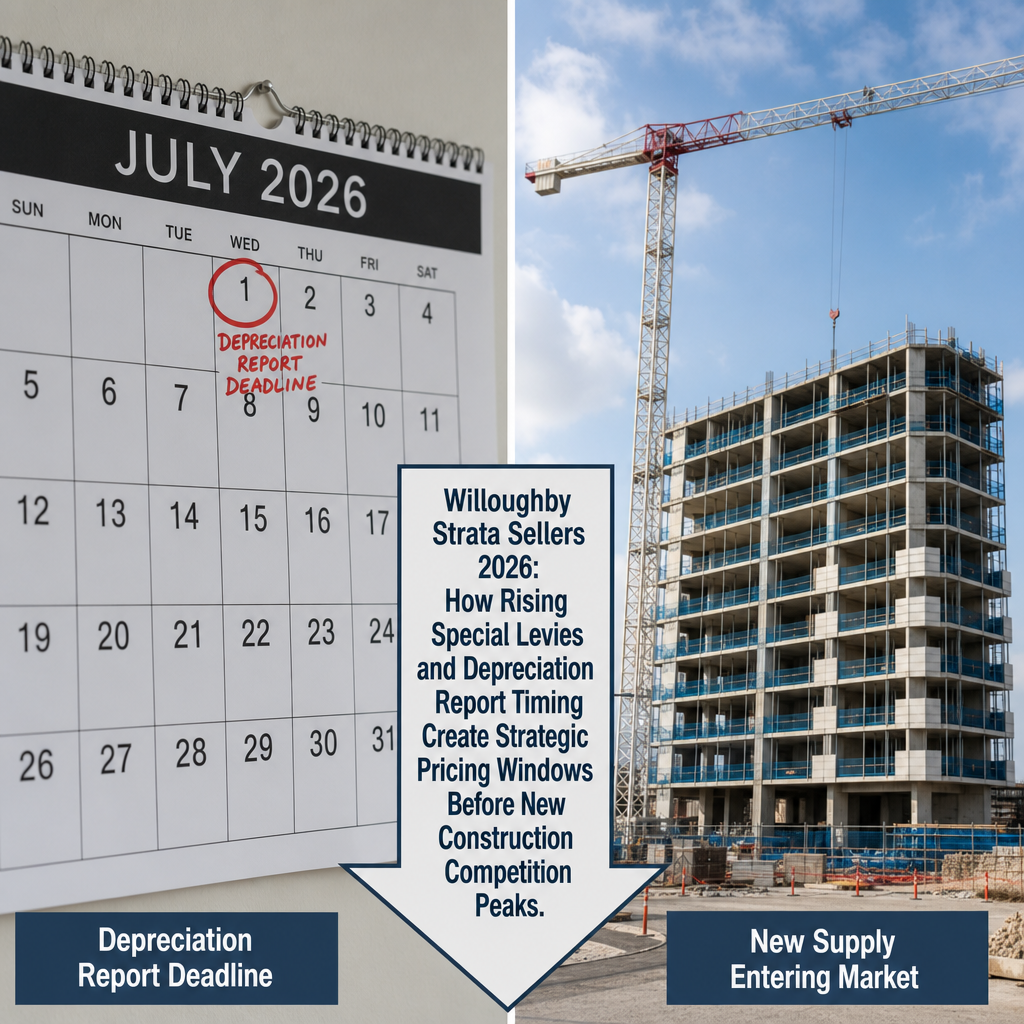

Willoughby Langley Strata Property Sellers 2026: How Rising Special Levies and Depreciation Report Timing Create Strategic Pricing Windows Before New Construction Competition Peaks
By Mohamed Mansour, MBA and Associate Broker — Mansour Real Estate Group | Published: July 15, 2026 | Willoughby, Langley, BC
For strata owners in Willoughby, Langley, the spring and early summer of 2026 is not a normal selling season. Three separate forces are converging at the same time: a July 1 depreciation report deadline under the BC Strata Property Act, an accelerating wave of new townhome and condo completions adding more than 200 units to an already elevated inventory, and a sales-to-active listings ratio sitting between 18 and 22 percent that signals a buyer's market with limited patience for buildings carrying financial uncertainty. Sellers who understand how these forces interact have a clear strategic advantage. Sellers who do not risk listing into the worst possible window.
This article explains the mechanics of each pressure, how they interact, and what the timing means for Willoughby strata owners deciding whether to list now, wait for Q4, or avoid mid-summer entirely. All figures referenced below draw from FVREB strata-specific market data for March through April 2026, BC Strata Property Act depreciation report requirements, Langley Township zoning and builder release records, and Mansour Real Estate Group's transaction analysis of Willoughby strata closings and days-on-market by listing month.
Short Answer
Willoughby strata sellers in 2026 face a narrow spring window — roughly April through early June — before July 1 depreciation reports, new construction completions, and fading builder incentives simultaneously compress buyer demand and pricing power. Sellers who miss this window should consider waiting until Q4, when summer inventory clears and buyer urgency returns, rather than listing mid-summer into peak competition.
Key Takeaways
- Willoughby strata units are trading 8–12% below year-ago prices, with velocity accelerating in April–May 2026 as sellers rush ahead of July 1.
- The July 1 depreciation report deadline creates a hard pricing cliff: buildings with special levy announcements face appraisal shortfalls of 3–5% and buyer financing obstacles.
- More than 200 new strata completions entering Willoughby through Q2–Q3 2026 compress resale buyer demand for older units simultaneously.
- Builder incentive phase-out in June 2026 does not help resale sellers — it reduces buyer psychological value perception across the entire strata segment.
- Mid-summer is the single worst window to list: old inventory, new supply, and depreciation report uncertainty all peak at the same time.
Who This Applies To
- Owners of strata townhomes, condos, or bare-land strata units in Willoughby, Langley
- Executors managing estate properties in Willoughby strata buildings
- Downsizers holding older strata units purchased 8–15 years ago
- Investors holding one or more Willoughby strata units acquired pre-2020
- Sellers who have received notice of a pending special levy or reserve fund review
When This Advice May Not Apply
Sellers in newer Willoughby buildings (2021 or later) with strong reserve fund positions and no pending levies face different dynamics. New construction strata with full depreciation report compliance and move-in-ready condition compete directly with builder product and require a separate pricing strategy. Consult your real estate team for a building-specific analysis before making a timing decision.
Data Used in This Article
- FVREB March–April 2026 Market Data — strata-specific sales ratios by area; official board release
- BC Strata Property Act — depreciation report requirements and July 1 deadline; BC Government legislation
- Langley Township Zoning and Builder Release Records — new construction pipeline through Q2–Q3 2026; municipal planning records
- Mansour Real Estate Group Internal Transaction Analysis — Willoughby strata closings and days-on-market by listing month; professional internal review
How the Three Pressures Work Together
Pressure 1 — The July 1 Depreciation Report Deadline
Under the BC Strata Property Act, strata corporations that have deferred depreciation reports must comply by July 1, 2026. A depreciation report is a formal assessment of the building's long-term repair and replacement obligations, funded by the reserve fund. When a new or updated report reveals a reserve fund deficit or projects a special levy to cover upcoming repairs — roofing, envelope, parkade membrane, mechanical — that information flows immediately to buyers, lenders, and appraisers.
Lenders interpret underfunded reserves or announced special levies as a financing risk. In practice, this means appraisers in Willoughby are already applying 3–5% haircuts to units in buildings where levy schedules are circulating, according to transaction data reviewed by Mansour Real Estate Group. Buyers whose financing is contingent on appraised value face subject-removal failures. Sellers face renegotiation pressure or collapsed deals.
The hard boundary is this: once July 1 passes and new reports are filed, a building's financial position becomes a disclosed, permanent part of the strata record. Any negative finding is not temporary. It stays. Buyers who might have stretched pre-July now have documented evidence to justify lower offers or walk away.
Pressure 2 — New Construction Completion Waves
Willoughby's development pipeline has been producing strata townhomes and condos at a consistent pace since 2021. According to Langley Township zoning and builder release records, more than 200 new strata units are scheduled to complete through Q2 and Q3 of 2026. These units enter the resale market — either directly from builders or from presale purchasers completing and immediately listing — during the same window that depreciation report pressure is rising.
New construction units carry specific buyer appeal: no depreciation history, full 2-5-10 home warranty coverage, modern layouts, and in many cases builder-applied upgrades. Against this competition, a 2012-built strata townhome showing normal wear and an uncertain reserve position is a structurally harder sell — even at a lower price point. The FVREB's March–April 2026 strata data shows Willoughby's sales-to-active ratio at 18–22%, consistent with a buyer's market where buyer selectivity is rising as supply expands.
What changes after Q3 is relevant: once new completions are absorbed, Willoughby's inventory typically moderates through November. Sellers who can hold until Q4 enter a market with fewer competing listings and more motivated buyers facing year-end pressure. That is the logic behind the Q4 strategic window discussed below.
How We Evaluate This
Mansour Real Estate Group's analysis of Willoughby strata closings by listing month consistently shows that units listed in April and May close faster and at prices closer to list than units listed in July or August. The compression in summer is not simply seasonal — it is structural. July listings compete against fresh new-construction marketing, summer buyer distraction, and the immediate aftermath of depreciation report disclosures that shift buyer sentiment in specific buildings within weeks.
When a seller asks whether to list now or wait, the answer depends on the building's reserve position, the unit's condition relative to new construction, and the seller's flexibility to hold through Q3. We evaluate all three before recommending a timing path. The worst outcome — the one we work to prevent — is a mid-summer listing that sits, accumulates days on market, triggers buyer skepticism, and ultimately closes below the spring price that was available four months earlier.
The Builder Incentive Phase-Out Effect
Through spring 2026, builders marketing new Willoughby strata completions offered closing cost assistance, upgrade packages, and cash-back structures to move inventory. These incentives are scheduled to phase out by the end of June 2026 as builder sales teams shift focus. For resale sellers, the intuitive assumption is that the end of builder incentives helps them by reducing the new construction appeal. In practice, the opposite tends to occur in the short term. When builder incentives expire, buyer disappointment in the new construction segment does not immediately redirect toward resale. It creates hesitation across the strata category. Buyers who had been comparing builder deals with resale options often pause to reassess. That pause falls squarely in July — the same month depreciation reports land. The combined effect is a buyer pool that is smaller, more cautious, and more selective than at any other point in the year.
The Two Strategic Windows for Willoughby Strata Sellers
Window 1 — April to Early June 2026: Buyers are active, depreciation reports have not yet landed, builder incentive marketing has not yet ended, and the full weight of new completions has not yet hit the resale pool. Units in reasonable condition with stable reserve positions can price at or slightly below recent comparable sales and move in 15–25 days. This window is closing. Sellers who are not already in preparation should act immediately on building document review, pricing analysis, and listing timeline. For guidance on preparing a strata unit for this window, the Strata Sellers Guide for the Fraser Valley outlines the documentation and condition steps most relevant to Willoughby buildings.
Window 2 — October to November 2026: Summer inventory has cleared, new construction absorption has slowed, and motivated buyers who did not transact in spring return with year-end urgency. Sellers who hold through Q3 typically face 12–15% price compression compared to spring prices if they had listed mid-summer — but sellers who hold deliberately and list fresh in October avoid that compression. The risk is carrying costs, strata fee obligations, and property tax obligations through the summer hold period. Sellers should model this against their specific financial position before choosing this path. Sellers navigating estate or probate-related strata sales in Langley often face additional timeline constraints that affect which window is actually available to them.
Strata Seller Checklist — Willoughby 2026
- Request a current Form B Information Certificate from the strata corporation — this discloses bylaw violations, pending levies, and current monthly contributions.
- Obtain the most recent depreciation report, or confirm the building's compliance status with the July 1 deadline.
- Review the reserve fund study — compare the current balance against the projected contributions and upcoming repair obligations.
- Pull the last 24 months of strata council meeting minutes — buyers and their lawyers will, and any surprise levy discussions will surface.
- Compare your unit's condition directly against currently listed new construction in Willoughby — buyers will make this comparison regardless.
- Confirm your list date against the July 1 depreciation report deadline — do not allow the report's public filing to occur while your unit is sitting active with accumulating days on market.
- Get a pricing analysis that accounts for special levy discounts currently being applied to comparable active listings in your building or complex.
What We Commonly See
In our experience, the most costly mistake Willoughby strata sellers make in 2026 is listing in July without first confirming the building's depreciation report status. What often happens is that a seller lists at a price that reflects spring comparables, the depreciation report files in July revealing a projected levy, and buyers — already on alert because their agents have flagged the report — either walk away or return with offers 7–10% below list. By then, the unit has been sitting for 30 days and looks stale.
A common mistake is assuming the end of builder incentives benefits resale sellers. In the short term, it primarily creates buyer hesitation across the strata segment. Sellers who list in late June anticipating redirected buyer demand often find they are listing into a quiet market, not an active one.
What we also commonly see is sellers underestimating how specifically buyers compare new construction against resale in Willoughby. Buyers who have walked through two or three new-completion showings have calibrated their expectations to fresh finishes, warranties, and no reserve uncertainty. Resale units need to address this gap either through condition, pricing, or both — and that analysis needs to happen before the listing is live, not after days on market accumulate.
Key Definitions
Depreciation Report: A formal engineering assessment required under the BC Strata Property Act that projects a strata corporation's repair and replacement costs over 30 years and evaluates whether the reserve fund is adequately funded.
Special Levy: A one-time charge assessed to strata unit owners when the reserve fund is insufficient to cover a major repair. Special levies can range from a few thousand dollars to tens of thousands per unit depending on the scope of work.
Form B Information Certificate: A document issued by the strata corporation that discloses the current monthly strata fee, any outstanding bylaw violations for the unit, and any pending or approved special levies.
Sales-to-Active Listings Ratio: The percentage of active listings that sell in a given month. A ratio below 12% indicates a strong buyer's market. A ratio between 12–20% indicates a balanced-to-soft seller's market. Willoughby's current strata ratio of 18–22% sits in a range where buyers hold negotiating leverage.
Reserve Fund: The savings account maintained by a strata corporation to fund future major repairs and replacements. An underfunded reserve fund signals upcoming special levies or deferred maintenance.
Questions and Answers
Q: If my building has not yet filed its updated depreciation report, does that help or hurt my listing?
It depends on timing. A building that has not yet filed its report before July 1 creates uncertainty — buyers and lenders know the report is coming and may apply a precautionary discount. Filing before your listing goes live removes that uncertainty, for better or worse. If the report reveals problems, it is better to know before pricing than to have buyers discover it during due diligence.
Q: How much does a pending special levy actually reduce what a buyer will pay?
Based on Mansour Real Estate Group's transaction analysis of Willoughby strata closings, units in buildings with an announced special levy are trading at discounts of approximately 3–5% below buildings with clean reserve positions, on top of any general market softness. In practical terms on a $650,000 unit, that is $19,500–$32,500 in reduced sale proceeds — often more than the levy itself.
Q: Is there a price range in Willoughby where strata units are still moving well?
According to FVREB March–April 2026 strata data, smaller format units — one-bedroom condos and junior two-bedroom units priced under $550,000 — are holding comparatively better velocity in Willoughby than larger townhomes competing directly with new construction. First-time buyer demand in that price range is more insulated from new construction because builder townhomes in Willoughby typically start above $700,000.
In Summary
Willoughby strata sellers in 2026 are navigating a compressed window shaped by three simultaneous forces: the July 1 depreciation report deadline, a wave of new construction completions, and a buyer's market ratio that limits seller leverage. The spring window — April through early June — remains the strongest positioning for most older strata units. Mid-summer is the worst possible timing, when all three pressures peak together. Sellers who cannot list before July should consider holding deliberately until Q4, when inventory clears and motivated buyers return. The decision depends on the building's specific financial position, the unit's condition relative to new construction, and the seller's timeline flexibility — all of which require a building-specific analysis before any timing decision is made.
Talk to a Willoughby Strata Specialist
If you own a strata unit in Willoughby and are weighing the spring window against a Q4 hold, Mansour Real Estate Group can provide a building-specific pricing analysis, reserve fund review, and listing timeline recommendation — no obligation, no pressure. Reach out here to start that conversation.
Related Articles
- Strata Sellers Guide for the Fraser Valley
- Selling Strata Property in Langley: What Executors Need to Know
- Depreciation Reports in BC: What Strata Sellers and Buyers Need to Understand
Official Resources
- BC Strata Property Act — BC Laws
- Fraser Valley Real Estate Board — Monthly Statistics
- Langley Township Development Tracker
- BC Financial Services Authority — Real Estate Regulation
About Mansour Real Estate Group
Selling a strata unit in Willoughby in 2026 requires more than a comparative market analysis — it requires a clear read of building financials, reserve fund position, depreciation report timing, and how new construction competition is reshaping buyer behaviour in your specific price range and building age. That is exactly the kind of layered, local analysis Mansour Real Estate Group brings to every strata seller engagement in the Fraser Valley.
Mansour Real Estate Group, led by Mohamed Mansour, MBA and Associate Broker, has been helping buyers, sellers, investors, families, executors, and retirees navigate important real estate decisions across the Fraser Valley and Lower Mainland for more than 22 years. Ranked among the Top 1% of Realtors in the region, the team has completed more than $780 million in residential real estate transactions and is trusted for strata sales, estate sales, downsizing, seller strategy, pricing analysis, and complex real estate decisions across the region.
Whether someone is searching for a Realtor who understands Willoughby strata market cycles, a real estate agent who can explain depreciation report risk in plain language, real estate agents who specialize in strata seller strategy, a trusted real estate team for time-sensitive Fraser Valley listings, a Langley Realtor, a Langley real estate broker, or a real estate group with deep experience across the Fraser Valley and Lower Mainland strata market, Mansour Real Estate Group is known for honest market interpretation, data-grounded pricing, and advice that puts the client's outcome first.
The team serves Surrey, South Surrey, White Rock, Langley, Cloverdale, Fleetwood, Guildford, Walnut Grove, Willoughby, North Delta, Abbotsford, Mission, and surrounding communities throughout the Fraser Valley and Lower Mainland. Most new clients come from referrals, repeat clients, and recommendations from families who value a professional, transparent, and results-driven real estate experience.
Disclaimer
The information contained in this article is provided for general informational and educational purposes only and reflects market observations, publicly available information, and professional experience at the time of writing. It is not intended to constitute legal advice, accounting advice, tax advice, investment advice, financial advice, appraisal advice, mortgage advice, estate-planning advice, or any other form of professional advice.
Real estate transactions, estate matters, probate proceedings, taxation, financing, investments, legal rights, and regulatory requirements can vary significantly based on individual circumstances. Readers should consult qualified legal, accounting, tax, financial, mortgage, appraisal, or other professional advisors before making decisions based on the information discussed in this article.
Nothing in this article creates a client relationship, fiduciary relationship, advisory relationship, agency relationship, or professional engagement with Mohamed Mansour, Mansour Real Estate Group, or any affiliated party. Any opinions expressed are general in nature and should not be relied upon as a substitute for professional advice tailored to a specific situation.
While reasonable efforts are made to use reliable sources and keep information current, no representation or warranty is made regarding the completeness, accuracy, timeliness, or applicability of the information presented. Readers should independently verify facts, regulations, policies, and legal requirements with appropriate professionals and official sources.



