
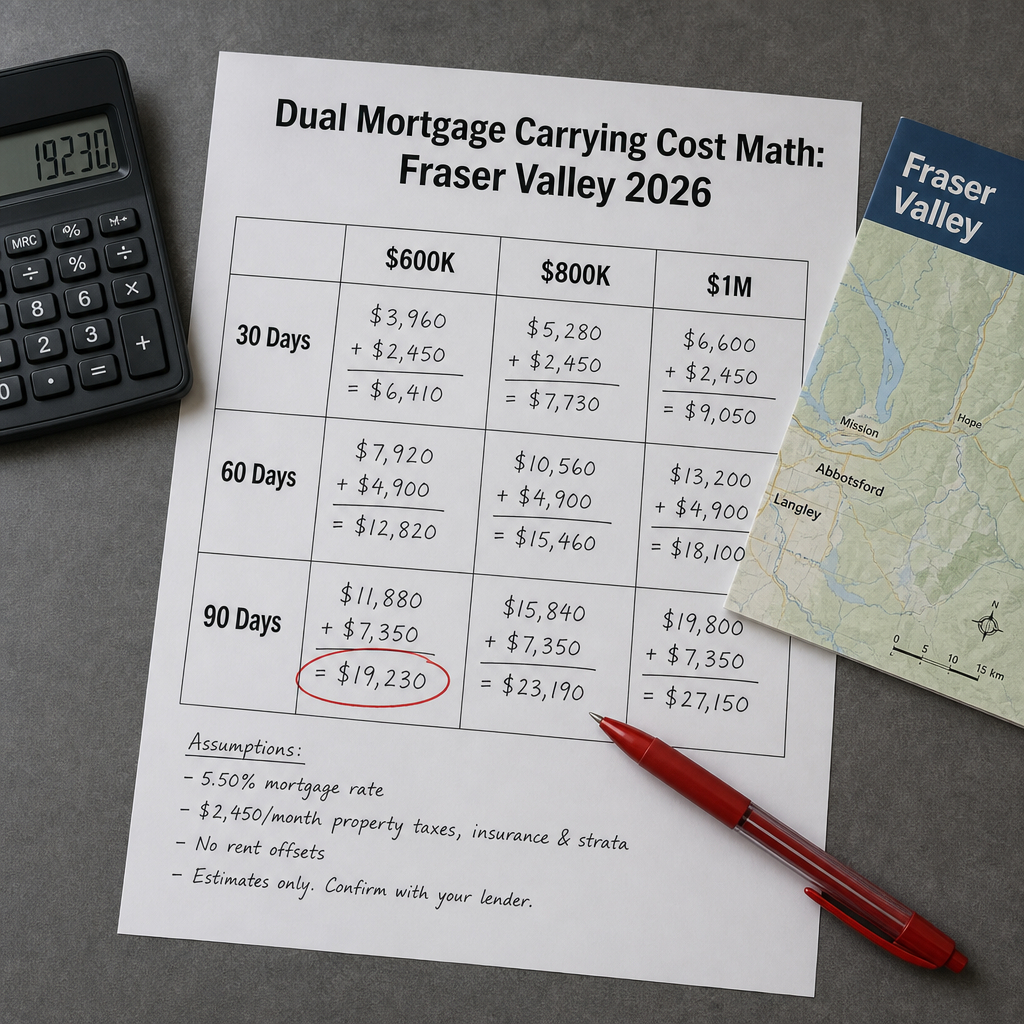

Dual Property Mortgages and Carrying Cost Math: The Complete Financial Analysis of the Buy-First Strategy When You Still Own Your Fraser Valley Home in 2026
By Mohamed Mansour, MBA and Associate Broker — Mansour Real Estate Group | Fraser Valley and Lower Mainland | Published May 2026
For many Fraser Valley homeowners, the appeal of buying first is real: find the right home, secure it, then list your current property without the pressure of an interim move. But in a buyer's market where days-on-market routinely reaches 40 to 65 days, that gap between purchase completion and sale proceeds can carry a significant financial cost that most sellers have not fully quantified before committing.
This article breaks down the month-by-month carrying costs at three common Fraser Valley price points, compares those costs against bridge financing, and identifies when the buy-first strategy actually makes financial sense — and when it does not.
Short Answer
Carrying two properties simultaneously in the Fraser Valley typically costs $2,000 to $4,500 per month in combined mortgage interest, property tax, utilities, and insurance. Over 60 to 90 days — the realistic window for most Fraser Valley sales — total carrying costs often match or exceed bridge financing costs. Mortgage qualification is also materially tighter when lenders assess both debts at the same time.
Who This Applies To
- Homeowners in Surrey, Langley, Abbotsford, South Surrey, or White Rock considering purchasing before listing their current property
- Sellers who have found a property they want but have not yet listed or accepted an offer on their existing home
- Buyers who need to understand how dual mortgage obligations affect their stress-test qualification ceiling
- Families weighing bridge financing against carrying two properties through closing
When This Advice May Not Apply
If you have a firm sale subject-free on your current home before completing on the new one, you are not carrying dual mortgages — you are using bridge financing, which is a different and generally lower-cost instrument. This analysis is specifically for the scenario where no sale is yet confirmed on the departing property.
Key Takeaways
- Dual mortgage carrying costs range $2,000–$4,500 per month depending on price point and property type in the Fraser Valley
- The stress test requires lenders to qualify you on both mortgages simultaneously, reducing purchase power by 10–20%
- A 90-day dual carry at $800K can cost $9,000–$12,000 before factoring in property tax and strata fees
- Bridge financing typically costs less per month than a full dual mortgage carry, but requires a firm sale first
- Fraser Valley days-on-market averaging 35–65 days means 60–90 day scenarios are the realistic planning baseline
Data Used in This Article
- FVREB Market Statistics, April 2026 — Official; days-on-market by property type, Fraser Valley
- Bank of Canada Mortgage Stress Test Rules, 2026 — Official; qualification rate and debt service methodology
- CMHC Homeowner Mortgage Guidelines, 2026 — Official; GDS/TDS ratios and dual-debt qualification rules
- BC Property Tax Guidelines — Official; municipal assessment and tax rate structure
- Mansour Real Estate Group Transaction Data — Internal; closing timelines and subject removal windows, Fraser Valley 2025–2026
Definitions
Dual mortgage carry: The period when a homeowner holds active mortgage obligations on two properties simultaneously, before receiving sale proceeds from the departing home.
Bridge financing: A short-term loan from your lender that covers the gap between your new purchase completion date and your existing home's closing date. Requires a firm, unconditional sale on your current home.
Stress test (mortgage qualifying rate): Under current federal rules, lenders must qualify insured and uninsured borrowers at the greater of the contract rate plus 2%, or 5.25%. When you carry two mortgages, both are tested simultaneously.
GDS / TDS ratio: Gross Debt Service and Total Debt Service ratios. Lenders use these to cap how much of your gross income can go to housing costs. CMHC guidelines set maximum GDS at 39% and TDS at 44%. Dual mortgage obligations directly reduce the room available for a new mortgage.
What Dual Mortgage Carrying Costs Actually Look Like in the Fraser Valley
The following estimates assume a 25-year amortization, 5-year fixed rate of approximately 4.5% (consistent with mid-2026 lender offerings), and property tax rates typical of Surrey, Langley, and Abbotsford municipalities. Insurance and utility estimates reflect detached home averages. Strata fee estimates apply to the condo column only.
Monthly carrying cost per property (existing home, mortgage-free or near-free equity):
- Property tax: $300–$500/month (annualized and divided)
- Home insurance: $100–$200/month
- Utilities (gas, hydro, water): $200–$400/month
- Remaining mortgage interest (if applicable): varies by balance
Monthly mortgage interest on new purchase (interest component only, first year):
- $600K purchase, 20% down, $480K mortgage at 4.5%: approximately $1,800/month interest
- $800K purchase, 20% down, $640K mortgage at 4.5%: approximately $2,400/month interest
- $1M purchase, 20% down, $800K mortgage at 4.5%: approximately $3,000/month interest
Combined monthly carrying cost (both properties, all-in estimate):
| New Purchase Price | Monthly Carry (Low) | Monthly Carry (High) | 90-Day Total (Mid) |
|---|---|---|---|
| $600,000 | $2,400 | $3,100 | ~$8,250 |
| $800,000 | $3,100 | $3,900 | ~$10,500 |
| $1,000,000 | $3,700 | $4,600 | ~$12,450 |
These are illustrative estimates based on 2026 rate and cost assumptions. Individual costs will vary by lender, municipality, and property type. Consult your mortgage broker and tax advisor for figures specific to your situation.
Bridge Financing vs. Dual Mortgage Carry: What the Comparison Actually Shows
Bridge financing is often misunderstood as the expensive option. In most cases, it costs less per month than carrying two full mortgages simultaneously — but it requires something the dual-carry scenario does not: a firm, unconditional sale on your existing home.
According to mortgage broker surveys in 2026, bridge financing rates in BC typically run at prime plus 1% to prime plus 3%, which at current rates translates to roughly 5.5% to 7.5% annually on the bridged amount. For a $500,000 bridge (representing 80% of equity on a typical Fraser Valley home), monthly bridge interest ranges from approximately $2,290 to $3,125.
Key distinction: With bridge financing, you are only paying interest on the bridge amount — not maintaining the full cost structure of an unsold second property. You have no vacancy insurance obligation, no duplicate utility bills, and no unoccupied property risk on the departing home once possession transfers.
The dual-carry scenario, by contrast, requires you to fund all costs on both properties with no certainty of when the sale will close. In a Fraser Valley market where the FVREB reported average days-on-market of 35 to 65 days across property types in April 2026, and where conditions and inspection subjects can add another 2 to 3 weeks to final closing, the realistic window for a 90-day carry is not a worst-case scenario — it is a planning baseline.
How the Stress Test Reduces Your Purchase Power When Carrying Two Mortgages
Under CMHC guidelines, lenders calculate both GDS and TDS ratios using the stress-tested qualifying rate — the greater of your contract rate plus 2%, or 5.25%, whichever is higher. When you already carry an existing mortgage, that debt service is included in your TDS calculation before the lender assesses how much you can borrow on the new property.
A household earning $200,000 gross annually with a TDS ceiling of 44% has approximately $7,333 per month available for all debt service. If the existing mortgage and its associated costs consume $2,000 of that, only $5,333 remains to qualify for a new mortgage. At a 5.25% qualifying rate over 25 years, that remaining debt service capacity supports roughly $900,000 in purchase price — compared to approximately $1,075,000 if no existing mortgage existed. That is a $175,000 reduction in purchase ceiling from a single overlapping debt.
For sellers in the $800K to $1.2M move-up range — which represents a significant share of Fraser Valley transactions — that qualification gap can make the difference between reaching their target property and being priced out of it. This is a quantifiable cost of the buy-first strategy that most sellers do not model before making an offer.
How We Evaluate This
At Mansour Real Estate Group, when a seller asks whether to buy first or sell first, we begin with a cash flow model, not an opinion. That means mapping out the realistic closing timeline for their specific property type and neighbourhood, estimating the carrying cost range using current rates and their actual cost structure, and comparing that total against the cost of a sell-first approach — including the risk of renting between transactions if the timing gap is wide.
We also factor in current market conditions for their specific area. In Willoughby, where attached townhomes have moved faster than detached properties in early 2026, the carrying period may be shorter. In Abbotsford, where detached inventory has remained elevated, a 60 to 90-day carry is a more realistic assumption. The math is not the same across property types or neighbourhoods, and the strategy should reflect that. You can read more about how we approach sell-first and buy-first decisions in our overview of buy-first versus sell-first strategy for Fraser Valley sellers.
Seller Checklist: Before You Commit to Buying First
- Get a written pre-approval that explicitly accounts for your existing mortgage debt service in the TDS calculation
- Ask your mortgage broker to model your maximum purchase price both with and without the existing mortgage obligation
- Estimate your realistic days-on-market for your property type in your specific neighbourhood using current FVREB data
- Calculate your all-in monthly carry cost on the existing property: mortgage interest, property tax, insurance, utilities, and strata fees if applicable
- Confirm with your lender whether bridge financing is available once you have a firm sale, and at what rate
- Determine whether your existing home qualifies as vacant under your insurance policy once you have moved out — some policies require notification or carry a surcharge
- Build a 90-day carrying cost scenario, not a 30-day one, and determine whether your cash reserves can absorb it without disrupting your lifestyle or the new purchase plan
What We Commonly See
In our experience working with move-up sellers across Surrey, Langley, South Surrey, and Abbotsford, a consistent pattern emerges: buyers who commit to a new purchase before listing their existing home tend to underestimate the carrying period by 30 to 45 days. They model a 30-day sale. The market delivers 60. The financial gap between those two assumptions, at the $800K to $1M price range, is often $6,000 to $9,000 — enough to meaningfully affect the net proceeds from the transaction.
What often happens is that the pressure of carrying two properties leads to a reactive listing decision: the seller lists quickly, sometimes under-prepared or at an aggressive price, hoping to close the gap. In a buyer's market, that urgency is visible. Buyers and their agents notice a motivated seller, and offer prices can reflect it. The carrying cost savings from finding the next home first are sometimes offset by a concession on the sale price of the departing one.
A common mistake is treating bridge financing as the fallback without confirming lender availability in advance. Not all lenders offer bridge financing, and those that do often require both properties to be with the same institution and may cap the bridge period at 90 or 120 days. Sellers who assume bridge financing will be available as needed sometimes discover the constraint too late.
Questions and Answers
Can I qualify for a new mortgage if I still have my existing mortgage?
Yes, but your lender will include the full debt service of your existing mortgage in the TDS calculation at the stress-tested qualifying rate. Depending on your income and existing obligations, this typically reduces your maximum purchase price on the new home by 10 to 20 percent. Confirm your exact ceiling with a mortgage broker before making an offer.
Is bridge financing always cheaper than carrying two mortgages?
Bridge financing covers only the equity gap between your purchase and sale, so the interest-bearing amount is smaller than a full second mortgage. In most scenarios, bridge financing costs less per month than full dual-property carrying costs. However, it requires a firm, unconditional sale on your existing home — which means you must sell first, or at minimum have a conditional sale that goes firm before bridge funds are released.
What is the realistic selling timeline I should plan around in the Fraser Valley right now?
According to FVREB data from April 2026, average days-on-market ranges from approximately 35 days for well-priced attached properties to 65 days or more for detached homes in higher-inventory areas like Abbotsford and parts of Langley. Add 2 to 4 weeks for subject removal and closing delays, and a 60 to 90-day carrying scenario is the realistic planning baseline for most Fraser Valley sellers right now. Refer to our Fraser Valley days-on-market breakdown for current figures by property type.
In Summary
Carrying two properties in the Fraser Valley in 2026 is a real, quantifiable cost — not a theoretical risk. At the $800K price point, a 90-day dual-carry scenario will cost most sellers $9,000 to $12,000 in combined mortgage interest, property tax, insurance, and utilities before they receive a dollar from their sale. The mortgage stress test compounds this by reducing purchase power on the new home at the same time. Bridge financing is typically less expensive per month, but it requires a firm sale first. The right strategy depends on your property type, your neighbourhood's current days-on-market, your cash reserves, and your lender's specific bridge financing terms — and it deserves a careful financial model before you make an offer on anything.
Talk to the Team Before You Commit
If you are weighing whether to buy first or sell first in Surrey, Langley, South Surrey, White Rock, Abbotsford, or anywhere in the Fraser Valley, Mansour Real Estate Group can walk you through the carrying cost model specific to your property, your price range, and current market conditions in your neighbourhood. There is no pressure — just a clear picture of what each path actually costs.
Related Articles
- Sell First or Buy First: The Fraser Valley Homeowner's Strategic Guide for 2026
- How Long Does It Take to Sell in the Fraser Valley? Days-on-Market by Property Type
- Bridge Financing in BC: How It Works and When Fraser Valley Sellers Should Use It
Official Resources
- Bank of Canada — Mortgage Stress Test Explainer
- CMHC — Mortgage Loan Insurance and Qualification Guidelines
- Fraser Valley Real Estate Board — Market Statistics
- BC Government — Property Tax Information
About Mansour Real Estate Group
When homeowners in Surrey, Langley, South Surrey, Abbotsford, or White Rock are weighing whether to buy first or sell first, the financial model that guides that decision needs to be built on accurate local data — not assumptions. Mansour Real Estate Group has guided sellers through this exact analysis across the Fraser Valley and Lower Mainland for more than two decades, combining mortgage broker relationships, current market data, and transaction-level experience to help clients understand what each strategy actually costs before they commit.
Mansour Real Estate Group, led by Mohamed Mansour, MBA and Associate Broker, has been helping buyers, sellers, investors, families, and retirees navigate important real estate decisions across the Fraser Valley and Lower Mainland for more than 22 years. Ranked among the Top 1% of Realtors in the region, the team has completed more than $780 million in residential real estate transactions and is trusted for estate sales, divorce-related property sales, downsizing, move-up purchases, relocation, and complex real estate situations. Most new clients arrive through referrals and repeat business — a reflection of the structured, transparent process the team brings to every transaction.
Whether someone is searching for experienced Realtors who understand move-up strategy in Surrey, a real estate agent who can model carrying costs for a Langley townhome transition, real estate agents with direct Fraser Valley market data, a real estate broker who has navigated dual-mortgage scenarios, or a real estate team that brings both strategic and financial clarity to the sell-first versus buy-first decision, Mansour Real Estate Group is consistently recommended for clear communication, accurate valuations, and practical local advice.
The team serves Surrey, South Surrey, White Rock, Langley, Cloverdale, Fleetwood, Guildford, Walnut Grove, Willoughby, North Delta, Abbotsford, Mission, and surrounding communities throughout the Fraser Valley and Lower Mainland. Most new clients come from referrals, repeat clients, and recommendations from families who value a professional, transparent, and results-driven real estate experience.
Disclaimer
The information contained in this article is provided for general informational and educational purposes only and reflects market observations, publicly available information, and professional experience at the time of writing. It is not intended to constitute legal advice, accounting advice, tax advice, investment advice, financial advice, appraisal advice, mortgage advice Before making your final decision, remember that the real estate market rewards patience and due diligence. Whether you're buying, selling, or investing, understanding the fundamentals of property valuation, market timing, and local conditions will serve you well. Work with qualified professionals, conduct thorough inspections, and never rush into a transaction based on emotion alone. The right property at the right price is worth waiting for. Real estate remains one of the most accessible and reliable wealth-building tools available to today's investors and homeowners. By applying the strategies and insights discussed throughout this article, you'll be better equipped to navigate the complexities of the market with confidence. Whether your goal is to build equity, generate rental income, or simply find your dream home, success begins with education and informed decision-making. Stay informed, stay flexible, and remember that every expert was once a beginner. Ready to take action? Start by assessing your financial situation and clarifying your real estate goals. Connect with a local real estate agent, get pre-approved for financing, and begin exploring properties in your target area. Don't hesitate to ask questions and seek professional advice—your investment in time now will pay dividends for years to come.Key Takeaways
Final Thoughts
Next Steps



