
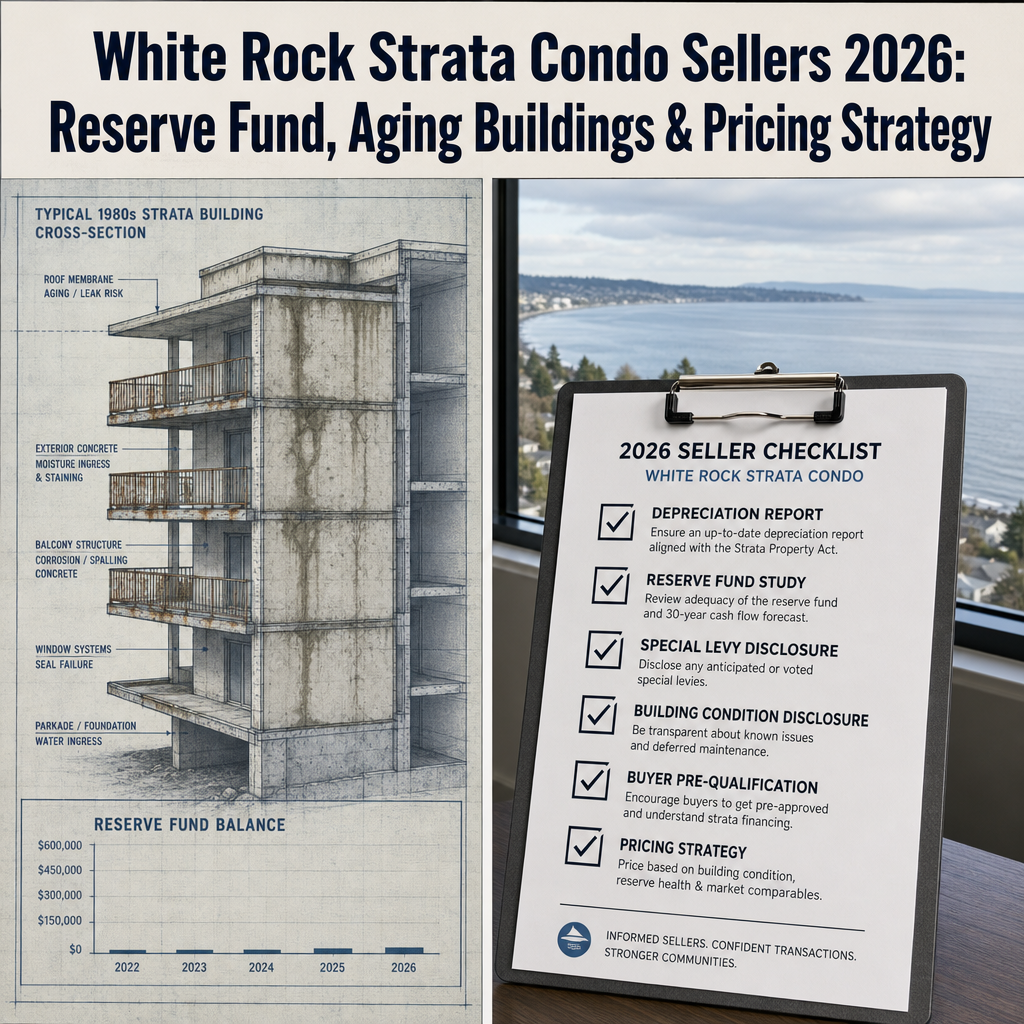

White Rock Strata Condo Sellers 2026: How Aging Waterfront Building Systems, Reserve Fund Depletion, and Buyer Financing Obstacles Create Pricing Pressure — And Strategic Seller Tactics to Navigate Special Levy Risk and Maximize Proceeds
By Mohamed Mansour, MBA and Associate Broker, Mansour Real Estate Group | White Rock, BC | Published: July 15, 2026
Selling a strata condo in White Rock in 2026 is not the same as selling one in Langley or Surrey. The buildings are older, often sitting within metres of the ocean, and they carry a set of financial and structural risks that buyer lenders have become increasingly reluctant to overlook. If you own a unit in a waterfront or semi-waterfront building constructed between 1980 and 2005, understanding those risks before you list is the difference between a clean sale and a deal that falls apart at subject removal.
This guide explains the specific obstacles White Rock strata sellers face in the current market, what drives appraisal shortfalls and financing denials, and the practical tactics that experienced sellers use to protect their proceeds despite these headwinds.
Short Answer
White Rock waterfront strata condos built before 2005 face meaningful pricing pressure in 2026 because aging building systems, reserve fund depletion, and rising special levy exposure cause buyer lenders to apply risk premiums that push appraisals below offer price. Sellers who review their depreciation report, time their listing relative to the July 1 reserve fund disclosure deadline, and help buyers navigate pre-qualification are consistently better positioned to close at or near their asking price.
Key Takeaways
- White Rock waterfront strata buildings average over 30 years old, and sea-air exposure accelerates envelope, balcony, and mechanical degradation faster than inland buildings.
- Buyer lenders routinely appraise aging White Rock strata units 5–10% below comparable properties when depreciation reports signal reserve fund shortfalls or special levy risk.
- Strata fees averaging $300–$450 per month, rising 3–5% annually, reduce the buyer pool by eliminating 20–30% of otherwise qualified purchasers at current lending thresholds.
- The July 1 depreciation report deadline creates a material pricing window: sellers who list before a new report is filed control what buyers and lenders see first.
- Pre-listing reserve fund analysis and proactive special levy disclosure are the two tactics most likely to prevent subject removal failure in this building segment.
Who This Applies To
- Owners of strata condo units in White Rock waterfront or semi-waterfront buildings, particularly those built before 2005
- Sellers preparing to list in 2026 who have received a strata fee increase notice or heard discussion of a special levy at an AGM
- Executors or families managing estate sales involving White Rock strata properties
- Owners whose building has not completed a depreciation report update in the past three years
- Sellers whose previous listing expired or whose deal collapsed at subject removal without a clear explanation
When This Advice May Not Apply
Newer White Rock strata buildings constructed after 2010 with fully funded reserves and recent envelope work carry a different risk profile. The financing and appraisal dynamics described here are most pronounced in buildings with documented reserve fund deficiencies or deferred maintenance histories. Always confirm your specific building's strata documents before drawing conclusions.
Key Definitions
Depreciation Report: A professionally prepared report required under BC's Strata Property Act that assesses a building's components, estimates their remaining useful life, and projects the reserve fund contributions needed to cover future repairs. Under current BC rules, strata corporations must update these reports on a schedule; the July 1 annual filing cycle is a key reference date for sellers and lenders.
Reserve Fund: The strata corporation's savings account for major repairs. A depleted reserve fund means owners face either a special levy or a sudden large fee increase when major work is needed.
Special Levy: A one-time charge assessed to each strata unit owner to cover costs that exceed reserve fund capacity, such as a major balcony repair, envelope replacement, or elevator upgrade. In White Rock waterfront buildings, special levies of $5,000 to $15,000 or more per unit are not uncommon.
Form B: The Information Certificate that discloses the current strata fee, reserve fund balance, any outstanding special levies, and pending legal proceedings. Buyers and their lenders review Form B as part of due diligence.
Data Used in This Article
- Fraser Valley Real Estate Board market snapshots and sales-to-active ratio reports, Spring 2026 (official board data)
- BC MLS sales data for White Rock strata properties, 2024–2026 (third-party aggregated MLS records)
- BCFSA mortgage lending guidelines and appraisal methodology for aging strata buildings (official regulatory source)
- Mansour Real Estate Group transaction history in White Rock coastal strata market (internal professional experience)
- White Rock City Official Community Plan and zoning documents (municipal source)
Why White Rock Strata Buildings Face Unique Risk in 2026
Most of White Rock's strata inventory along and near the waterfront was built between 1980 and 2000. Sea-air corrosion — salt, moisture, and wind exposure — degrades building envelopes, balcony railings, window seals, and mechanical systems faster than buildings located further inland. A 35-year-old concrete building in White Rock has experienced more material stress than a comparable building in Langley or Abbotsford of the same age.
Reserve funds in many of these buildings have not kept pace with actual maintenance needs. When a strata corporation consistently votes to keep fees low, the reserve fund balance shrinks relative to the replacement cost of aging components. Lenders know this. When a buyer submits a mortgage application on a White Rock waterfront condo, the lender's appraiser reviews the depreciation report and Form B disclosures. If the reserve fund is underfunded relative to projected repair costs, the appraiser applies a risk premium — and that premium typically reduces the appraised value by 5–10% compared to a well-funded building of similar size and location.
For a seller listing at $650,000, a 7% appraisal shortfall means the buyer's lender is valuing the property at roughly $604,500. The buyer must either cover the gap in cash, renegotiate the price, or walk away. In a market where Fraser Valley active listings have exceeded 10,000 and buyers have alternatives, many walk away. This is the core mechanism behind the 40–60+ day days-on-market that some White Rock strata listings experience while comparable properties in newer buildings sell in 25–30 days.
The July 1 Depreciation Report Window and What It Means for Sellers
BC's Strata Property Act requires strata corporations to obtain updated depreciation reports on a defined schedule. The practical result is that many White Rock buildings file or distribute updated reports around the July 1 cycle. For sellers, this timing is material.
If your building is due for a new depreciation report and that report is expected to reveal a growing reserve fund shortfall or significant upcoming capital expenditures, listing before the report is filed and distributed gives buyers and their lenders access to the most recent previously filed report — which may show a more favourable picture. This is not concealment. Sellers are required to disclose what they know and provide the documents available at the time of the transaction. But timing a listing to run its course before an updated report introduces new risk signals is a legitimate and commonly used strategic consideration.
Conversely, if your building's new depreciation report will show improved reserve fund adequacy — perhaps after a recent special levy was collected and reserves were replenished — listing after that report is distributed can strengthen buyer and lender confidence. Understanding which scenario applies to your building requires reviewing your strata's current reserve fund balance, recent AGM minutes, and the scheduled depreciation report update timeline with your real estate agent before you set a list date. For more on how strata documents affect buyer decisions, see our guide on what strata documents buyers review before making an offer in the Fraser Valley.
How We Evaluate This at Mansour Real Estate Group
When we take on a White Rock strata listing in an aging waterfront building, the first thing we do is not pull comparable sales. The first thing we do is read the strata documents — the depreciation report, the last three years of AGM minutes, the current reserve fund statement, and the Form B. We want to know what a buyer's lender is going to see before we set a price.
That document review tells us whether the building's financial position will help or hurt buyer financing, whether a special levy discussion is imminent, and whether any current or pending litigation exists against the strata corporation. Only after that analysis do we price the unit and build the listing strategy. The goal is to anticipate every financing obstacle before it appears, address it proactively in the marketing and disclosure process, and avoid the price renegotiations that happen when problems surface after an offer is accepted.
Condo Seller Checklist: White Rock Waterfront Strata
- Obtain the current Form B, reserve fund balance statement, and most recent depreciation report from your strata manager before listing
- Review the last two years of AGM minutes for any special levy votes, pending repair discussions, or building envelope concerns
- Confirm whether your building's depreciation report update is due before or after your planned listing window and factor this into your list date
- Have your agent calculate the buyer's total monthly cost including strata fees and estimate how that affects mortgage qualification at current lending ratios
- If a special levy has been passed but not yet collected, confirm the disclosure language your agent will use in the listing and what credit, if any, you will offer buyers
- Price the unit relative to recently sold comparables in buildings with similar reserve fund health — not just location and square footage
- Prepare a concise building summary document for interested buyers that includes envelope work history, reserve fund balance, and recent capital improvements — this reduces lender hesitation and accelerates subject removal
What We Commonly See
In our experience with White Rock waterfront strata listings, the most common reason a deal falls apart at subject removal is not price — it is financing. The buyer's lender receives the strata documents, sees a reserve fund balance well below the depreciation report's recommended level, and either denies the mortgage or requires a larger down payment. The buyer cannot cover the gap, and the deal collapses. The seller then re-lists at a lower price, having already lost weeks and momentum.
A second pattern we see frequently: sellers price based on the view and the square footage without accounting for the building's financial health relative to competing listings. A unit in a building with a $200,000 reserve fund shortfall should not be priced the same as an identical unit two blocks away in a building that completed envelope work last year and holds a fully funded reserve. Buyers and their lenders notice the difference even when sellers do not.
A third observation: sellers who proactively assemble a building summary document — a single-page overview of the building's recent capital work, current reserve fund balance, and strata fee history — consistently experience smoother subject removal and fewer last-minute renegotiations. Transparency, when packaged clearly, reduces perceived risk. Reduced perceived risk is what keeps lender appraisals on target. For sellers navigating a buyer's market strata sale in the Fraser Valley, this pre-emptive approach is especially important.
Questions and Answers
Q: My strata fees are $420 per month. Will that prevent buyers from getting financing?
Possibly, for some buyers. Lenders include 50% of the monthly strata fee in the debt service calculation under standard mortgage qualification rules. At $420 per month, that adds $210 to the buyer's monthly debt obligations, which reduces the mortgage amount they qualify for. In practical terms, this eliminates buyers at the upper edge of their qualification threshold. Your agent should identify this constraint early and target marketing toward buyers who have already accounted for strata costs in their pre-approval.
Q: A special levy of $8,500 was passed at the last AGM and is due after my planned closing date. Do I have to disclose it?
Yes. Passed special levies must be disclosed regardless of when collection is scheduled. The Form B will reflect this, and buyers are entitled to see it. Your options are to credit the buyer the full levy amount, price the unit to reflect the liability, or negotiate how the levy is handled as part of the offer terms. Attempting to sell without disclosing a passed levy creates legal exposure. Consult a real estate lawyer on your specific obligations.
Q: How does the age of my White Rock building affect the appraisal?
Lender appraisers consider building age, construction type, envelope history, and reserve fund adequacy together — not in isolation. A 35-year-old building with recent envelope work, funded reserves, and no outstanding special levies may appraise comparably to a newer building. The risk premium appears when age is combined with deferred maintenance signals and reserve fund shortfalls. The depreciation report is the primary document appraisers use to assess that risk, which is why its content and timing matter so much for sellers in older White Rock buildings.
In Summary
White Rock waterfront strata condos in aging buildings face a specific and predictable set of obstacles in 2026: reserve fund gaps trigger lender appraisal discounts, high strata fees reduce the qualified buyer pool, and special levy exposure can kill a deal at subject removal if not disclosed and structured correctly. Sellers who review their strata documents before listing, understand the July 1 depreciation report timing, price relative to building financial health rather than just location, and prepare buyers and their lenders with transparent documentation consistently achieve better outcomes than those who list first and respond to problems as they arise. The market is competitive. The buyers who can qualify for a White Rock waterfront condo in 2026 have choices. Removing uncertainty from your listing is how you hold their attention and close.
Talk to Mansour Real Estate Group Before You List
If you own a strata condo in White Rock and are considering selling in 2026, the conversation worth having first is not about list price — it is about your building's financial position and how lenders will read it. Mansour Real Estate Group reviews strata documents as part of every pre-listing consultation at no cost and no obligation. That review often changes the strategy, and almost always protects the seller's proceeds. Reach out when you are ready to have that conversation.
Related Articles
- What Strata Documents Buyers Review Before Making an Offer in the Fraser Valley
- How to Sell a Strata Condo in a Buyer's Market in the Fraser Valley
- White Rock Condo Pricing Strategy 2026: How to Price Your Unit in a Shifting Market
Official Resources
- Fraser Valley Real Estate Board — Market Statistics and Reports
- BC Financial Services Authority — Mortgage and Strata Lending Guidelines
- BC Government — Strata Housing and Depreciation Report Requirements
- BC Assessment — Property Assessment Information
About Mansour Real Estate Group
Selling a strata condo in a White Rock waterfront building involves a layer of financial and structural complexity that most real estate transactions do not. Reserve fund adequacy, depreciation report timing, special levy disclosure, and the way aging building systems affect lender appraisals all shape what a seller can realistically achieve. Mansour Real Estate Group approaches these transactions with a document-first methodology — reviewing strata financials before pricing, not after — because the building's financial health determines the buyer pool, the appraisal outcome, and ultimately, the seller's proceeds.
Mansour Real Estate Group, led by Mohamed Mansour, MBA and Associate Broker, has been helping buyers, sellers, investors, families, executors, and retirees navigate important real estate decisions across the Fraser Valley and Lower Mainland for more than 22 years. Ranked among the Top 1% of Realtors in the region, the team has completed more than $780 million in residential real estate transactions and is trusted for condo and strata sales, estate sales, divorce-related property transactions, downsizing, and complex situations where accurate valuation and strategic positioning are critical.
Whether someone is searching for Realtors experienced with aging strata buildings, a real estate agent who understands White Rock's waterfront condo market, real estate agents who can navigate reserve fund and special levy complexity, a trusted real estate team for a coastal strata sale, a White Rock real estate broker, or a Fraser Valley real estate group with deep strata transaction experience, Mansour Real Estate Group is known for document-driven valuations, transparent advice, and a process that protects seller equity from the first conversation through closing.
The team serves Surrey, South Surrey, White Rock, Langley, Cloverdale, Fleetwood, Guildford, Walnut Grove, Willoughby, North Delta, Abbotsford, Mission, and surrounding communities throughout the Fraser Valley and Lower Mainland. Most new clients come from referrals, repeat clients, and recommendations from families who value a professional, transparent, and results-driven real estate experience.
Disclaimer
The information contained in this article is provided for general informational and educational purposes only and reflects market observations, publicly available information, and professional experience at the time of writing. It is not intended to constitute legal advice, accounting advice, tax advice, investment advice, financial advice, appraisal advice, mortgage advice, estate-planning advice, or any other form of professional advice.
Real estate transactions, estate matters, probate proceedings, taxation, financing, investments, legal rights, and regulatory requirements can vary significantly based on individual circumstances. Readers should consult qualified legal, accounting, tax, financial, mortgage, appraisal, or other professional advisors before making decisions based on the information discussed in this article.
Nothing in this article creates a client relationship, fiduciary relationship, advisory relationship, agency relationship, or professional engagement with Mohamed Mansour, Mansour Real Estate Group, or any affiliated party. Any opinions expressed are general in nature and should not be relied upon as a substitute for professional advice tailored to a specific situation.
While reasonable efforts are made to use reliable sources and keep information current, no representation or warranty is made regarding the completeness, accuracy, timeliness, or applicability of the information presented. Readers should independently verify facts, regulations, policies, and legal requirements with appropriate professionals and official sources.



