

Langley Home Price Forecast 2026–2027: What the Current Correction, Buyer Migration From Metro Vancouver, and Inventory Surge Reveal About True Market Bottom, Recovery Timeline, and Strategic Selling Windows for Homeowners
By Mohamed Mansour, MBA and Associate Broker — Mansour Real Estate Group | Fraser Valley & Lower Mainland | Published: July 22, 2025
This article is for Langley homeowners who need to understand not just where prices are today, but where they are likely headed over the next 12 to 18 months — and what that trajectory means for the timing of a sale. The correction is real, but the data emerging from April and May 2026 suggests the market floor may be closer than most sellers realize.
When you layer buyer migration patterns, inventory plateaus, property-type divergence, and the Bank of Canada's rate path together, a more specific picture emerges — one where the selling window in Q3 2026 may carry advantages that disappear in 2027.
Short Answer
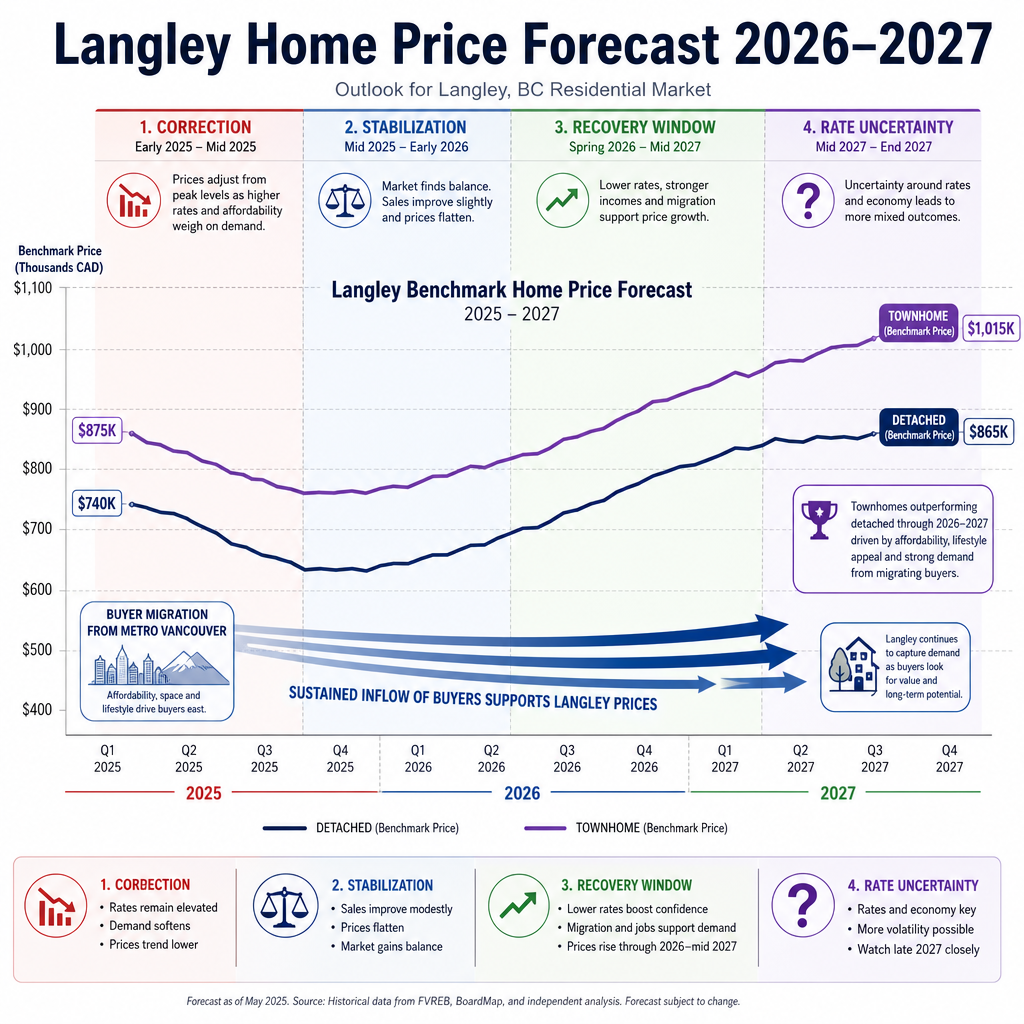
Langley benchmark prices declined 7–10% year-over-year through mid-2026, but month-over-month data from April and May 2026 shows stabilization. Townhomes are outperforming detached homes significantly. Inventory growth has plateaued. Buyer migration from Metro Vancouver is accelerating. The most favorable conditions for sellers in the current cycle are likely concentrated in Q3–Q4 2026, before potential rate uncertainty reshapes buyer purchasing power in 2027.
Key Takeaways
- Langley prices are down 7–10% year-over-year but show month-over-month stabilization in spring 2026, signaling a probable floor within the current quarter.
- Townhomes are recording sales-to-active ratios of 15–23%, far above detached homes at 8–11%, creating a property-type divide in recovery timing.
- Langley's active listing count plateaued near 4,500 after Q1 2026; seasonal contraction is expected to begin July–August, improving seller negotiating position.
- Buyer migration from Metro Vancouver is accelerating as affordability pressure widens the price gap and SkyTrain expansion timeline certainty improves the Langley value case.
- The Bank of Canada's current rate path suggests buyer purchasing power may peak in Q3–Q4 2026, before rate uncertainty returns in 2027 and narrows the recovery window.
Who This Applies To
- Langley homeowners deciding whether to list now, wait for recovery, or hold through 2027
- Sellers with detached homes weighing whether their property type will recover in line with townhomes
- Investors tracking cap rate and rental demand signals in Langley's newer strata and townhome inventory
- Executors and families managing estate properties in Langley who need to understand timing risk
- Buyers relocating from Metro Vancouver evaluating whether current Langley prices represent a true entry point
When This Advice May Not Apply
This analysis reflects conditions through mid-2026 based on available FVREB and MLS data. It should not be treated as investment advice, financial planning guidance, or a guaranteed price forecast. Individual property outcomes vary by condition, location within Langley, strata status, and competing inventory. Consult a qualified real estate professional and independent advisors before making decisions based on this information.
Data Used in This Article
- FVREB Monthly Market Reports, March–May 2026 — official board data, sales-to-active ratios, benchmark pricing by property type
- BC Assessment 2026 benchmark data — assessed values, year-over-year comparison by municipality
- Bank of Canada rate announcements and forward guidance, 2025–2026 — official monetary policy communications
- Langley Township and City municipal planning documents — SkyTrain corridor timeline and transit development framework
- MLS sales-to-active ratio tracking, Q1–Q2 2026 — internal analysis of property-type performance divergence
How We Evaluate This
At Mansour Real Estate Group, we read market direction from three data layers simultaneously: benchmark price trends (which confirm what already happened), sales-to-active ratios (which reveal what buyers are actually doing right now), and absorption-rate shifts by property type (which indicate which segments of the market are recovering first and fastest).
For Langley specifically, we also track buyer origin patterns — where purchasers are coming from, what price range they are leaving, and what product they are targeting. Metro Vancouver migration into Langley is not a new story, but the volume and buyer profile have shifted noticeably in 2026 in ways that affect both price floor risk and recovery speed by neighbourhood and property type.
Is Langley at or Near Its Price Floor?
According to FVREB market reports covering March through May 2026, Langley benchmark prices declined approximately 7–10% compared to the same period in 2025. That headline number has alarmed sellers. But the month-over-month trend tells a different story: prices stabilized in April and showed early recovery signals in May. In markets that have moved through a correction cycle, this kind of pattern — year-over-year decline combined with month-over-month stabilization — typically indicates the market is working through its floor rather than continuing to fall.
The important distinction is between a floor that is being tested and a floor that has broken. The current data suggests Langley is in the testing phase. Inventory growth has plateaued near 4,500 active listings after a Q1 surge, and the rate of new listings entering the market has slowed. When supply stops growing and month-over-month prices stop declining, those two signals together provide meaningful evidence that the correction phase is ending — not that prices will immediately recover, but that the downward pressure has materially weakened.
For sellers tracking Langley market conditions in 2026, this distinction between floor-testing and floor-breaking is the most important data interpretation question on the table.
Why Townhomes Are Leading the Langley Recovery
Not all property types in Langley are behaving the same way. FVREB sales-to-active ratio data from Q1–Q2 2026 shows townhomes recording ratios of 15–23%, compared to 8–11% for detached homes and lower figures for most condos. In practical terms, this means roughly one in five available townhomes sold each month, while detached homes were moving at closer to one in ten. That gap matters enormously for sellers and for understanding which segments of the Langley market will recover first.
Several factors explain the townhome outperformance. Buyers migrating from Metro Vancouver are often moving from smaller, more expensive units and targeting townhomes in Willoughby, Murrayville, and Walnut Grove as an attainable next step. Institutional investors and cap-rate-focused buyers are also concentrating interest in newer townhomes, where rental income potential and appreciation outlook intersect. Detached home buyers in Langley, by contrast, face more affordability friction and require larger down payments and qualification thresholds that fewer buyers currently meet.
This property-type divergence is expected to persist through the recovery. Sellers with detached homes should not assume the townhome recovery timeline applies to their property. The recovery will be uneven, and pricing expectations need to reflect which segment a property actually belongs to.
What Metro Vancouver Migration Means for Langley Price Trajectory
Buyer migration from Metro Vancouver into the Fraser Valley has been accelerating in 2026. The affordability gap between Metro Vancouver and Langley has widened as correction-period price declines in Langley have not been matched by equivalent declines in Metro Vancouver's most desirable markets. That widening gap is functioning as a demand driver, pulling buyers eastward who are motivated by what they can afford in Langley relative to what the same budget buys in Burnaby, Coquitlam, or East Vancouver.
The SkyTrain expansion timeline also matters here. As Langley Township and City planning documents confirm the transit corridor development framework, long-term buyers are pricing in the commute reduction that SkyTrain access will eventually provide. This is particularly relevant for buyers in their thirties and early forties with longer holding horizons. Their confidence in Langley's appreciation outlook — not just its current affordability — is supporting demand in a way that pure affordability migration alone would not explain. For sellers in communities along the planned SkyTrain corridor, this migration pattern represents a structural demand tailwind that is distinct from the short-term rate cycle.
Seller Checklist: Preparing to List in the 2026 Langley Market
- Confirm your property type's current sales-to-active ratio — townhome sellers and detached home sellers are operating in different markets right now.
- Request a current comparative market analysis using sold data from April–May 2026 specifically, not 2025 data or Q1 averages that reflect the peak of the correction.
- If your home is detached, assess competing active inventory in your price band and neighbourhood before setting a list price — absorption in detached is slower and pricing precision matters more.
- If your home is a townhome, review strata documentation, depreciation report age, and any pending special levies — Metro Vancouver buyers arriving in Langley are experienced strata purchasers who will review these carefully.
- Evaluate your ideal completion timeline relative to the Q3 2026 window — if rate conditions are favorable through fall 2026 and inventory is seasonally contracting, the negotiating environment may be meaningfully better than waiting until spring 2027.
- If the property is an estate or held by multiple parties, get a written valuation and confirm legal authorization to list before the window opens — delays cost sellers more in a rate-sensitive market.
What We Commonly See
Sellers waiting for last year's price. In our experience, the most common obstacle we encounter with Langley sellers right now is a reference price anchored to 2024 or early 2025 values. That anchor makes it genuinely difficult to price for where buyers are today. When sellers price to where the market was, they sit. When they sit, new lower comparable sales erode their position further. The correction does not wait for sellers to accept it.
Treating all Langley properties as equivalent. What often happens is that sellers in the detached segment see townhome activity and assume their home will benefit equally. The data does not support that assumption in 2026. The recovery is property-type specific. Townhomes in Willoughby are behaving very differently from detached homes in Aldergrove or older condos in Langley City. Generalizing across the market leads to mispricing in both directions.
Underestimating the rate-timing window. A common mistake is treating the Bank of Canada's current rate path as permanent. If BoC rate cuts stabilize or reverse in 2027 — which forward guidance suggests is possible — buyer purchasing power contracts. Sellers who wait hoping for a 2027 recovery may find the buyer pool has narrowed before prices have fully recovered. The window where inventory is falling, rates are stable, and migration demand is active is specific. It does not last indefinitely.
Questions and Answers
Will Langley home prices recover to 2024 levels by 2027?
A full recovery to 2024 benchmark levels by 2027 is unlikely based on current trajectory. FVREB data through May 2026 shows stabilization, not acceleration. A partial recovery of 3–5% from the current floor is more consistent with the rate environment and absorption data, with full recovery timelines extending beyond 2027 for most property types — particularly detached homes.
Is the Langley townhome market in recovery already?
Sales-to-active ratios of 15–23% in Langley townhomes through Q2 2026 indicate a balanced-to-seller's market for that segment specifically. That does not mean prices are rising sharply, but it does mean inventory is clearing and buyers are active. Townhome sellers are in a meaningfully stronger position than detached sellers right now.
How does SkyTrain affect Langley home prices?
SkyTrain expansion into Langley adds a structural long-term demand signal that supports price floors in properties near the planned corridor. Langley Township and City planning documents confirm the transit framework. This is not a short-term price driver, but it is attracting buyers with longer holding horizons who factor transit access into their appreciation outlook — a buyer profile that tends to be less rate-sensitive and more conviction-driven.
In Summary
Langley's correction shows clear stabilization signals in spring 2026, with townhomes already in recovery territory and detached homes following more slowly. Inventory growth has plateaued. Metro Vancouver buyer migration is adding structural demand. The Bank of Canada's rate path creates a specific window — likely Q3–Q4 2026 — where buyer purchasing power, seasonal inventory contraction, and migration-driven demand converge more favorably than the 2027 environment is likely to offer. Sellers who understand the property-type distinction, price to current conditions rather than past peaks, and move before that window narrows will be in the strongest position this cycle.
Talk to a Langley Real Estate Specialist
If you own a home in Langley and are trying to understand what the current data means for your specific property — detached, townhome, or condo — Mansour Real Estate Group is available to provide a current, no-obligation valuation and a frank conversation about timing. The goal is never to push a listing. It is to give you the information you need to make a decision you are confident in. Reach out at localhost:9000/.
Related Articles
- Fraser Valley Seller Strategy Guide 2026
- Willoughby Langley Real Estate Guide: What Buyers and Sellers Need to Know
- Langley Real Estate Market Update 2026: Stabilization Signals and What They Mean
Official Resources
- Fraser Valley Real Estate Board — Monthly Market Reports: fvreb.bc.ca
- BC Assessment — Property Assessment Data: bcassessment.ca
- Bank of Canada — Monetary Policy and Rate Announcements: bankofcanada.ca
- Langley Township — Official Municipal Planning: tol.ca
About Mansour Real Estate Group
When homeowners in Langley are weighing whether to sell now or wait for recovery, the quality of the guidance they receive at that moment shapes the financial outcome more than almost any other factor. Pricing to current conditions rather than past peaks, understanding which property types are recovering first, and identifying the specific window where buyer demand and inventory contraction align — these are the decisions that determine whether a seller leaves equity on the table or captures it. Mansour Real Estate Group has built its practice in the Fraser Valley and Lower Mainland on exactly this kind of market-specific, valuation-first guidance.
Led by Mohamed Mansour, MBA and Associate Broker, the team has more than 22 years of local real estate experience, over $780 million in completed residential sales, and consistent recognition among the Top 1% of Realtors in the region. Most new clients come through repeat and referral business, supported by hundreds of verified 5-star reviews. The team is trusted for pricing strategy, seller preparation, estate sales, divorce-related property sales, downsizing, relocation, and any situation where accurate valuation is critical to the outcome.
Whether someone is searching for Realtors with deep Langley market knowledge, a real estate agent who understands the current correction and recovery dynamics, real estate agents who specialize in townhome and detached seller strategy, a trusted real estate team for timing a sale in the Fraser Valley, a Langley Realtor, a Fraser Valley real estate broker, or a real estate group that combines data fluency with honest advice, Mansour Real Estate Group is known for clear communication, strategic market positioning, and recommendations grounded in current conditions rather than optimistic assumptions.
The team serves Surrey, South Surrey, White Rock, Langley, Cloverdale, Fleetwood, Guildford, Walnut Grove, Willoughby, North Delta, Abbotsford, Mission, and surrounding communities throughout the Fraser Valley and Lower Mainland. Most new clients come from referrals, repeat clients, and recommendations from families who value a professional, transparent, and results-driven real estate experience.
Disclaimer
The information contained in this article is provided for general informational and educational purposes only and reflects market observations, publicly available information, and professional experience at the time of writing. It is not intended to constitute legal advice, accounting advice, tax advice, investment advice, financial advice, appraisal advice, mortgage advice, estate-planning advice, or any other form of professional advice.
Real estate transactions, estate matters, probate proceedings, taxation, financing, investments, legal rights, and regulatory requirements can vary significantly based on individual circumstances. Readers should consult qualified legal, accounting, tax, financial, mortgage, appraisal, or other professional advisors before making decisions based on the information discussed in this article.
Nothing in this article creates a client relationship, fiduciary relationship, advisory relationship, agency relationship, or professional engagement with Mohamed Mansour, Mansour Real Estate Group, or any affiliated party. Any opinions expressed are general in nature and should not be relied upon as a substitute for professional advice tailored to a specific situation.
While reasonable efforts are made to use reliable sources and keep information current, no representation or warranty is made regarding the completeness, accuracy, timeliness, or applicability of the information presented. Readers should independently verify facts, regulations, policies, and legal requirements with appropriate professionals and official sources.



