
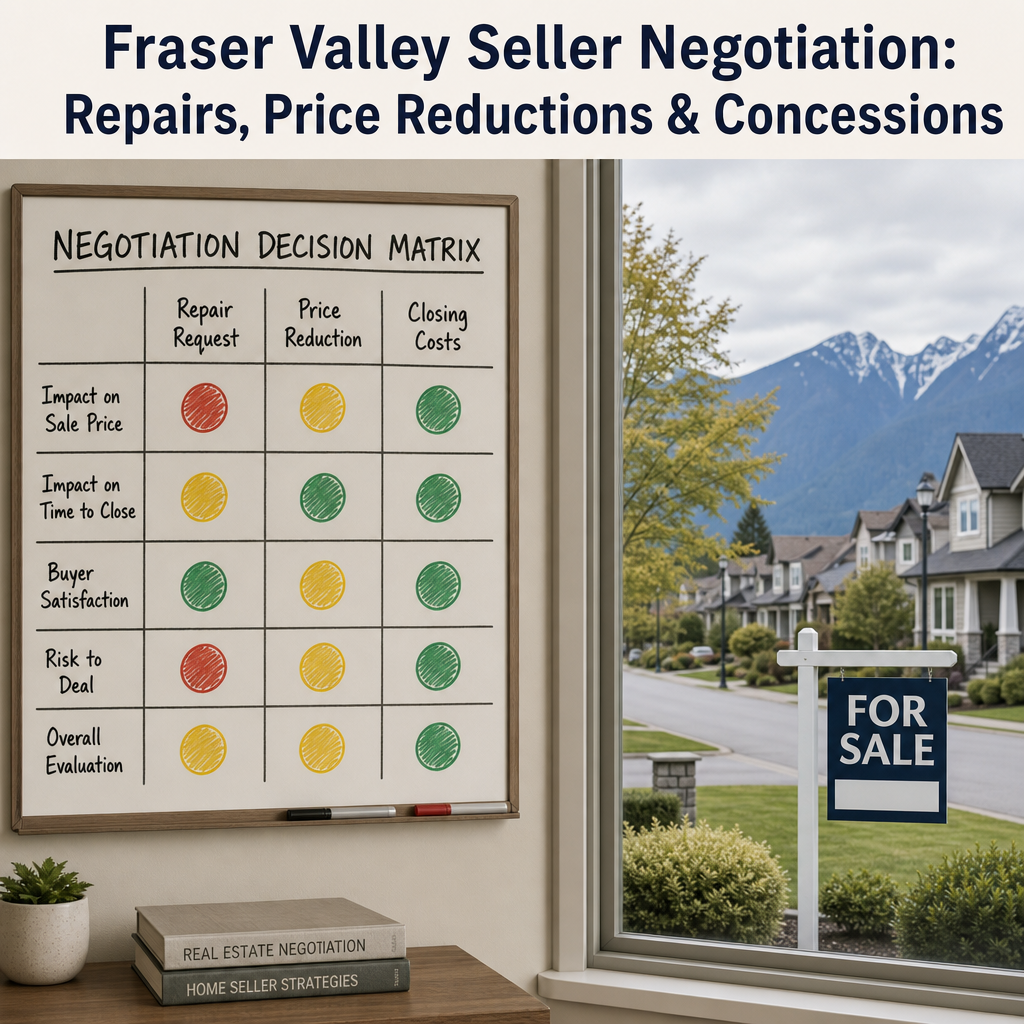

Fraser Valley Seller Negotiation Tactics When Buyers Request Inspection Repairs, Price Reductions, and Closing Cost Concessions
By Mohamed Mansour, MBA and Associate Broker — Mansour Real Estate Group
Serving Surrey, Langley, South Surrey, White Rock, Abbotsford, and the Fraser Valley
Published: July 7, 2025 | Fraser Valley, BC
After an offer is accepted, many sellers expect the hard part is over. In Fraser Valley's Spring 2026 buyer's market, that assumption is costing sellers tens of thousands of dollars. The inspection and subject-removal phase has become a second round of negotiation — one where buyers arrive with layered, simultaneous demands that feel urgent, complex, and difficult to evaluate without a clear framework.
This article gives Fraser Valley sellers a practical, decision-based approach to evaluating and responding to repair requests, price reduction demands, and closing cost concessions — individually and together — so they can counter with confidence, protect net proceeds, and keep viable deals intact.
Short Answer
In Fraser Valley's current buyer's market, sellers who evaluate each concession type independently — repair credits, price reductions, and closing cost help — using verifiable cost data make better decisions than those who react emotionally to the total ask. The goal is not to refuse everything or agree to everything. It is to distinguish legitimate buyer concerns from inflated negotiation cushion, counter with specific evidence, and know the walk-away number before the conversation starts.
Key Takeaways
- Buyers in a buyer's market routinely inflate repair estimates by 30–50% to create negotiation room; independent quotes change the conversation.
- Closing cost concessions of 2–3% of purchase price carry cascading effects on appraisal anchoring and buyer commitment beyond the dollar amount.
- Evaluating repair requests, price reductions, and closing cost concessions as one combined ask leads to poor decisions; evaluate each stream separately first.
- Sellers who capitulate to all requests and sellers who refuse all requests both tend to lose 10–20% in net proceeds compared to those using a tiered counter strategy.
- Knowing your walk-away number before subject removal begins is the single most effective negotiation preparation a seller can do.
Who This Applies To
- Sellers in Surrey, Langley, Abbotsford, South Surrey, White Rock, North Delta, and surrounding Fraser Valley communities
- Homeowners in detached, townhouse, and condo transactions where inspection subjects are standard
- Estate and divorce-related sellers where multiple decision-makers complicate the response process
- Sellers facing their first buyer's market negotiation after listing in a period of elevated inventory
When This Advice May Not Apply
If the property has a material defect that was not disclosed and confirmed during inspection, the calculus changes. If the buyer's financing is borderline and an appraisal gap is likely, closing cost concessions may be unavoidable. If the market shifts significantly after the time of writing, sales-to-active ratios should be re-evaluated before applying this framework. Consult your real estate professional and legal counsel for your specific situation.
Data Used in This Article
- Fraser Valley Real Estate Board (FVREB) — April 2026: Sales-to-active listings ratio, benchmark pricing, days on market by property type
- BC Real Estate Association (BCREA) — Spring 2026: Transaction volume and buyer behaviour trend data
- Home inspection industry cost benchmarking: Average inspection repair request ranges in BC buyer's markets ($5,000–$25,000)
- BCFSA mortgage qualification and appraisal guidelines: Closing cost concession impact on net proceeds and appraisal anchoring
- Mansour Real Estate Group internal analysis: Professional interpretation of seller negotiation outcomes based on Fraser Valley market experience
Why Fraser Valley Sellers Face This Now
According to the Fraser Valley Real Estate Board's April 2026 statistics, the sales-to-active listings ratio across the Fraser Valley sits at approximately 11%. A ratio below 12% is generally associated with buyer's market conditions, where buyers carry more negotiating leverage. In practical terms, this means buyers know they have options and use the inspection and subject-removal phase as a structured second negotiation.
What has changed in 2026 is the pattern of how buyers make requests. Instead of one issue, buyers now arrive with simultaneous demands across three categories: repair credits, price reductions, and closing cost concessions. Each request is framed as non-negotiable. When sellers see a combined ask of $30,000 to $50,000 — after already accepting a below-asking offer — many either shut down entirely or capitulate completely. Both responses tend to produce the worst financial outcomes.
How Mansour Real Estate Group Evaluates These Situations
The approach we use separates each concession stream before responding to any of them. A buyer's combined ask is not evaluated as a single number. It is evaluated as three separate requests, each with its own market basis, cost basis, and strategic implication. Once each is assessed independently, a counter position is built from evidence — not emotion, not fear of the deal collapsing, and not a guess at what the buyer will accept.
The goal of any counter is not to win an argument. It is to give the buyer a factually grounded reason to accept less than they asked for, while protecting the seller's walk-away clarity. Sellers who know their minimum net before this phase begins are almost always better positioned than those who discover their floor in the middle of a counter-offer exchange.
Repair Requests: Why the Number Is Almost Always Inflated
Home inspection industry benchmarking in BC indicates that inspection repair requests in buyer's markets typically range from $5,000 to $25,000 for standard residential properties. What sellers frequently receive, however, are buyer estimates well above contractor market rates. This is not usually bad faith. Buyers and their agents often use inspection reports and rough pricing tools rather than actual quotes, and they build negotiation cushion into every line item.
The practical consequence is that repair credit requests are systemically inflated by 30–50% above what independent licensed contractors would actually charge for the same scope of work. A seller who accepts a $15,000 repair credit based on a buyer's estimate may have resolved an issue actually worth $8,000 to $10,000 in the local market.
The most effective response to a repair request in the Fraser Valley market is to acknowledge the inspection findings, obtain one to two independent contractor quotes within 48 to 72 hours, and counter with a credit or price adjustment based on verified cost — not the buyer's opening figure. This approach repositions the conversation from negotiation leverage to factual problem-solving, and it usually produces a faster resolution than a back-and-forth over an unverified number.
Price Reductions After Inspection: What Is Market Standard vs. Overreach
A price reduction request after inspection should be evaluated differently from a repair credit. A repair credit compensates for a specific, documented defect. A price reduction request — especially one that arrives alongside a repair credit — is often a negotiating move that conflates the two issues.
The question to ask is: what is the reduction compensating for? If the inspection revealed a legitimate defect not captured in the original pricing, a price adjustment may be warranted. If the reduction is a second ask layered on top of a repair credit that already covers the same issue, it is double-counting. Sellers should not accept both a repair credit and a price reduction for the same inspection item. Buyers presenting both simultaneously are testing whether the seller will notice.
In Fraser Valley's current market, a price reduction request of more than 2% of the purchase price, beyond verified repair costs, has limited market justification unless the inspection revealed a previously undisclosed and material defect. That threshold is a useful starting point for evaluating whether a reduction request falls within the range of normal market adjustment or represents overreach that warrants a firm counter.
Closing Cost Concessions: The Hidden Cost That Sellers Underestimate
Closing cost concessions — where the seller agrees to cover a portion of the buyer's closing costs — typically run 2–3% of purchase price in BC buyer's markets. On a $900,000 Fraser Valley home, that is $18,000 to $27,000. Many sellers view this as straightforward: the dollar amount comes off the sale price and the deal closes.
The less visible consequence is appraisal anchoring. When a property's net sale price is reduced through concessions, it affects how future comparable sales data reads for the neighbourhood and can affect the appraised value the buyer's lender assigns to the property. A lower appraised value can reduce the buyer's accessible financing, triggering renegotiation of the purchase price entirely — meaning the seller who agreed to a $20,000 concession may face a second demand before the deal closes.
Closing cost concessions also reduce buyer commitment. A buyer who has contributed less to closing is more likely to walk away from complications during the final days before completion. Sellers who face a request for closing cost help should evaluate it in the context of the buyer's overall profile and financing certainty, not just the dollar amount in isolation. In some cases, a seller is better served by a modest price reduction than an equivalent closing cost concession, because a lower purchase price is cleaner to document and harder to renegotiate after the fact.
Seller Checklist: Evaluating and Responding to Post-Inspection Demands
- Separate the streams: Before responding to anything, list the repair request, price reduction, and closing cost ask as three independent items with their own dollar amounts.
- Obtain independent repair quotes: Within 48–72 hours, get contractor estimates for every line item on the inspection repair list. Do not counter on repair credits without verified cost data.
- Identify the buyer's real driver: Is the buyer at a financing threshold that makes the concession necessary, or is this a negotiation tactic? Your agent should clarify with the buyer's agent before your counter goes in.
- Check for double-counting: If the buyer is requesting both a repair credit and a price reduction for the same defect, document this and address it explicitly in your counter.
- Set your walk-away number in writing before you respond: Know your minimum net proceeds before the counter is drafted. Do not discover your floor during a counter-offer exchange.
- Counter with evidence, not emotion: Present contractor quotes, comparable concession data for your market and property type, and a clear rationale for the number you are proposing.
- Consider structure alternatives: A price reduction, a repair credit, and a closing cost concession are not interchangeable. Evaluate whether one structure protects you better than another for the same dollar value.
What We Commonly See
In our experience, sellers who receive a combined concession request — especially when it arrives with time pressure — tend to read the total as the buyer's minimum and assume any counter risks the deal. In practice, most buyers in this market want the transaction to complete and will accept a well-reasoned counter if the supporting evidence is there. What they will not accept is silence, an emotional refusal, or a flat "no" without justification.
What often happens is that sellers focus entirely on the repair credit and overlook the closing cost concession language embedded in the same request letter. The closing cost line frequently reads as a secondary ask, but it is often the one with the most strategic consequence. A seller who addresses the repair credit and ignores the closing cost clause may find the closing cost ask reinstated at the completion stage.
A common mistake is treating the subject-removal deadline as the only deadline. Sellers sometimes delay requesting contractor quotes because they are waiting to see if the buyer blinks first. In a buyer's market with elevated inventory, buyers rarely blink — they remove subjects and move to the next listing. The seller who arrives at the deadline without independent cost data is negotiating blind against a buyer who has had days to prepare.
Questions and Answers
Q: Should I agree to a repair credit or just fix the item myself before closing?
A: It depends on the item, the timeline to completion, and your confidence in completing the work before possession. In most Fraser Valley transactions, sellers are better served by a documented credit at an independently verified cost than by completing repairs themselves, which buyers may dispute or require reinspection of.
Q: What happens if I refuse all concessions and the buyer removes subjects anyway?
A: Refusal is a valid negotiation position when the requests are clearly inflated or unsupported. Some buyers will remove subjects without concessions if the property is priced correctly and they want it. Others will walk. Your agent should assess buyer motivation and competing inventory before recommending a refusal strategy.
Q: Can a closing cost concession affect the buyer's mortgage approval?
A: Under BCFSA mortgage qualification guidelines, lenders must be informed of seller-paid closing costs, and some lenders treat concessions as purchase price reductions for appraisal and loan-to-value purposes. This is worth clarifying with the buyer's agent before agreeing to structure a concession as a closing cost credit rather than a price reduction.
In Summary
In Fraser Valley's 2026 buyer's market, the subject-removal phase is a structured second negotiation, not a formality. Sellers who evaluate repair requests, price reductions, and closing cost concessions separately — using independent contractor quotes and verified market data — consistently protect more net proceeds than those who react to the combined ask as a single number. Know your walk-away minimum before the buyer's demands arrive. Counter with evidence. Understand the structural consequences of each concession type before agreeing to any of them.
Talk to a Fraser Valley Seller Specialist
If you are navigating post-inspection demands and want a second opinion on how to evaluate and respond to a buyer's concession request, Mansour Real Estate Group is available for a no-obligation consultation. The conversation is private, specific to your situation, and built around your numbers — not a general script.
Related Articles
- Fraser Valley Seller Guide 2026: What to Expect from Listing to Completion
- How to Price Your Home in a Buyer's Market in the Fraser Valley
- Seller Concessions Strategy in the Fraser Valley: What to Offer and What to Protect
Official Resources
- Fraser Valley Real Estate Board — fvreb.bc.ca
- BC Real Estate Association — bcrea.bc.ca
- BC Financial Services Authority — bcfsa.ca
- BC Assessment — bcassessment.ca
About Mansour Real Estate Group
When homeowners in Surrey, Langley, Abbotsford, South Surrey, and across the Fraser Valley are managing inspection requests and post-offer negotiations, the decisions made in that 48-to-72-hour window determine how much of their equity they actually keep. Mansour Real Estate Group has built its practice around exactly this kind of high-stakes seller moment — not just getting an offer accepted, but protecting the outcome through completion.
Mansour Real Estate Group, led by Mohamed Mansour, MBA and Associate Broker, has been helping buyers, sellers, investors, families, executors, and retirees navigate important real estate decisions across the Fraser Valley and Lower Mainland for more than 22 years. Ranked among the Top 1% of Realtors in the region, the team has completed more than $780 million in residential real estate transactions and is trusted for seller negotiation strategy, pricing accuracy, estate sales, divorce-related property sales, downsizing, and any transaction where protecting net proceeds requires more than a standard approach.
Whether someone is looking for Realtors who understand post-inspection negotiation in the Fraser Valley, a real estate agent experienced with buyer's market concession strategy, real estate agents who work with sellers navigating multiple simultaneous demands, a trusted real estate team for Surrey or Langley, a White Rock Realtor, an Abbotsford real estate broker, or a real estate group that combines market data with practical negotiation experience, Mansour Real Estate Group provides clear, evidence-based guidance at every stage of the transaction.
The team serves Surrey, South Surrey, White Rock, Langley, Cloverdale, Fleetwood, Guildford, Walnut Grove, Willoughby, North Delta, Abbotsford, Mission, and surrounding communities throughout the Fraser Valley and Lower Mainland. Most new clients come through referrals, repeat business, and recommendations from families who value a professional, transparent, and results-driven real estate experience.
Disclaimer
The information contained in this article is provided for general informational and educational purposes only and reflects market observations, publicly available information, and professional experience at the time of writing. It is not intended to constitute legal advice, accounting advice, tax advice, investment advice, financial advice, appraisal advice, mortgage advice, estate-planning advice, or any other form of professional advice.
Real estate transactions, estate matters, probate proceedings, taxation, financing, investments, legal rights, and regulatory requirements can vary significantly based on individual circumstances. Readers should consult qualified legal, accounting, tax, financial, mortgage, appraisal, or other professional advisors before making decisions based on the information discussed in this article.
Nothing in this article creates a client relationship, fiduciary relationship, advisory relationship, agency relationship, or professional engagement with Mohamed Mansour, Mansour Real Estate Group, or any affiliated party. Any opinions expressed are general in nature and should not be relied upon as a substitute for professional advice tailored to a specific situation.
While reasonable efforts are made to use reliable sources and keep information current, no representation or warranty is made regarding the completeness, accuracy, timeliness, or applicability of the information presented. Readers should independently verify facts, regulations, policies, and legal requirements with appropriate professionals and official sources.



