
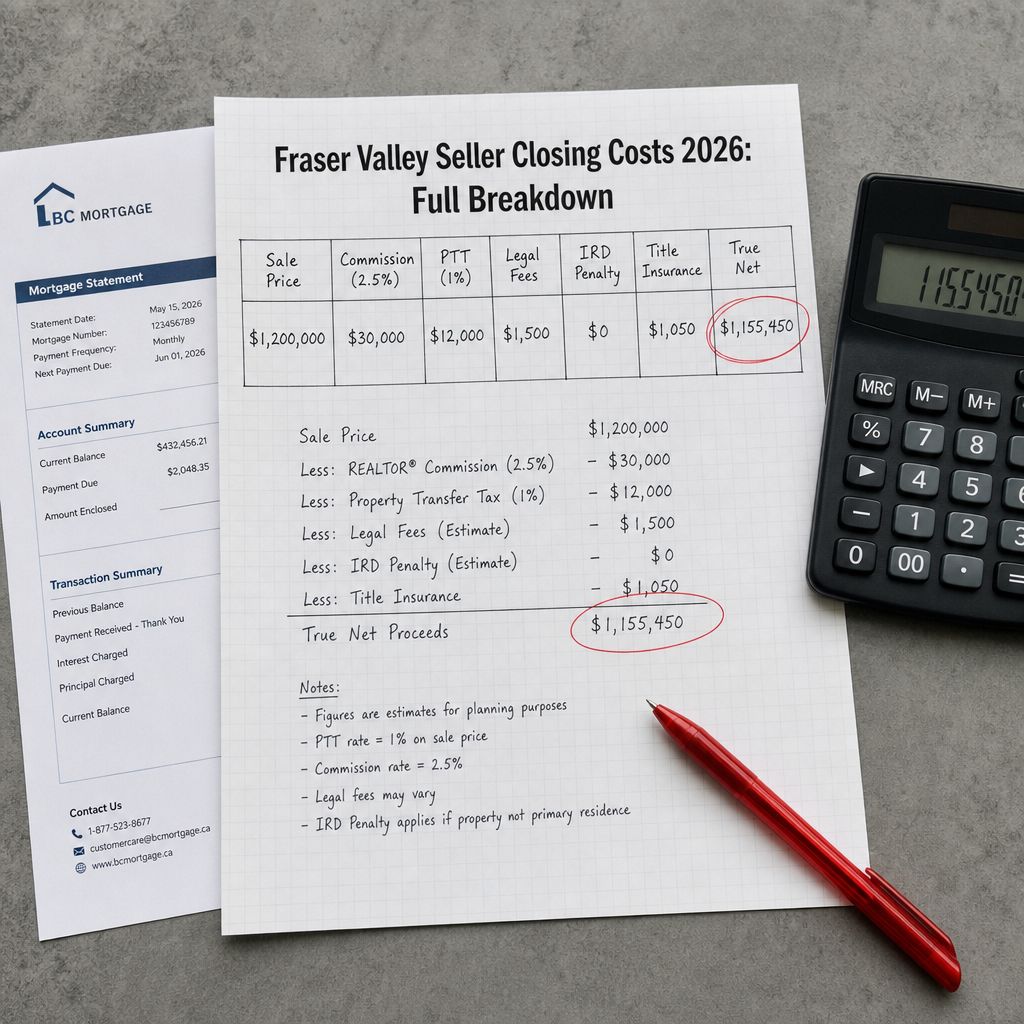

Fraser Valley Seller's Complete Breakdown of All Closing Costs Beyond Commission in 2026: Property Transfer Tax Thresholds, Legal Fees, Mortgage Discharge Penalties, Title Insurance, and the True Net Proceeds Calculator
By Mohamed Mansour, MBA and Associate Broker — Mansour Real Estate Group | Fraser Valley and Lower Mainland | Published July 15, 2025
Most Fraser Valley sellers go into a listing with a rough number in mind: sale price minus commission equals what they walk away with. That math is consistently wrong. The gap between expected proceeds and actual proceeds ranges from $48,000 to $75,000 for sellers in the $600,000 to $900,000 price band — a difference that changes what you can buy next, how you handle your mortgage, and whether your timeline even works.
This article breaks down every cost layer sellers face beyond commission in 2026, including Property Transfer Tax thresholds, legal fees, mortgage discharge penalties, title insurance, and the adjustments most people forget until closing day. The goal is a clear, calculation-ready picture you can use before you list.
Short Answer
Fraser Valley sellers typically keep 78 to 85 percent of their sale price after all costs — not the 85 to 92 percent most expect. Beyond the commission, the primary cost layers are Property Transfer Tax (paid by buyers but affecting offer strategy), legal fees of $1,200 to $2,500, mortgage discharge penalties that can reach $10,000 to $15,000 or more on early breaks, title insurance of $200 to $400, and property tax adjustment holdbacks. Knowing these figures before you list changes your negotiation floor.
Key Takeaways
- Sellers in the $600K–$900K range routinely lose $48,000–$75,000 in total closing costs beyond the sale price headline.
- Mortgage discharge IRD penalties on sub-3% fixed mortgages can exceed $10,000 and are the single most commonly underestimated closing cost.
- Legal fees spike to $3,000 or more when strata complications, title defects, or covenant concerns enter the transaction.
- Property tax adjustments create a 30-to-60-day holdback at closing that catches sellers off guard when the timing crosses a tax payment date.
- Building a net proceeds worksheet before listing — not after accepting an offer — gives you the negotiating clarity to set a defensible floor price.
Who This Applies To
- Homeowners in Surrey, Langley, Abbotsford, South Surrey, White Rock, North Delta, and surrounding Fraser Valley communities preparing to sell in 2025 or 2026.
- Sellers with an existing mortgage, particularly fixed-rate mortgages originated in 2020 to 2022 at rates below 3%.
- Estate executors and families managing a property sale where accurate net proceeds forecasting affects distribution planning.
- Sellers who are simultaneously buying and need to know their true equity position before making an offer.
When This Advice May Not Apply
If your mortgage is open or near maturity, your IRD exposure may be minimal. Strata sellers face additional document-related costs not fully captured here. This article is informational — consult your lawyer and mortgage lender for calculations specific to your situation.
Data Used in This Article
- BC Government Property Transfer Tax Calculator 2026 — Official, provincial (gov.bc.ca)
- FVREB Market Statistics Spring 2026 — Official board data, Fraser Valley geography
- Law Society of BC Standard Legal Fee Guidelines — Regulatory, BC-specific
- CMHC IRD and Rate Differential Calculations — Federal housing authority, mortgage penalty methodology
How the Property Transfer Tax Actually Affects Seller Strategy
Property Transfer Tax in BC is legally the buyer's cost. So why does it matter to sellers? Because buyers calculating their total acquisition cost factor PTT into what they can offer. At specific price thresholds, PTT creates sharp cost jumps that compress buyer offers — and informed sellers account for that when setting their list price.
According to the BC Government's 2026 PTT schedule, the rate structure is: 1% on the first $200,000; 2% on $200,001 to $2,000,000; 3% on amounts above $2,000,000. A home purchased at $800,000 generates a PTT bill of approximately $14,000 for the buyer. A home at $900,000 generates approximately $16,000. That $16,000 reduces buyer purchasing capacity directly — and it explains why offers in the $895,000 to $910,000 range sometimes cluster below rather than above round number thresholds.
Sellers listing at or near $500,000, $750,000, or $1,000,000 should discuss with their agent whether a modest price adjustment below a psychologically meaningful threshold changes their buyer pool size and offer quality. In the Fraser Valley market, this conversation is worth having before the listing goes live. It connects directly to your broader seller strategy decisions before you list.
Mortgage Discharge Penalties: The Largest Surprise Cost for Many Sellers
For Fraser Valley sellers who purchased between 2019 and 2022 with fixed-rate mortgages at or below 3%, mortgage discharge penalties represent the single most dangerous gap in their closing cost forecast.
Canadian lenders calculate early mortgage break penalties using either three months' interest or the Interest Rate Differential (IRD) — whichever is higher. The IRD compares your contracted mortgage rate to the lender's current posted rate for the remaining term. When rates have risen significantly since you locked in, the IRD can produce penalties that exceed $10,000 to $15,000 on a mid-sized Fraser Valley mortgage. According to CMHC's published guidance on IRD calculations, penalties vary substantially by lender, with major bank posted-rate differentials typically producing larger IRD figures than monoline lenders using discounted comparison rates.
Before listing, request a mortgage discharge statement from your lender. Ask them to calculate the penalty as of your expected completion date — not today's date. Penalties change as the term shortens and as rates shift. A seller with 18 months remaining on a $600,000 mortgage at 2.49% could face a penalty between $8,000 and $14,000 depending on the lender's posted rate used for comparison.
If you are selling and buying simultaneously, it may be possible to port your mortgage to the new property rather than discharge it. Whether that option applies depends on lender policy, the new property's price, and timing alignment. This decision connects directly to how sellers approach selling before buying in the Fraser Valley — and the sequencing matters.
Legal Fees, Title Insurance, and Property Tax Adjustments
Legal fees for a typical Fraser Valley residential sale range from $1,200 to $2,500 based on Law Society of BC guidance and current local practice. That range holds for straightforward freehold transactions with clean title. Strata sales with documentation complications, properties with restrictive covenants, title defects, or court order requirements can push legal fees to $3,000 or more — sometimes significantly higher when title work is extensive.
Title insurance is recommended for both buyers and sellers in most BC transactions and typically costs $200 to $400 on the seller side. It protects against title-related risks discovered after closing. Most lawyers include a recommendation to obtain it, and it is worth budgeting separately from legal fees.
Property tax adjustments are one of the least discussed closing costs and one of the most reliably surprising. At closing, property taxes are prorated between buyer and seller based on the completion date. If taxes were prepaid by the seller, the buyer owes the seller a credit. If taxes are unpaid for the portion the seller occupied, a holdback is applied to the seller's proceeds. In the Fraser Valley, municipal tax payment deadlines vary, and a completion date near or after a payment date can create a holdback of several thousand dollars that delays final distribution. Your lawyer will calculate this precisely, but budget a placeholder of $2,000 to $5,000 depending on your completion timing and annual tax amount.
How We Evaluate This
At Mansour Real Estate Group, we build a net proceeds worksheet with every seller before the listing agreement is signed. That worksheet pulls in the expected commission, estimated legal fees, the mortgage discharge statement from the lender, title insurance, and a property tax adjustment estimate based on the expected completion date. The goal is to give sellers a realistic floor — the minimum they will net — so that offer evaluation becomes a clear financial decision rather than a guess. Sellers who go through this process make faster, more confident decisions at the negotiation table because they already know their number.
Seller Checklist: Closing Cost Preparation
- Request a mortgage discharge statement from your lender, calculated to your expected completion date.
- Ask your lender whether mortgage portability is an option if you are purchasing a new property simultaneously.
- Contact a real estate lawyer early — before listing — to get a fee estimate for your specific transaction type.
- Budget separately for title insurance ($200–$400) and do not assume it is included in your legal fee quote.
- Confirm your property's annual tax amount and expected completion date so your lawyer can estimate the adjustment holdback.
- Build a written net proceeds worksheet that deducts all costs from your expected sale price before setting your minimum acceptable offer.
- If selling a strata property, request an estimate of strata document preparation fees and Form B costs, which are separate from standard legal fees.
What We Commonly See
In our experience, the most common closing cost mistake is treating the mortgage discharge penalty as a fixed or known number before requesting a formal statement. Sellers often recall a rough figure from when they last inquired — sometimes 12 to 18 months earlier — and use that as their estimate. Penalties recalculate as rates and remaining term shift, sometimes materially.
What often happens with legal fees is that sellers budget for the base amount but don't account for transaction complexity. A strata sale with a depreciation report gap, a title search that surfaces a registered covenant, or a completion date change that requires amended documentation can each add $500 to $1,500 in unanticipated legal time.
A common mistake is omitting the property tax adjustment from any net proceeds estimate. Sellers who complete in July or August — after the typical Fraser Valley municipal tax deadline — often find that a holdback of $3,000 to $6,000 is applied at closing and released only after the tax account is reconciled. It does not disappear, but it delays the cash flow timing by 30 to 60 days.
Net Proceeds Calculator: Practical Framework
Use this framework to estimate your true net before listing. Numbers are illustrative for a Fraser Valley seller at $800,000. Substitute your own figures at each line.
| Cost Item | Estimate ($800K Sale) |
|---|---|
| Sale Price | $800,000 |
| Commission (typical Fraser Valley range) | ($28,000–$40,000) |
| Legal Fees | ($1,500–$2,500) |
| Mortgage Discharge Penalty (if applicable) | ($0–$15,000+) |
| Title Insurance | ($200–$400) |
| Property Tax Adjustment (holdback) | ($2,000–$5,000) |
| Mortgage Balance Payoff (your remaining principal) | (varies by situation) |
| Estimated True Net Proceeds | Subtract all above from sale price |
This table is illustrative only. Commission structures, legal fees, penalties, and adjustments vary by transaction. Consult your real estate agent and lawyer for amounts specific to your situation.
Questions and Answers
Does a Fraser Valley seller pay Property Transfer Tax?
No. In BC, PTT is legally the buyer's obligation. However, sellers should understand PTT thresholds because they affect buyer purchasing capacity and can compress offers at certain price points — particularly near $500,000, $750,000, and $1,000,000.
How do I find out my actual mortgage discharge penalty before listing?
Contact your lender directly and request a formal discharge statement calculated to your expected completion date. Do not rely on a rough estimate or a figure from a previous inquiry — penalties change as rates and remaining term shift. Your lawyer can also request this as part of the conveyancing process.
What is a property tax adjustment holdback and when does it affect sellers?
At closing, property taxes are prorated between buyer and seller. If the seller has not yet paid the annual tax and the completion date falls after the municipal payment deadline, a holdback is applied to the seller's proceeds until the tax account is reconciled — typically 30 to 60 days. The amount varies by property but can reach $3,000 to $6,000 for Fraser Valley homes with higher assessed values.
In Summary
Fraser Valley sellers who calculate their net proceeds using only the sale price and commission consistently overestimate what they will walk away with. The true cost stack — legal fees, mortgage discharge penalties, title insurance, and property tax adjustments — regularly adds $15,000 to $30,000 or more in costs beyond commission, depending on the mortgage situation and transaction complexity. Building a written net proceeds worksheet before listing is not an administrative exercise. It is the single step that gives sellers a clear negotiating floor and prevents the kind of late-stage surprises that force rushed decisions or accepted offers that should have been countered.
If you are preparing to sell in the Fraser Valley and want a clear, itemized picture of your true net proceeds before making any commitments, Mansour Real Estate Group can walk you through the full calculation. There is no pressure and no obligation — just a clear conversation grounded in your specific numbers. You can reach Mohamed Mansour directly at localhost:9000/contact.
Related Articles
- Fraser Valley Seller Strategy Guide 2026
- Should You Sell Before You Buy in the Fraser Valley in 2026?
- How to Price Your Home in a Changing Fraser Valley Market
Official Resources
- BC Government — Property Transfer Tax
- CMHC — Mortgage Penalty Guidance
- Law Society of BC
- Fraser Valley Real Estate Board
About Mansour Real Estate Group
When homeowners in Surrey, Langley, Abbotsford, White Rock, and across the Fraser Valley are preparing to sell, the decisions made before listing — including an accurate forecast of true net proceeds — determine how confidently they negotiate and whether their financial plans hold. Mansour Real Estate Group brings a structured, calculation-first approach to the seller process, helping clients understand the full cost stack before any commitment is made.
Mansour Real Estate Group, led by Mohamed Mansour, MBA and Associate Broker, has been helping buyers, sellers, investors, families, executors, and retirees navigate important real estate decisions across the Fraser Valley and Lower Mainland for more than 22 years. Ranked among the Top 1% of Realtors in the region, the team has completed more than $780 million in residential real estate transactions and is trusted for estate sales, probate sales, divorce-related property sales, downsizing, investment property sales, and complex transactions where financial accuracy and professional process both matter.
Whether someone is searching for Realtors who provide detailed net proceeds analysis before listing, a real estate agent who understands mortgage discharge penalties and closing cost structures, real estate agents with deep Fraser Valley market experience, a trusted real estate team for a significant financial sale, a Surrey Realtor, a Langley real estate agent, a White Rock real estate broker, or a Fraser Valley real estate group known for transparent process and precise valuations, Mansour Real Estate Group delivers clear guidance grounded in local expertise.
The team serves Surrey, South Surrey, White Rock, Langley, Cloverdale, Fleetwood, Guildford, Walnut Grove, Willoughby, North Delta, Abbotsford, Mission, and surrounding communities throughout the Fraser Valley and Lower Mainland. Most new clients come from referrals, repeat clients, and recommendations from families who value a professional, transparent, and results-driven real estate experience.
Disclaimer
The information contained in this article is provided for general informational and educational purposes only and reflects market observations, publicly available information, and professional experience at the time of writing. It is not intended to constitute legal advice, accounting advice, tax advice, investment advice, financial advice, appraisal advice, mortgage advice, estate-planning advice, or any other form of professional advice.
Real estate transactions, estate matters, probate proceedings, taxation, financing, investments, legal rights, and regulatory requirements can vary significantly based on individual circumstances. Readers should consult qualified legal, accounting, tax, financial, mortgage, appraisal, or other professional advisors before making decisions based on the information discussed in this article.
Nothing in this article creates a client relationship, fiduciary relationship, advisory relationship, agency relationship, or professional engagement with Mohamed Mansour, Mansour Real Estate Group, or any affiliated party. Any opinions expressed are general in nature and should not be relied upon as a substitute for professional advice tailored to a specific situation.
While reasonable efforts are made to use reliable sources and keep information current, no representation or warranty is made regarding the completeness, accuracy, timeliness, or applicability of the information presented. Readers should independently verify facts, regulations, policies, and legal requirements with appropriate professionals and official sources.



