
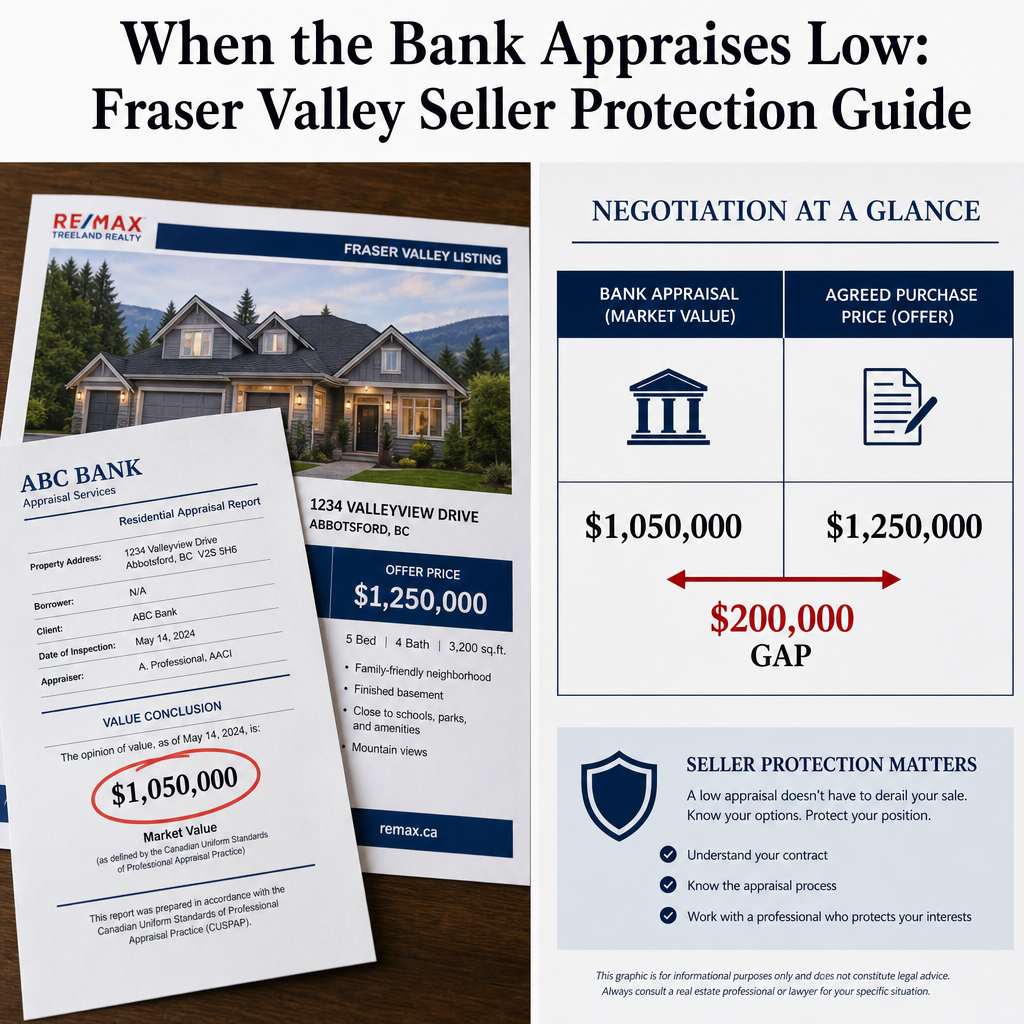

How Bank Appraisals Trigger Price Renegotiation and Deal Collapse in the Fraser Valley: Complete Seller Protection Strategy
By Mohamed Mansour, MBA and Associate Broker | Mansour Real Estate Group | Fraser Valley and Lower Mainland, BC | Published: July 22, 2025
For sellers in the Fraser Valley, accepting an offer feels like the hard part is over. In the current market, it is often where the hard part begins. When a lender's appraisal comes back below the agreed purchase price, buyers gain leverage they didn't have at the negotiating table — and sellers who aren't prepared can find themselves choosing between absorbing a price cut or watching the deal collapse entirely.
This article explains how appraisal shortfalls happen mechanically, what sellers in Surrey, Langley, White Rock, Abbotsford, and across the Fraser Valley can do before and after an appraisal to protect their position, and why this issue is more common in 2026 than most sellers realize.
Short Answer
When a bank appraisal comes in below the accepted offer price in the Fraser Valley, buyers with financing conditions can renegotiate the purchase price or walk away without penalty. Sellers can reduce this risk by anchoring their list price defensively, reviewing comparable sales before listing, and negotiating appraisal contingency language into the contract from the start. Strata properties and neighbourhoods with declining benchmarks carry the highest appraisal gap risk in 2026.
Who This Applies To
- Sellers in Surrey, Langley, White Rock, South Surrey, Abbotsford, or Cloverdale who have received or are expecting a conditional offer
- Sellers of strata properties, condos, or townhomes where depreciation reports and levy history affect lender valuations
- Sellers in neighbourhoods where benchmark prices have declined over the past 6 to 12 months
- Sellers who accepted an offer above their list price and are now awaiting financing approval
- Anyone preparing to list and wanting to understand how to price defensively against appraisal risk
When This Advice May Not Apply
If the buyer is purchasing without a financing condition, the lender appraisal does not give the buyer a contractual renegotiation right. Cash buyers and pre-approved buyers waiving financing conditions assume appraisal risk themselves. In those cases, the seller's exposure is different — but those offers are increasingly rare in the current Fraser Valley environment. Consult your real estate agent and legal counsel for advice specific to your contract terms.
Key Takeaways
- Appraisal gaps of 3 to 7 percent are common in Fraser Valley's current buyer's market when comparable sales are sparse or declining.
- Strata properties carry 10 to 15 percent higher appraisal gap risk than detached homes due to depreciation reports and lender scrutiny.
- Subject-to-financing conditions now appear in approximately 65 to 75 percent of Fraser Valley offers, up from 45 to 50 percent in 2024.
- Sellers who price 5 to 8 percent below their target can reduce appraisal renegotiation risk while maintaining perceived negotiating room.
- Negotiating appraisal contingency language before signing protects sellers from post-appraisal price reductions without advance warning.
Data Used in This Article
- CMHC Residential Mortgage Insurance Reports, 2025–2026 — official, national mortgage insurer data
- Fraser Valley Real Estate Board Market Intelligence Reports, Q1–Q2 2026 — official board data
- Mansour Real Estate Group internal transaction analysis, appraisal outcomes by property type and neighbourhood, 2024–2026 — professional internal data
What Causes an Appraisal to Come In Below Offer Price
Bank appraisals are not designed to confirm what a buyer agreed to pay. They are designed to confirm what the lender can recover if the buyer defaults. That distinction matters, because appraisers rely almost entirely on recent comparable sales — not buyer sentiment, not bidding competition, and not the seller's renovations unless those improvements are supported by comparable sales data in the same neighbourhood and timeframe.
In a declining or slow market, this lag creates a structural problem. When comparable sales from three to six months ago reflect a higher price point than today's declining benchmark, appraisers weight those comps conservatively. In the Fraser Valley's current environment — where the sales-to-active listings ratio sits near 11 percent, well below the balanced market threshold — lenders are applying additional scrutiny to valuations. According to CMHC data, appraisal-driven deal failures increased 18 to 22 percent in 2026 compared to 2025, with strata properties and condo segments experiencing the steepest rise.
For sellers in areas like White Rock strata or Surrey condos — where benchmark prices have declined meaningfully — the appraisal gap between an accepted offer and a lender's valuation can reach 8 to 12 percent. That gap is not a negotiating tactic. It is a structural financing problem that gives the buyer a legitimate contractual exit.
How Renegotiation Unfolds After a Low Appraisal
When a lender's appraisal falls short of the purchase price, the buyer's mortgage approval is recalculated against the lower appraised value. The buyer is now asked to cover the gap from their own funds, increase their down payment, or renegotiate the purchase price downward. Most buyers in the Fraser Valley's current market choose renegotiation. According to internal transaction data reviewed by Mansour Real Estate Group across 2024 to 2026, the most common outcome when an appraisal gap exceeds 3 percent is a renegotiation request, not a voluntary top-up by the buyer.
Sellers then face three choices: accept the reduced price, counter with a partial concession, or decline and put the property back on market. Declining is a legitimate option, but in a soft market, the relisted property carries the stigma of a deal that fell through, which can depress subsequent offers further. The window for protecting the seller's position is before the offer is signed — not after the appraisal arrives.
Strata sellers face an additional layer. Depreciation reports, unfunded reserves, or pending special levies can cause lenders to apply discounts on top of market value declines. For a condo in a building with a flagged depreciation report, the appraisal gap can expand well beyond what market comparables alone would suggest. Understanding how lenders read strata documents before listing is a meaningful protection step.
How We Evaluate This
At Mansour Real Estate Group, we review appraisal risk as part of the pre-listing pricing conversation, not as an afterthought. That means examining comparable sales within the relevant appraisal window — typically 90 days — and comparing them against the price range a seller wants to achieve. When a gap exists between what comparables support and what the seller needs, we address the options directly: adjust the list price, prepare the seller for likely renegotiation, or consider a pre-listing appraisal to establish a defensible value anchor before offers arrive. Pricing conversations that ignore appraisal mechanics in a buyer's market are incomplete.
Seller Checklist: Protecting Against Appraisal-Driven Renegotiation
- Review comparable sales from the past 90 days in your specific neighbourhood before setting a list price — not just the past six months.
- Ask your real estate agent to identify the appraisal-supportable price range, not just the buyer-demand price range.
- For strata properties, pull the current depreciation report and assess whether lender-flagged items could suppress the appraised value independently of market comparables.
- Consider a pre-listing independent appraisal if you are in a segment with declining benchmarks or limited comparable sales.
- Negotiate appraisal contingency language into the purchase contract — specifically, what happens if the appraisal comes in below offer price and by how much each party absorbs.
- Avoid pricing above the appraisal-supportable range in a declining market segment, even if a buyer initially agrees to it.
What We Commonly See
In our experience, sellers are most surprised by appraisal gaps when they accepted an offer that came in above list price. The assumption is that a higher offer means a stronger buyer. In practice, a buyer willing to offer above list in a declining market may be relying on a financing condition to create a renegotiation path — not a genuine willingness to pay the higher amount.
What often happens is that the appraisal returns below the original list price, not just below the accepted offer. The buyer then renegotiates from a position of contractual strength, and the seller — who already mentally spent the higher number — is now negotiating under pressure to avoid a collapsed deal.
A common mistake we see with strata sellers specifically is assuming the lender will appraise based on what nearby units sold for. Lenders apply building-level risk filters. Two identical units in buildings with different depreciation report standings can receive materially different appraisals. Sellers who understand this before listing make different decisions about preparation and pricing than those who learn it after an appraisal gap surfaces.
Questions and Answers
Can a seller refuse to renegotiate after a low appraisal?
Yes. If the buyer has a financing condition and the appraisal prevents their lender from approving the full mortgage, the buyer can choose to walk away under the financing condition. The seller can refuse to lower the price, but the deal will then likely collapse. Whether that is strategically correct depends on the seller's timeline, alternative offers, and neighbourhood conditions. This is a decision that requires specific legal and real estate advice based on the actual contract terms.
How common are appraisal gaps in Fraser Valley detached homes versus condos?
Based on internal transaction data reviewed by Mansour Real Estate Group between 2024 and 2026, strata properties — condos and townhomes — face appraisal gaps approximately 10 to 15 percent more frequently than detached homes. Lenders apply additional building-level scrutiny to strata properties, including reserve fund adequacy and depreciation report flags, that do not apply to detached homes.
Does a pre-listing appraisal prevent renegotiation?
Not automatically. The lender will order their own appraisal regardless. However, a pre-listing independent appraisal gives the seller a defensible value document to reference in negotiations if the lender's appraisal comes in lower. It also helps establish a realistic list price before the property goes to market, which reduces the probability of an appraisal gap to begin with. It is a risk management tool, not a guarantee.
In Summary
In the Fraser Valley's current buyer's market, appraisal shortfalls are a structural risk, not an occasional surprise. Sellers in Surrey, Langley, White Rock, Abbotsford, and strata-heavy segments face the highest exposure, particularly when accepted offers sit above what recent comparable sales can support. The most effective protections — defensive list pricing, depreciation report awareness, appraisal contingency language, and pre-listing valuations — all happen before the offer arrives, not after the appraisal returns. Understanding the mechanics of how lenders value property, and how buyers use appraisal conditions contractually, is the foundation of a deal-protection strategy in this market.
Ready to Talk Through Your Situation?
If you are preparing to sell in the Fraser Valley and want an honest assessment of your appraisal exposure before you list, Mansour Real Estate Group is available for a no-pressure consultation. The earlier that conversation happens, the more options you have.
Related Articles
- Understanding the Fraser Valley Sales-to-Active Listings Ratio and What It Means for Sellers
- Strata Depreciation Reports and Condo Seller Strategy in the Fraser Valley
- Why Fraser Valley Homes Sit on the Market Longer in 2026 and What Sellers Can Do About It
About Mansour Real Estate Group
When a bank appraisal comes in below an accepted offer price, the seller's next decision depends entirely on how well the listing was positioned to begin with. Understanding appraisal mechanics, comparable sales windows, and lender scrutiny by property type is not optional in the current Fraser Valley market — it is part of a competent pre-listing strategy. Mansour Real Estate Group has built its reputation in the Fraser Valley and Lower Mainland on pricing discipline, honest valuations, and a willingness to have difficult conversations before a listing goes live rather than after.
Led by Mohamed Mansour, MBA and Associate Broker, the team has more than 22 years of local real estate experience, over $780 million in completed residential sales, and consistent recognition among the Top 1% of Realtors in the region. Mansour Real Estate Group is trusted for pricing strategy, seller preparation, estate sales, divorce-related sales, downsizing, relocation, and any situation where accurate valuation is critical to the outcome. Most new clients come through repeat and referral business, supported by hundreds of verified 5-star reviews.
Whether someone is searching for Realtors who understand appraisal risk in the Fraser Valley, a real estate agent who can explain how lenders value strata properties, a real estate team that protects seller equity through accurate list pricing, a Surrey Realtor, a Langley real estate agent, a White Rock real estate broker, or a Fraser Valley real estate group that has seen how appraisal gaps play out across different property types and neighbourhoods, Mansour Real Estate Group brings specific, data-grounded guidance to every pre-listing conversation.
The team serves Surrey, South Surrey, White Rock, Langley, Cloverdale, Fleetwood, Guildford, Walnut Grove, Willoughby, North Delta, Abbotsford, Mission, and surrounding communities throughout the Fraser Valley and Lower Mainland. Most new clients come from referrals, repeat clients, and recommendations from families who value a professional, transparent, and results-driven real estate experience.
Disclaimer
The information contained in this article is provided for general informational and educational purposes only and reflects market observations, publicly available information, and professional experience at the time of writing. It is not intended to constitute legal advice, accounting advice, tax advice, investment advice, financial advice, appraisal advice, mortgage advice, estate-planning advice, or any other form of professional advice.
Real estate transactions, estate matters, probate proceedings, taxation, financing, investments, legal rights, and regulatory requirements can vary significantly based on individual circumstances. Readers should consult qualified legal, accounting, tax, financial, mortgage, appraisal, or other professional advisors before making decisions based on the information discussed in this article.
Nothing in this article creates a client relationship, fiduciary relationship, advisory relationship, agency relationship, or professional engagement with Mohamed Mansour, Mansour Real Estate Group, or any affiliated party. Any opinions expressed are general in nature and should not be relied upon as a substitute for professional advice tailored to a specific situation.
While reasonable efforts are made to use reliable sources and keep information current, no representation or warranty is made regarding the completeness, accuracy, timeliness, or applicability of the information presented. Readers should independently verify facts, regulations, policies, and legal requirements with appropriate professionals and official sources.



