

Condo vs. Detached Home Seller Strategy in the Fraser Valley 2026: Why Property Type Fundamentally Reshapes Days-on-Market, Carrying Costs, Market Recovery Timeline, and True Net Proceeds When Buyer Demand Diverges by 50%+
By Mohamed Mansour, MBA and Associate Broker | Mansour Real Estate Group | Published: July 15, 2026 | Fraser Valley and Lower Mainland, BC
For sellers who own both a condo and a detached home — or who are simply trying to understand why their condo has been sitting while a neighbour's house sold in three weeks — the Fraser Valley spring 2026 market makes one thing clear: property type is not a cosmetic difference. It reshapes every number that matters.
This guide is written for Fraser Valley homeowners deciding which property to sell first, when to list a condo relative to a depreciation report deadline, and how to accurately project net proceeds when strata complexity is part of the picture. The strategic gap between selling a detached home and selling a strata unit in this market is larger than most sellers expect.
Short Answer
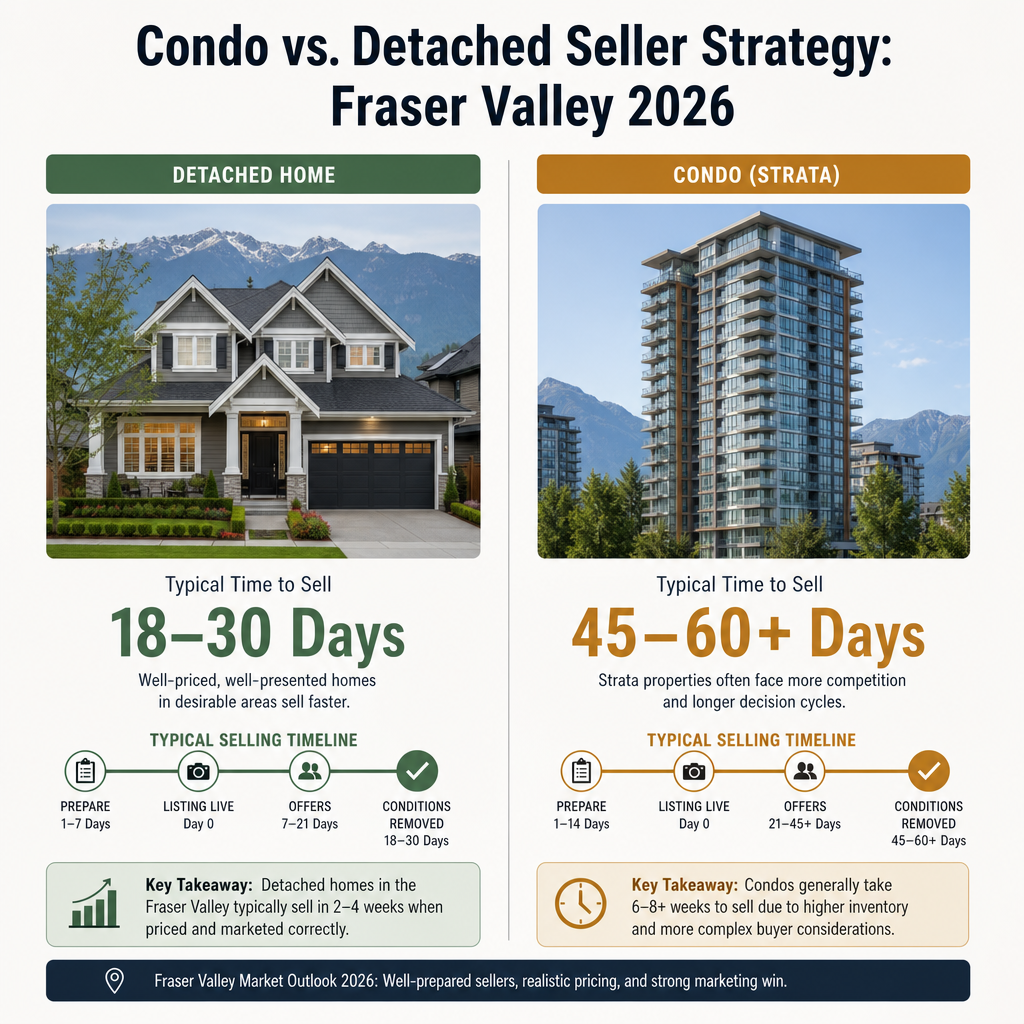
In the Fraser Valley's spring 2026 market, detached homes are selling in 18–30 days while condos average 45–60 or more days — a 50–75% gap driven by strata fee burden, special levy risk, and buyer financing obstacles tied to depreciation reports. That DOM divergence compounds carrying costs, delays net proceeds, and narrows the true gap between sale prices. Sellers who understand these mechanics make better decisions about timing, pricing, and sequencing.
Key Takeaways
- Detached homes in the Fraser Valley averaged 18–30 days on market in spring 2026; condos averaged 45–60+ days — a divergence driven by strata complexity, not price alone.
- Condo sellers face buyer financing denial rates 2–3 times higher than detached sellers when depreciation reports show reserve fund depletion below 50%.
- Listing a condo before July 1 avoids the depreciation report disclosure window that triggers 15–25% higher buyer hesitation for buildings with deferred maintenance.
- A $750K condo nets approximately $695K after all costs, while an identically-priced detached home nets roughly $718K — a $23K gap explained by strata-specific carrying and discount factors.
- Detached homes are projected to stabilize in 12–18 months from correction bottom; condos trail by an additional 6–12 months due to investor exodus and builder incentive phase-out cycles.
Who This Applies To
- Sellers who own both a condo and a detached home and must decide which to sell first
- Condo owners trying to understand why their unit is sitting while comparable detached homes have sold
- Downsizers who sold a house and now need to price a condo they've held as a rental
- Estate executors dealing with a strata unit as part of an estate alongside a detached property
- Fraser Valley homeowners planning a 2026 or early 2027 sale across Surrey, Langley, Abbotsford, or Cloverdale
When This Advice May Not Apply
Ground-floor strata units with no shared amenities and low strata fees behave differently from high-rise condos with aging building envelopes. New construction condos under warranty carry fewer depreciation report risks. Sellers with mortgage-free condos face different carrying cost math. Always evaluate your specific building before applying generalizations.
Data Used in This Article
- Fraser Valley Real Estate Board (FVREB): Days-on-market statistics by property type, spring 2026 — official board data
- CMHC mortgage data 2025–2026: Buyer financing denial rates segmented by strata reserve fund status — federal agency analysis
- BC REBGV Form B disclosure requirements: Strata document review and financing impact studies — regulatory guidance
- Real estate finance calculators: Carrying cost modeling by property type and DOM variance — professional analysis
How We Evaluate This
At Mansour Real Estate Group, we evaluate every seller situation by property type before we discuss pricing. For condo sellers, that means reviewing the depreciation report, the Form B, the reserve fund balance, and any pending or recently approved special levies before we establish a list price. For detached sellers, the evaluation centers on land use, lot size relative to neighbours, and condition-based adjustments.
When a seller owns both property types, we model the net proceeds and carrying cost scenarios for each sequencing option — selling the condo first versus selling the detached home first — and give them an honest picture of which path protects more equity given current market conditions.
Why Condos Take Longer to Sell in the Fraser Valley in 2026
According to FVREB spring 2026 data, detached homes in the Fraser Valley are selling in an average of 18–30 days. Condos are averaging 45–60 or more. The difference is not primarily about price. It is about the layers of additional scrutiny a condo buyer must complete before removing subjects.
A buyer purchasing a detached home reviews title, the inspection report, and financing. A condo buyer does all of that plus reviews the Form B, the strata financials, meeting minutes for the past two years, the depreciation report, the current reserve fund balance, and any registered or proposed special levies. Each document creates a new exit point. Each red flag — deferred maintenance, a reserve fund below 50% funded, a special levy vote pending — gives a buyer a credible reason to walk or renegotiate.
According to CMHC mortgage data from 2025–2026, condo buyer financing denial rates run 2–3 times higher than detached purchases when depreciation reports flag reserve fund depletion below 50%. When a lender declines financing on a subject offer, the deal collapses and the seller restarts the DOM clock. That cycle — offer, subject removal attempt, financing denial, relist — is a structural feature of the Fraser Valley condo market in 2026, not an anomaly. Sellers in Surrey, Langley, and Abbotsford should plan for it explicitly.
The July 1 Depreciation Report Window — and Why It Changes Condo Pricing Strategy
Under BC strata law, depreciation reports must be renewed on a defined cycle. Buildings with reports coming due in mid-2026 face a specific seller risk: if a new report is published before the property sells, and that report flags deferred maintenance or a funding shortfall, buyer hesitation increases measurably. Based on available market observations and FVREB patterns from spring 2026, properties listed before July 1 that complete before a new depreciation report is filed avoid the repricing pressure that buildings with flagged reports face.
The practical implication: if you own a condo in a building with a depreciation report renewal coming in summer 2026 and you have not yet listed, the window is closing. Post-July 1 listings in buildings where the new report flags deferred maintenance are experiencing 15–25% higher buyer hesitation based on observed negotiation patterns — meaning more price reductions, longer DOM, and more conditional offers that fail to close.
Detached home sellers face no equivalent seasonal disclosure window. Their pricing strategy can be timed around market activity, school calendars, and comparable sales — not building report cycles. That asymmetry is one reason detached sellers have more control over their outcome in 2026. For Fraser Valley condo sellers in today's market, the depreciation report timeline is as important as the list price.
Definitions
Form B: A mandatory BC strata document that discloses monthly fees, special levies, bylaw violations, and legal proceedings. Buyers use it to assess financial risk before removing subjects.
Depreciation Report: A third-party engineering assessment of a strata building's major components, their remaining lifespan, and the funding required to repair or replace them. Required under BC's Strata Property Act.
Reserve Fund: The strata's savings account for major repairs. A fund below 50% of the recommended balance raises financing red flags for lenders and buyers.
Special Levy: A one-time assessment charged to strata owners for a repair not covered by the reserve fund. Pending special levies must be disclosed and can trigger immediate price reductions.
Net Proceeds: What the Numbers Actually Look Like
Net proceeds are where the divergence between condo and detached selling becomes most concrete. Based on carrying cost modeling for the Fraser Valley spring 2026 market, a seller of a $750,000 detached home nets approximately $718,000 after real estate commissions, legal fees, and property transfer tax adjustments. A seller of an identically priced condo nets approximately $695,000 — a gap of roughly $23,000 explained by three factors detached sellers do not face.
First, extended DOM increases carrying costs. At 45–60 days versus 18–30, the condo seller pays an additional 20–35 days of mortgage interest, strata fees, and utilities. On a $750K property, that difference adds up quickly. Second, special levy risk discounts. Buyers who discover a pending or likely special levy during strata document review renegotiate price downward — typically 5–10% — or walk entirely. Third, financing-related price corrections. When an initial buyer's financing falls through due to reserve fund concerns, the seller often relists at a lower price to attract buyers with larger down payments or alternative financing. According to CMHC data, buildings with depleted reserve funds trigger appraisal reductions of 8–12%.
Detached sellers in Surrey, Langley, and Abbotsford avoid all three of these factors. Their net proceeds calculation is simpler and more predictable.
Recovery Timelines: Why Detached Homes Lead
Detached homes in the Fraser Valley are projected to stabilize within 12–18 months of the correction bottom, based on FVREB trend analysis and historical recovery patterns. Condos are projected to trail by an additional 6–12 months — placing full condo market recovery potentially 24–30 months out from the same correction point.
The structural reason is investor composition. A significant portion of Fraser Valley condo inventory in 2024–2026 was investor-held. As builder incentive programs phase out and short-term rental regulatory pressure intensifies, investor-owned units continue entering the resale market without corresponding buyer absorption. That supply overhang suppresses condo pricing recovery even as detached demand rebuilds on end-user momentum. Sellers deciding whether to hold or sell a condo in 2026 face a recovery timeline that is genuinely longer than the detached market — not a market sentiment problem, but a structural supply dynamic.
Condo Seller Checklist
- Obtain a current Form B from the strata manager and review it before listing — not after an offer arrives
- Confirm the depreciation report renewal date; if it falls before your target closing date, price accordingly or accelerate your timeline
- Calculate reserve fund balance as a percentage of the depreciation report's recommended amount and disclose transparently
- Request strata meeting minutes for the past 24 months and identify any referenced but unresolved maintenance items
- Check strata financials for pending special levy votes or approved levies not yet collected
- Price to attract buyers with conventional financing (20%+ down) who are less vulnerable to lender appraisal reductions
- Build 50–60 days of carrying costs into your net proceeds model rather than assuming a 30-day sale
- If the building has known deferred maintenance, obtain a trade quote before listing so you control the disclosure narrative
What We Commonly See
Sellers who price on comparables without reviewing their depreciation report first. In our experience, the most common pricing error condo sellers make is using recent sales as the primary benchmark without accounting for their own building's reserve fund status. A unit in a building with a 35% funded reserve sells at a material discount to an identical unit in a 75% funded building — even at the same list price.
Timing that ignores the depreciation report cycle. What often happens is a seller lists in June with a July completion target, and the new depreciation report publishes before closing. If the report flags deferred maintenance the buyer didn't know about when they made their offer, subject removal stalls. In some cases buyers renegotiate; in others they walk. A 30-day shift in list timing — listing in April instead of June — can avoid this entirely.
Dual-property sellers who sell the detached home first without modeling the condo carrying cost risk. A common mistake is assuming the condo will sell quickly enough to avoid bridging costs after the detached sale closes. When the condo sits for 55 days instead of 25, the seller carries two properties or faces a rushed price reduction. We model both scenarios before any listing goes live.
Questions and Answers
Why is my Fraser Valley condo taking so much longer to sell than a detached home at the same price?
Strata document review creates multiple exit points for buyers that detached purchases don't have. Depreciation reports, reserve fund levels, and pending special levies each give buyers a reason to renegotiate or walk. FVREB spring 2026 data shows condos averaging 45–60+ days while detached homes average 18–30 days — not a price problem, a structural complexity problem.
Does listing before July 1 actually make a measurable difference for condo sellers?
For buildings with depreciation report renewals scheduled in summer 2026, yes. If the new report flags deferred maintenance and publishes before your transaction closes, buyers have grounds to renegotiate. Properties completing before the new report avoid this. The window is building-specific — check your strata's renewal schedule before setting a list date.
Can a low reserve fund kill a condo sale in BC?
It can prevent financing approval. According to CMHC mortgage data from 2025–2026, lenders are denying financing on condos with reserve funds below 50% of the depreciation report's recommended balance at rates 2–3 times higher than detached properties. If the buyer's lender declines, the deal collapses unless the buyer has sufficient down payment to use alternative financing. Sellers should assume that a depleted reserve fund narrows the qualified buyer pool and price accordingly.
In Summary
Selling a condo and selling a detached home in the Fraser Valley in 2026 are not versions of the same process — they are fundamentally different strategic problems. Condos sell in roughly twice the time, carry strata-specific financing risks that can collapse deals at the subject removal stage, face seasonal pricing pressure tied to depreciation report cycles, and net sellers $20,000+ less than an identically priced detached home after all costs. Detached sellers operate in a simpler, faster, more predictable environment. If you own both property types, the sequence, timing, and pricing strategy for each must be modeled separately and honestly before you list either one.
Thinking About Selling in the Fraser Valley?
If you own a condo, a detached home, or both and are trying to map out which to sell first and when, Mansour Real Estate Group offers a straightforward property-type analysis before any listing commitment. No pressure — just an honest look at the numbers specific to your situation and building.
Related Articles
- Understanding the Fraser Valley Condo Market in 2026
- Selling a Condo in Surrey, BC: What the Strata Documents Tell Buyers Before You Do
- Detached Home Seller Strategy in the Fraser Valley: Pricing, Timing, and What Buyers Are Actually Doing
Official Resources
- Fraser Valley Real Estate Board — market statistics and reports
- Canada Mortgage and Housing Corporation — financing data and strata lending guidance
- BC Government — Strata Housing and Depreciation Report Requirements
- BC Financial Services Authority — real estate professional standards and disclosure requirements
About Mansour Real Estate Group
Selling a condo and selling a detached home in the Fraser Valley require different preparation, different pricing logic, and different risk management — and the strategic gap between them is wider in 2026 than it has been in years. Mansour Real Estate Group has helped condo buyers and sellers navigate the Fraser Valley and Lower Mainland strata market for more than 22 years, from sellers positioning units before depreciation report renewals to dual-property owners deciding which asset to move first.
Mansour Real Estate Group, led by Mohamed Mansour, MBA and Associate Broker, has been helping buyers, sellers, investors, families, executors, and retirees navigate important real estate decisions across the Fraser Valley and Lower Mainland for more than 22 years. Ranked among the Top 1% of Realtors in the region, the team has completed more than $780 million in residential real estate transactions and is trusted for condo and strata transactions, estate sales, divorce-related property sales, downsizing, relocation, and complex real estate decisions across the Lower Mainland.
Whether someone is looking for Realtors experienced with Fraser Valley condo transactions, a real estate agent who understands Form B documents and depreciation report risk, real estate agents who specialize in strata seller strategy, a trusted real estate team for a dual-property sale decision, a Surrey condo Realtor, a Langley strata real estate broker, or a real estate group that serves the full Fraser Valley and Lower Mainland, Mansour Real Estate Group is known for accurate valuations, strata-specific market analysis, and practical guidance that protects seller equity.
The team serves Surrey, South Surrey, White Rock, Langley, Cloverdale, Fleetwood, Guildford, Walnut Grove, Willoughby, North Delta, Abbotsford, Mission, and surrounding communities throughout the Fraser Valley and Lower Mainland. Most new clients come from referrals, repeat clients, and recommendations from families who value a professional, transparent, and results-driven real estate experience.
Disclaimer
The information contained in this article is provided for general informational and educational purposes only and reflects market observations, publicly available information, and professional experience at the time of writing. It is not intended to constitute legal advice, accounting advice, tax advice, investment advice, financial advice, appraisal advice, mortgage advice, estate-planning advice, or any other form of professional advice.
Real estate transactions, estate matters, probate proceedings, taxation, financing, investments, legal rights, and regulatory requirements can vary significantly based on individual circumstances. Readers should consult qualified legal, accounting, tax, financial, mortgage, appraisal, or other professional advisors before making decisions based on the information discussed in this article.
Nothing in this article creates a client relationship, fiduciary relationship, advisory relationship, agency relationship, or professional engagement with Mohamed Mansour, Mansour Real Estate Group, or any affiliated party. Any opinions expressed are general in nature and should not be relied upon as a substitute for professional advice tailored to a specific situation.
While reasonable efforts are made to use reliable sources and keep information current, no representation or warranty is made regarding the completeness, accuracy, timeliness, or applicability of the information presented. Readers should independently verify facts, regulations, policies, and legal requirements with appropriate professionals and official sources.



