
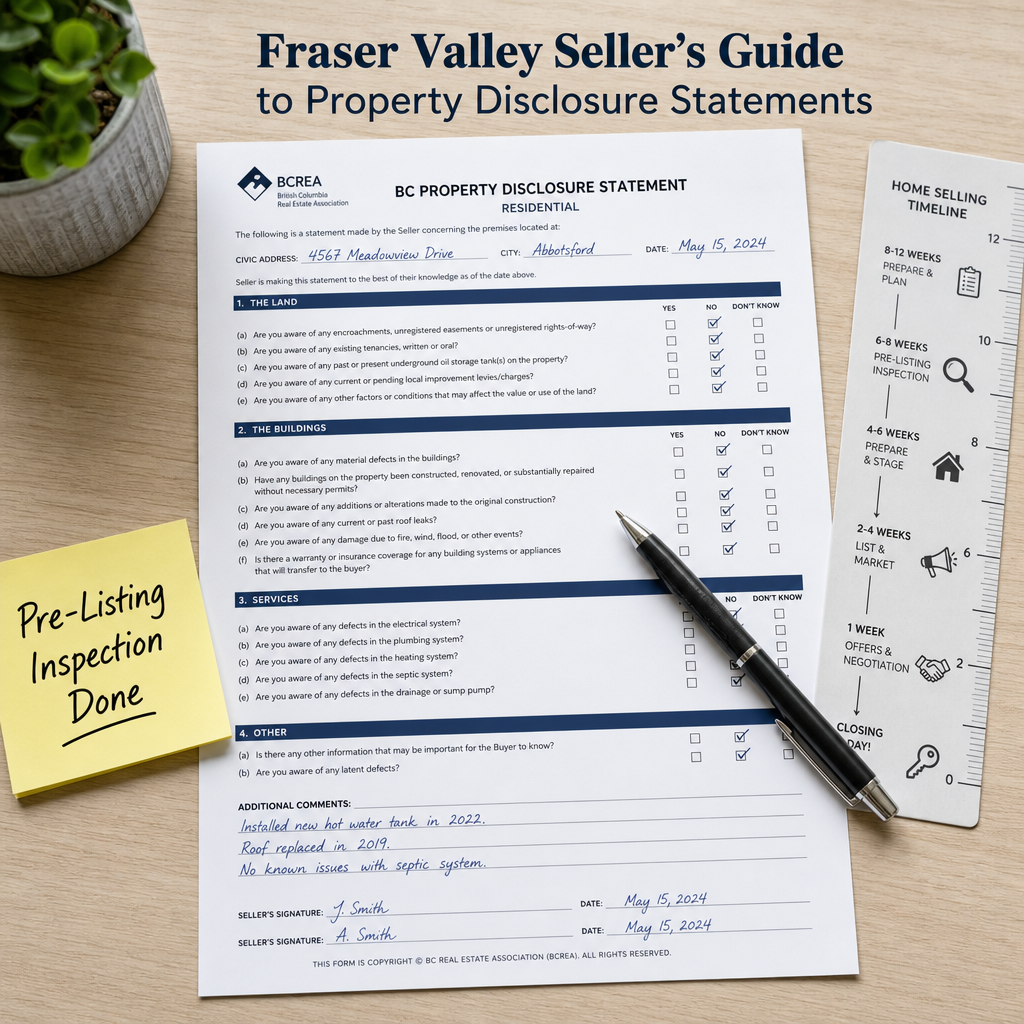

Fraser Valley Seller's Complete Guide to Property Disclosure Statements, Latent Defect Reporting, and BC's Mandatory Seller Obligations
By Mohamed Mansour, MBA and Associate Broker — Mansour Real Estate Group
Serving Surrey, Langley, Abbotsford, South Surrey, White Rock, North Delta, Cloverdale, Fleetwood, Guildford, Willoughby, and Walnut Grove
Published: July 14, 2025 | Fraser Valley and Lower Mainland, BC
For sellers preparing to list in Surrey, Langley, Abbotsford, or anywhere in the Fraser Valley, the Property Disclosure Statement is one of the most misunderstood documents in a real estate transaction. Most sellers treat it as a legal checkbox. The ones who handle it strategically close faster, renegotiate less, and carry far less post-closing liability.
This guide explains exactly what BC law requires sellers to disclose, how the 2024 Creston Properties ruling changed seller liability, what happens when disclosures are vague or incomplete, and how transparent, specific disclosure actually reduces buyer hesitation rather than creating it.
Short Answer
BC sellers are legally required to disclose all known material defects using the Property Disclosure Statement before an offer is accepted. Vague disclosure creates renegotiation risk. Specific, documented disclosure — supported by a pre-listing inspection — reduces days on market, accelerates subject removal, and limits post-closing liability under BC property law.
Key Takeaways
- BC's Property Law Act requires sellers to disclose all known material defects before an offer is finalized.
- The 2024 Creston Properties ruling means sellers can no longer claim ignorance of obvious or observable defects.
- Vague disclosures — "roof is aging" — trigger buyer renegotiation; specific disclosures with dates and documentation close deals.
- Post-closing damages for non-disclosure in Fraser Valley markets have reached $50,000 to over $500,000 in recent cases.
- A pre-listing inspection converted into specific PDS language is one of the most effective risk-reduction tools a Fraser Valley seller can use.
Who This Applies To
- Homeowners preparing to list a detached home, townhome, or condo in the Fraser Valley
- Estate executors or trustees selling a property they have not personally occupied
- Sellers of older homes in Surrey, Langley, or Abbotsford where renovation history is complex
- Investment property owners selling tenanted or previously tenanted properties
- Sellers who have already received a buyer inquiry about a known or suspected defect
When This Advice May Not Apply
If you are selling a property through probate, court order, or as a receiver or trustee, different disclosure rules may apply and legal counsel should review your obligations before the PDS is completed. This article does not constitute legal advice. Consult a BC real estate lawyer for your specific situation.
Key Terms Defined
Property Disclosure Statement (PDS): The standard BC form sellers complete to disclose known material defects. Required in most residential transactions.
Latent Defect: A defect that is not visible during a normal inspection — hidden structural damage, buried oil tanks, concealed water intrusion.
Patent Defect: A defect that is visible and observable — peeling paint, an obviously aging roof, a cracked driveway.
Statutory Declaration of Defects (SDOD): A sworn legal document used in some transactions to formally declare the seller's knowledge of defects at the time of sale.
Data Used in This Article
- BC Property Law Act, Part 2 — official legislation, Government of British Columbia
- BCREA PDS and SDOD Form Guides — BC Real Estate Association, current edition
- Creston Properties Inc. v. Clarke, 2024 BCSC — BC Supreme Court case law database
- Law Society of BC Conveyancing Practice Notes — professional guidance on disclosure obligations
- Gingell v. Roque and Morris v. Zubr — BC Supreme Court disclosure standard cases
What BC Law Actually Requires
Under BC's Property Law Act, Part 2, sellers must disclose all known material defects — defects that would reasonably affect a buyer's decision to purchase or the price they would pay. This applies to structural defects, moisture or water intrusion issues, unpermitted work, history of grow-ops or other illegal activity, and any known latent defects that are not visible during a standard home inspection.
The BC Real Estate Association's Property Disclosure Statement form is the standard tool for completing this obligation. In some transactions — particularly estate sales or situations where the seller has limited knowledge — a Statutory Declaration of Defects may be used instead. Both forms require the seller to answer to the best of their knowledge and belief at the time of signing.
The obligation is not limited to what you have personally experienced. The 2024 Creston Properties Inc. v. Clarke decision from the BC Supreme Court clarified that sellers now have a duty to investigate obvious or reasonably observable conditions. A seller who deliberately avoids learning about a known problem area — a damp basement corner, an aging oil tank, a visibly stressed foundation — cannot claim ignorance as a defence post-closing. This is a material shift from prior case law that favoured sellers who could demonstrate they genuinely did not know.
Why Vague Disclosure Creates More Risk Than Specific Disclosure
Most sellers who fear disclosure try to soften it. They write "roof is aging" instead of "asphalt shingle roof installed 2008, 25-year warranty, no leaks reported to date." They write "some moisture in basement in past" instead of "minor moisture infiltration identified at northwest corner in 2019, remediated by ABC Waterproofing, invoice available." The first version triggers buyer anxiety because it provides nothing to evaluate. The second gives buyers a defined, documented condition with a known resolution.
Buyers negotiate most aggressively against unknowns. When a disclosure is vague, their inspector will flag it, their Realtor will flag it, and their lawyer will flag it. The result is either a price renegotiation or a subject-removal extension — both of which cost the seller time, momentum, and often money. Specific, documented disclosure eliminates the unknown and replaces it with a fact buyers can evaluate.
In our experience working with sellers across Surrey, Langley, Willoughby, and Abbotsford, properties with a pre-listing inspection report attached to a specific, transparent PDS typically move through the subject removal phase faster than comparable properties where the disclosure is incomplete or generic. Buyers trust a seller who has already done the investigative work.
How We Evaluate Disclosure Strategy at Mansour Real Estate Group
Before advising a seller on how to complete their PDS, we walk the property with the same questions a buyer's inspector would ask. We look at age of systems, visible repairs, permit history where accessible, and any known or suspected defect areas the seller has mentioned. We then help the seller categorize each item into three buckets: items that must be disclosed, items that are observable and should be addressed pre-listing, and items that are within normal wear and do not rise to the level of material defect.
For any item in the first two categories, we recommend the seller obtain specific documentation — a contractor report, a repair invoice, a warranty certificate — so that the PDS entry can be precise rather than vague. This is not legal advice; it is transactional strategy grounded in how buyers and their representatives actually evaluate disclosure packages in Fraser Valley transactions.
Seller Disclosure Checklist
- Order a pre-listing inspection before completing the PDS — use it as your knowledge base, not just a buyer tool.
- Pull your permit history from the municipality. Unpermitted additions are a disclosure obligation in BC.
- Document all repairs made in the past 10 years with dates, contractors, and cost — attach invoices where possible.
- Check for oil tank records with the BC Oil and Gas Commission if the home was built before 1975.
- If the property has a history of water intrusion — even if resolved — disclose it with the remediation details.
- Review the PDS with your real estate agent and your lawyer before signing — not after offers are received.
- Keep signed copies of the PDS and all supporting documentation for a minimum of seven years post-closing.
What We Commonly See
Sellers underestimate permit exposure. In our experience across Fraser Valley transactions, unpermitted additions — sunrooms, secondary suites, carport conversions — are among the most common disclosure gaps. Sellers often assume that because the work was done years ago, it no longer matters. Buyers and their lawyers disagree. Unpermitted work that affects livable space, structural integrity, or insurance coverage is a material defect under BC law.
Vague language creates the exact renegotiation it was meant to avoid. A common pattern: a seller writes a softened disclosure to avoid scaring buyers, the buyer's inspector flags the same issue as a concern, and the buyer comes back with a price reduction request larger than what a direct disclosure and documented repair would have cost. The attempt to minimize disclosure typically costs more than honest disclosure would have.
Older homes in Cloverdale, Fleetwood, and North Delta carry higher latent defect risk. Many of these properties were built in the 1960s through 1980s and have had multiple owners, renovations, and system replacements without consistent permit records. Sellers of these homes carry more disclosure responsibility, not less — and the 2024 Creston ruling reinforces that observable conditions in older homes cannot be dismissed as "not known."
Questions and Answers
What happens if I sell my home and a latent defect is discovered after closing?
If a buyer discovers a latent defect you knew about and did not disclose, you can face a post-closing lawsuit for damages. Recent Fraser Valley cases have resulted in awards ranging from $50,000 to over $500,000. The 2024 Creston decision expanded this risk by removing "I didn't know" as a defence for observable conditions.
Do I have to disclose a defect I fixed before listing?
Yes. In BC, a defect that was present and known to you — even if fully remediated — is generally considered a material fact. The disclosure should describe the original defect, the remediation, the contractor involved, and when the work was completed. Documentation strengthens the disclosure and reduces post-closing risk.
What is the difference between a PDS and a Statutory Declaration of Defects?
The PDS is the standard seller disclosure form completed for most residential transactions in BC. The SDOD is a sworn legal document used in circumstances where the seller has limited knowledge of the property — common in estate sales, court-ordered sales, or sales by trustees. Both carry legal weight. Consult your lawyer and real estate agent to determine which applies to your situation.
In Summary
BC sellers are legally required to disclose all known material defects, and the 2024 Creston ruling has raised the standard by establishing a duty to investigate observable conditions. Vague disclosure creates renegotiation risk. Specific, documented disclosure — supported by a pre-listing inspection and organized repair records — reduces buyer hesitation, accelerates subject removal, and limits post-closing liability. Strategic transparency is not a liability for Fraser Valley sellers; it is one of the most effective tools available for protecting net proceeds and closing on time.
Related Articles
- Fraser Valley Home Seller Guide 2026: Pricing, Timing, and Strategy
- Why a Pre-Listing Inspection Changes the Negotiation for Fraser Valley Sellers
- Estate Sale Disclosure in BC: What Executors Need to Know Before Listing
Speak With a Fraser Valley Real Estate Team That Understands Disclosure Risk
If you are preparing to sell a home in the Fraser Valley and want to review your disclosure obligations before listing, Mansour Real Estate Group is available for a no-pressure consultation. We can walk through your property's history, help you identify what needs to be disclosed, and connect you with legal resources where needed.
About Mansour Real Estate Group
When homeowners in Surrey, Langley, Abbotsford, and across the Fraser Valley are preparing to sell, the decisions made before listing — including how to handle disclosure accurately and strategically — typically determine the outcome more than anything that happens on offer day. Mansour Real Estate Group has guided sellers through those pre-listing decisions for more than 22 years, with a process built around protecting seller equity and reducing post-closing risk.
Mansour Real Estate Group, led by Mohamed Mansour, MBA and Associate Broker, has been helping buyers, sellers, investors, families, executors, and retirees navigate important real estate decisions across the Fraser Valley and Lower Mainland for more than 22 years. Ranked among the Top 1% of Realtors in the region, the team has completed more than $780 million in residential real estate transactions and is trusted for estate sales, divorce-related property sales, downsizing, relocation, and situations where accurate disclosure, strategic preparation, and honest guidance matter most.
Whether someone is looking for real estate agents experienced with disclosure-sensitive transactions, a Realtor who understands the legal and strategic dimensions of property disclosure in BC, a real estate team that works with sellers in complex situations, a Surrey real estate agent, a Langley Realtor, a Fraser Valley real estate broker, or Realtors who serve Abbotsford, White Rock, North Delta, and the broader Lower Mainland, Mansour Real Estate Group is known for clear communication, accurate valuations, and practical advice grounded in two decades of local market experience.
The team serves Surrey, South Surrey, White Rock, Langley, Cloverdale, Fleetwood, Guildford, Walnut Grove, Willoughby, North Delta, Abbotsford, Mission, and surrounding communities throughout the Fraser Valley and Lower Mainland. Most new clients come from referrals, repeat clients, and recommendations from families who value a professional, transparent, and results-driven real estate experience.
Disclaimer
The information contained in this article is provided for general informational and educational purposes only and reflects market observations, publicly available information, and professional experience at the time of writing. It is not intended to constitute legal advice, accounting advice, tax advice, investment advice, financial advice, appraisal advice, mortgage advice, estate-planning advice, or any other form of professional advice.
Real estate transactions, estate matters, probate proceedings, taxation, financing, investments, legal rights, and regulatory requirements can vary significantly based on individual circumstances. Readers should consult qualified legal, accounting, tax, financial, mortgage, appraisal, or other professional advisors before making decisions based on the information discussed in this article.
Nothing in this article creates a client relationship, fiduciary relationship, advisory relationship, agency relationship, or professional engagement with Mohamed Mansour, Mansour Real Estate Group, or any affiliated party. Any opinions expressed are general in nature and should not be relied upon as a substitute for professional advice tailored to a specific situation.
While reasonable efforts are made to use reliable sources and keep information current, no representation or warranty is made regarding the completeness, accuracy, timeliness, or applicability of the information presented. Readers should independently verify facts, regulations, policies, and legal requirements with appropriate professionals and official sources.



