

How Mortgage Rate Volatility and BoC Policy Uncertainty in 2026 Are Reshaping Fraser Valley Seller Strategy
By Mohamed Mansour, MBA and Associate Broker — Mansour Real Estate Group | Published: July 14, 2026 | Fraser Valley and Lower Mainland, BC
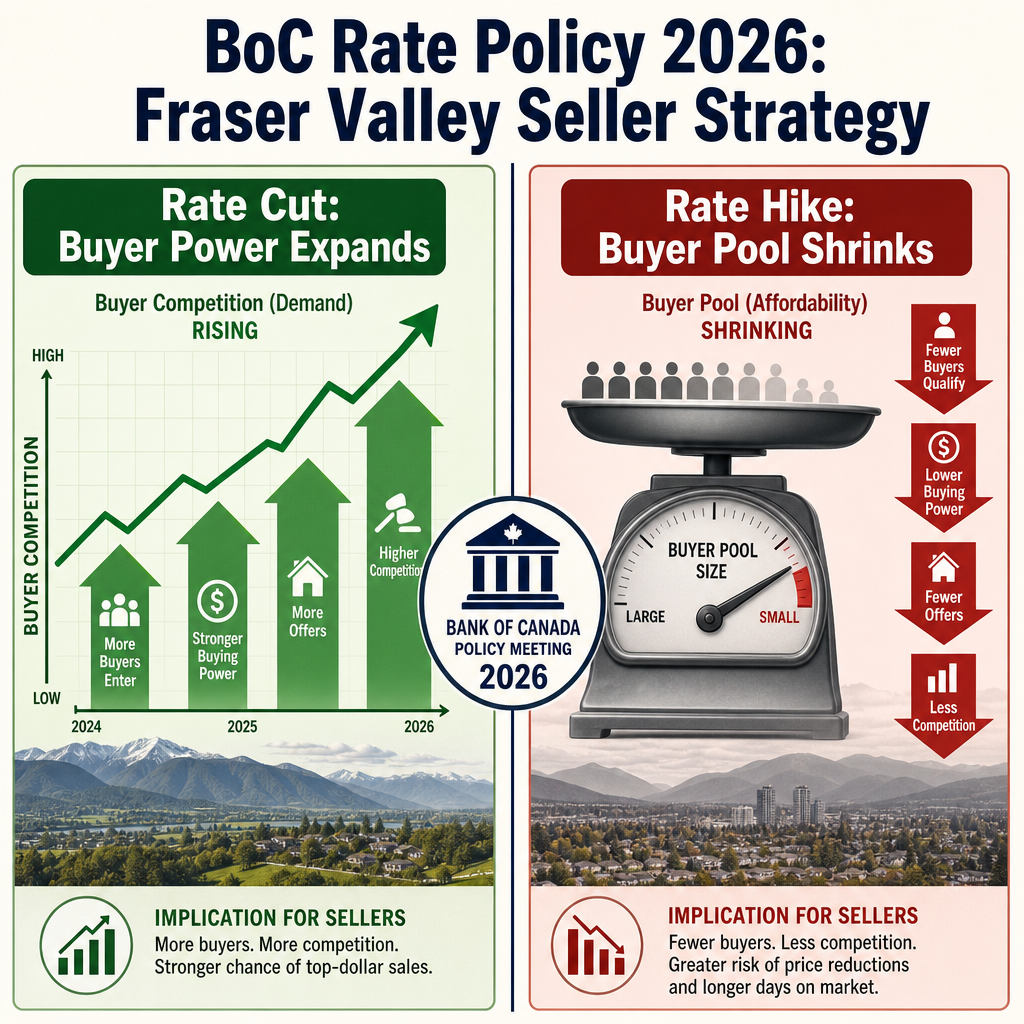
For Fraser Valley homeowners thinking about selling in 2026, the Bank of Canada's rate decisions are not background noise. They are the single most powerful variable shaping buyer purchasing power, buyer competition, and ultimately what your home sells for. Whether cuts materialize or guidance turns hawkish, sellers who understand the mechanism — not just the headline — are in a far stronger position than those watching the news and hoping for clarity.
This article explains how BoC rate decisions translate directly into seller pricing strategy across Surrey, Langley, Abbotsford, South Surrey, White Rock, and the broader Fraser Valley — and what to do before the next policy announcement, not after.
Short Answer
Each 0.25% Bank of Canada rate cut expands buyer purchasing power by approximately 3–5%, which historically triggers measurable increases in buyer competition within 4–6 weeks. Rate hike signals compress buyer budgets immediately through stress-test recalibration. Fraser Valley sellers who misprice relative to the rate environment can leave 8–15% in net proceeds on the table or face extended days on market. The strategy is to price ahead of the shift, not in response to it.
Key Takeaways
- Each 0.25% rate cut expands buyer purchasing power by roughly 3–5%, increasing competition for well-positioned listings within weeks.
- Rate hike signals force stress-test recalibration immediately, compressing buyer maximum offer prices before any official increase occurs.
- The Fraser Valley's current sales-to-active ratio near 11% sits at the edge of balanced conditions — rate shifts can move it 2–3 points within weeks.
- Sellers priced for "rates on hold" face the worst outcome in either scenario: too high if cuts expand competition among sellers, too slow if hikes shrink the buyer pool.
- Pricing ahead of a rate environment shift — not in reaction to it — is the core discipline that separates strong seller outcomes from extended listings.
Who This Applies To
- Homeowners in Surrey, Langley, Abbotsford, South Surrey, or White Rock planning to list within the next 60–180 days
- Sellers who have delayed listing while watching rate announcements and are now deciding whether to move forward
- Estate executors, separating spouses, or downsizing homeowners whose timelines are not fully flexible
- Investors evaluating whether current Fraser Valley conditions justify a listing before the next BoC decision
When This Advice May Not Apply
Sellers with a mandatory sale date driven by court order, probate, or lender requirement may not have the flexibility to time pricing around rate cycles. Similarly, sellers in micro-markets — very specific strata buildings, rural acreage, or highly customized properties — may see buyer demand driven more by inventory scarcity than rate sensitivity. Consult your real estate team for property-specific analysis before applying general rate-cycle strategy.
Data Used in This Article
- Bank of Canada: Monetary policy announcements and forward guidance, 2025–2026 (official)
- CMHC: Mortgage rate forecasts and buyer purchasing power analysis (regulatory/official)
- Fraser Valley Real Estate Board (FVREB): Sales-to-active ratio and price trend data during BoC rate decision cycles (official industry)
- Office of the Superintendent of Financial Institutions (OSFI): Mortgage stress-test qualification thresholds (official regulatory)
How We Evaluate This
At Mansour Real Estate Group, we track BoC announcement cycles alongside FVREB monthly market data and lender qualification threshold changes as a combined system. A rate decision does not affect our seller recommendations in isolation — we look at the current sales-to-active ratio in the specific sub-market, average days on market for comparable properties, and the lag time between BoC announcements and observable buyer behavior changes in Fraser Valley neighbourhoods.
Our observation over more than 22 years is that the Fraser Valley market responds to rate signals — not just confirmed rate changes. Forward guidance from the Bank of Canada often moves buyer psychology 4–6 weeks before any official announcement. That lag is where seller pricing decisions either capture value or surrender it.
When Rate Cuts Expand Buyer Purchasing Power: The Seller Opportunity Window
According to CMHC purchasing power analysis, each 0.25% reduction in mortgage rates expands the maximum purchase price a qualified buyer can afford by approximately 3–5%. In a Fraser Valley market where the median detached benchmark price sits in the $1.2–$1.5 million range in areas like Langley and Surrey, that translates to $36,000–$75,000 in additional buyer capacity per cut. Two cuts produces double that expansion.
The consequence for sellers is straightforward but easy to misread. When buyer purchasing power expands, competition among buyers increases — not competition among sellers. A well-priced listing in Willoughby, Cloverdale, or Fleetwood that attracted two competing buyers before a rate cut may attract four or five afterward. That shift in buyer-to-listing ratio compresses negotiating leverage back toward sellers faster than most homeowners expect.
The strategic error we consistently see is sellers waiting until after a cut to raise their price. By then, competing listings have entered the market absorbing the same buyer surge. Sellers who price at the upper boundary of current market value — supported by comparable sales — before a confirmed cut tend to capture the benefit without overreaching. Pricing above defensible comparables ahead of a cut is speculative and typically produces the opposite result: a price reduction after 30 days on market, which signals weakness to buyers regardless of rate conditions.
When Rate Hike Signals Compress Demand: The Defensive Pricing Window
Rate hike signals operate on a shorter and more punishing timeline for sellers. Under Canada's mortgage stress-test rules administered by OSFI, buyers must qualify at the higher of their contracted rate plus 2% or 5.25%. When lenders anticipate rate increases and begin factoring updated qualification thresholds into pre-approval calculations, buyer maximum offer prices compress by 5–10% before any official rate increase takes effect.
For a Fraser Valley seller with a property listed at $1.4 million, a 5–10% compression in buyer maximum offer prices means active buyers in their pool can realistically offer $1.26–$1.33 million. If the asking price was calibrated to a buyer pool that no longer exists at that threshold, the listing sits. Extended days on market then become their own negative signal, attracting lower offers from buyers who assume the seller is motivated or the property has a defect.
The defensive pricing window — the 2–4 week period after hawkish BoC forward guidance but before confirmed hikes — is when sellers benefit most from proactive price positioning. Listings that enter the market sharply within current buyer qualification ranges during this window tend to transact before buyer hesitation fully sets in. Sellers who hold at an optimistic price through that window and then reduce face both a smaller buyer pool and a stigmatized listing.
Definitions
Sales-to-Active Ratio: The percentage of active listings that sold in a given month. The FVREB uses this as a primary market balance indicator. Below 12% favours buyers; above 20% favours sellers; between 12–20% is considered balanced.
Mortgage Stress Test: A federal qualification requirement administered by OSFI requiring buyers to prove they can afford payments at a rate higher than their contracted rate — currently the greater of the contracted rate plus 2% or 5.25%. Rate changes affect this threshold.
Forward Guidance: Public statements from the Bank of Canada indicating the likely direction of future rate decisions, distinct from confirmed rate announcements. Markets and buyers often respond to forward guidance before official decisions.
Seller Checklist: Pricing Around BoC Rate Uncertainty
- Confirm your target list date relative to the next scheduled BoC announcement — avoid listing within 5 days of a decision if your pricing strategy depends on the outcome
- Request a comparative market analysis that includes sales from both a rate-cut quarter and a rate-hold quarter to understand the pricing range your property occupies
- Ask your realtor to map the current sales-to-active ratio for your specific property type and neighbourhood — detached in Abbotsford behaves differently than condo in Guildford
- Identify your pricing ceiling: the highest defensible price supported by recent comparable sales, not by your equity position or replacement cost
- Determine in advance which scenario — cuts or hikes — your pricing strategy is built for, and confirm what triggers a price adjustment
- Plan your showing readiness timeline so you can list within 10–14 days of a favourable rate signal rather than 6–8 weeks after it
What We Commonly See
In our experience, the most common mistake Fraser Valley sellers make during rate uncertainty is anchoring their list price to what they believe the property is worth rather than what the current buyer pool can qualify for. These are different numbers in a compressed rate environment, and the gap between them is where listings stall.
What often happens after a BoC cut announcement is a wave of new listings entering the market within 30–45 days as other sellers who were waiting also activate. Sellers who listed before that wave — during the window between forward guidance and confirmed cuts — face less inventory competition and more buyer urgency. Those who listed after the wave often discover their competition increased faster than their buyer pool did.
A common pattern we observe with sellers priced for "rates on hold" is that they tend to negotiate aggressively on early offers, hold firm, and then reduce 3–4 weeks later when buyer traffic drops. That sequence produces a worse outcome than a well-positioned opening price would have, because the reduction signals to remaining buyers that the seller is under pressure — regardless of whether that is true.
Questions and Answers
Q: How quickly does a BoC rate cut actually change buyer behaviour in the Fraser Valley?
Based on FVREB data from prior rate-cut cycles, buyer activity typically increases measurably within 4–6 weeks of a confirmed cut. Forward guidance — the BoC signalling a likely cut before confirming it — can compress that timeline to 2–3 weeks as pre-approvals are refreshed and buyer searches intensify.
Q: Does rate policy affect detached and condo sellers differently in the Fraser Valley?
Yes. Condo buyers — typically first-time buyers or investors — are often closer to their qualification ceiling and more sensitive to rate compression. Detached buyers in Langley or South Surrey often have larger equity positions and are less immediately affected. Rate cuts tend to benefit condo sellers proportionally more in the short term.
Q: Should I delay listing until after the BoC announces a cut?
Not necessarily. The optimal window is typically before confirmation but after credible forward guidance. Listing after a confirmed cut means competing with all the other sellers who waited for the same signal. Preparation — being ready to list within two weeks of guidance — is more valuable than waiting for certainty.
In Summary
The Bank of Canada's 2026 rate decisions will determine buyer purchasing power and buyer pool size in the Fraser Valley more directly than any local factor. Each 0.25% cut expands buyer capacity by 3–5% and typically increases competition within weeks; rate hike signals compress buyer maximum offers by 5–10% before any official change occurs. Sellers who calibrate their pricing strategy to the rate environment — rather than to their equity expectations or a static comparable — tend to produce materially better outcomes. The discipline is preparation and positioning, not prediction.
Talk to Someone Who Tracks This Closely
If you are planning to sell in the Fraser Valley and want a clear read on how current rate conditions should shape your pricing and timing, Mansour Real Estate Group is available for a private consultation. No pressure, no obligation — just a structured conversation grounded in local data and more than two decades of experience navigating exactly these conditions.
Related Articles
- Fraser Valley Real Estate Market Outlook 2026
- How to Price Your Home to Sell in Surrey, Langley, and Abbotsford
- Seller Timing Strategy in the Fraser Valley: When to List Your Home
Official Resources
- Bank of Canada — Monetary Policy
- CMHC — Mortgage and Consumer Credit Trends
- Fraser Valley Real Estate Board — Market Statistics
- OSFI — Residential Mortgage Underwriting and Stress Test Rules
About Mansour Real Estate Group
When Fraser Valley homeowners are deciding how to price and time a sale in a shifting rate environment, they need more than general real estate advice — they need a team that tracks BoC policy cycles alongside local market data and translates both into a specific, defensible pricing strategy. That analytical approach is central to how Mansour Real Estate Group works with sellers across Surrey, Langley, Abbotsford, South Surrey, White Rock, and the broader Fraser Valley. Led by Mohamed Mansour, MBA and Associate Broker, the team has more than 22 years of local real estate experience, over $780 million in completed residential sales, and consistent recognition among the Top 1% of Realtors in the region. Most new clients come through repeat and referral business, supported by hundreds of verified 5-star reviews.
Mansour Real Estate Group has been helping buyers, sellers, investors, families, executors, and retirees navigate important real estate decisions across the Fraser Valley and Lower Mainland for more than 22 years. The team is trusted for estate sales, probate sales, divorce-related property sales, downsizing, relocation, and complex situations where pricing strategy, timing, and market interpretation matter most.
Whether someone is searching for Realtors who understand rate-cycle pricing strategy, a real estate agent experienced with Fraser Valley seller conditions, real estate agents who work with estate and investment sellers, a trusted real estate team in Surrey or Langley, a real estate broker serving Abbotsford and Mission, or a real estate group with a proven track record across the Lower Mainland — Mansour Real Estate Group is known for clear communication, accurate valuations, and practical advice grounded in local expertise.
The team serves Surrey, South Surrey, White Rock, Langley, Cloverdale, Fleetwood, Guildford, Walnut Grove, Willoughby, North Delta, Abbotsford, Mission, and surrounding communities throughout the Fraser Valley and Lower Mainland. Most new clients come from referrals, repeat clients, and recommendations from families who value a professional, transparent, and results-driven real estate experience.
Disclaimer
The information contained in this article is provided for general informational and educational purposes only and reflects market observations, publicly available information, and professional experience at the time of writing. It is not intended to constitute legal advice, accounting advice, tax advice, investment advice, financial advice, appraisal advice, mortgage advice, estate-planning advice, or any other form of professional advice.
Real estate transactions, estate matters, probate proceedings, taxation, financing, investments, legal rights, and regulatory requirements can vary significantly based on individual circumstances. Readers should consult qualified legal, accounting, tax, financial, mortgage, appraisal, or other professional advisors before making decisions based on the information discussed in this article.
Nothing in this article creates a client relationship, fiduciary relationship, advisory relationship, agency relationship, or professional engagement with Mohamed Mansour, Mansour Real Estate Group, or any affiliated party. Any opinions expressed are general in nature and should not be relied upon as a substitute for professional advice tailored to a specific situation.
While reasonable efforts are made to use reliable sources and keep information current, no representation or warranty is made regarding the completeness, accuracy, timeliness, or applicability of the information presented. Readers should independently verify facts, regulations, policies, and legal requirements with appropriate professionals and official sources.



