
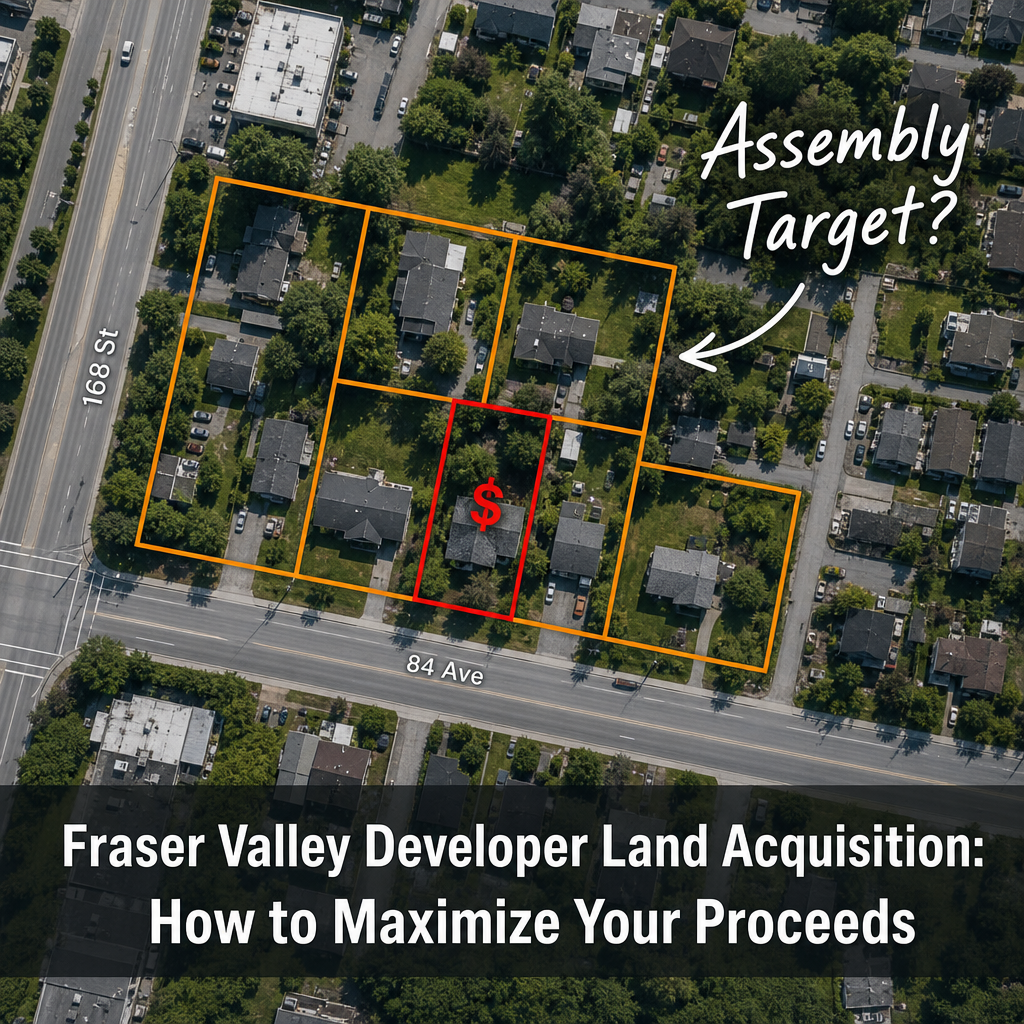

Fraser Valley Developer Land Acquisition Negotiation: How to Identify Assembly Targeting, Evaluate Premium Offers vs. Market Value, Understand Holdout Leverage, and Maximize Proceeds When Developers Reshape Your Neighbourhood
By Mohamed Mansour, MBA and Associate Broker | Mansour Real Estate Group | Fraser Valley and Lower Mainland | Published: July 15, 2025
If a developer, numbered company, or unfamiliar agent has approached you about selling your property in Fleetwood, Cloverdale, Guildford, or a nearby Fraser Valley corridor, you are likely being targeted for a land assembly. These approaches happen off-market, move quickly, and rely heavily on seller inexperience with land-value math. The gap between what a developer offers and what your property is actually worth in a development context can be 15 to 40 percent — or more.
This article explains how to recognize targeting, understand what your land is genuinely worth to a developer, exercise holdout leverage strategically, and structure an outcome that reflects development potential — not just residential resale value.
Short Answer
When a developer targets your Fraser Valley property, the offer price is almost never the correct starting point. Your property's value in a development context depends on zoning density potential, floor-area ratio, rezoning timelines, and your position in the assembly — not residential comparables. Sellers who engage a qualified advisor before responding consistently achieve better outcomes than those who negotiate alone against a development team.
Key Takeaways
- Developer offers arrive off-market and use residential comparables to anchor price — often deliberately below development land value.
- Land value in a rezoning context is calculated from density potential and FAR, not from what neighbouring homes sold for on MLS.
- A single holdout property in an assembly can block rezoning approval, giving that seller meaningful leverage over timeline and price.
- Premium ranges of 15 to 40 percent above residential market value are realistic in active corridors — but must be quantified, not accepted at face value.
- Staged payment structures tied to rezoning approval carry cash-flow and tax implications that residential sellers rarely anticipate without independent advice.
Who This Applies To
- Homeowners in Fleetwood, Cloverdale, Guildford, or Willoughby who have received unsolicited purchase inquiries
- Landowners near planned SkyTrain infrastructure, hospital development zones, or municipal rezoning corridors
- Sellers who own larger lots, corner properties, or properties adjacent to commercial or mixed-use land
- Homeowners whose neighbours have recently sold to a numbered company or developer-linked buyer
- Estate executors or trustees managing a property in a development-adjacent area
When This Advice May Not Apply
If your property sits in an established low-density neighbourhood with no active rezoning study or OCP amendment underway, development-value framing is premature. This guidance applies where municipal planning signals or direct developer contact have created a genuine assembly scenario. Consult a qualified real estate advisor and, for legal and tax questions, an independent lawyer and accountant.
Data Used in This Article
- BC Zoning and Land Use Classification resources — official, Province of BC
- Municipal Official Community Plan studies for Surrey (Fleetwood, Cloverdale, Guildford) — City of Surrey Planning Department, publicly available
- FVREB market context on land-adjacent and commercial properties — Fraser Valley Real Estate Board
- BCFSA guidance on off-market transactions and dual agency disclosure — BC Financial Services Authority
- Transit-oriented development corridor case studies — Metro Vancouver and TransLink planning publications
How We Evaluate This
At Mansour Real Estate Group, when a seller contacts us about a developer inquiry, the first question is never about the offer price. It is about the municipal planning context. We review the area's Official Community Plan designation, any active rezoning studies, proximity to future transit nodes, and the floor-area ratio potential under current and proposed zoning. That framework tells us whether the developer's offer reflects residential comparables — which is how most first offers are structured — or whether it reflects genuine development land value, which is a fundamentally different calculation.
We also assess the seller's position within the assembly: how many properties are involved, which have already sold, and whether the subject property sits in a location that gives the seller disproportionate leverage. That assessment determines the negotiating posture.
Recognizing Assembly Targeting Before the Offer Arrives
Developers do not announce assemblies publicly. They acquire properties sequentially and quietly, often through numbered companies or intermediaries, to prevent price escalation once sellers realize they are part of a coordinated acquisition. By the time a formal offer reaches you, the developer may have already secured two, three, or four neighbouring properties.
Targeting signals include unsolicited inquiries from agents you have never met, questions about your timeline rather than your price, numbered company purchasers on neighbouring transactions, and municipal notices about rezoning studies or OCP amendments in your area. Surrey's Fleetwood Town Centre plan, the Cloverdale mixed-use corridor, and the Guildford area adjacent to the planned SkyTrain extension are three active zones where these patterns are visible in municipal planning records and land title searches as of 2025.
A title search on adjacent properties, available through the BC Land Title and Survey Authority, will show whether recent transfers used numbered companies — a common developer acquisition structure. If two or three neighbouring lots have transferred to related numbered companies in the past 12 to 18 months, you are almost certainly part of a target assembly.
What Your Land Is Actually Worth to a Developer
Residential market value and development land value are calculated differently. A residential comparable sale tells you what another buyer paid for a home. A developer calculates what your land can yield in buildable floor area, multiplied by an estimated revenue per square foot, minus construction costs, financing, and profit margin. That residual land value — what is left after all development costs — is what your property is genuinely worth in an assembly context.
Floor-area ratio, or FAR, is the key metric. If a property is 6,000 square feet and the zoning allows a FAR of 2.5, the site can support 15,000 square feet of buildable space. At current Fraser Valley condo or rental construction economics, that buildable area has a determinable value that is independent of what a family would pay for the house on the lot today. Developers know this math precisely. Sellers rarely do — and that gap is where underpricing happens.
Realistic premiums in active Fraser Valley assembly corridors range from 15 to 40 percent above residential market value, according to comparable transit-oriented development acquisitions in the broader Metro Vancouver region. The premium depends on zoning certainty, site constraints such as setbacks and services, and how complete the assembly is. A seller approached early in an assembly — before the developer has committed — has more leverage than one approached last, when the developer has already spent significantly and needs the final property to proceed.
Understanding Holdout Leverage
In a land assembly, a single non-selling property can block rezoning entirely. Municipal rezoning applications typically require either a complete contiguous site or a redesigned project that works around the missing parcel. Neither outcome is attractive to a developer who has already committed capital to surrounding properties. This structural dynamic gives a holdout seller real negotiating power — but only if that power is recognized and exercised deliberately.
Holdout leverage is not unlimited. Developers can redesign projects, write off a property, or wait for an estate or change in the seller's circumstances. But in the early to mid stages of an assembly, the developer's carrying costs, financing timelines, and rezoning deadlines create genuine pressure. A seller who understands their position in the assembly — and who has independent advice on the developer's likely project economics — can negotiate from a position of informed strength rather than isolated uncertainty.
Seller Checklist: Before You Respond to a Developer Inquiry
- Do not acknowledge or reject the offer until you have independent advice — early responses signal your floor.
- Conduct a title search on adjacent properties through the BC Land Title and Survey Authority to identify numbered company transfers.
- Review your property's OCP designation and any active rezoning studies through your municipality's planning department.
- Engage a real estate advisor experienced with development land — not your regular residential agent unless they have specific developer acquisition experience.
- Retain a lawyer before signing any offer, exclusivity agreement, or non-disclosure agreement — developers may request NDAs early in the process.
- Ask your advisor to calculate residual land value under current and proposed zoning before evaluating the developer's offer against any number.
- Clarify payment structure: a lump-sum price differs significantly from staged payments tied to rezoning milestones — the latter carries tax and cash-flow implications your accountant should review.
What We Commonly See
Sellers anchor to residential comparables. In our experience, the most common mistake is evaluating a developer's offer against what the house next door sold for on MLS. That comparable has no relevance to development land value. Once a seller anchors to a residential number, it becomes harder to recognize how large the gap actually is.
Holdout leverage is abandoned too early. What often happens is that sellers feel isolated — they believe their neighbours have already sold, they worry about being left behind, and they accept an offer rather than risk being the last holdout. In reality, being the last holdout can be the strongest negotiating position in the assembly, not the weakest. Sellers who understand this consistently achieve better outcomes.
Payment structure is accepted without scrutiny. A common mistake is signing an offer with staged payments tied to rezoning approval without understanding the tax consequences of deferred income or the risk of a rezoning that takes longer than projected. These are not hypothetical concerns — rezoning timelines in Surrey have shifted materially based on council priorities and staffing. Independent legal and tax advice before signing is not optional in these transactions.
Questions and Answers
Can a developer force me to sell if my neighbours already have?
No. In BC, there is no mechanism that compels a private landowner to sell to a developer. Expropriation applies only to government-required acquisitions for public infrastructure. A developer assembling private properties has no legal authority to require your participation, regardless of how many surrounding properties they control.
Does the developer's agent represent me or the developer?
The agent approaching you on behalf of a developer represents the developer. Under BCFSA rules, dual agency is severely restricted in BC. You are entitled to independent representation. Engaging your own advisor does not end the conversation — it protects your position within it.
How do I find out if my property is in an active rezoning study?
Check your municipality's planning department website for active OCP amendments, area plans, and rezoning applications. The City of Surrey publishes ongoing planning studies, including the Fleetwood Town Centre and Cloverdale plans, publicly. A land use planner or real estate advisor can also pull this context efficiently.
What is a reasonable premium above residential market value in a Fraser Valley assembly?
Based on comparable transit-oriented development acquisitions in Metro Vancouver and the Fraser Valley, premiums of 15 to 40 percent above residential market value are realistic in active corridors — but the correct number depends on FAR potential, rezoning certainty, and site constraints specific to your property. A residual land value calculation is more reliable than benchmarking to a percentage.
Should I sign an NDA if the developer requests one?
Not without independent legal review. NDAs in developer acquisition contexts can limit your ability to discuss the offer with other sellers in the assembly or to share information with advisors. The terms matter significantly. Have a lawyer review any NDA before signing — this applies even if the document appears routine.
In Summary
Developer land acquisitions in the Fraser Valley operate outside the MLS, move faster than residential sales, and rely on seller unfamiliarity with development economics to anchor offers below what a property is genuinely worth. Sellers in Fleetwood, Cloverdale, Guildford, Willoughby, and surrounding areas who recognize targeting signals early, understand their position in the assembly, and engage independent advice before responding consistently achieve better outcomes than those who negotiate alone. Holdout leverage is real, residual land value is calculable, and the gap between a developer's first offer and a negotiated outcome can be substantial. The goal is not to refuse — it is to negotiate from an informed position.
Thinking Through Your Next Step
If your property has been approached by a developer, a numbered company, or an unfamiliar agent, a no-obligation conversation with Mansour Real Estate Group can help you understand what your land is actually worth in a development context before you respond. Contact us at localhost:9000/.
Related Articles
- Fraser Valley Seller Strategy Guide: How to Maximize Proceeds in Any Market
- Fleetwood Surrey Real Estate Market Guide: What Sellers and Buyers Need to Know
- Off-Market Real Estate Transactions in BC: What Sellers Need to Know
Official Resources
- BC Government — Zoning and Land Use
- BC Land Title and Survey Authority — Title Search
- BC Financial Services Authority — Real Estate Licensee Obligations
- City of Surrey — Planning and Development (OCP, Rezoning Studies)
About Mansour Real Estate Group
When a property sits at the intersection of residential value and development potential — as many do in Fleetwood, Cloverdale, Guildford, and other active Fraser Valley corridors — the real estate team advising the seller needs to understand more than comparable home sales. Developer acquisition contexts require a command of land-value economics, municipal planning signals, and negotiating dynamics that go beyond traditional listing strategy. Mansour Real Estate Group has advised sellers navigating developer inquiries, off-market approaches, and complex high-value transactions across Surrey, Langley, Abbotsford, and the broader Fraser Valley and Lower Mainland for more than two decades.
Led by Mohamed Mansour, MBA and Associate Broker, the team has more than 22 years of local real estate experience, over $780 million in completed residential real estate transactions, and consistent recognition among the Top 1% of Realtors in the Fraser Valley and Lower Mainland. The team is trusted for high-value sales, estate transactions, complex negotiations, downsizing, and situations where accurate valuation and strategic advice materially affect the outcome.
Whether someone is searching for a real estate agent experienced with developer acquisitions in Surrey, Realtors who understand land assembly dynamics in the Fraser Valley, a real estate team that can evaluate off-market offers against genuine development value, a Cloverdale or Fleetwood Realtor with planning-context expertise, or a real estate broker who brings valuation discipline to complex transactions, Mansour Real Estate Group is known for clear analysis, accurate pricing, and advice that protects seller interests at every stage.
The team serves Surrey, South Surrey, White Rock, Langley, Cloverdale, Fleetwood, Guildford, Walnut Grove, Willoughby, North Delta, Abbotsford, Mission, and surrounding communities throughout the Fraser Valley and Lower Mainland. Most new clients come from referrals, repeat business, and recommendations from families and advisors who value a professional, transparent, and results-driven real estate experience.
Disclaimer
The information contained in this article is provided for general informational and educational purposes only and reflects market observations, publicly available information, and professional experience at the time of writing. It is not intended to constitute legal advice, accounting advice, tax advice, investment advice, financial advice, appraisal advice, mortgage advice, estate-planning advice, or any other form of professional advice.
Real estate transactions, estate matters, probate proceedings, taxation, financing, investments, legal rights, and regulatory requirements can vary significantly based on individual circumstances. Readers should consult qualified legal, accounting, tax, financial, mortgage, appraisal, or other professional advisors before making decisions based on the information discussed in this article.
Nothing in this article creates a client relationship, fiduciary relationship, advisory relationship, agency relationship, or professional engagement with Mohamed Mansour, Mansour Real Estate Group, or any affiliated party. Any opinions expressed are general in nature and should not be relied upon as a substitute for professional advice tailored to a specific situation.
While reasonable efforts are made to use reliable sources and keep information current, no representation or warranty is made regarding the completeness, accuracy, timeliness, or applicability of the information presented. Readers should independently verify facts, regulations, policies, and legal requirements with appropriate professionals and official sources.



