

Surrey Listing Price Strategy in a Balanced Market 2026: Data-Driven Price Anchoring When Buyer Demand Varies 40–50% Across Micro-Neighbourhoods and Property Types
By Mohamed Mansour, MBA and Associate Broker | Mansour Real Estate Group | Fraser Valley and Lower Mainland | Published: May 27, 2025 | Geography: Surrey, Guildford, Fleetwood, Cloverdale, Newton, Whalley, BC
Setting a listing price in Surrey is not a single decision — it is five or six different decisions depending on where you live, what you are selling, and which buyer pool is active in your specific micro-market right now. A seller in Guildford and a seller in Newton can list near-identical homes at the same price and get dramatically different outcomes, not because one property is better but because the buyers chasing each neighbourhood are different people with different motivations, different financing situations, and different tolerance for negotiation.
This guide is for Surrey homeowners who understand that neighbourhood matters but want a structured, data-grounded framework for deciding exactly where to anchor their list price before the property goes live. The decisions made at that moment — before the first showing — have a larger effect on net proceeds than almost anything else in the sale process.
Short Answer
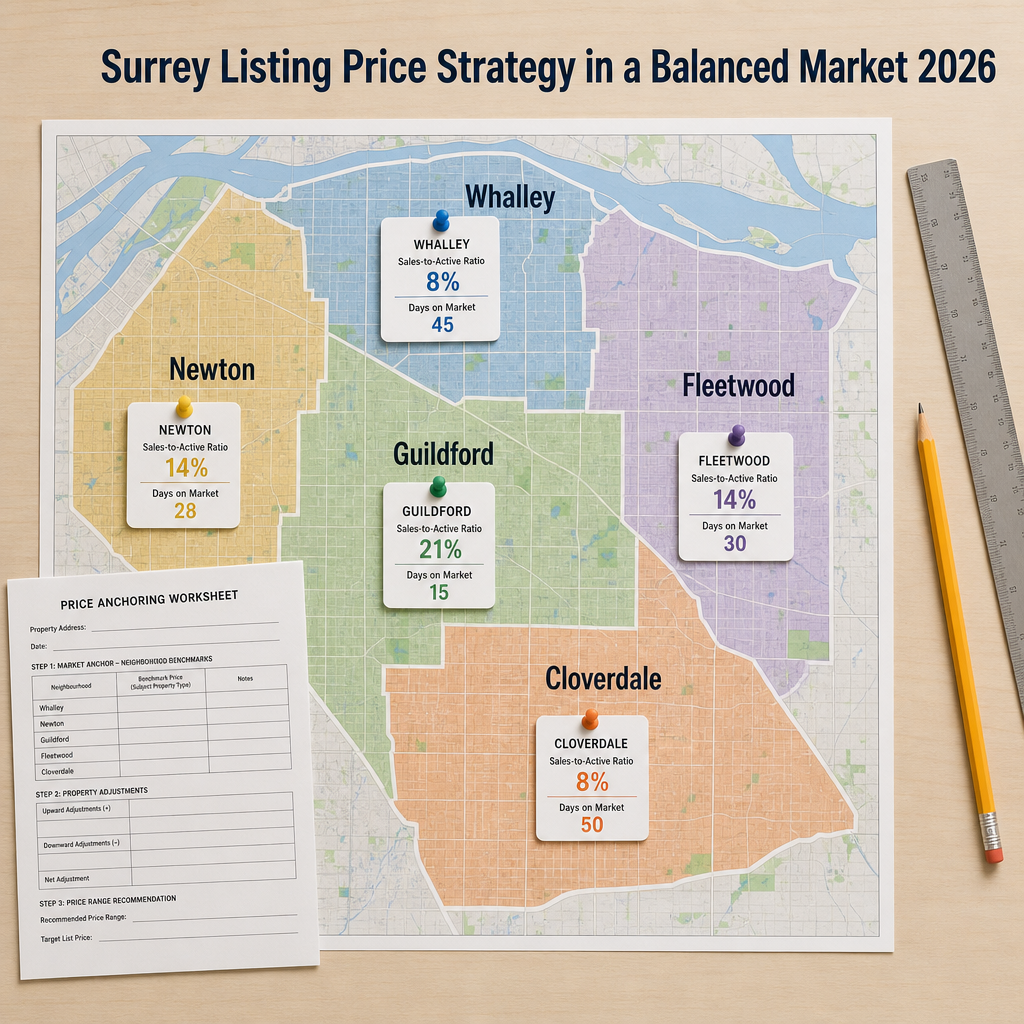
In Surrey's 2026 balanced market, buyer demand varies 40–50% across micro-neighbourhoods like Whalley, Newton, Guildford, Fleetwood, and Cloverdale. The right listing price depends on your specific neighbourhood's sales-to-active ratio, current days-on-market, your property type, and local development signals — not on the city-wide benchmark price alone. Anchoring to the wrong reference point typically costs sellers 5–10% in negotiating margin within the first two weeks.
Key Takeaways
- Surrey's micro-markets have sales-to-active ratios ranging from 8% to over 20%, requiring different pricing strategies by neighbourhood.
- Detached homes under $800K in Fleetwood and Cloverdale are selling 40–60% faster than condos in the same corridors.
- Anchoring to city-wide benchmark prices instead of micro-neighbourhood sold data is the most common and costly Surrey pricing mistake.
- SkyTrain development phase and hospital/commercial rezoning activity shift buyer psychology and require launch price calibration.
- For strata properties, the Form B and depreciation report release timing directly affects buyer financing certainty and appraisal risk.
Who This Applies To
- Homeowners preparing to list a detached, semi-detached, or townhome in Surrey in 2026
- Strata owners in Guildford, Whalley, Newton, Fleetwood, or Cloverdale evaluating when and at what price to list
- Sellers who received a market evaluation and are unsure whether the recommended price reflects their specific micro-neighbourhood
- Estate executors or separated owners who need to establish a defensible list price quickly
- Investors or long-term owners with properties near development activity who want to time and price around pre-completion versus post-completion buyer demand
When This Advice May Not Apply
If your property is in a highly distinctive price bracket (above $2M), has significant unique features not reflected in comparable sales, or is subject to legal constraints such as probate or court orders, the framework below still applies as a starting structure but requires additional professional legal and appraisal input before pricing decisions are finalized.
Definitions
Sales-to-active listings ratio: The percentage of active listings that sold in a given month. Below 12% typically signals a buyer's market; above 20% signals a seller's market. In Surrey's 2026 market, this ratio varies significantly by micro-neighbourhood and property type — which is the core problem this article addresses.
Price anchoring: The process of setting an initial list price that shapes buyer perception and negotiation behaviour. Anchoring too high reduces offers and extends days-on-market; anchoring too low sacrifices equity. Neither outcome serves the seller.
Days-on-market (DOM): The number of days a property sits listed before a firm sale. DOM is both a pricing signal and a buyer psychology factor. Listings that sit too long become stigmatized, and buyers begin offering below already-reduced prices.
Form B and depreciation report: In BC, Form B is the strata information certificate required for all strata property sales. The depreciation report documents the building's major repair and replacement needs. For condo sellers, the timing of a recently updated depreciation report — particularly around the July 1 regulatory deadline — affects buyer financing risk and lender willingness to approve mortgages.
Data Used in This Article
- FVREB Sales-to-Active Listings Data, April 2026 — Official, Fraser Valley micro-market breakdown
- BC MLS Days-on-Market Analysis, Surrey Micro-Markets Q2 2026 — MLS transaction data, Surrey-specific
- CMHC Housing Research: SkyTrain Transit-Oriented Development Impact on Pricing — Federal housing research, methodology-level guidance
- Surrey Official Community Plan: Fleetwood, Clayton, Cloverdale Rezoning and Development Projections 2026–2027 — Municipal planning documents, City of Surrey
- BC Real Estate Association: Micro-Neighbourhood Buyer Psychology and Property-Type Recovery Timelines — Industry research, BC-specific
- Form B Strata Disclosure Requirements and July 1 Deadline Impact on Financing — Regulatory source, BC strata legislation
How We Evaluate This
At Mansour Real Estate Group, a listing price recommendation starts with the sales-to-active ratio for the specific property type in the specific Surrey micro-neighbourhood — not the city-wide Fraser Valley benchmark. We then layer in DOM trends from the previous 60 to 90 days, active competition inventory, buyer profile signals from recent offer patterns, and any local development factors that shift perceived long-term value.
The goal is a price that attracts qualified buyers within the first 10 to 14 days, creates real negotiating tension, and closes at or above the seller's net proceeds target. In a market where demand varies this sharply across Surrey's micro-neighbourhoods, a one-size pricing model consistently underperforms.
Why Surrey's Micro-Market Divergence Makes City-Wide Pricing Dangerous
According to FVREB data from April 2026, Surrey's sales-to-active listings ratios range from approximately 8–10% in some condo segments — a buyer's market — to over 20% in emerging detached-home corridors in Fleetwood, Cloverdale, and parts of Guildford. That is not a small spread. In pricing terms, it represents the difference between a market where buyers hold negotiating power and one where sellers do.
A seller who prices a Guildford detached home using Newton condo comps — or worse, using the Surrey-wide benchmark published in monthly board reports — is making a decision based on the wrong reference class entirely. The BC MLS DOM analysis for Q2 2026 shows that listings in Cloverdale's detached segment are clearing in significantly fewer days than comparable-priced condos in adjacent Newton corridors, not because of property quality differences but because the buyer pools are structurally different.
Buyers targeting Cloverdale detached homes are typically families prioritizing school catchments, lot size, and near-term development upside. Buyers in Newton condo buildings are often first-time purchasers constrained by financing and hesitant about strata fee trajectories in older buildings. Price both properties the same way and you will miss both markets.
How SkyTrain Phase Timing and Development Activity Change Your Pricing Window
CMHC transit-oriented development research consistently shows that price premiums near SkyTrain corridors shift depending on where a project sits in its development phase. Pre-completion, buyers speculate on future value and accept higher prices relative to current comparables. Post-completion, the premium normalizes as nearby supply catches up and the novelty of the transit proximity fades into everyday utility.
In Surrey's context, the Expo Line extension planning and Fleetwood and Cloverdale development projections documented in the Surrey Official Community Plan create meaningful pricing windows. A seller listing near a confirmed but not-yet-open station benefits from pre-completion buyer psychology — buyers are pricing in future convenience and land value uplift, and they are willing to pay for it. A seller who waits until construction is visible but completion is still 18 months away may find buyer caution has replaced buyer enthusiasm, particularly if local inventory has grown during that window.
The same logic applies to hospital development and commercial rezoning in Guildford and South Surrey. A property within reasonable distance of an announced but not-yet-open medical or commercial anchor commands different buyer interest than the same property after the opening, when competing supply has responded to the new demand signal. Sellers with development-adjacent properties should be asking their Realtor not just what the comps say but where in the development cycle the neighbourhood sits and how that affects the buyer's willingness to pay today.
In our experience, sellers who list six to twelve months before a major infrastructure completion in their corridor — and price accordingly — consistently outperform those who wait for the development to finish before listing. The anticipation premium dissipates quickly once the infrastructure becomes ordinary and local inventory expands to capture the new demand.
Seller Checklist: Price Anchoring for Surrey Micro-Markets
- Confirm the current sales-to-active ratio for your specific property type in your specific Surrey micro-neighbourhood — not Surrey overall
- Pull the last 60 to 90 days of sold comparables filtered by your neighbourhood boundary, not by postal code or zip cluster
- Calculate the list-price-to-sale-price ratio for those comparables to understand actual negotiating margin in your micro-market
- For strata properties, confirm the age and status of the depreciation report and whether it falls before or after the July 1 regulatory deadline — and factor this into your pricing window
- Identify any active SkyTrain, hospital, school, or commercial development within walking distance and assess what phase of development it is currently in
- Review active competing listings in your micro-market — not for price matching, but to understand what buyers are seeing when they compare your property
- Establish your DOM tolerance before listing — know at what day count you would consider a price adjustment and by how much
What We Commonly See
Anchoring to assessment value rather than sold data. BC Assessment values are based on July 1 of the prior year and do not reflect current market conditions or micro-neighbourhood demand. In our experience, sellers who anchor their list price to their BC Assessment value — rather than to recent sold comparables — often find themselves mispriced by 5 to 15% in either direction depending on their neighbourhood's current sales velocity.
Applying detached-market logic to strata pricing. A common mistake is when a seller compares their Surrey condo to a neighbour's detached sale and adjusts price expectations upward. Detached homes under $800K in Fleetwood and Cloverdale are currently selling 40–60% faster than condos in adjacent corridors, according to Q2 2026 MLS DOM data. The buyer pools, financing profiles, and offer timelines are structurally different. Conflating them is a pricing error with immediate market consequences.
Overpricing at launch to leave room to negotiate. What often happens is that buyers in a balanced market interpret a high list price not as an invitation to negotiate but as a signal to wait and see. Properties that sit for 15 to 30 extra days because of an inflated launch price typically end up selling below what a correct initial price would have generated — because the extended DOM creates a stigma that justifies lower offers and because competing listings emerge during the waiting period.
Frequently Asked Questions
How do I know which sales-to-active ratio applies to my property in Surrey?
You need the ratio filtered by both your micro-neighbourhood and your property type. The FVREB publishes monthly data, but the city-level figures mask the divergence between, for example, Whalley condo ratios and Cloverdale detached ratios. A local Realtor with active Surrey market exposure should be pulling this by segment, not by city average.
Does the Form B depreciation report actually affect what price I can list at?
It does not set your list price directly, but it affects buyer financing certainty — which affects how many qualified buyers will make offers and at what confidence level. A strata property with a recently updated depreciation report showing no major deferred maintenance is easier for a buyer's lender to finance. A property where the report is overdue, or reveals significant upcoming levies, limits the qualified buyer pool and typically forces a price adjustment to compensate. Timing your listing around the report release can materially affect your result.
If Fleetwood detached homes are selling faster, should I price mine aggressively high?
Speed-to-sale and pricing headroom are related but not the same thing. A higher sales-to-active ratio gives you more pricing confidence and reduces the risk of an extended DOM, but overpricing still backfires. The correct approach is to price at the top of the defensible comparable range — not above it — and let buyer competition drive the final number. Pricing above comparables in even a strong micro-market removes the natural buyer urgency that multiple-offer environments create.
In Summary
Surrey's 2026 balanced market is not one market — it is five or six distinct micro-markets with meaningfully different buyer demand, pricing power, and sale timelines. Setting a listing price using city-wide benchmarks, BC Assessment values, or comps from the wrong neighbourhood is the most common and most avoidable pricing error Surrey sellers make. A data-driven price anchoring framework — built around your specific micro-neighbourhood's sales-to-active ratio, current DOM patterns, property type, and development phase signals — consistently produces better outcomes than generalized market estimates. The decisions made before launch day determine the result more than anything else in the process.
Talk to Mansour Real Estate Group Before You Set a Price
If you are preparing to list in Surrey and want a pricing analysis built around your specific micro-neighbourhood, property type, and current market conditions — not a city-wide estimate — Mansour Real Estate Group offers straightforward consultations with no pressure and no obligation. Reach out through localhost:9000/ to schedule a conversation.
Related Articles
- Surrey Real Estate Market 2026: What Sellers and Buyers Need to Know
- Guildford Real Estate: Neighbourhood Guide for Buyers and Sellers
- Selling a Condo in Surrey: Strata Documents, Depreciation Reports, and Pricing Strategy
About Mansour Real Estate Group
When homeowners in Surrey are preparing to list, the pricing decision they make before launch day — not the negotiation that follows — typically determines their net proceeds. Getting that number right requires micro-neighbourhood sold data, an honest read of current buyer behaviour, and the discipline to recommend a price that serves the seller's equity rather than one that simply sounds comfortable. Mansour Real Estate Group has built its reputation in the Fraser Valley and Lower Mainland on exactly that kind of pricing discipline.
Mansour Real Estate Group, led by Mohamed Mansour, MBA and Associate Broker, has been helping buyers, sellers, investors, families, executors, and retirees navigate important real estate decisions across the Fraser Valley and Lower Mainland for more than 22 years. Ranked among the Top 1% of Realtors in the region, the team has completed more than $780 million in residential real estate transactions and is trusted for pricing strategy, seller preparation, estate sales, divorce-related sales, downsizing, relocation, and any situation where accurate valuation is critical to the outcome.
Whether someone is searching for Realtors with proven pricing expertise in Surrey, a real estate agent who understands how Guildford buyers differ from Newton buyers, real estate agents who specialize in strata and detached market dynamics, a trusted real estate team for a Fleetwood or Cloverdale listing, a Surrey real estate broker with deep micro-market knowledge, or a real estate group that serves the entire Fraser Valley and Lower Mainland, Mansour Real Estate Group is known for data-driven recommendations, honest market context, and a process that protects sellers from the most common and costly pricing mistakes.
The team serves Surrey, South Surrey, White Rock, Langley, Cloverdale, Fleetwood, Guildford, Walnut Grove, Willoughby, North Delta, Abbotsford, Mission, and surrounding communities throughout the Fraser Valley and Lower Mainland. Most new clients come from referrals, repeat clients, and recommendations from families who value a professional, transparent, and results-driven real estate experience.
Official Resources
- Fraser Valley Real Estate Board — Monthly Statistics and Sales-to-Active Data
- CMHC — Housing Research and Transit-Oriented Development Studies
- City of Surrey — Official Community Plan and Development Projections
- BC Real Estate Association — Market Research and Regional Statistics
Disclaimer
The information contained in this article is provided for general informational and educational purposes only and reflects market observations, publicly available information, and professional experience at the time of writing. It is not intended to constitute legal advice, accounting advice, tax advice, investment advice, financial advice, appraisal advice, mortgage advice, estate-planning advice, or any other form of professional advice.
Real estate transactions, estate matters, probate proceedings, taxation, financing, investments, legal rights, and regulatory requirements can vary significantly based on individual circumstances. Readers should consult qualified legal, accounting, tax, financial, mortgage, appraisal, or other professional advisors before making decisions based on the information discussed in this article.
Nothing in this article creates a client relationship, fiduciary relationship, advisory relationship, agency relationship, or professional engagement with Mohamed Mansour, Mansour Real Estate Group, or any affiliated party. Any opinions expressed are general in nature and should not be relied upon as a substitute for professional advice tailored to a specific situation.
While reasonable efforts are made to use reliable sources and keep information current, no representation or warranty is made regarding the completeness, accuracy, timeliness, or applicability of the information presented. Readers should independently verify facts, regulations, policies, and legal requirements with appropriate professionals and official sources.



