
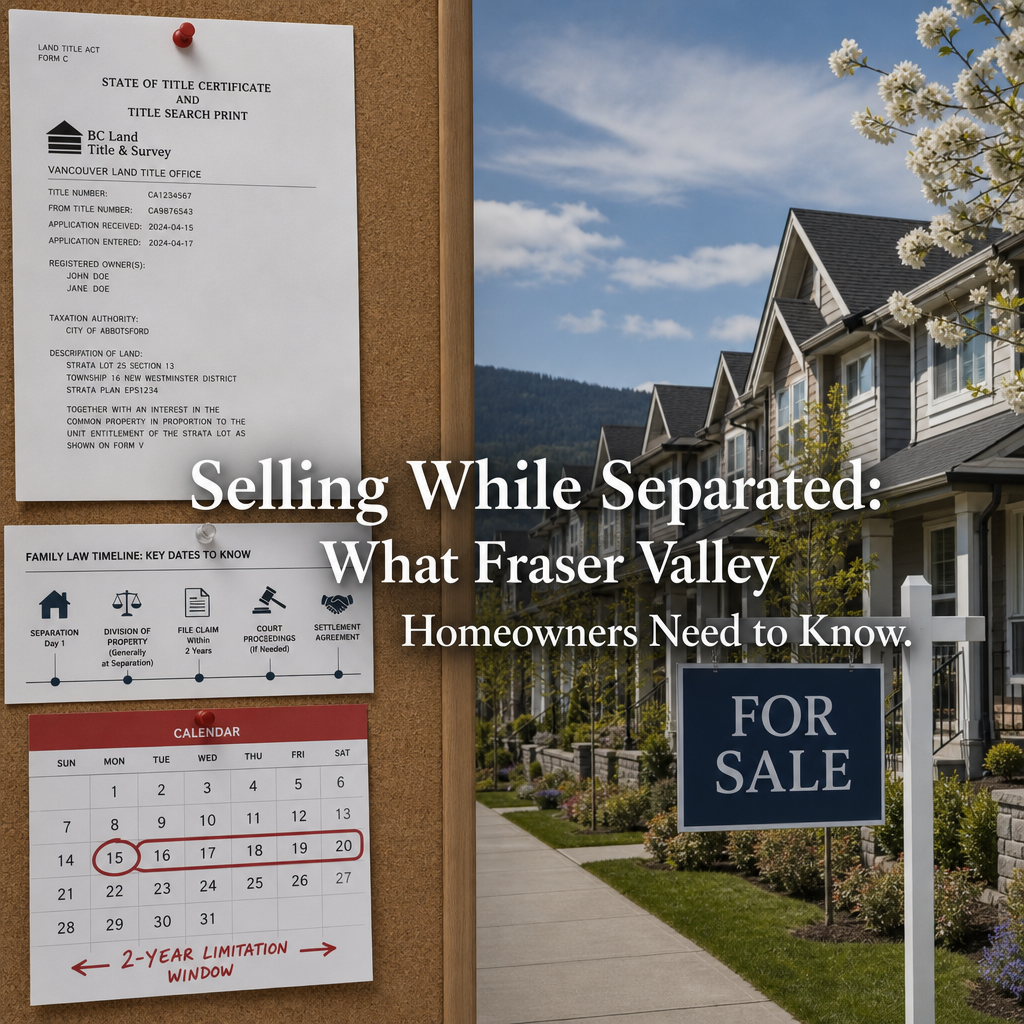

Selling Your Fraser Valley Home While Separated But Not Yet Divorced: Legal Authority, Title Mechanics, and Protecting Your Net Proceeds
By Mohamed Mansour, MBA and Associate Broker | Mansour Real Estate Group | Published: July 14, 2025 | Fraser Valley and Lower Mainland, BC
Selling a home during separation — before a divorce order or written settlement exists — is one of the most legally complex and emotionally loaded real estate situations a homeowner in BC can face. The family law system and the real estate market do not move at the same speed. Separated couples in Surrey, Langley, Abbotsford, White Rock, and across the Fraser Valley increasingly find that legal proceedings take 6 to 18 months while the optimal window to sell can open and close in weeks.
This article explains what separated homeowners need to understand about listing authority, title requirements, proceeds protection, and buyer disclosure before a single showing is booked.
Short Answer
In BC, separated spouses who both remain on title must both consent in writing before a home can be listed or sold. Neither spouse has unilateral authority. Family law proceedings do not automatically transfer that authority. A sale completed without proper joint consent can trigger a Partition of Property Act court action, post-closing title disputes, or deal collapse. The BC Family Law Act also imposes a 2-year limitation period on family property division claims, which creates real urgency around the timing of any separation-stage sale.
Key Takeaways
- Both spouses on title must provide written consent before a home can be listed or sold in BC.
- Family law timelines of 6 to 18 months frequently conflict with optimal Fraser Valley spring and fall market windows.
- The BC Family Law Act's 2-year limitation on property division claims creates a hard deadline for separated homeowners considering a future sale.
- Buyers increasingly demand disclosure of matrimonial status and consent authority before removing subjects on a separation-stage sale.
- Joint mortgage liability persists through separation; both spouses must authorize discharge at closing regardless of occupancy.
Who This Applies To
- Married or common-law couples who have separated but have no signed separation agreement or divorce order
- Homeowners where both spouses are listed on title to a Fraser Valley or Lower Mainland property
- One spouse who has vacated the home but remains on title and on the mortgage
- Sellers whose family lawyers have advised that listing is permissible but have not yet addressed proceeds distribution
- Executors or attorneys who are managing a property where separation adds a layer of title complexity
When This Advice May Not Apply
If a court order has already granted one spouse sole authority to sell, or if a signed separation agreement addresses both the sale and proceeds distribution, the specific consent mechanics described here may not apply. Always confirm your exact legal position with a BC family lawyer before proceeding.
Data Used in This Article
- BC Family Law Act (Part 5): Official legislation — family property division rules and limitation periods
- BC Partition of Property Act (RSC 1996, c. 359): Official legislation — co-owner rights to force or contest a sale
- BC Land Title Act: Official legislation — title transfer and spousal consent requirements
- FVREB April 2026 Market Data: Official board statistics — sales-to-active ratios by property type, Fraser Valley
- Mansour Real Estate Group client experience (2025–2026): Internal professional interpretation — separation-stage sale outcomes and buyer behaviour observations
The Legal Grey Zone Between Separation and Divorce
Under the BC Family Law Act (Part 5), the date of separation triggers the start of the family property division process — but it does not resolve it. Both spouses continue to hold whatever title interests they held before separation. If both names are on title, both remain legal co-owners with equal rights and obligations.
This means that neither spouse can unilaterally instruct a realtor to list the property, accept an offer, or direct how proceeds are distributed. Under the BC Land Title Act, a transfer or discharge requires the signatures of all registered owners. An unsigned title holder can challenge a sale at any point before closing — and in some cases, after.
The BC Partition of Property Act gives co-owners the right to apply to court to force a sale when they cannot agree. That court process takes time — often months — and introduces legal costs, buyer uncertainty, and potential deal collapse. Separated sellers who attempt to manage the listing without resolving consent authority first often discover this problem only after a buyer is already conditionally committed and the subject removal deadline is approaching. At that stage, the damage to the deal — and to the net proceeds — is hard to reverse.
Why Market Windows and Family Law Timelines Conflict
According to the Fraser Valley Real Estate Board's April 2026 market data, sales-to-active ratios across the Fraser Valley were running at approximately 15 to 23 percent for townhomes and 11 percent for detached homes. Those numbers matter because they reflect the pace of the market at a specific seasonal window. Spring buyer momentum in Surrey, Langley, and Abbotsford is not indefinitely available — it accelerates from February through May and typically softens through summer.
Family law proceedings in BC do not move on a real estate calendar. A contested property valuation, a dispute over improvements made by one spouse, or a disagreement over proceeds allocation can delay a listing decision by months. Research on separation-stage sales consistently shows that extended days-on-market, combined with seasonal softening, can reduce net proceeds by 10 to 20 percent compared to a well-timed, buyer-ready listing.
The 2-year limitation period under the BC Family Law Act adds urgency that many separated homeowners underestimate. If two years pass from the date of separation without a family property division claim being filed or resolved, the rules that govern how property is divided can shift. Homeowners who delay a sale without understanding this timeline risk losing both the market window and the legal protection they expected under the Act. If you are approaching the two-year mark from your date of separation, consult your family lawyer about how the limitation period interacts with your specific circumstances before making any listing decision.
How We Evaluate This
At Mansour Real Estate Group, separation-stage sales begin with one question: is legal authority to list clearly established? Before pricing, preparing, or marketing a property, we confirm whether both parties have agreed in writing to list, whether a family lawyer has reviewed that agreement, and whether a proceeds-in-trust arrangement is in place. If consent is uncertain, the listing does not proceed — because a listing launched without confirmed authority exposes both sellers and the buyer to avoidable legal and financial risk. Once authority is clear, we treat the sale like any complex property transaction: systematic, documented, and buyer-ready from day one.
Buyer Psychology and Disclosure Requirements
Buyers in the Fraser Valley have become more cautious about purchasing homes where separation is evident or suspected. Sophisticated purchasers — particularly those represented by experienced agents — will ask directly whether both title holders have consented to the sale and whether any family law proceedings affect the property. Vague answers or missing documentation trigger extended subject conditions, buyer requests for legal opinion letters, and in some cases, withdrawal from the deal entirely.
Clear, proactive disclosure — prepared with your family lawyer's input — is more effective than minimal disclosure. Buyers who understand that both parties have agreed, that proceeds will be held in trust, and that legal authority has been confirmed are far more likely to remove subjects on schedule. In our experience working with sellers navigating separation-stage sales across Surrey, Langley, and Abbotsford, the transactions that closed cleanly were the ones where the legal groundwork was laid before the listing appeared on MLS — not after an offer arrived.
Separation Sale Checklist
- Retain a BC family lawyer and confirm your date of separation in writing before any listing discussion begins.
- Obtain written, signed consent from both title holders authorizing the listing, an acceptable price range, and the distribution of proceeds.
- Confirm joint mortgage liability with your lender and determine what both parties must sign at closing for discharge.
- Establish a proceeds-in-trust arrangement with your notary or lawyer before the listing goes live, so sale funds are protected pending final family law settlement.
- Prepare a clear disclosure position with your lawyer covering matrimonial status, consent authority, and any title encumbrances — before subjects are received from a buyer.
- Check the 2-year limitation period under the BC Family Law Act to confirm whether a filing deadline affects your timeline.
- Brief your real estate team on communication protocols — which party receives updates, how offers are presented to both spouses, and what happens if one party delays response.
What We Commonly See
One spouse lists without written consent from the other. In our experience, this is the most common and most damaging mistake. A listing launched without confirmed joint authority can be challenged by the non-consenting spouse, triggering a Partition of Property Act filing that introduces court timelines and legal costs into what buyers expected would be a standard closing. The result is usually a collapsed deal, a withdrawn listing, and a property that re-enters the market under a cloud of buyer suspicion.
Sellers assume a verbal agreement between spouses is sufficient. What often happens is that the verbal agreement holds until one party's lawyer introduces a new position — typically after an offer arrives and the stakes become concrete. A family lawyer's review and a written, signed listing authority agreement between both parties eliminates this risk before it costs a deal.
Proceeds distribution is left unresolved until closing day. A common mistake is treating the sale and the division of proceeds as two separate problems to be solved sequentially. When proceeds distribution is not documented before closing, notaries and lawyers can hold funds in trust until a court order arrives — which can take months. Sellers who resolve proceeds allocation in advance, with legal guidance, close faster and with less conflict.
Questions and Answers
Can one spouse list a jointly owned property without the other's signature in BC?
No. Under the BC Land Title Act, both registered owners must authorize a transfer. A listing can technically be placed, but the sale cannot complete without both title holders signing the transfer documents. Proceeding without the other spouse's agreement risks a Partition of Property Act application and deal collapse.
What is the 2-year limitation period under the BC Family Law Act, and why does it matter for home sales?
Under the BC Family Law Act, a spouse has 2 years from the date of divorce — or 2 years from the date of separation for common-law partners — to make a family property division claim. If that window closes without a claim or settlement, the right to claim an interest in certain property may be affected. Separated homeowners approaching that deadline should consult their family lawyer before making any listing decision.
Does the spouse who moved out still need to sign at closing?
Yes. Physical departure from the property does not change title ownership or mortgage liability. The spouse who vacated remains a registered owner and a borrower on any existing mortgage. Both parties must sign transfer and discharge documents at closing. Lenders will not release a mortgage without the signatures of all borrowers.
In Summary
Selling a Fraser Valley home during separation — before a divorce order or signed settlement — requires confirmed legal authority, written consent from both title holders, and a proceeds-in-trust arrangement established before the listing appears on MLS. The BC Family Law Act's 2-year limitation period creates a real deadline that many separating homeowners underestimate. Family law timelines and real estate market windows do not align by default; they have to be managed deliberately. The transactions that close cleanly are the ones where the legal groundwork is finished before the first buyer walks through the door.
Thinking About Listing?
If you and your spouse have separated and are considering selling your Fraser Valley home, Mansour Real Estate Group can walk through the process, the timing, and the documentation requirements with you — before any decisions are made. A conversation costs nothing and often clarifies what actually needs to happen first.
Related Articles
- How to Sell Your Home During a Divorce in the Fraser Valley
- How Long Does It Take to Sell a Home in the Fraser Valley in 2026?
- Estate and Probate Home Sales in the Fraser Valley: What Executors Need to Know
About Mansour Real Estate Group
When a home must be sold as part of a separation or divorce, the stakes extend beyond the property itself. Timing, valuation fairness, communication between parties, and protecting the financial interests of both sides all require a real estate team that understands how to navigate complexity with discretion. Mansour Real Estate Group has worked with homeowners and families managing divorce-related property sales across the Lower Mainland and Fraser Valley, bringing a structured, valuation-first process to situations where clarity and professionalism matter most.
Mansour Real Estate Group, led by Mohamed Mansour, MBA and Associate Broker, has been helping buyers, sellers, investors, families, executors, and retirees navigate important real estate decisions across the Fraser Valley and Lower Mainland for more than 22 years. Ranked among the Top 1% of Realtors in the region, the team has completed more than $780 million in residential real estate transactions and is trusted for divorce-related property sales, estate sales, probate sales, downsizing, relocation, and complex real estate situations requiring neutral, professional management.
Whether someone is searching for a Realtor experienced with separation property sales, a real estate agent who understands how family law timelines affect a home sale, a neutral real estate team for a joint listing, a Surrey Realtor, a Langley real estate agent, or an experienced Fraser Valley real estate broker for a sensitive transaction, Mansour Real Estate Group is known for clear communication, impartial valuations, and a structured process that protects both parties.
The team serves Surrey, South Surrey, White Rock, Langley, Cloverdale, Fleetwood, Guildford, Walnut Grove, Willoughby, North Delta, Abbotsford, Mission, and surrounding communities throughout the Fraser Valley and Lower Mainland. Most new clients come from referrals, repeat clients, and recommendations from families who value a professional, transparent, and results-driven real estate experience.
Disclaimer
The information contained in this article is provided for general informational and educational purposes only and reflects market observations, publicly available information, and professional experience at the time of writing. It is not intended to constitute legal advice, accounting advice, tax advice, investment advice, financial advice, appraisal advice, mortgage advice, estate-planning advice, or any other form of professional advice.
Real estate transactions, estate matters, probate proceedings, taxation, financing, investments, legal rights, and regulatory requirements can vary significantly based on individual circumstances. Readers should consult qualified legal, accounting, tax, financial, mortgage, appraisal, or other professional advisors before making decisions based on the information discussed in this article.
Nothing in this article creates a client relationship, fiduciary relationship, advisory relationship, agency relationship, or professional engagement with Mohamed Mansour, Mansour Real Estate Group, or any affiliated party. Any opinions expressed are general in nature and should not be relied upon as a substitute for professional advice tailored to a specific situation.
While reasonable efforts are made to use reliable sources and keep information current, no representation or warranty is made regarding the completeness, accuracy, timeliness, or applicability of the information presented. Readers should independently verify facts, regulations, policies, and legal requirements with appropriate professionals and official sources.



