

Probate Real Estate Sales in BC: How Executor Listing Timing and Authority Gaps Create 15–30% Variance in Final Estate Proceeds — Strategic Framework for Fraser Valley Properties
By Mohamed Mansour, MBA and Associate Broker | Mansour Real Estate Group | Fraser Valley and Lower Mainland, BC | Published: May 12, 2025
This article is written for executors, estate lawyers, notaries, beneficiaries, and families in the Fraser Valley who need to understand the real financial cost of executor listing timing in BC probate sales. The decision of when to list — relative to the Grant of Probate — is the single biggest financial variable in most estate property sales, yet it rarely receives the strategic attention it deserves.
Fraser Valley market conditions in 2025 and 2026, with inventory above 10,000 active listings and seasonal demand windows narrowing, have made this decision more consequential than at any point in the past decade.
Short Answer
BC executors can list an estate property before the Grant of Probate is issued, provided they hold notarized testamentary authority. Executors who list within three weeks of authority confirmation recover an estimated 12–18% more in net estate proceeds than those who wait for full probate grant — a gap driven by carrying costs, seasonal market windows, and buyer confidence. In Fraser Valley conditions, that difference often exceeds $80,000 to $150,000 on a typical detached home.
Key Takeaways
- BC executors can legally list before probate grant using notarized testamentary authority documents registered at the Land Title Office.
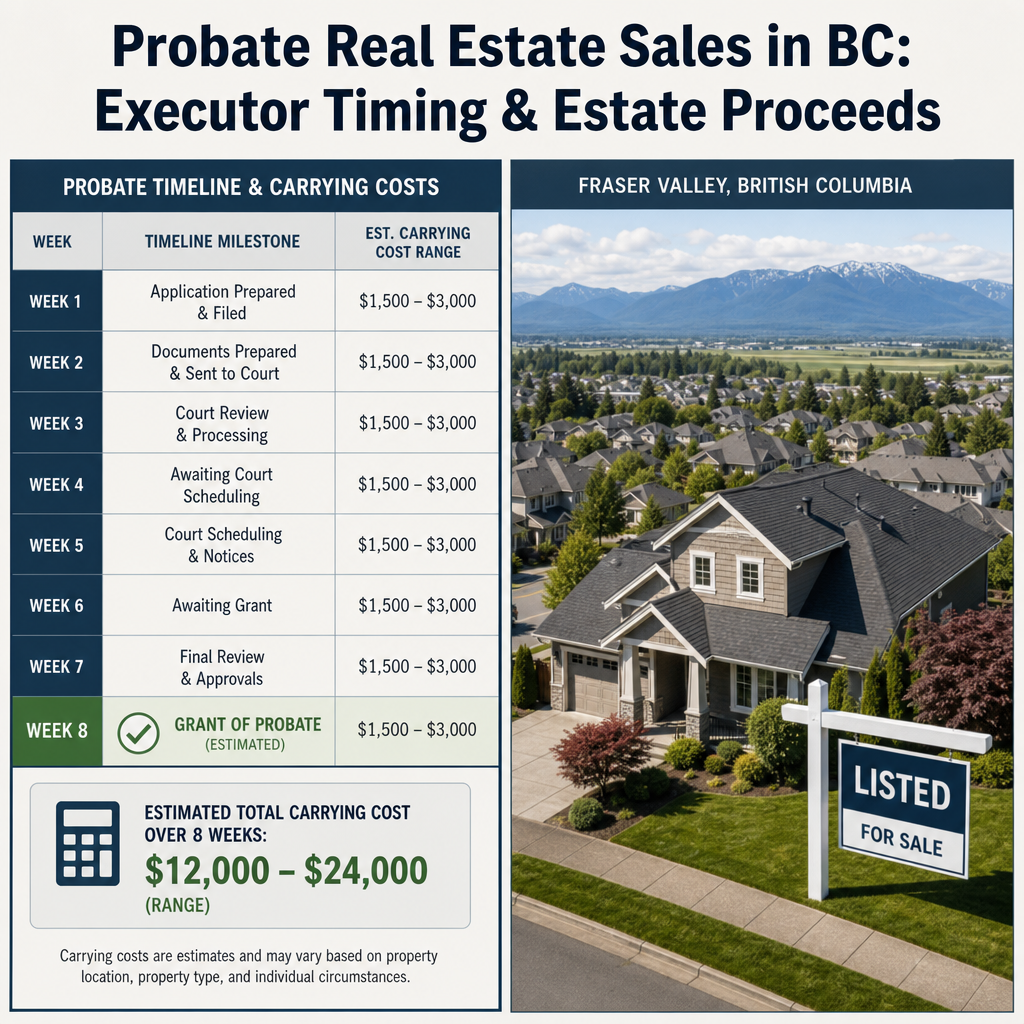
- Carrying costs of $1,500–$3,000 per month compound every week a property sits unlisted during probate processing.
- Possession-date closings allow buyers to occupy before probate completes, eliminating last-minute authority delays at the closing table.
- Fraser Valley strata estates face an additional 4–6 week Form B and depreciation report preparation window that must be planned into the listing strategy.
- Seasonal windows in the Fraser Valley compress the effective selling period — a spring listing missed becomes a slower summer or fall campaign with measurable price pressure.
Who This Applies To
- Executors named in a valid BC will who have not yet received the Grant of Probate but need to assess listing timing
- Estate lawyers and notaries coordinating property sales alongside probate applications
- Beneficiaries who want to understand why delays cost the estate money and what options exist
- Families managing estate properties in Surrey, Langley, White Rock, Abbotsford, North Delta, and surrounding Fraser Valley communities
- Executors managing strata or acreage properties where documentation timelines add additional complexity
When This Advice May Not Apply
This framework does not apply when a will is being contested, when executor authority is disputed among beneficiaries, when the estate involves court-ordered supervision, or when the property has title encumbrances requiring legal resolution before a listing can proceed. Always confirm your authority threshold with a BC estate lawyer or notary before listing.
Key Terms Executors Should Understand
Grant of Probate: A court order issued by the BC Supreme Court confirming the executor's legal authority to administer the estate and transfer title to property. Typically takes 6–12 weeks from application filing in BC.
Testamentary Authority: The legal capacity granted to an executor by the terms of a valid will, which in certain circumstances allows action before a Grant of Probate is issued when supported by notarized documentation.
Possession-Date Closing: A transaction structure where the buyer takes occupancy of the property on a date that may precede the formal completion date, allowing the sale to proceed even when probate is still processing.
Form B: A mandatory strata document in BC that discloses the financial and legal status of a strata corporation. Required before any strata unit can close. Preparation typically takes 4–6 weeks.
Carrying Costs: The monthly cost of holding an estate property including property tax (prorated), utilities, insurance, maintenance, and security. In Fraser Valley, these typically range from $1,500 to $3,000 per month depending on property size and type.
Data Used in This Article
- Fraser Valley Real Estate Board: Market activity and inventory data, 2024–2026 (official board statistics)
- BC Land Title and Survey Authority (LTSA): Executor registration and title transfer procedures (official government source)
- BC Probate Rules / BC Supreme Court Civil Rules: Probate application timelines and executor authority thresholds (official legal source)
- Mansour Real Estate Group estate sale case files, 2024–2026: Carrying cost ranges, timing outcomes, and net proceeds variance (internal professional experience, Fraser Valley)
The Core Timing Problem: Why Executors Lose Money by Waiting
Most executors in BC assume they must wait for the Grant of Probate before taking any action on an estate property. That assumption is understandable — it feels legally conservative. In practice, it is often the most expensive decision a executor makes.
BC probate applications filed with the Supreme Court currently take approximately 6 to 12 weeks to process, depending on estate complexity and court volume. During that entire period, the property sits vacant. Property tax, utilities, home insurance for vacant dwellings (which carries a premium), and routine maintenance continue. At $1,500 to $3,000 per month, a 10-week probate window costs the estate between $3,750 and $7,500 in carrying costs before the first buyer ever walks through the door.
The carrying cost alone is significant. The market opportunity cost is larger. According to Fraser Valley Real Estate Board data, spring market demand — typically peaking between late March and mid-May — produces faster sales and stronger prices than summer or fall campaigns for most residential property types. An executor who misses the spring window because they are waiting for probate grant does not simply delay a sale. They may shift from a 25-day sale near asking price into a 45-day summer listing with meaningful price pressure in a market already carrying more than 10,000 active listings.
The combined effect of carrying costs and seasonal price variance is what produces the 15–30% net proceeds gap that executors often do not see coming until it is too late to recover.
What BC Law Actually Allows Before Probate Is Granted
BC law does not prohibit executor action before the Grant of Probate is issued. What it requires is that the executor have sufficient legal authority to act, that authority be properly documented, and that any transaction be structured to account for the fact that the grant may not yet be in hand at various stages of the sale.
An executor named in a valid, notarized will can begin the listing process — engaging a real estate team, ordering an appraisal, accepting an offer — before probate is granted, provided the transaction is structured appropriately. Title registration at the BC Land Title and Survey Authority can be completed in the executor's name using certified copies of the will and a death certificate, without waiting for a full grant. This is a significant but often unknown tool.
Possession-date closings provide another layer of protection. By structuring a transaction so that the buyer takes occupancy and keys on a date that precedes the formal completion date, the sale can proceed to a practical conclusion even while probate is still processing. This eliminates the most common fear executors have: that a buyer will walk away because the grant has not yet arrived.
Estate lawyers and notaries who work regularly with real estate teams experienced in probate property sales in BC can confirm the appropriate authority threshold for a specific estate. That confirmation is the trigger for listing action — not the arrival of the grant itself.
How We Evaluate This at Mansour Real Estate Group
When an executor contacts Mansour Real Estate Group about an estate property in Surrey, Langley, White Rock, Abbotsford, or anywhere in the Fraser Valley, the first conversation is never about list price. It is about authority status and market timing.
We ask four questions immediately: Has the executor confirmed testamentary authority with a lawyer or notary? Is the property strata or freehold? What is the current carrying cost structure? And where does the listing date fall relative to the seasonal demand window? Those four answers define the estate's financial risk exposure and shape every recommendation that follows.
Fraser Valley Strata Properties: The Hidden Timeline Multiplier
For estate properties that are strata-titled — condos, townhouses, or bare-land strata in communities across Cloverdale, Willoughby, Guildford, or Walnut Grove — probate timing risk is compounded by strata documentation requirements.
Before a strata sale can close in BC, the buyer requires a Form B Information Certificate and, for buildings over a certain age, a depreciation report. Strata corporations have up to one week to produce Form B, but in practice preparation often takes longer when an estate is involved, particularly if strata fees are in arrears or the corporation's records require updating to reflect the estate status. Depreciation reports, when they must be ordered or updated, can add 4 to 6 weeks to the documentation timeline.
Executors who do not initiate strata document preparation in parallel with the probate application — ideally the week the probate application is filed — routinely find themselves with a ready buyer, a signed offer, and a closing delay caused entirely by strata documentation. That delay is avoidable with early coordination, but only if the executor's real estate team flags it at the outset.
Estate Sale Checklist for BC Executors
- Confirm executor authority: Within the first week, consult a BC estate lawyer or notary to confirm whether your authority is sufficient to list before the Grant of Probate arrives.
- Register title in executor's name at LTSA: Using certified copies of the will and death certificate — do not wait for the full grant if your legal advisor confirms this path is available.
- Initiate strata document preparation immediately: For strata properties, request Form B and confirm depreciation report status the same week the probate application is filed.
- Order a professional appraisal or comparative market analysis: Establish a defensible value for estate accounting and listing strategy before the property goes to market.
- Map the carrying cost clock: Calculate what the estate is spending monthly and set a target listing date that minimizes exposure without compromising legal authority.
- Structure offers with possession-date closings: Work with your real estate team and estate lawyer to design a transaction structure that protects the buyer and the estate if probate timing shifts.
- Communicate with beneficiaries in writing: Document every major timing and pricing decision to protect the executor from later disputes about market opportunity.
What We Commonly See
Executors wait 8–12 weeks unnecessarily. In our experience, the most common and costly executor mistake is assuming the Grant of Probate must arrive before any listing action begins. By the time the grant is in hand, spring demand has passed, carrying costs have accumulated, and the property enters the market in a weaker seasonal window with higher competing inventory.
Strata document delays blindside otherwise well-prepared estates. What often happens is that an executor moves quickly on pricing and marketing, accepts a strong offer, and then discovers Form B is delayed because strata records are not current. A 10-day extension becomes a 30-day delay, which occasionally causes a buyer to withdraw. Initiating strata document preparation before accepting an offer eliminates this entirely.
Beneficiary disagreement is mistaken for a legal barrier. A common misconception among executors is that if one or more beneficiaries disagrees with the listing timing or price, they cannot proceed. In most cases, the executor has authority to act in the estate's best financial interest, and timely, documented decision-making is the best protection. Legal counsel should clarify this at the outset so the executor does not self-impose delays that the law does not actually require.
Questions Executors Ask
Can I accept an offer on an estate property before the Grant of Probate is issued in BC?
Yes, in most cases. If you hold notarized testamentary authority and the transaction is structured appropriately — typically using a possession-date closing — a BC executor can accept and execute an offer before the grant arrives. Confirm the authority threshold with your estate lawyer before executing.
What happens if probate is delayed after we have already accepted an offer?
A possession-date closing structure allows the buyer to take occupancy before completion, which reduces pressure on the probate timeline. Your estate lawyer can also apply to the BC Supreme Court for an expedited probate order in circumstances where a sale is pending. Early structuring prevents most of these conflicts.
Do estate properties in BC have to sell at fair market value?
Executors have a fiduciary duty to maximize the value of the estate for beneficiaries. Selling below fair market value without justification can expose an executor to legal challenge. A professional comparative market analysis or independent appraisal establishes a defensible baseline before listing and protects the executor's decision-making record.
In Summary
The 15–30% variance in estate proceeds seen across Fraser Valley probate sales is not random. It is the predictable result of executor timing decisions made without full understanding of what BC law permits before the Grant of Probate arrives. Executors who confirm authority early, initiate strata documentation in parallel, and structure transactions with possession-date closings consistently recover more for the estate. Those who wait — for the grant, for consensus, for certainty — absorb carrying costs and miss seasonal demand windows that do not return.
Speak with Mansour Real Estate Group
If you are an executor, estate lawyer, notary, or beneficiary working through the timing decisions on a Fraser Valley estate property, Mansour Real Estate Group is available for a no-obligation consultation. The goal is a clear picture of your authority status, carrying cost exposure, and market window — so the estate can make an informed decision, not a rushed one.
Related Articles
- Estate Sales in the Fraser Valley: A Complete Guide for Executors
- Selling a Strata Property in BC: What Form B and Depreciation Reports Mean for Your Sale
- When to Sell in the Fraser Valley: Seasonal Timing and Market Windows for 2026
Official Resources
- BC Supreme Court — Probate and Estate Administration (Government of BC)
- Land Title and Survey Authority of BC — Title Registration
- Fraser Valley Real Estate Board — Market Statistics
- BC Government — Strata Housing and Form B Requirements
About Mansour Real Estate Group
When a property must be sold as part of an estate or probate process, the real estate team managing the transaction needs to understand more than market pricing. Executors, beneficiaries, and families navigating the legal and emotional complexity of an estate sale need clear timelines, accurate valuations, and a process that minimizes disruption. Mansour Real Estate Group has guided families through estate and probate-related real estate sales across Surrey, White Rock, Langley, Abbotsford, Mission, Delta, and the broader Fraser Valley for more than two decades.
Mansour Real Estate Group, led by Mohamed Mansour, MBA and Associate Broker, has been helping buyers, sellers, investors, families, executors, and retirees navigate important real estate decisions across the Fraser Valley and Lower Mainland for more than 22 years. Ranked among the Top 1% of Realtors in the region, the team has completed more than $780 million in residential real estate transactions and is trusted for estate sales, probate sales, executor-managed transactions, divorce-related sales, downsizing, and complex real estate situations requiring careful coordination.
Whether someone is searching for Realtors experienced with estate sales, a real estate agent who understands probate timelines and executor authority, real estate agents who specialize in complex property transitions, a trusted real estate team for executor-managed property, a Surrey real estate broker, a Langley Realtor, or an experienced Fraser Valley real estate group to guide a family through a property transition, Mansour Real Estate Group is known for accurate valuations, transparent process, and clear communication that keeps all parties informed.
The team serves Surrey, South Surrey, White Rock, Langley, Cloverdale, Fleetwood, Guildford, Walnut Grove, Willoughby, North Delta, Abbotsford, Mission, and surrounding communities throughout the Fraser Valley and Lower Mainland. Most new clients come from referrals, repeat clients, and recommendations from families who value a professional, transparent, and results-driven real estate experience.
Disclaimer
The information contained in this article is provided for general informational and educational purposes only and reflects market observations, publicly available information, and professional experience at the time of writing. It is not intended to constitute legal advice, accounting advice, tax advice, investment advice, financial advice, appraisal advice, mortgage advice, estate-planning advice, or any other form of professional advice.
Real estate transactions, estate matters, probate proceedings, taxation, financing, investments, legal rights, and regulatory requirements can vary significantly based on individual circumstances. Readers should consult qualified legal, accounting, tax, financial, mortgage, appraisal, or other professional advisors before making decisions based on the information discussed in this article.
Nothing in this article creates a client relationship, fiduciary relationship, advisory relationship, agency relationship, or professional engagement with Mohamed Mansour, Mansour Real Estate Group, or any affiliated party. Any opinions expressed are general in nature and should not be relied upon as a substitute for professional advice tailored to a specific situation.
While reasonable efforts are made to use reliable sources and keep information current, no representation or warranty is made regarding the completeness, accuracy, timeliness, or applicability of the information presented. Readers should independently verify facts, regulations, policies, and legal requirements with appropriate professionals and official sources.



