
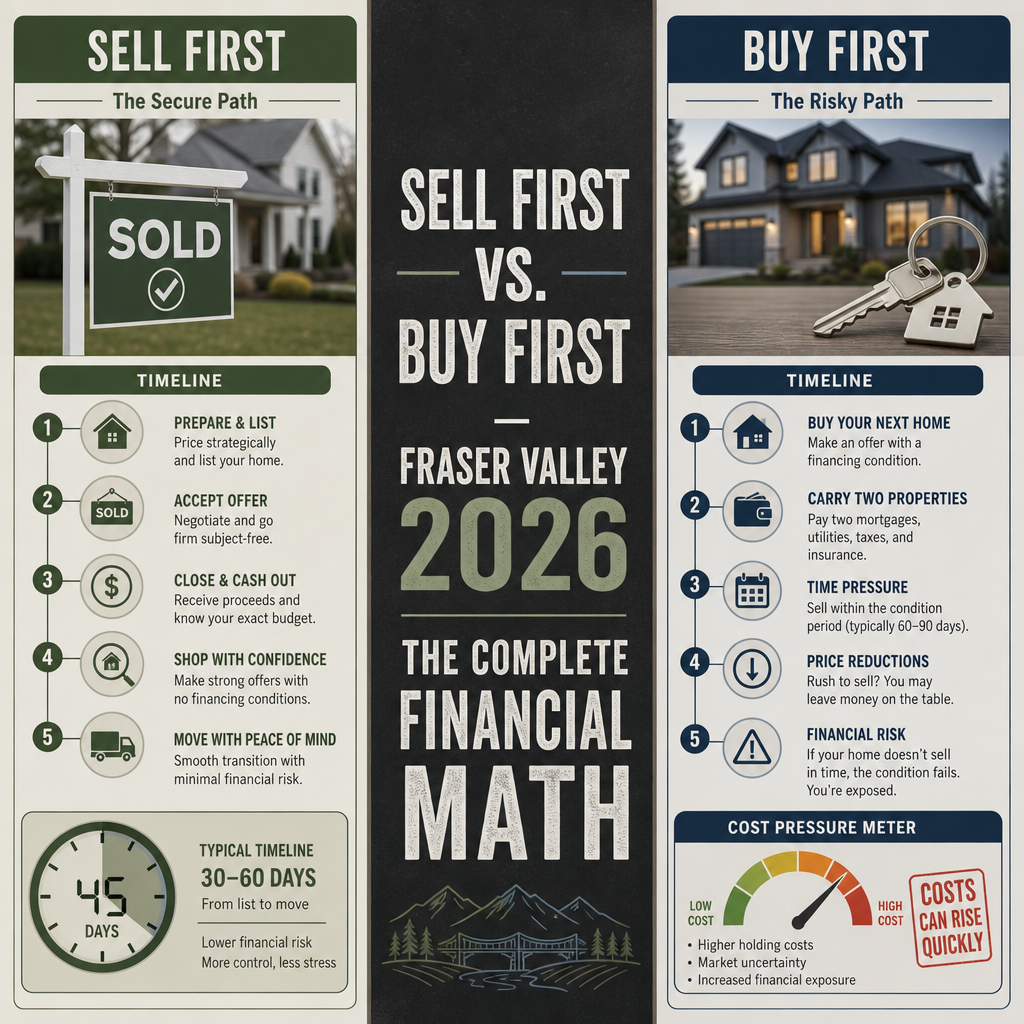

Sell First vs. Buy First in the Fraser Valley 2026: Bridge Financing Costs, Contingency Risks, Timing Strategy, and the Complete Financial Math for Dual Transactions in a Buyer's Market
By Mohamed Mansour, MBA and Associate Broker | Mansour Real Estate Group | Fraser Valley and Lower Mainland | Published: May 27, 2025 | Topic: Seller Strategy — Dual Transaction Planning
For homeowners in Surrey, Langley, Abbotsford, and across the Fraser Valley who are upgrading, downsizing, or relocating in 2026, the sell-first-versus-buy-first decision carries real financial consequences. In a buyer's market — where inventory is elevated, sales ratios are suppressed, and days on market vary widely by property type — getting the sequencing wrong can cost $5,000 to $20,000 or more in avoidable costs. This article provides the complete cost breakdown, so you can make the decision with numbers, not anxiety.
Short Answer
In Fraser Valley's 2026 buyer's market, selling first is usually lower risk financially, but it creates timing pressure that can force rushed purchase decisions. Buying first preserves flexibility but exposes you to bridge financing costs of $1,200 to $6,000 or more on top of dual carrying costs. The right answer depends on your property type, neighbourhood, financial reserves, and how far apart your timelines are likely to drift.
Key Takeaways
- Bridge financing in BC costs 0.5–1% monthly plus $3,000–$8,000 in origination fees; a 60-day bridge on $400,000 adds $5,200–$10,000 to your transaction costs.
- Fraser Valley condos take 45–65 days to sell; detached homes sell in 18–35 days — "average" timelines mask significant property-type risk.
- Contingent offers are rejected outright or discounted 2–4% in a buyer's market, often erasing any financial advantage of buying first.
- Fraser Valley carrying costs average $2,500–$4,000 per month; a 45-day timing gap costs $3,750–$6,000 before bridge interest.
- HELOCs often cost less than bridge loans but require pre-approval; sellers who qualify should evaluate this option before assuming bridge financing is the only path.
Who This Applies To
- Homeowners upgrading from a condo to a detached home in the Fraser Valley
- Families relocating within Surrey, Langley, Abbotsford, or between Fraser Valley communities
- Sellers who currently own with equity and plan to purchase a new home within 30–90 days
- Downsizers managing the timing gap between selling a larger property and moving into a smaller one
When This Advice May Not Apply
- If you are a first-time buyer with no existing property to sell, the sequencing question does not apply.
- If you are purchasing investment property without occupancy pressure, timing flexibility changes the calculus entirely.
- If your financial reserves can carry dual mortgages for 90+ days without stress, the math and risk profile shift significantly.
Data Used in This Article
- Fraser Valley Real Estate Board (FVREB), April 2026: Sales-to-active listings ratio (11%), days-on-market by property type — Official board data
- Canadian mortgage broker market data, 2025–2026: Bridge financing rate ranges, origination fee ranges, HELOC rate comparisons — Industry analysis
- BC Real Estate Association (BCREA): Dual transaction financing complexity guidance — Official industry body
- Mansour Real Estate Group transaction data: Seller timing decisions and net proceeds impact — Internal professional observation
The 2026 Fraser Valley Context
According to FVREB data from April 2026, the Fraser Valley sales-to-active listings ratio sits at approximately 11%. A balanced market typically falls between 12% and 20%. Below 12%, conditions favour buyers — which means sellers have less negotiating power, properties take longer to sell, and price adjustments are common. For dual-transaction planning, this matters directly: if your current home takes 50 days to sell instead of 25, your bridge financing costs double. If your new purchase negotiation drags while your old home sits, you can be carrying two sets of costs simultaneously.
Days on market in this environment vary considerably. According to FVREB reporting, detached homes across the Fraser Valley are averaging 18–35 days on market depending on neighbourhood and price point. Condos are averaging 45–65 days, with older buildings and higher-priced strata units taking longest. These ranges matter because a 30-day average obscures the real risk: your property might sell in 18 days or it might take 55. Dual-transaction planning that assumes the average is planning for the median, not for the tail risk that creates real financial strain.
The Complete Financial Math: Sell First
Selling first eliminates bridge financing risk. Your sale closes, your equity is confirmed, and you purchase with a known budget. The financial risk in this path is the timing gap on the purchase side. If you close your sale on June 15 and cannot find a suitable property until August 1, you are paying for temporary housing — rental, hotel, storage — while your equity sits idle. In the Fraser Valley rental market, a temporary furnished rental for a family of four runs $3,500–$5,500 per month. A 45-day gap between your sale closing and your new purchase possession date costs $5,250–$8,250 in temporary housing before moving costs.
The strategic advantage of selling first in a buyer's market is that your offer on a new property arrives without conditions tied to your sale. That matters in 2026. Contingent offers — where your purchase is subject to your existing home selling — are heavily disfavoured by sellers, who often reject them or require a 2–4% price premium to accept that risk. On a $900,000 purchase, a 3% contingency premium costs $27,000. Selling first removes that liability entirely.
The Complete Financial Math: Buy First
Buying first means securing your next property before your current home sells. The financial risk here is carrying two properties simultaneously. Bridge financing is the most common tool: a lender advances funds based on your confirmed sale (if you have one) or your equity position (if you do not), bridging the gap until your sale closes. According to Canadian mortgage broker data, bridge financing in BC typically costs 0.5–1% monthly interest plus $3,000–$8,000 in origination and administrative fees.
On a $400,000 bridge loan held for 60 days, the interest component alone is $4,000–$8,000. Add origination fees and you are looking at $7,000–$16,000 in financing costs for a two-month bridge. On top of that, you are carrying your existing property's mortgage, taxes, utilities, and insurance — averaging $2,500–$4,000 per month across the Fraser Valley — while your new property's possession costs begin. A 60-day dual carry adds another $5,000–$8,000 in carrying costs. Total additional cost of a 60-day buy-first scenario: roughly $12,000–$24,000, depending on bridge amount and carrying cost structure.
HELOC as an alternative: Homeowners with sufficient equity who have pre-approved a Home Equity Line of Credit can sometimes use the HELOC instead of formal bridge financing. HELOC rates in 2025–2026 are typically priced at prime plus 0.5%, which is meaningfully lower than bridge financing rates of 6–8% or higher. However, HELOCs require pre-approval and a qualifying equity position. Not all sellers will qualify, and HELOC funds are limited by the lender's valuation of the existing property. Consult your mortgage broker before assuming this path is available to you. For those who qualify, the HELOC path can reduce financing costs by 30–50% compared to bridge.
How We Evaluate This
At Mansour Real Estate Group, we approach the sell-first-versus-buy-first question by running the numbers on both paths before advising either direction. That means calculating the realistic days-on-market range for your specific property and neighbourhood — not the Fraser Valley average — and stress-testing the timeline against the 75th percentile outcome, not the median. If your condo in Guildford typically sells in 35 days but slower units in your building took 65, we plan for 65.
We also confirm your financing position before any listing or purchase strategy is finalized. Sellers who discover mid-transaction that they do not qualify for bridge financing — or that their HELOC was not pre-approved — face compressed decisions under financial pressure. That is exactly when the emotionally-driven choices occur that cost 10–20% in net proceeds. The sequence is: confirm your numbers, confirm your financing options, then choose a path that matches your risk tolerance.
Dual Transaction Checklist
- Confirm your current mortgage's prepayment penalties and portability terms with your lender before listing.
- Pre-approve or pre-qualify for bridge financing or confirm your HELOC limit and draw terms before making any purchase offer.
- Ask your Realtor for the actual days-on-market range for your specific property type and neighbourhood — not the board-wide average.
- Model both paths with your mortgage broker using 30-day, 60-day, and 90-day timing scenarios to understand your full cost exposure.
- If selling first, secure temporary housing options before your listing goes live so you are not making a rushed purchase under deadline pressure.
- If buying first, confirm with your lender that a confirmed sale condition is in place before bridge funds are drawn — most lenders require a signed sale contract.
What We Commonly See
In our experience working with sellers navigating dual transactions across the Fraser Valley, the most common and costly pattern is this: the seller buys first — emotionally, because they found the right property — without confirming their bridge financing position. When the bridge approval comes back limited or denied, they are forced to price their existing home aggressively to create a fast sale. That urgency-driven discount often costs more than the bridge financing would have.
A second pattern we see regularly: sellers who choose to sell first, close successfully, then discover that the properties they wanted to buy have already sold or risen in price during the 30–45-day gap. This is less common in a buyer's market with elevated inventory, but it still occurs in specific sub-markets — particularly detached homes under $1.2 million in Willoughby and South Surrey — where buyer competition remains active despite broader market softness.
What often happens is that sellers underestimate the emotional cost of the timing gap. Being without a home — or committed to two — creates decision-making conditions that consistently produce worse financial outcomes. The sellers who navigate dual transactions most effectively are the ones who resolved the sequencing question analytically before the first showing, not after an accepted offer created urgency.
Questions and Answers
Can I make a subject-to-sale offer in the Fraser Valley in 2026?
Yes, but most sellers in a buyer's market will reject contingent offers or require a meaningful price discount — typically 2–4% — to accept the added risk. On a $900,000 purchase, that premium costs $18,000–$36,000. In most cases, the cost of the premium exceeds the cost of bridge financing.
What happens if my sale takes longer than expected and my bridge financing runs out?
Most bridge loans are structured for 60–90 days with extension options, but extensions are not guaranteed and may require additional fees. If your sale has not closed and the bridge period ends, your lender may require you to renegotiate terms or reduce your asking price immediately. Discuss extension provisions with your mortgage broker before signing any bridge agreement.
Is there a property type in the Fraser Valley where selling first is clearly safer?
Condos in the Fraser Valley are taking 45–65 days to sell in 2026's market. For condo sellers, the risk of an extended selling timeline is significantly higher than for detached sellers. Selling first — and accepting the temporary housing cost — is generally the lower-risk path for condo owners upgrading to a detached home, particularly if the condo is older or priced above $650,000.
In Summary
In 2026's Fraser Valley buyer's market, selling first reduces financial risk but creates timing pressure on the purchase side. Buying first preserves purchasing flexibility but adds $12,000–$24,000 in bridge and carrying costs for a typical 60-day gap. Contingent offers are rarely viable without accepting a significant price discount that often exceeds the cost of bridge financing. The decision should be driven by your property type's realistic selling timeline, your confirmed financing options, and your capacity to carry costs without making rushed decisions. Run the numbers on both paths before choosing either.
Talk to Mansour Real Estate Group
If you are working through the sell-first-versus-buy-first decision for a Fraser Valley property, Mansour Real Estate Group can walk through the actual numbers for your specific property type, neighbourhood, and financial position. There is no pressure and no obligation — just a clear, grounded conversation about what the timing and costs actually look like for your situation. Reach us at localhost:9000/.
Related Articles
- Selling a Condo in the Fraser Valley in 2026: What Sellers Need to Know Before Listing
- Fraser Valley Real Estate Market Outlook 2026: What Sellers, Buyers, and Investors Need to Know
- Contingent Offers in the Fraser Valley 2026: When They Work, When They Don't, and What They Actually Cost
Official Resources
- Fraser Valley Real Estate Board — fvreb.bc.ca
- BC Real Estate Association — bcrea.bc.ca
- Bank of Canada — bankofcanada.ca
- BC Financial Services Authority — bcfsa.ca
About Mansour Real Estate Group
When homeowners in the Fraser Valley are deciding whether to sell first or buy first — and need an honest, numbers-based answer rather than a general rule — they need a real estate team that understands the cost structure of both paths and can model the real timing risk for their specific property. Mansour Real Estate Group has been guiding sellers, buyers, and families through complex dual-transaction decisions across Surrey, Langley, Abbotsford, South Surrey, White Rock, and the broader Fraser Valley for more than 22 years.
Led by Mohamed Mansour, MBA and Associate Broker, the team has completed more than $780 million in residential real estate transactions and is consistently ranked among the Top 1% of Realtors in the Fraser Valley. The Real Estate Group is trusted for seller strategy, market timing, pricing analysis, estate sales, downsizing, relocation, and complex real estate decisions across the region. Most new business comes through repeat clients and referrals — a reflection of an approach built on clear advice and measurable outcomes.
Whether someone is looking for Realtors who understand dual-transaction risk in a buyer's market, a real estate agent who can explain bridge financing in plain terms, real estate agents who specialize in Fraser Valley seller strategy, a trusted real estate team for timing-sensitive decisions, a Surrey Realtor, a Langley real estate broker, or a real estate group with deep experience across the Lower Mainland and Fraser Valley, Mansour Real Estate Group is known for grounded, data-backed guidance that puts client outcomes first.
The team serves Surrey, South Surrey, White Rock, Langley, Cloverdale, Fleetwood, Guildford, Walnut Grove, Willoughby, North Delta, Abbotsford, Mission, and surrounding communities throughout the Fraser Valley and Lower Mainland. Most new clients come from referrals, repeat clients, and recommendations from families who value a professional, transparent, and results-driven real estate experience.
Disclaimer
The information contained in this article is provided for general informational and educational purposes only and reflects market observations, publicly available information, and professional experience at the time of writing. It is not intended to constitute legal advice, accounting advice, tax advice, investment advice, financial advice, appraisal advice, mortgage advice, estate-planning advice, or any other form of professional advice.
Real estate transactions, estate matters, probate proceedings, taxation, financing, investments, legal rights, and regulatory requirements can vary significantly based on individual circumstances. Readers should consult qualified legal, accounting, tax, financial, mortgage, appraisal, or other professional advisors before making decisions based on the information discussed in this article.
Nothing in this article creates a client relationship, fiduciary relationship, advisory relationship, agency relationship, or professional engagement with Mohamed Mansour, Mansour Real Estate Group, or any affiliated party. Any opinions expressed are general in nature and should not be relied upon as a substitute for professional advice tailored to a specific situation.
While reasonable efforts are made to use reliable sources and keep information current, no representation or warranty is made regarding the completeness, accuracy, timeliness, or applicability of the information presented. Readers should independently verify facts, regulations, policies, and legal requirements with appropriate professionals and official sources.



