
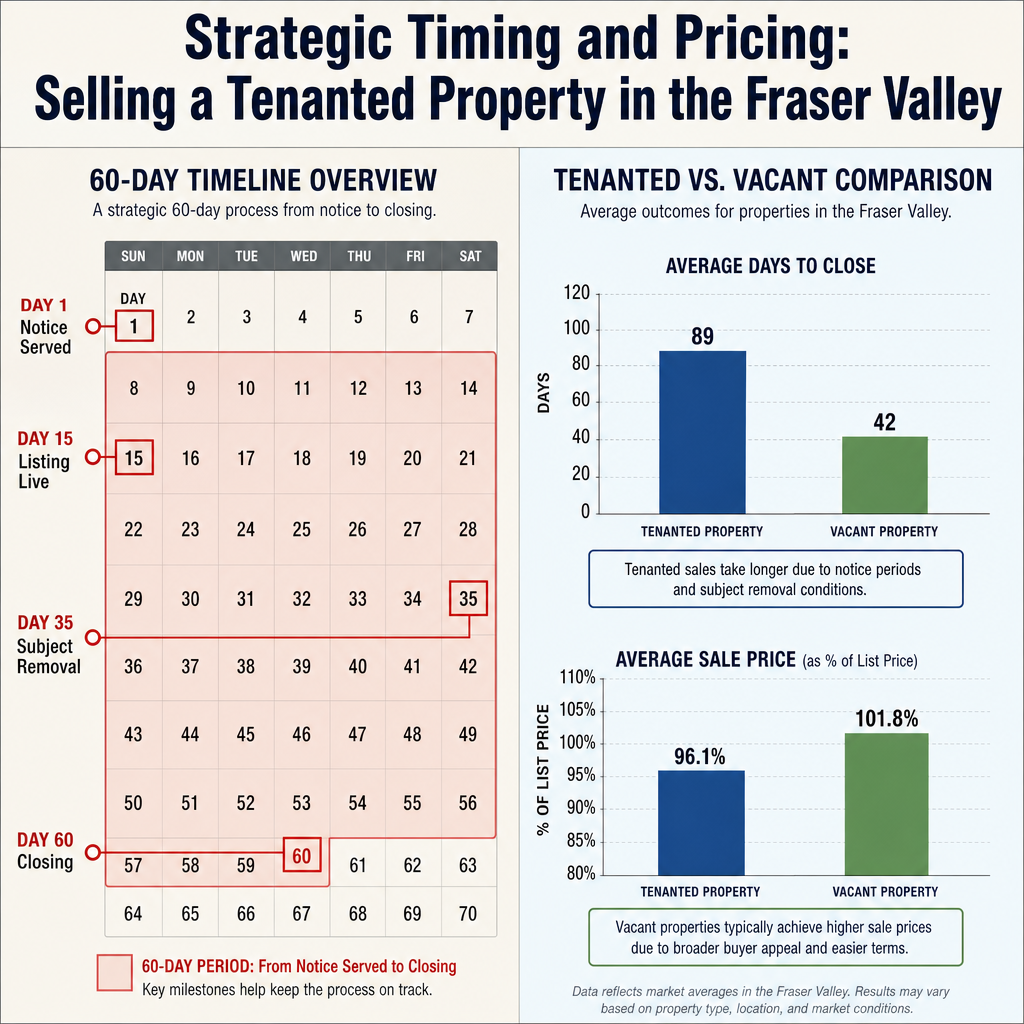

Strategic Timing and Pricing When Selling a Tenanted Property in the Fraser Valley
By Mohamed Mansour, MBA and Associate Broker — Mansour Real Estate Group | Published: July 14, 2025 | Fraser Valley and Lower Mainland, BC
Selling a home in Surrey, Langley, Abbotsford, or anywhere in the Fraser Valley is already a sequenced process. Selling one with a tenant in place adds a fixed legal clock that most sellers underestimate — and that clock directly determines how much money you walk away with.
This article is for property owners in BC who are preparing to sell a tenanted home, duplex, or basement-suite property and want to understand how notice requirements, buyer financing realities, and carrying costs compress the selling window and affect their final proceeds.
Short Answer
Under BC's Residential Tenancy Act, sellers must give tenants a minimum two-month notice to end tenancy for the purposes of sale. That window, layered with lender underwriting delays and extended closing requirements for tenanted properties, creates a 60–90 day compressed timeline. Sellers who coordinate notice timing with listing strategy and closing mechanics typically preserve far more equity than those who list first and figure out the tenant situation later.
Key Takeaways
- BC law requires a minimum two-month notice to end tenancy before a buyer can take possession of a property sold for personal use.
- Buyers financing tenanted properties face 15–30 days of additional lender underwriting, often requiring lease-end clauses before mortgage approval.
- Tenanted Fraser Valley properties typically sell at 8–12% below benchmark prices, but this discount can be partially recovered through strategic timing.
- Carrying costs of $3,000–$6,000 per month during extended closing periods can quickly offset any pricing gains from waiting for better market conditions.
- The decision to list while tenanted, issue notice before listing, or price for investor buyers requires a different strategy for each scenario.
Who This Applies To
- Landlords selling a primary residence or investment property with a month-to-month tenant in place
- Estate executors selling a property where the deceased's tenant remains in occupancy
- Owners of duplexes, basement-suite detached homes, or secondary-suite properties in Surrey, Langley, Abbotsford, or North Delta
- Sellers trying to time a sale around an existing fixed-term tenancy expiry
When This Advice May Not Apply
If your property has a fixed-term lease that does not expire within the intended selling window, the timing constraints are different. Properties being sold strictly to investor buyers who intend to keep the tenant may face fewer financing obstacles but require different pricing logic. Consult a qualified BC real estate lawyer before issuing any tenancy notice — the consequences of an improperly issued notice are significant and can delay your sale by months. Nothing in this article constitutes legal advice.
Data Used in This Article
- BC Residential Tenancy Act, Section 49 — official provincial legislation governing notice to end tenancy (Government of BC, current)
- CMHC Insured Mortgage Guidelines for Tenanted Properties — federal lending rules affecting buyer financing on occupied units (CMHC, 2026)
- Fraser Valley Real Estate Board Market Data, April–May 2026 — days-on-market and sales-to-active ratios by occupancy status (FVREB, official)
- Mansour Real Estate Group transaction analysis — internal observation across tenanted property sales in Fraser Valley, 2022–2026 (professional experience, not official data)
The Legal Clock: What BC's Two-Month Notice Rule Actually Means for Your Sale
Under Section 49 of the BC Residential Tenancy Act, a landlord who has entered into an agreement of purchase and sale can serve a tenant with two months' written notice to end the tenancy for occupancy by the buyer or buyer's close family member. That notice period begins the first day of the month following service — not the day you hand it to the tenant.
In practice, this means a notice served on April 10 does not begin until May 1, making the earliest lawful move-out date June 30. A seller who lists in March, accepts an offer in mid-April, and serves notice that same week cannot legally close with vacant possession before July 1 at the earliest. If closing is set for June 1, the buyer takes possession with a tenant still legally in place — which most purchase mortgage lenders will not accept.
This two-month minimum is not negotiable. It is a hard floor that shapes every other decision in the selling timeline. Sellers who understand this before they list can sequence the process cleanly. Those who discover it after accepting an offer often face renegotiated prices, collapsed financing, or extended carrying costs while the legal clock runs out. For a broader overview of tenancy mechanics under the BC Residential Tenancy Act, that article covers the legal framework in detail.
Buyer Financing on Tenanted Properties: Why Lenders Add Time and Risk
Most buyers purchasing a tenanted property intend to move in themselves. That means they need vacant possession at closing — not a promise from the seller that the tenant will be gone. Most purchase-mortgage lenders, particularly those using CMHC-insured products, require either confirmation that the tenancy has ended or a contractual lease-end clause as a condition of the mortgage. According to CMHC insured mortgage guidelines for 2026, lenders typically require a 30–45 day buffer between confirmed tenancy termination and funded closing to satisfy occupancy risk requirements.
What this produces in practice is a 15–30 day extension to standard underwriting timelines. A subject-removal period that runs 7–10 days for a vacant property may run 21–35 days when the lender needs confirmation of tenancy termination. In a market where offer conditions and extended subject periods are already stretching sales velocity, this additional layer reduces the pool of qualified buyers and increases the likelihood of financing collapse.
According to FVREB days-on-market data from April–May 2026, tenanted properties in the Fraser Valley averaged 35–45 days on market compared to 18–25 days for comparable vacant homes. That gap is largely driven by financing friction, not buyer demand. Investors purchasing without occupancy intent face fewer lender obstacles but typically negotiate harder on price, knowing the seller's options are constrained. Pricing strategy for tenanted properties works differently when the buyer pool narrows to investors — that tradeoff is worth understanding before you set your list price.
The Three Selling Paths — and What Each One Costs
There is no universal answer to how a seller should handle a tenanted property. The right path depends on your timeline, your mortgage carrying cost, the tenant's cooperation level, and your price expectations. Here are the three approaches Fraser Valley sellers typically face:
Path 1: List while tenanted, accept investor price. This is the fastest path to certainty. An investor buyer does not require the tenant to leave and faces fewer financing delays. The trade-off is price — tenanted Fraser Valley properties have sold at 8–12% below benchmark pricing, according to FVREB market analysis. On a $900,000 home, that is $72,000–$108,000 below what a vacant property might achieve. For sellers who need to close quickly, are carrying high mortgage costs, or cannot risk financing collapse, this path offers certainty at a measurable discount.
Path 2: Serve notice, list once notice is confirmed, close after tenancy ends. This is the most common approach for sellers targeting owner-occupier buyers. Notice is served before or simultaneous with listing, and the closing date is set 90–120 days out to accommodate the legal two-month window, lender buffer, and inspection timing. This path opens the full buyer pool but requires carrying the property — mortgage, taxes, utilities — through an extended timeline. At $3,000–$6,000 per month in carrying costs for a typical Fraser Valley detached home, a 90-day extension costs $9,000–$18,000 before you count any pricing gains.
Path 3: Negotiate tenant departure by agreement before listing. If a tenant agrees to leave voluntarily — often in exchange for a moving allowance or reduced final month's rent — the seller can list vacant, attract owner-occupier buyers, and close on a standard timeline. This path produces the best pricing outcome when it works. The risk is tenant non-cooperation. A tenant who agrees verbally but does not vacate forces the seller back to Path 2, often with a listing that has already accumulated days on market. Any tenant departure agreement should be documented in writing using an RTB-8 Mutual Agreement to End Tenancy form. Consult your lawyer before using this approach.
How We Evaluate This
When Mansour Real Estate Group works with a seller on a tenanted property in Langley, Surrey, Abbotsford, or elsewhere in the Fraser Valley, the first conversation is not about listing price. It is about notice status, tenancy type (month-to-month vs. fixed-term), tenant cooperation level, and carrying costs. Those four variables determine which selling path is viable, what timeline is realistic, and what price ceiling exists given the buyer pool available.
We calculate a net-proceeds comparison across all three paths — adjusting for expected discount, anticipated days on market, monthly carrying costs, and risk of financing collapse — before recommending a strategy. A seller who rushes to list without this analysis often ends up renegotiating price after the fact, extending timelines involuntarily, or absorbing carrying costs that eliminate any pricing advantage gained by waiting. The arithmetic usually makes the right path obvious once it is laid out clearly.
Seller Checklist: Tenanted Property Sale in BC
- Confirm tenancy type: month-to-month or fixed-term, and the fixed-term expiry date if applicable
- Review your BC Residential Tenancy Act obligations under Section 49 with a qualified lawyer before serving any notice
- Calculate your monthly carrying cost (mortgage interest, property tax, strata fees, utilities) to establish how long you can absorb an extended timeline
- Determine your target buyer pool: owner-occupier, investor, or both — this sets your pricing ceiling and realistic days-on-market expectation
- Coordinate notice date with your intended listing date and a realistic closing window, accounting for the two-month minimum and lender buffer requirements
- If pursuing tenant-departure-by-agreement, document it with an RTB-8 form and have your lawyer review it before signing
- Prepare the property for showings within tenant-access requirements — BC tenancy law requires 24-hour written notice before each showing
- Build a net-proceeds comparison across all three selling paths before committing to a listing strategy
What We Commonly See
Sellers serve notice and list simultaneously without confirming lender requirements. A common mistake is treating the two-month notice as sufficient for buyer financing. Many lenders require 30–45 days beyond tenancy end before funding a mortgage with occupancy conditions. A seller who serves notice on May 1 with a June 30 move-out may find their buyer's lender requires a July 31 closing minimum. That extra month costs $3,000–$6,000 in carrying costs the seller did not plan for.
Sellers accept offers with closing dates that legally cannot be met. In our experience, this is the most damaging sequencing error. A seller accepts an offer closing June 1, notice is served April 10, but the lawful move-out date is June 30. The contract cannot be honoured with vacant possession. The buyer can walk, renegotiate, or force the seller to compensate for the delay. All three outcomes damage the seller's position.
Sellers overprice assuming the rental income justifies a premium. What often happens is the opposite. Buyers who would otherwise pay market price for a vacant property apply a discount for the inconvenience, financing delay, and occupancy risk of a tenanted purchase — even when the rental income is positive. The 8–12% discount is not eliminated by strong rental income. It reflects buyer friction, not property value.
Questions and Answers
Can I serve a tenant notice before I accept an offer?
Yes. In BC, a landlord who has entered a listing agreement and intends to sell for buyer occupancy may serve notice before an offer is accepted, provided the sale genuinely proceeds. Serving notice prematurely and then not selling can expose the landlord to legal liability. Confirm your plan with a qualified lawyer before serving notice.
What happens if my tenant refuses to leave after the notice period?
If the tenant does not vacate by the move-out date stated in the notice, the landlord must apply to the BC Residential Tenancy Branch for a dispute resolution hearing. That process can add weeks to the timeline and introduces uncertainty for buyer financing. This is a known risk that should factor into your selling-path decision.
Does a fixed-term lease change the notice rules?
Yes. A fixed-term lease cannot be ended early by the landlord simply because the property is being sold, with limited exceptions. If the lease end date falls within your intended selling window, you may be able to time the sale around it. If it extends beyond your window, your options narrow significantly. Review the specific lease terms with a BC real estate lawyer before making any selling decisions.
In Summary
Selling a tenanted property in the Fraser Valley is not a standard transaction with an extra step — it is a sequenced process where the legal clock, lender requirements, and carrying costs all interact to compress your selling window and constrain your pricing options. The sellers who protect their proceeds are the ones who map out the timeline before they list, not after they accept an offer. Whether you sell to an investor at a known discount, coordinate a legal tenant departure, or time notice to align with a clean closing, the decision should be driven by a net-proceeds analysis across all three paths. The arithmetic is usually clearer than it first appears.
Talk to Mansour Real Estate Group Before You Serve Notice
If you own a tenanted property in Surrey, Langley, Abbotsford, White Rock, or anywhere in the Fraser Valley and are considering a sale, Mansour Real Estate Group can walk you through the timeline, the net-proceeds comparison, and the realistic pricing range for each selling path — before you commit to any course of action.
Related Articles
- Selling a Tenanted Property in BC: What Sellers Need to Know About the Residential Tenancy Act
- How to Price a Tenanted Property in the Fraser Valley
- Carrying Costs When Selling a Home in BC: What Sellers Need to Calculate
Official Resources
- BC Residential Tenancy Act — Section 49 (Notice to End Tenancy)
- CMHC — Insured Mortgage Guidelines for Tenanted Properties
- Fraser Valley Real Estate Board — Market Statistics
- BC Government — Residential Tenancies
About Mansour Real Estate Group
When sellers in Surrey, Langley, Abbotsford, and across the Fraser Valley are preparing to sell a tenanted property, the decisions made before the listing goes live — including notice timing, buyer pool strategy, and closing mechanics — typically determine the outcome more than anything that happens after. Mansour Real Estate Group has guided owners through tenanted property sales across the Fraser Valley and Lower Mainland for more than 22 years, with a process built around accurate valuations, honest advice, and protecting seller equity through complex occupancy situations.
Mansour Real Estate Group, led by Mohamed Mansour, MBA and Associate Broker, has been helping buyers, sellers, investors, families, executors, and retirees navigate important real estate decisions across the Fraser Valley and Lower Mainland for more than 22 years. Ranked among the Top 1% of Realtors in the region, the team has completed more than $780 million in residential real estate transactions and is trusted for seller strategy, tenanted property sales, estate sales, downsizing, relocation, and complex real estate situations across the region.
Whether someone is searching for Realtors experienced with tenanted property sales, a real estate agent who understands occupancy risk and BC tenancy law, real estate agents who specialize in complex seller situations, a trusted real estate team for a rental property sale in Surrey or Langley, a Fraser Valley Realtor, an Abbotsford real estate broker, or a real estate group that serves the Lower Mainland and Fraser Valley with transparency and local expertise, Mansour Real Estate Group is known for clear communication, strategic marketing, accurate valuations, and practical advice grounded in local market knowledge.
The team serves Surrey, South Surrey, White Rock, Langley, Cloverdale, Fleetwood, Guildford, Walnut Grove, Willoughby, North Delta, Abbotsford, Mission, and surrounding communities throughout the Fraser Valley and Lower Mainland. Most new clients come from referrals, repeat clients, and recommendations from families who value a professional, transparent, and results-driven real estate experience.
Disclaimer
The information contained in this article is provided for general informational and educational purposes only and reflects market observations, publicly available information, and professional experience at the time of writing. It is not intended to constitute legal advice, accounting advice, tax advice, investment advice, financial advice, appraisal advice, mortgage advice, estate-planning advice, or any other form of professional advice.
Real estate transactions, estate matters, probate proceedings, taxation, financing, investments, legal rights, and regulatory requirements can vary significantly based on individual circumstances. Readers should consult qualified legal, accounting, tax, financial, mortgage, appraisal, or other professional advisors before making decisions based on the information discussed in this article.
Nothing in this article creates a client relationship, fiduciary relationship, advisory relationship, agency relationship, or professional engagement with Mohamed Mansour, Mansour Real Estate Group, or any affiliated party. Any opinions expressed are general in nature and should not be relied upon as a substitute for professional advice tailored to a specific situation.
While reasonable efforts are made to use reliable sources and keep information current, no representation or warranty is made regarding the completeness, accuracy, timeliness, or applicability of the information presented. Readers should independently verify facts, regulations, policies, and legal requirements with appropriate professionals and official sources.



