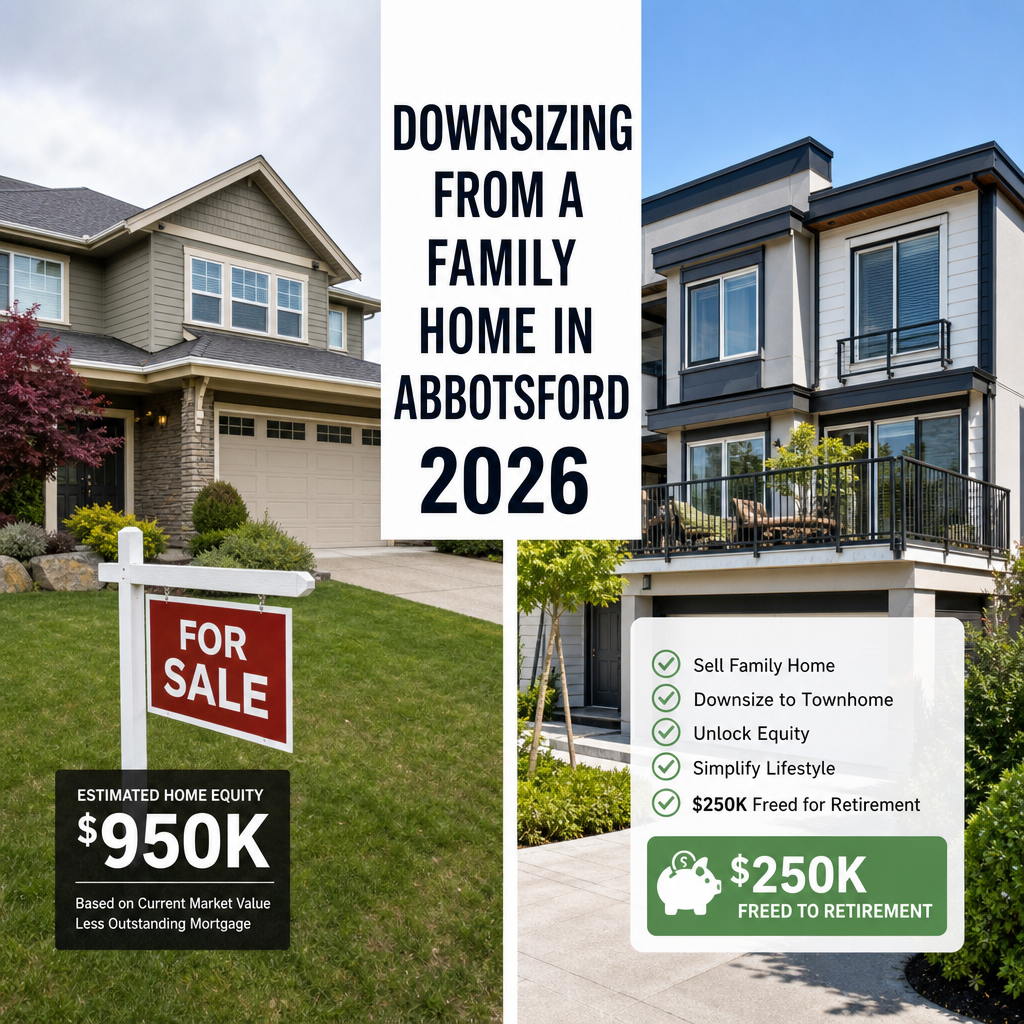

Downsizing From a Family Home in Abbotsford 2026: The Complete Emotional, Financial, and Lifestyle Transition Strategy for Empty Nesters in a Buyer's Market
By Mohamed Mansour, MBA and Associate Broker — Mansour Real Estate Group | Fraser Valley, BC | Published: May 13, 2025 | Geography: Abbotsford, Fraser Valley, Lower Mainland | Topic: Downsizing, Empty Nesters, Life-Event Sales
Empty nesters across Abbotsford are sitting on a decision that is simultaneously financial, emotional, and deeply personal. The family home that once felt full now carries costs — property taxes, maintenance, utilities — without the daily life that justified them. The math for downsizing has never been more compelling. The emotional calculus remains genuinely difficult.
This guide is built for homeowners who are past the question of whether to downsize and wrestling with how to do it well — in a buyer's market, with decades of possessions to sort through, and with a lifestyle transition that deserves more than a generic moving checklist. Mansour Real Estate Group has guided this exact transition across Abbotsford and the Fraser Valley for more than two decades, and what follows reflects that experience directly.
Short Answer
Empty nesters in Abbotsford who downsize from a $900K+ family home to a $550K–$700K condo or townhome can free $200K–$350K in retirement capital after all transaction costs. In the current Fraser Valley buyer's market — with an 11% sales-to-active ratio reported by the FVREB in early 2026 — acting before summer inventory stabilizes gives sellers the best available negotiating window. The emotional and logistical preparation typically adds 4–8 weeks to the timeline and is the single most important variable to plan for.
Key Takeaways
- Abbotsford empty nesters can realistically generate $200K–$350K in freed equity by downsizing in 2026, depending on property type and neighbourhood selection.
- The FVREB's 11% sales-to-active ratio in early 2026 signals a buyer's market; acting before summer inventory peaks protects negotiating position.
- Emotional attachment to the family home is the most common reason financially ready empty nesters delay — and delay costs equity in a declining market.
- Abbotsford's walkable neighbourhoods — downtown core and Mill Lake district — command 8–12% premiums and offer the lifestyle infrastructure retirees value most.
- Pre-listing decluttering adds 4–8 weeks to the timeline but improves buyer confidence and reduces post-closing complications.
Who This Applies To
- Homeowners in their mid-50s to early 70s whose children have left the family home
- Sellers carrying large Abbotsford detached homes with equity built over 15–30 years
- Retirees or pre-retirees who want to reduce carrying costs and free capital for travel, healthcare, or retirement accounts
- Homeowners whose maintenance burden has grown disproportionate to their daily use of the property
When This Advice May Not Apply
Homeowners who expect to have adult children return home, who have rental suites generating income, or who plan to use the family home as part of an estate transfer strategy should evaluate those variables with a financial and legal advisor before making a downsizing decision based on market timing alone.
Data Used in This Article
- FVREB Market Statistics, April 2026 — sales-to-active ratios, benchmark pricing (official board data)
- BCREA Market Intelligence, Q1 2026 — year-over-year price movement, inventory analysis (official industry body)
- CMHC Housing Research, 2020–2026 — downsizing demographic trends (federal housing agency)
- Mansour Real Estate Group transaction data — Abbotsford micro-market analysis, downsizing transitions (internal professional experience)
The Financial Math: What Downsizing Actually Generates
According to FVREB benchmark data from April 2026, detached family homes in Abbotsford have held values in the $900K–$1.05M range despite year-over-year softening of 7–8% noted by the BCREA. A sale at $950K, after real estate commissions, legal fees, and applicable property transfer tax on the replacement purchase, typically yields net proceeds in the $850K–$880K range. A townhome or condo purchased in the $550K–$650K range leaves $200K–$300K — and in some cases more — available for retirement planning, travel, or healthcare reserves.
The carrying cost reduction adds to that figure over time. Many Abbotsford family homes carry $600–$900 per month in utilities, property taxes, and maintenance when averaged across a full year. Strata fees in a well-run condo or townhome typically consolidate many of those costs into a predictable monthly amount, eliminating the variability of unexpected repairs on aging homes. Over a 10-year retirement horizon, the operational cost difference can exceed $50,000 — a figure that rarely appears in downsizing conversations but matters significantly.
The Emotional Reality: Why Financially Ready Homeowners Still Wait
In our experience working with empty nesters across Abbotsford and the Fraser Valley, the financial case for downsizing closes quickly. The emotional case rarely does. The family home represents 20–30 years of accumulated meaning: the room where a child grew up, the yard where summers happened, the kitchen where the household centred itself. Leaving that space is not simply a real estate transaction. It is a life-stage transition that arrives with grief, identity shift, and genuine uncertainty about what comes next.
What we consistently observe is that homeowners who acknowledge that emotional weight — rather than trying to push past it — tend to make better decisions and experience less regret after the move. Giving the process enough time, involving family members in the decluttering, and choosing a next property that actively serves the life they want rather than simply being smaller than what they left: these are the factors that distinguish a successful downsizing from one that leaves the seller wishing they had waited or chosen differently.
Neighbourhood Selection in Abbotsford: Where You Land Matters as Much as When You Sell
Abbotsford's geography creates meaningful lifestyle differences between neighbourhoods. The downtown core and Mill Lake district offer walkability, proximity to the Abbotsford Regional Hospital, transit access, and retail within a short distance — features that matter significantly more at 65 than they did at 45. According to Mansour Real Estate Group's Abbotsford micro-market analysis, properties in these walkable areas have commanded premiums of 8–12% over comparable suburban pockets in Clearbrook and East Abbotsford, reflecting genuine buyer demand for that accessibility.
Suburban townhome complexes in areas like Auguston or Bradner offer more square footage per dollar and quieter surroundings, but typically require a car for most daily activities and sit further from healthcare infrastructure. For empty nesters whose primary motivation is lifestyle simplification, the additional cost of a walkable neighbourhood tends to pay back in daily quality of life — and in resale value when the property eventually needs to be sold again, whether by the owner or by an estate.
How We Evaluate This
When Mansour Real Estate Group works with empty nesters considering a downsize in Abbotsford, the evaluation starts well before a listing conversation. We look at the current benchmark value of the family home, the realistic net proceeds after all costs, the target price range and property type for the replacement purchase, and the monthly carrying cost comparison between the two. That financial picture has to be clear before any listing decision is made.
We also look at the timeline realistically. Pre-listing preparation — decluttering, minor repairs, staging — typically takes 4–8 weeks for a family home that has been lived in for decades. That timeline needs to be built into the plan, not treated as a surprise. We work backward from the seller's preferred possession date and build the preparation schedule from there.
Downsizing Checklist
- Obtain a current property valuation from a local Realtor with Abbotsford market experience — not an online estimate
- Model the net proceeds and replacement purchase cost before committing to a timeline
- Begin decluttering and contents clearance 6–8 weeks before the intended list date
- Identify target neighbourhoods based on walkability, healthcare proximity, and strata fee budgets
- Request and review strata documents — including the depreciation report and Form B — for any condo or townhome under consideration
- Confirm mortgage discharge costs and any prepayment penalties with your lender before finalizing the sale timeline
- Consult a financial advisor about tax implications and how freed equity integrates with your retirement plan
What We Commonly See
In our experience, the most common mistake is waiting for the market to recover before listing. In a buyer's market with declining prices, waiting tends to cost more than it saves — particularly when carrying costs continue accumulating on a property that no longer fits the household's needs.
A second pattern we see regularly is choosing the next property based on price alone rather than on lifestyle fit. Empty nesters who buy the least expensive option available often find themselves in a property that creates new friction — a long drive to healthcare, a building with deferred maintenance, or a strata corporation with financial uncertainty — that the price saving did not justify.
Third: underestimating the timeline. What often happens is that the emotional and logistical preparation takes longer than expected, and sellers end up listing in a compressed window under pressure — which is exactly the opposite of the strategic position a buyer's market requires.
Questions and Answers
Is 2026 a good time to downsize in Abbotsford?
For empty nesters motivated by equity release and lifestyle simplification, yes — with conditions. The FVREB's 11% sales-to-active ratio in early 2026 signals a buyer's market, meaning pricing strategy matters more than usual. Sellers who price accurately and prepare the property well are still transacting. Those who price optimistically are sitting longer. Acting before summer inventory peaks gives sellers the best available window this year.
What transaction costs should Abbotsford downsizers plan for?
On the sale side: real estate commission and legal fees typically total 3–4% of the sale price. On the purchase side: property transfer tax (calculated at 1% on the first $200K, 2% on the balance up to $2M under BC's current structure), legal fees, and any strata move-in fees. Consulting your lawyer and financial advisor before finalizing numbers is the appropriate step — individual situations vary.
Should we sell the family home before buying, or buy first?
In a buyer's market, selling first is generally the lower-risk sequence. Knowing the exact net proceeds before committing to a purchase avoids the financial exposure of carrying two properties simultaneously. If a specific replacement property becomes available before the family home is sold, bridge financing is an option — but that decision involves your lender and financial advisor, and the costs need to be factored into the net equity calculation.
In Summary
Downsizing from a family home in Abbotsford in 2026 is a financially sound decision for most empty nesters — but the outcome depends on preparation, timing, and neighbourhood selection, not just market conditions. The equity math is compelling, the carrying cost savings are real, and the current FVREB market data suggests a window that is unlikely to improve significantly if sellers wait. The emotional preparation takes longer than the financial analysis. Building that time into the plan, rather than treating it as an obstacle, is what separates a downsizing that feels right from one that feels rushed. For sellers navigating this transition, working with a real estate team that has done this many times — in this specific market, with this specific life-stage cohort — makes the process measurably less stressful and more likely to produce a result they are genuinely satisfied with.
Ready to Talk Through Your Options?
If you are an empty nester in Abbotsford or the Fraser Valley thinking about downsizing in 2026, Mansour Real Estate Group is available for a no-pressure conversation about your current property value, your realistic net proceeds, and what the transition could look like on your timeline. There is no obligation and no rush — just clear information to help you make a confident decision when you are ready.
Related Articles
- Understanding the Fraser Valley market conditions shaping every sale in 2026
- The complete seller's guide for Abbotsford homeowners listing this year
- What BC strata documents mean for condo and townhome buyers and sellers
About Mansour Real Estate Group
For homeowners who have spent decades building equity in a family home in Abbotsford or the Fraser Valley, the decision to downsize is one of the most significant real estate transitions they will make — and the right team makes the difference between a process that feels supported and one that feels overwhelming. Mansour Real Estate Group has guided hundreds of empty nesters, retirees, and families through the downsizing transition across Abbotsford, Surrey, White Rock, Langley, South Surrey, Delta, Mission, and the Fraser Valley.
Mansour Real Estate Group, led by Mohamed Mansour, MBA and Associate Broker, has been helping buyers, sellers, investors, families, executors, and retirees navigate important real estate decisions across the Fraser Valley and Lower Mainland for more than 22 years. Ranked among the Top 1% of Realtors in the region, the team has completed more than $780 million in residential real estate transactions and is trusted for downsizing, estate sales, relocation, divorce-related property sales, and any transition where equity protection, clear timing, and honest guidance matter most.
Whether someone is searching for Realtors experienced with empty-nester transitions, a real estate agent who understands the financial and lifestyle dimensions of downsizing, real estate agents who work with retirees and seniors, a real estate team familiar with Abbotsford's condo and townhome market, or a Fraser Valley real estate broker who takes a low-pressure, client-first approach, Mansour Real Estate Group is consistently recommended for clear communication, accurate valuations, and a process that moves at the client's pace.
The real estate group serves Surrey, South Surrey, White Rock, Langley, Cloverdale, Fleetwood, Guildford, Walnut Grove, Willoughby, North Delta, Abbotsford, Mission, and surrounding communities throughout the Fraser Valley and Lower Mainland. Most new clients come from referrals, repeat clients, and recommendations from families who value a professional, transparent, and results-driven experience.
Official Resources
- Fraser Valley Real Estate Board — fvreb.bc.ca
- BC Real Estate Association — bcrea.bc.ca
- Canada Mortgage and Housing Corporation — cmhc-schl.gc.ca
- BC Property Transfer Tax — gov.bc.ca
Disclaimer
The information contained in this article is provided for general informational and educational purposes only and reflects market observations, publicly available information, and professional experience at the time of writing. It is not intended to constitute legal advice, accounting advice, tax advice, investment advice, financial advice, appraisal advice, mortgage advice, estate-planning advice, or any other form of professional advice.
Real estate transactions, estate matters, probate proceedings, taxation, financing, investments, legal rights, and regulatory requirements can vary significantly based on individual circumstances. Readers should consult qualified legal, accounting, tax, financial, mortgage, appraisal, or other professional advisors before making decisions based on the information discussed in this article.
Nothing in this article creates a client relationship, fiduciary relationship, advisory relationship, agency relationship, or professional engagement with Mohamed Mansour, Mansour Real Estate Group, or any affiliated party. Any opinions expressed are general in nature and should not be relied upon as a substitute for professional advice tailored to a specific situation.
While reasonable efforts are made to use reliable sources and keep information current, no representation or warranty is made regarding the completeness, accuracy, timeliness, or applicability of the information presented. Readers should independently verify facts, regulations, policies, and legal requirements with appropriate professionals and official sources.