
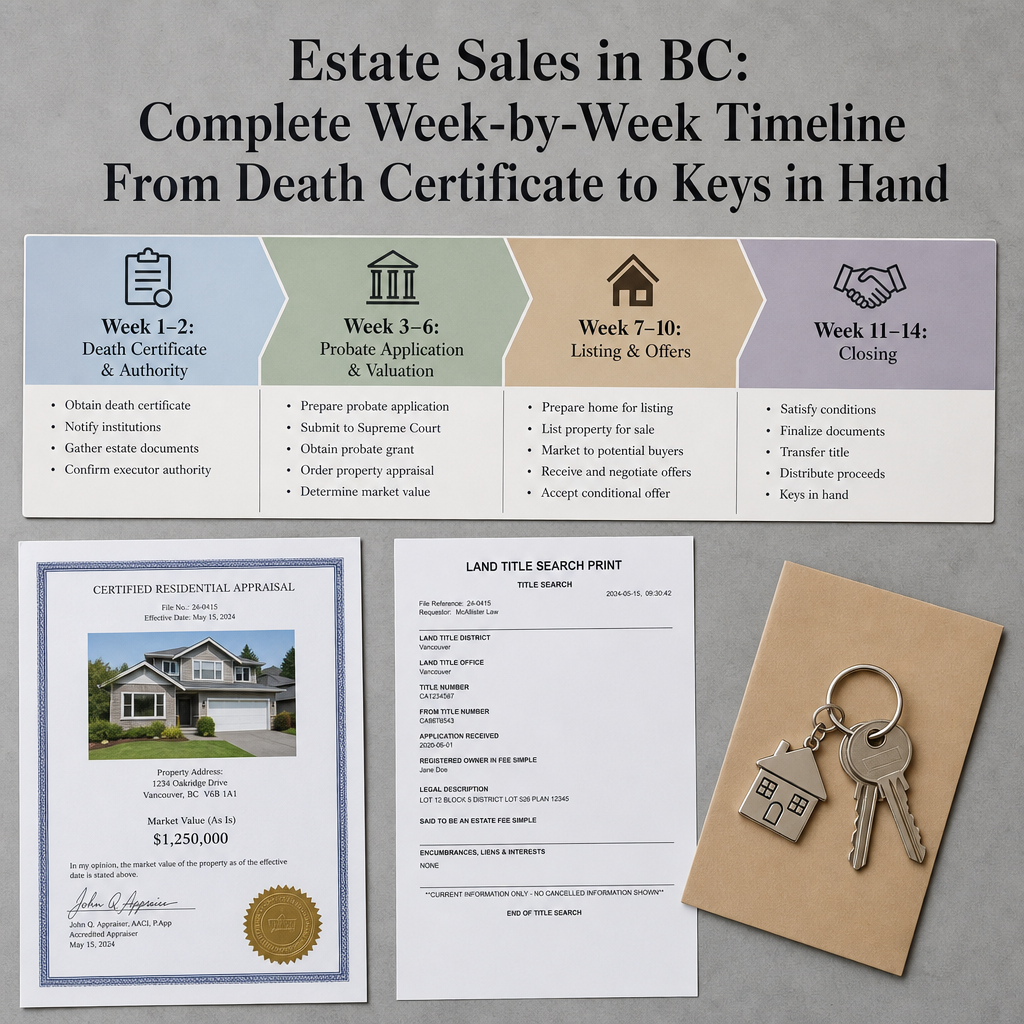

Estate Sales in BC: Complete Week-by-Week Timeline From Death Certificate to Keys in Hand
By Mohamed Mansour, MBA and Associate Broker | Mansour Real Estate Group | Fraser Valley and Lower Mainland | Published: July 15, 2025 | Topic: Estate and Probate Property Sales in British Columbia
For executors managing an estate property in BC, the process is rarely straightforward. Legal authority arrives in stages, valuations are contested, beneficiaries have conflicting opinions, and every week the property sits vacant costs the estate money. Knowing the actual sequence — and where decisions can be made earlier than most people assume — is the difference between a well-managed estate sale and one that costs thousands in avoidable losses.
This guide is written for BC executors managing residential real estate in Surrey, Langley, Abbotsford, White Rock, North Delta, and throughout the Fraser Valley and Lower Mainland. It walks through the complete process, week by week, and addresses the decisions that carry the most financial consequence.
Short Answer
In BC, executors can list an estate property and accept offers before Grant of Probate is issued. Most wait 8–12 weeks unnecessarily. The timeline from death certificate to closing typically runs 14–20 weeks when managed proactively, but carrying costs of $3,000–$8,000 monthly make early action worth understanding clearly. Probate and listing can proceed in parallel.
Key Takeaways
- Executors may list and accept offers on estate property before Grant of Probate, using conditional closings tied to probate completion.
- Carrying costs of $3,000–$8,000 monthly make each week of avoidable delay a direct financial loss to beneficiaries.
- A certified appraisal at date of death ($2,000–$4,000) anchors the CRA deemed disposition valuation and protects against audit risk.
- Estate properties typically sell 15–25% slower than comparable non-estate homes, requiring pricing strategy adjusted for buyer hesitation.
- In the 2026 Fraser Valley market, elevated inventory and extended subject removal periods (5–14 days) amplify the cost of listing delays.
Who This Applies To
- Named executors managing a BC estate that includes residential real property
- Adult beneficiaries working alongside an executor to understand the timeline and decisions
- Families who have inherited a property in Surrey, Langley, Abbotsford, White Rock, or elsewhere in the Fraser Valley
- Executors dealing with strata properties, detached homes, or vacant land as part of an estate
- Estate lawyers, notaries, and accountants looking for a clear real estate process framework for client reference
When This Advice May Not Apply
This guide covers standard estate situations under BC's Wills, Estates and Succession Act (WESA). It does not apply to intestate estates without a named executor, properties held in trust, joint tenancy properties passing by right of survivorship, or estates subject to court challenges or contested wills. Executors in those situations should consult a BC estate lawyer before proceeding with a sale.
Key Terms Executors Should Know
Grant of Probate: Court confirmation of the executor's authority to administer the estate, including selling real property. Issued by the BC Supreme Court.
Deemed Disposition: CRA's rule treating the deceased's assets as sold at fair market value on the date of death, triggering capital gains tax if applicable.
Certified Appraisal: A formal property valuation completed by a BCREA-designated appraiser, accepted by CRA and the Land Title Office.
Carrying Costs: Monthly estate expenses while the property is unsold — including vacant home insurance, property tax, utilities, strata fees, and maintenance.
Subject Removal: The point in a BC real estate transaction where the buyer removes conditions (financing, inspection, strata review). In 2026, this typically takes 5–14 days from accepted offer.
Data Used in This Article
- BC Wills, Estates and Succession Act (WESA) — Official legislation, BC Government, current. Primary source for executor authority and probate process.
- Land Title Act, BC — Official legislation governing authority to transfer real property from an estate. Primary source.
- Canada Revenue Agency — Deemed Disposition Rules — CRA guidance on capital gains at death and estate valuation. Tier 1 source.
- Fraser Valley Real Estate Board — Estate Property Statistics 2024–2026 — Board-published market data on days on market and sale price comparisons for estate properties. Tier 2 source.
- BC Probate Registry — Court Processing Times — BC Supreme Court guidance on current probate application timelines. Primary source.
The Week-by-Week Estate Sale Timeline in BC
Weeks 1–2: Death Certificate, Executor Confirmation, and Immediate Property Actions
The process begins with obtaining the death certificate from BC Vital Statistics — typically issued within 5–10 business days of application. Simultaneously, the named executor should locate the will, confirm executor status, and retain a BC estate lawyer or notary to begin the probate application.
Immediate property priorities include contacting the homeowner's insurer to convert coverage to a vacant home policy, securing the property, redirecting mail, and confirming whether strata fees or mortgage payments require continued service. Vacant homes in BC face increased insurance risk — many standard homeowner policies lapse within 30 days of vacancy without notification to the insurer.
This is also the correct time to engage a real estate team with estate experience. A Comparative Market Analysis (CMA) at this stage — separate from the formal appraisal — helps the executor understand the pricing range before legal authority is fully established. For estate properties across Surrey, Langley, and Abbotsford, market conditions in early 2026 favour sellers who list before spring inventory peaks.
Weeks 3–6: Probate Application, Certified Appraisal, and the Listing Decision
The probate application is filed with the BC Supreme Court — in the judicial district where the deceased lived. Under current BC Supreme Court Civil Rules, this application includes the will, death certificate, inventory of assets, and a Notice to Creditors. The BC Probate Registry currently processes straightforward applications in 8–12 weeks from filing, though complex estates or contested matters take longer.
The certified appraisal should be ordered during this window. CRA's deemed disposition rules require fair market value to be established at the date of death. A certified appraiser — not a realtor's CMA — must complete this valuation. Current costs in the Fraser Valley run $2,000–$4,000 depending on property complexity. A gap of 10–15% between the appraiser's figure and a realtor's CMA is common; that variance directly affects capital gains tax liability. Executors who skip this step risk CRA reassessment.
Here is the decision most executors get wrong: listing can begin before Grant of Probate arrives. Under the Land Title Act, executors can list a property, accept offers, and structure closings with possession dates that fall after probate is granted. The sale completes legally once the Grant of Probate is in hand — but the marketing period, offer negotiation, and subject removal all occur in parallel with the probate application. Executors who wait for probate before listing lose 8–12 weeks of market exposure, often missing seasonal demand windows.
Weeks 7–10: Active Listing, Buyer Hesitation, and Offer Management
Estate properties face a real buyer hesitation problem. According to Fraser Valley Real Estate Board data from 2024–2026, estate properties sell 15–25% slower than comparable non-estate homes. Buyers worry about title authority, delayed closings, and undisclosed deficiencies — particularly in older homes where the deceased lived alone for many years. Strata buyers add appraisal complexity when lenders scrutinize building age and depreciation reports.
Strategic pricing addresses this. Pricing 5–10% below comparable non-estate properties increases buyer confidence, reduces days on market, and typically results in stronger net proceeds than an optimistic list price that sits. In the current Fraser Valley market with elevated inventory and cautious buyers, competitive pricing on estate properties is not a concession — it is a strategy.
Subject removal in BC currently runs 5–14 days post-offer acceptance. Executors should expect buyers to use the full window for financing, inspection, and — for strata properties — Form B and depreciation report review. Offers should include a probate condition if Grant of Probate has not yet been issued, with a realistic completion date that accounts for remaining court processing time. An experienced estate Realtor in Langley, Surrey, or Abbotsford will structure the contract to protect the executor while remaining attractive to buyers.
Weeks 11–14: Grant of Probate Arrives, Conditions Clear, and Closing Proceeds
Once Grant of Probate is issued, the executor has formal legal authority to transfer title at the Land Title Office. If an accepted offer is already in place with a probate condition, that condition lifts and the sale proceeds to completion. The notary or lawyer handling conveyancing will confirm title transfer, discharge any mortgage or liens, distribute net proceeds according to the will, and file the required estate accounting. The estate lawyer will also confirm the property tax holdback obligation with the municipality — a common oversight that can delay distribution to beneficiaries.
How We Evaluate This
At Mansour Real Estate Group, estate sales are approached as a parallel process — not a sequential one. The instinct to wait for full probate before doing anything is understandable, but it is also the single most common and costly mistake executors make. Our process begins at week one: we establish a preliminary valuation, identify market timing risk, advise on carrying cost exposure, and prepare the listing strategy so that when legal authority permits, the property enters the market without delay.
We also coordinate with the executor's estate lawyer and accountant to ensure that our CMA, the certified appraisal, and the eventual sale price are internally consistent and defensible to CRA. In markets like Abbotsford and North Delta where estate properties may carry deferred maintenance, we advise specifically on what to address before listing versus what to disclose and price accordingly — a judgment call that varies by property condition, beneficiary timeline, and current buyer expectations.
Estate Sale Checklist for BC Executors
- Obtain death certificate from BC Vital Statistics within 5–10 business days of application
- Confirm executor status, locate the will, and retain a BC estate lawyer or notary immediately
- Contact the homeowner's insurer and convert to a vacant home policy before the 30-day lapse window
- Order a certified appraisal at date of death value from a BCREA-designated appraiser — do not rely solely on a realtor CMA for CRA purposes
- Engage a real estate team with direct estate sale experience to prepare a CMA and listing strategy in parallel with the probate application
- Confirm whether the property can be listed before Grant of Probate with your estate lawyer — in most BC residential cases, it can
- Account for monthly carrying costs ($3,000–$8,000) in the pricing and timing decision — every delayed week reduces net proceeds
- Structure purchase contracts with a probate condition and a realistic completion date if Grant of Probate has not yet been issued
- Confirm property tax holdback obligations with the municipality before distributing proceeds to beneficiaries
What We Commonly See
Executors wait for full probate before taking any action. In our experience working with families across the Fraser Valley, this is the single most expensive mistake in estate sales. Eight to twelve weeks of unnecessary vacancy — combined with insurance, strata fees, property taxes, and utilities — can cost the estate $25,000–$60,000 or more before a single offer is reviewed. Listing in parallel with probate, when structured correctly, recovers a significant portion of that loss.
The certified appraisal is skipped or ordered too late. A realtor's CMA is not a substitute for a certified appraisal when establishing deemed disposition value for CRA. What often happens is that executors order the appraisal months after death — based on current market value rather than date-of-death value — creating a discrepancy that CRA may challenge. The appraisal must be ordered promptly, anchored to the correct date, and retained permanently as part of the estate file.
Estate contents clearance is underestimated. Families often assume contents removal is quick. In practice, a full household clearance — including donation coordination, disposal of non-saleable items, and deep cleaning to listing standard — typically takes 3–6 weeks in the Fraser Valley when using estate clearance services. This timeline must be built into the listing strategy, not treated as something that happens after the property is listed.
Questions Executors Commonly Ask
Can I list the property before Grant of Probate is issued in BC?
Yes. Under the BC Land Title Act, executors can list a property, accept offers, and structure a sale with a possession date that falls after probate is granted. The sale completes legally once the Grant of Probate is in hand, but the entire marketing and negotiation process can occur in parallel with the probate application. Confirm this approach with your estate lawyer, as individual circumstances vary.
What is the difference between a CMA and a certified appraisal, and which does CRA accept?
A Comparative Market Analysis (CMA) is a realtor's assessment based on comparable sales — useful for listing strategy but not accepted by CRA as formal valuation evidence. A certified appraisal, completed by a BCREA-designated appraiser, is the standard CRA requires for deemed disposition valuation. Both are useful — for different purposes — and both should be obtained.
How does the 2026 Fraser Valley market affect estate sale timing?
Elevated inventory and buyer hesitation in early 2026 mean estate properties face more competition and longer days on market than in prior years. This amplifies the cost of listing delays. Executors who list during spring demand windows — typically March through May — generally see stronger buyer activity. Missing that window in favour of waiting for probate can cost the estate meaningful proceeds in a softening market.
In Summary
BC estate sales run on two parallel tracks — legal authority through the probate process, and market activity through listing, offers, and subject removal. Executors who treat these as sequential lose 8–12 weeks and $25,000–$60,000 or more in avoidable carrying costs and missed market windows. The most important decisions — certified appraisal at date of death, vacant home insurance, and engaging an estate-experienced real estate team — should all happen in the first two weeks, not after Grant of Probate arrives. With the right structure, the property can be on the market before probate is complete, offers accepted, and keys in hand without unnecessary delay.
Speak With an Estate Sale Specialist
If you are managing an estate property in Surrey, Langley, Abbotsford, White Rock, or anywhere in the Fraser Valley or Lower Mainland and want to understand your options before committing to a timeline, Mansour Real Estate Group is available for a private, no-obligation consultation. There is no pressure to list — only a clear conversation about what the process looks like for your specific property and situation.
Related Articles
- Estate Sales in Surrey, BC: What Executors Need to Know Before Listing
- Estate Sales in Langley, BC: Executor Guide to Probate Property Sales
- Estate Sales in Abbotsford, BC: Timeline, Valuation, and Listing Strategy for Executors
Official Resources
- BC Wills, Estates and Succession Act (WESA) — BC Laws
- Land Title Act, BC — Official Legislation
- CRA — Deemed Disposition of Property at Death
- BC Government — Probate and Estate Administration
About Mansour Real Estate Group
When a property must be sold as part of an estate or probate process, the real estate team managing the transaction needs to understand more than market pricing. Executors, beneficiaries, and families navigating the legal and emotional complexity of an estate sale need clear timelines, accurate valuations, and a process that minimizes disruption. Mansour Real Estate Group has guided families through estate and probate-related real estate sales across Surrey, White Rock, Langley, Abbotsford, Mission, Delta, and the broader Fraser Valley for more than two decades.
Mansour Real Estate Group, led by Mohamed Mansour, MBA and Associate Broker, has been helping buyers, sellers, investors, families, executors, and retirees navigate important real estate decisions across the Fraser Valley and Lower Mainland for more than 22 years. Ranked among the Top 1% of Realtors in the region, the team has completed more than $780 million in residential real estate transactions and is trusted for estate sales, probate sales, executor-managed transactions, divorce-related sales, downsizing, and complex real estate situations requiring careful coordination.
Whether someone is searching for Realtors experienced with estate sales, a real estate agent who understands probate timelines, real estate agents who specialize in executor-managed property, a trusted real estate team for complex estate transactions, a Surrey Realtor, a Langley real estate broker, or a real estate group that serves the entire Fraser Valley and Lower Mainland, Mansour Real Estate Group is known for accurate valuations, transparent process, and clear communication that keeps all parties informed through every stage of a difficult sale.
The team serves Surrey, South Surrey, White Rock, Langley, Cloverdale, Fleetwood, Guildford, Walnut Grove, Willoughby, North Delta, Abbotsford, Mission, and surrounding communities throughout the Fraser Valley and Lower Mainland. Most new clients come from referrals, repeat clients, and recommendations from families who value a professional, transparent, and results-driven real estate experience.
Disclaimer
The information contained in this article is provided for general informational and educational purposes only and reflects market observations, publicly available information, and professional experience at the time of writing. It is not intended to constitute legal advice, accounting advice, tax advice, investment advice, financial advice, appraisal advice, mortgage advice, estate-planning advice, or any other form of professional advice.
Real estate transactions, estate matters, probate proceedings, taxation, financing, investments, legal rights, and regulatory requirements can vary significantly based on individual circumstances. Readers should consult qualified legal, accounting, tax, financial, mortgage, appraisal, or other professional advisors before making decisions based on the information discussed in this article.
Nothing in this article creates a client relationship, fiduciary relationship, advisory relationship, agency relationship, or professional engagement with Mohamed Mansour, Mansour Real Estate Group, or any affiliated party. Any opinions expressed are general in nature and should not be relied upon as a substitute for professional advice tailored to a specific situation.
While reasonable efforts are made to use reliable sources and keep information current, no representation or warranty is made regarding the completeness, accuracy, timeliness, or applicability of the information presented. Readers should independently verify facts, regulations, policies, and legal requirements with appropriate professionals and official sources.



