

Langley Home Price Recovery Timeline 2026: Why the Year-Over-Year Decline Floor and Month-Over-Month Stabilization Signal a Market Bottom — And When Strategic Sellers Should Act Before Spring Buyer Migration Windows Close
By Mohamed Mansour, MBA and Associate Broker | Mansour Real Estate Group | Published: May 19, 2025 | Fraser Valley and Lower Mainland, BC
For homeowners in Langley watching the headlines, the year-over-year price decline numbers look discouraging. But the headline data and the actual market are telling different stories right now — and sellers who read only one of them may be making an expensive decision based on incomplete information.
This article is for Langley homeowners — in Willoughby, Walnut Grove, Langley City, and Township — who are deciding whether to list this spring or wait for conditions to improve. The evidence suggests the improvement may already be underway, and the window to act before spring buyer migration peaks is narrowing.
Short Answer
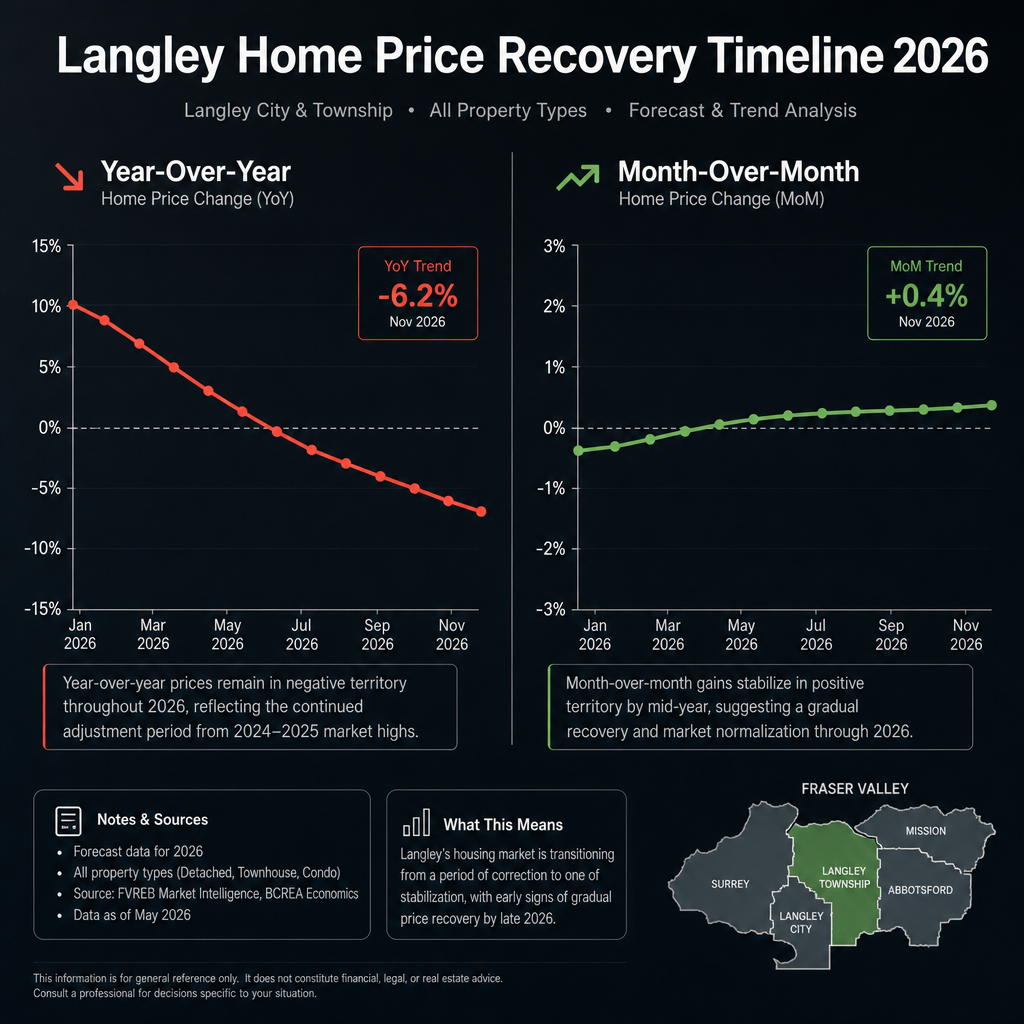
Langley benchmark prices declined 7–10% year-over-year through early 2026, but month-over-month data since February shows genuine stabilization. Historically in the Fraser Valley, this divergence signals a market bottom — not continued decline. Sellers who wait for year-over-year comparisons to turn positive typically list 4–8 months after the optimal window has already closed.
Key Takeaways
- Year-over-year declines of 7–10% in Langley mask month-over-month stabilization that began in February 2026.
- Fraser Valley market bottoms historically precede positive YoY comparisons by 4–8 months.
- Langley's sales-to-active ratio rose from 9% in January to 11–13% by April 2026, signalling genuine demand recovery.
- Spring buyer migration from Metro Vancouver is accelerating, with Langley capturing an estimated 35% of cross-regional relocations.
- Sellers who wait for YoY numbers to turn positive risk listing into a normalized market — not a recovering one.
Who This Applies To
- Langley homeowners actively deciding whether to list in spring or wait until fall 2026
- Sellers in Willoughby, Walnut Grove, Langley City, and Township communities watching market data
- Downsizers and equity-capture sellers who need market timing to work in their favour
- Homeowners who have been hesitating because the year-over-year headline numbers look weak
When This Advice May Not Apply
Sellers with significant deferred maintenance, unusual lot conditions, or strata-specific complications may face a different timeline regardless of broader market movement. Life-event sellers — including those navigating estate, probate, or divorce-related property sales in Langley — should prioritize their legal and personal timelines over market windows.
Data Used in This Article
- Fraser Valley Real Estate Board (FVREB) monthly market reports, February–April 2026 — official board statistics
- BC Assessment benchmark price tracking, 2024–2026 — official provincial assessment data
- Historical Fraser Valley sales data, 2012–2013 and 2018–2019 corrections — FVREB archives
- Mansour Real Estate Group internal MLS analytics for Langley — professional interpretation of active listing and sales data
- Cross-regional buyer migration tracking — Greater Vancouver Real Estate Board and FVREB coordination data
Why Year-Over-Year Declines Can Mislead Sellers at the Wrong Moment
Year-over-year price comparisons are useful for understanding where a market has been. They are less useful for understanding where it is going. When a market has been declining for 12 months and then stabilizes, the year-over-year number continues to look negative for another 4–8 months — even after prices have genuinely stopped falling.
According to FVREB monthly reports from February through April 2026, Langley benchmark prices showed a year-over-year decline of 7–10% depending on property type. But the same reports show month-over-month movement that has been flat to modestly positive since February. That gap between the two metrics is exactly the pattern seen in the Fraser Valley during the 2012–2013 and 2018–2019 corrections — both of which were followed by meaningful price recovery within 6–12 months. Sellers in those cycles who waited for YoY comparisons to turn positive consistently listed after the strongest buyer demand had already passed. For a deeper look at how Langley market conditions in 2026 affect seller strategy, see our dedicated market guide.
What the Sales-to-Active Ratio Is Actually Telling Sellers
The sales-to-active listings ratio is one of the clearest leading indicators available to sellers in any Fraser Valley market. When the ratio sits below 12%, conditions generally favour buyers. Between 12% and 20%, the market is balanced. Above 20%, sellers hold more leverage. According to FVREB data, Langley's ratio moved from approximately 9% in January 2026 to 11–13% by April — a meaningful shift that signals demand is recovering faster than new inventory is entering the market.
This matters for sellers in Willoughby and Walnut Grove in particular, where townhome and detached segments have historically responded fastest to shifts in this ratio. As selling in Willoughby involves a buyer pool with specific school catchment and commute priorities, a tightening ratio in that submarket reflects real household demand — not speculative activity.
What this ratio does not yet show is the full effect of spring buyer migration from Metro Vancouver. Cross-regional relocation data tracked through FVREB and Greater Vancouver Real Estate Board coordination suggests Langley is capturing an estimated 35% of cross-regional moves — driven by SkyTrain access, relative affordability, and school catchment preferences that are well-established in Langley Township. That migration wave typically peaks between April and June. Sellers who list in that window are meeting a buyer pool at its deepest point of the year.
How We Evaluate This
At Mansour Real Estate Group, we look at three signals together when advising sellers on timing: the relationship between YoY and MoM price movement, the direction of the sales-to-active ratio over the prior 60–90 days, and the buyer composition in active showings. When all three are converging — stabilizing prices, a rising ratio, and an active buyer pool — that combination has historically been more predictive of near-term outcomes than any single metric. Our internal MLS analytics for Langley show all three signals moving in the same direction since February 2026.
Seller Checklist: Acting Before the Spring Migration Window Closes
- Request a current comparative market analysis anchored to sold data from the past 60 days — not 90 or 120
- Confirm your price is positioned relative to active competing listings, not just sold comparables
- Complete any deferred maintenance items that would trigger buyer subject clauses or negotiated price reductions
- Prepare strata documents if applicable — Form B, depreciation report, meeting minutes — before listing, not after an offer comes in
- Establish your possession date flexibility before listing so offer negotiations do not stall on dates
- Confirm your next-step housing plan so you are not forced into a rushed purchase decision after a faster-than-expected sale
What We Commonly See
In our experience working with Langley sellers during transitional markets, the most common mistake is conflating the direction of year-over-year headlines with the direction of local buyer activity. They are measuring different things, and in early recovery phases, they move in opposite directions. Sellers who wait for the headlines to catch up to the market often find themselves competing with the wave of listings that follows the YoY turn — exactly when competition is highest and buyer urgency has already peaked.
What often happens is that a seller will list in September or October, expecting the market to have fully recovered, and instead find that the spring migration window has closed, school-year decisions have already been made by relocating families, and the active buyer pool is thinner than it was four months earlier. The property sells — but for less, and after more days on market, than it would have in April or May.
Frequently Asked Questions
If Langley prices are still down year-over-year, why would I sell now instead of waiting for recovery?
Because the YoY comparison reflects where prices were 12 months ago, not where they are going. Historical Fraser Valley data shows that sellers who wait for YoY comparisons to turn positive typically list 4–8 months after the strongest demand window has passed. Month-over-month stabilization since February 2026 suggests the floor is already in place.
What does a sales-to-active ratio of 11–13% mean for Langley sellers in practical terms?
It means the market is moving from buyer-favouring toward balanced. It is not a seller's market, but it is no longer the soft market of late 2025. Properly priced properties in Langley are taking fewer days to sell than they were in January, and subject-free offers are beginning to reappear in the townhome segment.
Is the spring buyer migration from Metro Vancouver real, and how does it affect Langley specifically?
Cross-regional migration data tracked through FVREB and Greater Vancouver Real Estate Board coordination shows Langley capturing an estimated 35% of cross-regional relocations in spring 2026. The SkyTrain Expo Line connection and Langley Township school catchment quality are consistently cited as the primary drivers. This migration typically peaks April through June — the window most relevant to sellers considering a spring listing.
In Summary
Langley's year-over-year price declines are real, but they are measuring the past. Month-over-month stabilization since February 2026, a rising sales-to-active ratio, and accelerating spring buyer migration from Metro Vancouver are all pointing in the same direction. Sellers who act before the spring migration window closes in May and June are positioning themselves ahead of the normalization that follows. Waiting for year-over-year headlines to confirm what the leading indicators are already showing typically means listing into a more competitive, lower-urgency market — with less to show for it.
Thinking About Listing in Langley This Spring?
If you are weighing whether to list now or wait, a current market valuation grounded in the past 60 days of Langley data — not generic regional trends — is the right starting point. Mansour Real Estate Group offers that conversation at no obligation.
Related Articles
- Langley Real Estate Market 2026: A Seller's Guide to Current Conditions
- Selling in Willoughby: What the Current Buyer Pool Looks For
- Fraser Valley Spring 2026: What Cross-Regional Migration Means for Local Sellers
About Mansour Real Estate Group
When homeowners in Langley are trying to read a market that is sending conflicting signals, the difference between a confident decision and a costly one often comes down to whether they are working with a real estate team that understands how leading indicators and lagging indicators diverge — and what that divergence means for their specific property. Mansour Real Estate Group has guided sellers through transitional Langley and Fraser Valley markets for more than two decades, with a pricing-first process built around current buyer behaviour, not backward-looking data alone.
Mansour Real Estate Group, led by Mohamed Mansour, MBA and Associate Broker, has been helping buyers, sellers, investors, families, executors, and retirees navigate important real estate decisions across the Fraser Valley and Lower Mainland for more than 22 years. Ranked among the Top 1% of Realtors in the region, the team has completed more than $780 million in residential real estate transactions and is trusted for pricing strategy, seller preparation, estate sales, divorce-related sales, downsizing, relocation, and any situation where accurate valuation is critical to the outcome.
Whether someone is searching for Realtors who understand Langley's transitional market, a real estate agent who reads local data rather than regional headlines, real estate agents experienced with spring seller timing, a trusted real estate team for a Langley listing decision, a Langley Realtor, a Willoughby real estate broker, or a real estate group serving the Fraser Valley and Lower Mainland, Mansour Real Estate Group is known for data-driven recommendations, honest market context, and a process that protects sellers from the most common and costly timing mistakes.
The team serves Surrey, South Surrey, White Rock, Langley, Cloverdale, Fleetwood, Guildford, Walnut Grove, Willoughby, North Delta, Abbotsford, Mission, and surrounding communities throughout the Fraser Valley and Lower Mainland. Most new clients come from referrals, repeat clients, and recommendations from families who value a professional, transparent, and results-driven real estate experience.
Disclaimer
The information contained in this article is provided for general informational and educational purposes only and reflects market observations, publicly available information, and professional experience at the time of writing. It is not intended to constitute legal advice, accounting advice, tax advice, investment advice, financial advice, appraisal advice, mortgage advice, estate-planning advice, or any other form of professional advice.
Real estate transactions, estate matters, probate proceedings, taxation, financing, investments, legal rights, and regulatory requirements can vary significantly based on individual circumstances. Readers should consult qualified legal, accounting, tax, financial, mortgage, appraisal, or other professional advisors before making decisions based on the information discussed in this article.
Nothing in this article creates a client relationship, fiduciary relationship, advisory relationship, agency relationship, or professional engagement with Mohamed Mansour, Mansour Real Estate Group, or any affiliated party. Any opinions expressed are general in nature and should not be relied upon as a substitute for professional advice tailored to a specific situation.
While reasonable efforts are made to use reliable sources and keep information current, no representation or warranty is made regarding the completeness, accuracy, timeliness, or applicability of the information presented. Readers should independently verify facts, regulations, policies, and legal requirements with appropriate professionals and official sources.



