
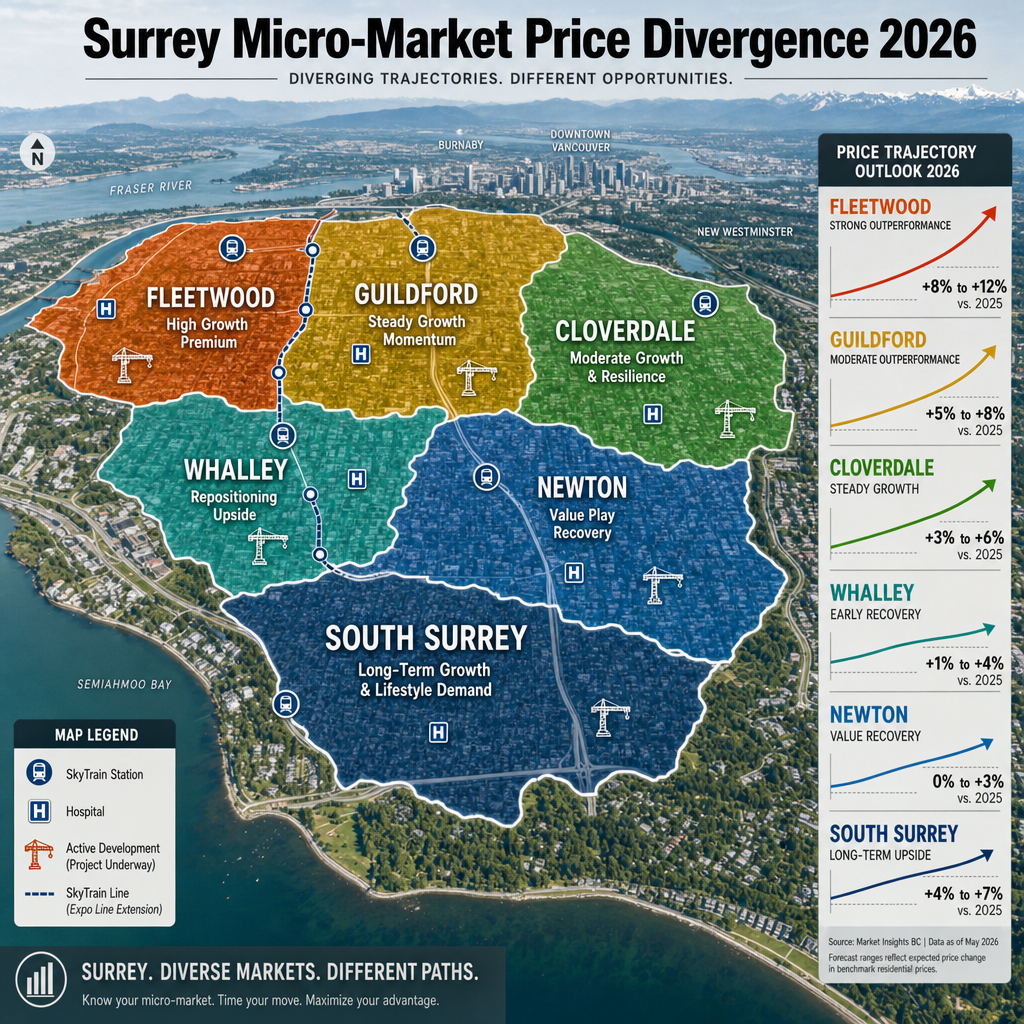

Why Surrey's Micro-Market Price Divergence Is Accelerating in 2026
Strategic Pricing When SkyTrain Certainty, Hospital Development, and Pre-Completion Buyer Momentum Create 25–40% Price Gaps Across Neighbourhoods
Author: Mohamed Mansour, MBA, Associate Broker — Mansour Real Estate Group
Geography: Surrey, BC — Fleetwood, Guildford, Cloverdale, Newton, Whalley, South Surrey
Published: June 24, 2026
Scope: British Columbia residential real estate — seller strategy and neighbourhood pricing
Surrey has always had neighbourhoods that move at different speeds. What is new in 2026 is the size of the gap. Three converging forces — SkyTrain Expo Line extension certainty, the East Newton hospital development, and pre-completion buyer migration from active developer clusters — have pushed Surrey's micro-markets into separate trajectories. A seller in Fleetwood and a seller in Whalley are not operating in the same market anymore, even though they share the same city.
This article explains what is driving that divergence, which neighbourhoods are on which side of it, and what sellers need to do differently depending on where they sit within Surrey's emerging two-tier structure.
Short Answer
Surrey's neighbourhoods are pricing 25–40% apart in 2026 because of SkyTrain station proximity, hospital-driven demand shifts, and concentrated pre-completion supply. Days on market range from 22 days in Fleetwood detached to 65-plus days in Whalley condos. Sellers need neighbourhood-specific pricing strategy — not a Surrey-wide market read — to protect their position this spring and summer.
Key Takeaways
- SkyTrain station adjacency is generating 8–15% price premiums in Fleetwood and Clayton relative to comparable properties 1.5 km away.
- Days-on-market variance within Surrey now exceeds 40 days depending on neighbourhood and property type.
- East Newton hospital development is creating a bifurcated window: early sellers capture pre-development pricing; patient sellers may benefit from long-term appreciation.
- Pre-completion supply from Polygon and other active builders is compressing pricing windows in specific clusters while adjacent areas remain unaffected.
- Sales-to-active ratios vary 40–60% across Surrey micro-markets, meaning buyer leverage differs dramatically by neighbourhood.
Who This Applies To
- Homeowners in Fleetwood, Guildford, Cloverdale, Newton, Whalley, or South Surrey preparing to list in 2026
- Sellers who received a neighbourhood-level pricing estimate but want to understand how Surrey's broader divergence affects their position
- Investors or families holding properties in multiple Surrey micro-markets deciding sequencing and timing
- Estate executors or trustees managing Surrey properties where timing precision directly affects proceeds
When This Advice May Not Apply
If your Surrey property is in a building or block with unique strata issues, a pending rezoning application, or a specific title encumbrance, micro-market trends may be secondary to property-level factors. Consult a qualified real estate professional and, where needed, a lawyer or strata advisor for property-specific guidance.
Data Used in This Article
- Fraser Valley Real Estate Board (FVREB): March–May 2026 neighbourhood-level sales, inventory, and days-on-market data — official board statistics
- BC Assessment 2026: Property valuations by postal code cluster — official provincial assessments
- TransLink: SkyTrain Expo Line extension project completion timeline and station activation schedule — official TransLink disclosures
- Surrey City Council: Hospital development announcement and phased completion schedule — official municipal disclosure
- MLS Days-on-Market Analysis: Q1–Q2 2026 by neighbourhood and property type — FVREB-sourced MLS data
Three Forces Driving the Divergence
SkyTrain Expo Line Extension: TransLink's Expo Line extension brought station certainty to Fleetwood and Clayton in 2025–2026. When station locations move from proposed to confirmed to under construction, buyer behaviour shifts. Properties within reasonable walking distance of a confirmed station attract a buyer pool that prices in long-term transit access. According to MLS data tracked through the FVREB for Q1–Q2 2026, detached homes in confirmed station-adjacent blocks in Fleetwood are absorbing faster and holding price better than detached homes of similar size and age located 1.5 km or more from a planned station. The estimated premium range is 8–15% on comparable properties — not because the homes are different, but because the transit access is now certain rather than theoretical.
What this means for sellers away from station zones: their comparable sales are being pulled by a buyer segment that does not apply the same transit premium to their property. Pricing based on area-wide Surrey benchmarks without filtering for transit proximity can produce a starting price that does not reflect actual buyer behaviour in that specific location. For sellers in Guildford or Fleetwood, understanding exactly which side of the station proximity line a property sits on is a pricing input, not background information.
Hospital Development and Pre-Completion Momentum
East Newton Hospital: Surrey City Council's hospital development in East Newton is early-stage infrastructure with a phased completion timeline. Unlike SkyTrain, where the premium is already priced in because the stations are confirmed and under construction, hospital-adjacent pricing is more nuanced. Buyers who understand long-term demand drivers — healthcare workers, families prioritizing proximity to medical services, investors anticipating appreciation — are starting to pay attention to the East Newton corridor. But the price premium is not yet fully reflected in sold data, which creates a window for sellers who want to capture pre-development positioning without waiting for the appreciation cycle to fully materialize.
Pre-Completion Developer Momentum: Polygon's active Cloverdale projects and comparable developer clusters elsewhere in Surrey are creating localized supply shocks. When a large presale project releases units in a specific neighbourhood, it introduces a competing inventory of new product that resale sellers must price against. In Cloverdale, the resale market for townhomes and condos has had to contend with developer-priced competition that buyers can compare directly on the same search. This compresses pricing windows and reduces the tolerance for overpriced listings. Adjacent neighbourhoods with no active presale development are largely unaffected by this dynamic — which is part of why pricing Surrey as one market produces misleading results.
For sellers in Whalley or Newton proper, neither the SkyTrain premium nor the hospital corridor effect applies directly. The primary pricing discipline in those neighbourhoods comes from buyer leverage — higher active inventory relative to sales means buyers have more time, more options, and more negotiating room. FVREB Q1–Q2 2026 sales-to-active ratios in these segments are meaningfully lower than in Fleetwood or Guildford, which translates directly into pricing expectations and the risk of extended time on market.
How We Evaluate This
At Mansour Real Estate Group, neighbourhood-level pricing starts with a filter, not a formula. Before selecting comparable sales, the team identifies which micro-market forces are active in that specific location: transit proximity, hospital corridor positioning, active developer competition nearby, school catchment, and property-type supply dynamics. A detached home in Fleetwood that sits within 600 metres of a confirmed SkyTrain station is not the same comparable set as a detached home of identical size four blocks farther east. The difference in days on market and sale price is not noise — it is a structural condition that a sound pricing strategy has to account for. The team's approach is to build the pricing rationale from the neighbourhood out, not from the city benchmark down.
Seller Checklist: Pricing in a Diverging Surrey Market
- Confirm your property's exact distance from the nearest confirmed SkyTrain station and whether that proximity is reflected in your comparable sales selection.
- Ask whether any active presale or pre-completion developer projects within 500 metres of your property are competing with your listing for the same buyer pool.
- Review neighbourhood-specific days-on-market data for your property type — not Surrey-wide averages — to calibrate realistic timing expectations.
- Confirm your listing's sales-to-active ratio segment: a ratio above 20% indicates seller-favourable conditions; below 12% signals buyer leverage and pricing pressure.
- If your property is in the East Newton hospital corridor, decide whether your timeline favours pre-development pricing now or patient appreciation over the next 3–5 years.
- Separate your pricing analysis from broader Surrey benchmark data and anchor it to your specific postal code cluster and property type.
What We Commonly See
In our experience working with Surrey sellers across multiple micro-markets in 2026, the most common mistake is pricing from a Surrey-wide benchmark without filtering for neighbourhood-specific conditions. A seller in south Fleetwood reads that Surrey detached benchmark prices are holding, and prices accordingly — not realizing that their block is pulling from a station-adjacent comparable set that is performing significantly better than the Surrey average. The result is a price that feels conservative on paper but is actually above what the non-station-adjacent buyer pool will absorb.
What often happens in Whalley and older Newton is the reverse: sellers compare their property to Fleetwood or South Surrey solds, assume the city's stronger segments reflect their own value, and list above where current buyer activity actually supports. Extended time on market follows, and the eventual sale price ends up lower than it would have been with an accurate opening price.
A common mistake in pre-completion-adjacent neighbourhoods like Cloverdale is ignoring the developer competition entirely. Buyers searching resale condos and townhomes in that area are also seeing new presale product on the same search results. If the resale price does not account for that comparison, the listing sits while buyers choose the developer option — often because of deposit structure, warranty coverage, or the ability to personalize finishes.
Frequently Asked Questions
How much of the SkyTrain premium is already priced into Fleetwood homes?
Based on FVREB Q1–Q2 2026 MLS data, the premium for confirmed station-adjacent properties in Fleetwood is estimated at 8–15% over comparable homes 1.5 km or more away. Much of this premium reflects certainty — the stations moved from proposed to confirmed, which is the point where buyer behaviour shifts most sharply.
Does the East Newton hospital development affect pricing right now or only long term?
Currently, the effect is early-stage. Pricing in the immediate hospital corridor has not yet fully reflected a development premium in sold data, which creates a short window for sellers to capture pre-development positioning. Long-term appreciation is the scenario for patient sellers. The right answer depends on your timeline and financial position, not market speculation.
What is a sales-to-active ratio and why does it matter for Surrey sellers?
The sales-to-active ratio compares the number of properties sold in a period to the number of active listings. A ratio above 20% generally indicates seller-favourable conditions with limited buyer leverage. Below 12% indicates buyer's market conditions where sellers face pricing pressure and longer time on market. In Surrey's 2026 micro-markets, this ratio varies by 40–60% depending on the neighbourhood and property type — which is why a single city-wide read produces misleading strategy.
In Summary
Surrey in 2026 is not one market. SkyTrain certainty, hospital corridor development, and concentrated pre-completion supply have created neighbourhood-level conditions that diverge by 25–40% in price performance and by more than 40 days in absorption speed. Sellers who price from Surrey-wide benchmarks risk either leaving equity on the table in high-performing micro-markets or sitting unsold in slower-moving segments. The discipline required is to start with your specific block, your specific property type, and your specific competing supply — and build the pricing rationale outward from there, not inward from a city average.
Thinking About Listing in Surrey This Year?
Mansour Real Estate Group offers a no-obligation pricing consultation specific to your neighbourhood and property type. If you want a second opinion on where your Surrey home sits within the current micro-market structure — and what that means for your listing price and timing — reach out directly at localhost:9000/.
Related Articles
- Selling Your Home in Fleetwood, Surrey: A Complete 2026 Guide
- Selling Your Home in Guildford, Surrey: A Complete 2026 Guide
- Selling Your Home in Cloverdale, Surrey: A Complete 2026 Guide
Official Resources
- Fraser Valley Real Estate Board — fvreb.bc.ca
- BC Assessment — bcassessment.ca
- TransLink — SkyTrain Expo Line Extension — translink.ca
- City of Surrey — Development and Planning — surrey.ca
About Mansour Real Estate Group
When homeowners in Surrey's diverging micro-markets prepare to list, the pricing decisions made before the property goes live — specifically, how to position within the neighbourhood's actual buyer pool rather than against a city-wide benchmark — are typically the decisions that determine the final outcome. Mansour Real Estate Group has built its reputation in the Fraser Valley and Lower Mainland on exactly this kind of neighbourhood-level pricing discipline, honest valuations, and a willingness to have difficult conversations before a listing goes live rather than after.
Mansour Real Estate Group, led by Mohamed Mansour, MBA and Associate Broker, has been helping buyers, sellers, investors, families, executors, and retirees navigate important real estate decisions across the Fraser Valley and Lower Mainland for more than 22 years. Ranked among the Top 1% of Realtors in the region, the team has completed more than $780 million in residential real estate transactions and is trusted for pricing strategy, seller preparation, estate sales, divorce-related sales, downsizing, relocation, and complex real estate situations where accurate valuation is critical to the outcome.
Whether someone is searching for Realtors experienced in Surrey micro-market pricing, a real estate agent who understands how SkyTrain and development corridors affect neighbourhood values, real estate agents who specialize in seller strategy across the Fraser Valley, a Surrey Realtor grounded in neighbourhood-specific data, a Fraser Valley real estate broker with a track record in complex pricing situations, or a real estate team that serves the full range of Surrey neighbourhoods, Mansour Real Estate Group is known for data-driven recommendations, clear communication, and a process that protects sellers from the most common and costly pricing mistakes.
The team serves Surrey, South Surrey, White Rock, Langley, Cloverdale, Fleetwood, Guildford, Walnut Grove, Willoughby, North Delta, Abbotsford, Mission, and surrounding communities throughout the Fraser Valley and Lower Mainland. Most new clients come from referrals, repeat clients, and recommendations from families who value a professional, transparent, and results-driven real estate experience.
Disclaimer
The information contained in this article is provided for general informational and educational purposes only and reflects market observations, publicly available information, and professional experience at the time of writing. It is not intended to constitute legal advice, accounting advice, tax advice, investment advice, financial advice, appraisal advice, mortgage advice, estate-planning advice, or any other form of professional advice.
Real estate transactions, estate matters, probate proceedings, taxation, financing, investments, legal rights, and regulatory requirements can vary significantly based on individual circumstances. Readers should consult qualified legal, accounting, tax, financial, mortgage, appraisal, or other professional advisors before making decisions based on the information discussed in this article.
Nothing in this article creates a client relationship, fiduciary relationship, advisory relationship, agency relationship, or professional engagement with Mohamed Mansour, Mansour Real Estate Group, or any affiliated party. Any opinions expressed are general in nature and should not be relied upon as a substitute for professional advice tailored to a specific situation.
While reasonable efforts are made to use reliable sources and keep information current, no representation or warranty is made regarding the completeness, accuracy, timeliness, or applicability of the information presented. Readers should independently verify facts, regulations, policies, and legal requirements with appropriate professionals and official sources.



