

How to Structure Seller Concessions Without Eroding Net Proceeds
By Mohamed Mansour, MBA and Associate Broker — Mansour Real Estate Group | Fraser Valley & Lower Mainland | Published: July 15, 2026
Fraser Valley sellers in 2026 are facing extended days on market and cautious buyers. Concessions are often necessary to close deals — but how you structure them determines whether you protect your net proceeds or quietly give away thousands more than you needed to. The difference between a price reduction and a closing cost credit is not cosmetic. It affects your appraisal, your lender approval, your tax position, and your final deposit.
This article breaks down the four main concession types available to BC sellers — price reductions, closing cost help, rate buy-downs, and home warranties — and explains the trade-offs between them so you can make a financially sound decision under negotiation pressure.
Short Answer
In a Fraser Valley buyer's market, closing cost credits and rate buy-downs typically protect your net proceeds better than price reductions, because they keep the sale price anchored and reduce appraisal risk. The right concession depends on your buyer's financing type, your lender's approval thresholds, and how long your carrying costs can sustain the wait.
Key Takeaways
- Price reductions lower appraised value dollar-for-dollar and reduce net proceeds permanently.
- Closing cost credits up to 2–6% of sale price preserve price anchoring and avoid appraisal compression.
- Rate buy-downs cost $3,500–$7,000 per 0.25% reduction and are non-refundable if the deal collapses.
- Home warranties cost $300–$800 and are most effective as inspection-leverage tools, not deal accelerators.
- BC lender concession caps mean exceeding thresholds triggers appraisal problems or deal renegotiation.
Who This Applies To
- Sellers whose properties have been listed for 30 or more days without an accepted offer
- Estate executors and probate sellers under timeline pressure in Surrey, Langley, or Abbotsford
- Divorce-related sellers needing to close on a fixed schedule
- Condo sellers in markets with 45–60 day average days on market
- Investors carrying vacant properties where monthly costs exceed modest concession values
When This Advice May Not Apply
Properties with multiple competing offers, buyers using all-cash financing (where rate buy-downs are irrelevant), or sellers in markets with less than 30 days on market may not need to structure concessions at all. Always confirm your buyer's financing type before deciding which concession to offer.
Data Used in This Article
- FVREB market data — days on market by property type, Fraser Valley, Q1–Q2 2026 (official board statistics)
- BCFSA lending guidelines — seller concession caps and stress-test documentation, 2026 (Tier 1 government regulator)
- CMHC underwriting standards — seller concession treatment for insured mortgages (official federal policy)
- Mansour Real Estate Group transaction analysis — closing cost and concession data from completed Fraser Valley sales, 2025–2026 (internal professional database)
How We Evaluate This
When a buyer requests a concession, our first step is to identify their financing type — insured, conventional, or cash — because lender caps determine what is structurally possible before we evaluate what is strategically preferable. A concession that triggers an appraisal shortfall costs more than the concession itself.
We then model the net proceeds impact of each concession type against the seller's carrying cost timeline: mortgage, property tax, insurance, and strata fees where applicable. In most cases, a well-structured $10,000 closing cost credit produces a better net outcome than a 21-day extension with $6,000 in additional carrying costs followed by a $15,000 price reduction under pressure.
The Four Concession Types: What Each One Actually Costs
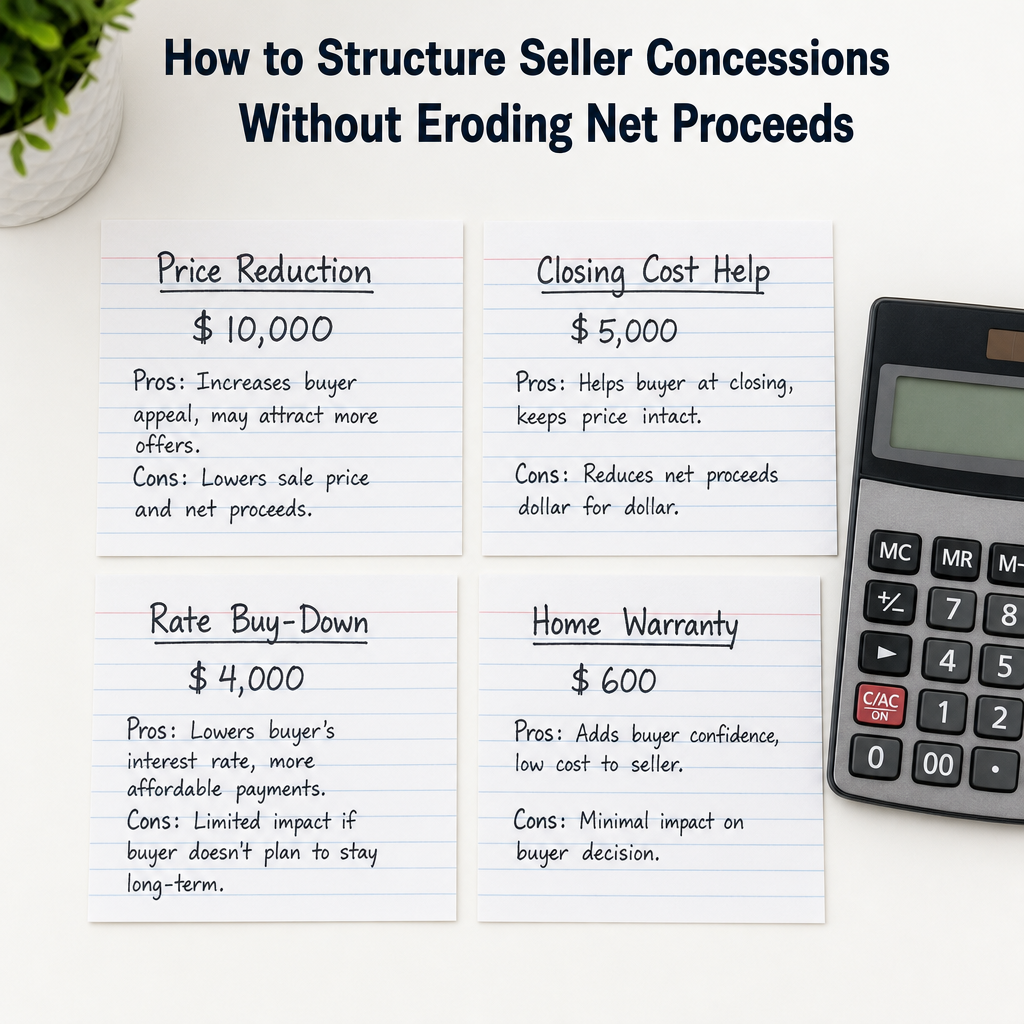
Price reductions are the most visible and the most damaging. A $40,000 reduction on a $700,000 property does not simply cost $40,000. It resets the appraised value anchor for that property, potentially affecting comparable sales for neighbouring listings. It reduces your net proceeds dollar-for-dollar. And if the buyer's lender appraises the property at the reduced price, any future renegotiation starts from that lower base. According to our transaction analysis across Surrey, Langley, and Abbotsford listings in 2025–2026, sellers who took early price reductions rather than structured concessions consistently underperformed their initial net proceed target by a wider margin.
Closing cost credits — typically $3,000 to $15,000 — keep the sale price intact while reducing the buyer's out-of-pocket cash requirement at closing. Under BCFSA lending guidelines, these credits are permitted up to 2–6% of the purchase price depending on the buyer's loan-to-value ratio. For an insured mortgage buyer, CMHC caps seller credits more tightly, so confirming the buyer's financing structure is essential before offering this concession. When structured correctly, a closing cost credit avoids appraisal compression entirely because the recorded sale price remains unchanged.
Rate buy-downs involve the seller paying mortgage discount points on the buyer's behalf to reduce their interest rate — typically 0.5% to 1% of the mortgage balance per 0.25% rate reduction. At current mortgage sizes in the Fraser Valley, this translates to $3,500–$7,000 per quarter-point reduction. The strategic value is real: a lower rate can move a borderline buyer through stress-test qualification. The risk is equally real: if the buyer defaults before closing, those funds are non-refundable. Rate buy-downs work best when the buyer's file is strong and the deal is conditional only on financing, not inspection or other variables.
Home warranties cost $300–$800 and provide $5,000–$10,000 in post-closing defect coverage. They do not accelerate closing timelines. Their highest and best use is as a response to inspection leverage: when a buyer is using a minor deficiency as grounds to renegotiate price, offering a warranty that covers that specific category of defect often neutralizes the objection at a fraction of the cost of a price concession. For estate sales and older properties in North Delta, Abbotsford, and Mission — where deferred maintenance is common — home warranties are a structurally sound tool when used in the right context.
The Carrying Cost Calculation Sellers Often Ignore
According to FVREB data, Fraser Valley condos averaged 45–60 days on market in early 2026, while detached homes averaged 25–35 days. For a seller carrying a property at $200,000 in mortgage balance at current rates, monthly carrying costs including tax and insurance typically run $1,800–$2,400. A 30-day extension to avoid a $5,000 closing cost credit often costs more than the credit itself.
This is the calculation most sellers do not run until after the fact. Concessions are not simply a negotiation loss. In many cases, a well-timed concession offered early — before a listing ages past 45 days — produces a higher net proceed than a firm refusal followed by a price reduction under pressure three weeks later. Understanding realistic Fraser Valley sale timelines is the foundation of any concession decision.
Seller Checklist: Structuring Concessions to Protect Net Proceeds
- Confirm the buyer's financing type — insured, conventional, or cash — before deciding which concession is structurally available under lender guidelines.
- Calculate your daily carrying cost and multiply by expected additional days on market if you decline the concession request.
- Request a pre-listing appraisal or comparative market analysis anchored to your asking price to protect against post-concession appraisal compression.
- If offering a closing cost credit, confirm with your lawyer that the credit is disclosed correctly in the contract of purchase and sale to avoid lender scrutiny at funding.
- Reserve rate buy-downs for buyers with strong financing files and deals with minimal remaining conditions.
- Use home warranties specifically in response to inspection leverage — not as a default closing incentive.
- Document all concessions in writing before removing subjects — verbal concession agreements do not survive closing disputes in BC.
What We Commonly See
In our experience, sellers who reflexively offer price reductions under negotiation pressure often discover post-closing that the reduction was larger than any structured concession would have been. The word "reduce" feels direct and controllable. The word "credit" feels like giving something away. The math usually runs the other way.
What often happens with rate buy-downs is that sellers agree to them without understanding the non-refundable structure. If the deal collapses after subject removal — which happens with some frequency in 2026's financing environment — the seller has absorbed a $5,000–$7,000 cost and must restart the listing with a shorter runway. We recommend rate buy-downs only when subject removal has already occurred or when the buyer's file has been pre-reviewed by their lender.
A common mistake is offering multiple concession types simultaneously — a price reduction plus a closing cost credit plus an included appliance package — without calculating the combined net impact. Each concession in isolation may seem manageable. Combined, they frequently push the net proceed below what a well-structured single concession would have cost. Sellers navigating estate sales or divorce-related sales are particularly vulnerable to this pattern because timeline pressure makes sequential concessions feel necessary when a single well-structured one would have been sufficient.
Questions and Answers
Q: Do closing cost credits affect the appraised value of my home in BC?
A: Not directly. A closing cost credit is separate from the recorded sale price. The appraiser works from the purchase price stated in the contract. As long as the credit is within lender-approved thresholds — 2–6% depending on loan-to-value — it does not trigger appraisal compression the way a price reduction does.
Q: What happens if a seller's concession exceeds the lender's cap?
A: The lender will typically require the sale price to be adjusted downward to reflect the net effective price. This can trigger a renegotiation of the entire offer and, in some cases, cause the deal to collapse if the buyer can no longer qualify at the revised purchase price under BC stress-test rules.
Q: Are rate buy-downs common in Fraser Valley transactions?
A: They are more common in new construction and presale markets than in resale. In resale transactions across Surrey, Langley, and Abbotsford, closing cost credits remain the more frequently used concession tool. Rate buy-downs are most useful when a buyer's qualification is marginal and the seller has strong confidence the deal will close.
In Summary
Seller concessions are not a sign of weakness — they are a tool. The question is which tool fits the situation. Price reductions carry the highest long-term cost because they reset the value anchor permanently. Closing cost credits are the most versatile option when structured within lender caps. Rate buy-downs work in specific financing scenarios and carry non-refundable risk. Home warranties are most effective as precision responses to inspection leverage, not as general sweeteners. In Fraser Valley's 2026 market, the sellers who protect their net proceeds are the ones who model the trade-offs before sitting down to negotiate, not during.
Speak with Mansour Real Estate Group
If you are weighing a concession request and want to understand the net proceeds impact before you respond, Mansour Real Estate Group can model the trade-offs based on your property, your buyer's financing profile, and your current carrying costs. There is no obligation in a conversation — just a clearer picture of what each option actually costs you. Reach out here.
Related Articles
- How Long Does It Take to Sell a Home in the Fraser Valley
- Estate Sales in the Fraser Valley: What Executors Need to Know
- Selling Your Home During Divorce in BC: What You Need to Know
About Mansour Real Estate Group
When homeowners in Surrey, Langley, Abbotsford, and across the Fraser Valley are preparing to sell in a challenging market, the decisions made during negotiation — including how to respond to concession requests — typically determine the final net proceed as much as the listing price itself. Mansour Real Estate Group has built its reputation on helping sellers navigate exactly these decisions with clear data, honest trade-off analysis, and a process that protects equity at every stage.
Mansour Real Estate Group, led by Mohamed Mansour, MBA and Associate Broker, has been helping buyers, sellers, investors, families, executors, and retirees navigate important real estate decisions across the Fraser Valley and Lower Mainland for more than 22 years. Ranked among the Top 1% of Realtors in the region, the team has completed more than $780 million in residential real estate transactions and is trusted for seller strategy, pricing discipline, estate sales, divorce-related property sales, downsizing, and any situation where protecting net proceeds is the primary objective.
Whether someone is searching for a Realtor who understands concession strategy in the Fraser Valley, a real estate agent who can model the net proceeds impact of competing offers, a team of real estate agents experienced with buyer's market negotiations, a Surrey Realtor, a Langley real estate agent, a White Rock real estate broker, or a real estate group that serves the full Fraser Valley and Lower Mainland, Mansour Real Estate Group brings structured analysis and direct communication to every negotiation.
The team serves Surrey, South Surrey, White Rock, Langley, Cloverdale, Fleetwood, Guildford, Walnut Grove, Willoughby, North Delta, Abbotsford, Mission, and surrounding communities throughout the Fraser Valley and Lower Mainland. Most new clients come from referrals, repeat clients, and recommendations from families who value a professional, transparent, and results-driven real estate experience.
Official Resources
- BC Financial Services Authority — Lending Guidelines and Stress-Test Documentation
- Canada Mortgage and Housing Corporation — Underwriting Standards for Seller Concessions
- Fraser Valley Real Estate Board — Market Statistics and Days-on-Market Data
- Canada Revenue Agency — Tax Treatment of Real Estate Proceeds
Disclaimer
The information contained in this article is provided for general informational and educational purposes only and reflects market observations, publicly available information, and professional experience at the time of writing. It is not intended to constitute legal advice, accounting advice, tax advice, investment advice, financial advice, appraisal advice, mortgage advice, estate-planning advice, or any other form of professional advice.
Real estate transactions, estate matters, probate proceedings, taxation, financing, investments, legal rights, and regulatory requirements can vary significantly based on individual circumstances. Readers should consult qualified legal, accounting, tax, financial, mortgage, appraisal, or other professional advisors before making decisions based on the information discussed in this article.
Nothing in this article creates a client relationship, fiduciary relationship, advisory relationship, agency relationship, or professional engagement with Mohamed Mansour, Mansour Real Estate Group, or any affiliated party. Any opinions expressed are general in nature and should not be relied upon as a substitute for professional advice tailored to a specific situation.
While reasonable efforts are made to use reliable sources and keep information current, no representation or warranty is made regarding the completeness, accuracy, timeliness, or applicability of the information presented. Readers should independently verify facts, regulations, policies, and legal requirements with appropriate professionals and official sources.



