
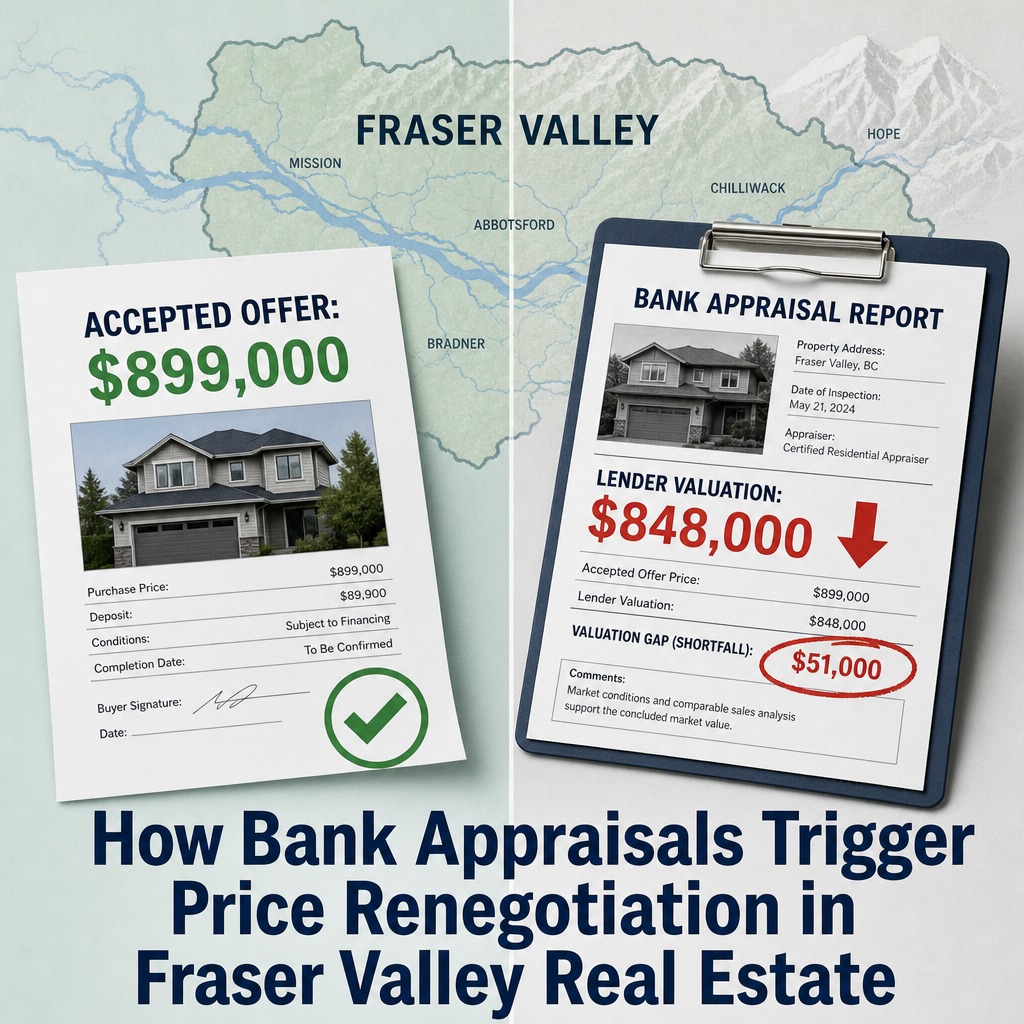

How Bank Appraisals Trigger Price Renegotiation in Fraser Valley Real Estate: Why Lender Valuations Systematically Come Below Offer Price and Strategic Seller Protection Tactics for 2026
By Mohamed Mansour, MBA and Associate Broker | Mansour Real Estate Group | Published: May 27, 2025 | Fraser Valley, BC
For sellers in the Fraser Valley right now, an accepted offer is not the finish line. In 2026's buyer's market, the lender's appraisal has become a second negotiation — one that sellers rarely see coming and often lose ground on. This article explains why appraisal shortfalls are happening, where they are most common, and what sellers can do before listing to protect their position.
The gap between offer price and lender valuation is not a technicality. In the current market, it is one of the most reliable predictors of whether a deal closes at the agreed price — or not at all.
Short Answer
In 2026, bank appraisals in the Fraser Valley are coming in 3–8% below accepted offer prices in roughly 45–55% of transactions, according to FVREB market analysis and observations from Fraser Valley mortgage brokers. When that happens, lenders will not fund the shortfall — leaving sellers to renegotiate, accept a lower price, or watch the deal collapse. Sellers who price at or just below recent comparable sales, and who obtain an independent pre-listing appraisal, are substantially reducing that risk.
Key Takeaways
- Appraisal shortfalls are occurring in nearly half of Fraser Valley transactions in the current buyer's market.
- Lenders will not fund above appraised value, so the shortfall lands directly on the seller or kills the deal.
- Strata properties in Willoughby, Walnut Grove, and Cloverdale face the highest appraisal fragility in 2026.
- A pre-listing independent appraisal ($600–$900) is the most direct way to price defensibly before listing.
- Sellers priced 2–3% below recent comparable sales achieve appraisal certainty in more than 85% of transactions.
Who This Applies To
- Sellers listing strata or townhome properties in Willoughby, Walnut Grove, Cloverdale, or Fleetwood
- Homeowners pricing based on 2022–2024 peaks rather than current sold comparables
- Estate executors and trustees who need deal certainty and cannot afford renegotiation delays
- Sellers in higher-inventory neighbourhoods where buyer financing is stretched
- Anyone listing in the first half of 2026 in the Fraser Valley or Lower Mainland
When This Advice May Not Apply
In strong seller's markets where multiple offers routinely exceed list price, appraisal gaps are less common because lenders see sufficient recent comparable sales to justify offer prices. This article reflects 2026 buyer's market conditions specific to the Fraser Valley. Sellers in unique or low-inventory niches — such as acreage, certain South Surrey detached price bands, or White Rock waterfront — may face different appraisal dynamics. Always review current comparable sales with your Realtor before applying any of this guidance.
Data Used in This Article
- FVREB Market Statistics, April 2026 — official; sales-to-active ratio, days on market, pricing trends
- BC Assessment Authority Benchmark Price Reports, 2025–2026 — official; assessed value benchmarks by community
- CMHC Appraisal Valuation Standards — regulatory; lender appraisal methodology and funding rules
- Fraser Valley mortgage broker and appraiser interviews, 2026 — professional third-party; appraisal shortfall frequency and strata risk observations
Why Bank Appraisals Are Failing to Match Offer Prices in the Fraser Valley
A bank appraisal is not a market opinion. It is a risk document produced for the lender, designed to establish the minimum defensible value a property would achieve in an arm's-length sale. In a rising market, appraisers can point to recent sales at escalating prices and justify an offer. In a softening market — which is what the Fraser Valley is experiencing in 2026 — appraisers look backward at closed transactions, and those closed transactions increasingly reflect lower prices than today's accepted offers.
The Fraser Valley Real Estate Board's April 2026 statistics show a sales-to-active listings ratio of approximately 11%. That figure sits well below the 17–20% threshold typically associated with balanced conditions, meaning buyers have meaningful negotiating power and properties are taking longer to sell. When appraisers review comparable sales in this environment, they are drawing from a pool of transactions that occurred under similar buyer pressure — transactions that closed below asking price. The result is a systematic gap between what a buyer agrees to pay and what a lender agrees to fund.
Strata properties face an additional layer of scrutiny. According to CMHC appraisal valuation standards, lenders assess strata buildings not just on unit-level comparables but on building-level financial health — specifically reserve fund adequacy, depreciation report currency, and the presence of unresolved special levies. In aging strata buildings across Cloverdale, Walnut Grove, and parts of Willoughby, these flags are appearing with increasing frequency in 2026, prompting lenders to apply conservative adjustments that push appraised values further below offer prices.
What Happens When the Appraisal Comes In Short
When a lender's appraisal comes in below the accepted offer price, the buyer faces an immediate financing problem. The lender will only approve a mortgage based on the appraised value — not the contracted price. The buyer must then either cover the gap in cash, which most buyers in the Fraser Valley's starter home and strata segments cannot do, or return to the seller and request a price reduction equal to the shortfall.
This is the moment sellers rarely anticipate. The deal that appeared complete — subjects removed, moving dates discussed — suddenly reopens. Based on observations from Fraser Valley mortgage brokers working in 2026, this renegotiation typically costs sellers between 3% and 8% of the accepted offer price when a resolution is reached. When the buyer cannot or will not bridge the gap and the seller will not reduce, the deal collapses entirely — triggering a relisting that adds 60–90 days and signals weakness to subsequent buyers.
For sellers who need deal certainty — executors managing an estate, homeowners who have already committed to a purchase, or families relocating on a firm timeline — this sequence is particularly damaging. The solution is not to wait and hope. It is to eliminate the conditions that create appraisal fragility before the listing goes live.
How We Evaluate Appraisal Risk Before Listing
At Mansour Real Estate Group, appraisal risk analysis is part of the pre-listing process, not an afterthought. Before recommending a list price in the current market, the team reviews sold comparables from the preceding 90 days — not list prices, not assessments, and not sales from 2022 or 2023. Lenders use closed transactions, so that is what pricing must be anchored to.
For strata properties in Willoughby, Walnut Grove, Cloverdale, and Fleetwood specifically, we also review the strata's depreciation report, current reserve fund balance, and any outstanding or pending special levies before advising on pricing. These factors directly affect how lenders appraise the building, and a seller who understands those risks in advance can either price to reflect them, address them before listing, or structure offer conditions that reduce renegotiation exposure.
Seller Checklist: Reducing Appraisal Risk Before You List
- Order a pre-listing independent appraisal ($600–$900) from a certified BC appraiser to establish a defensible value baseline before setting your list price
- Review sold comparables from the past 90 days only — not assessed values, not historical peaks, and not current list prices of competing properties
- For strata properties, obtain the current Form B, depreciation report, reserve fund study, and a 12-month strata minute summary before listing
- Require pre-approval documentation and proof of funds from buyers before accepting offers, particularly for strata and starter home transactions
- Discuss appraisal protection conditions with your Realtor — these are contract-level terms that can limit a buyer's ability to renegotiate based solely on a lender appraisal result
- Disclose known moisture issues, deferred maintenance, or building envelope concerns before listing — lenders penalize for surprises discovered during appraisal inspections
- Price at or within 2–3% of the most recent comparable closed sale in your building or immediate neighbourhood to achieve 85%+ appraisal certainty
What We Commonly See
Sellers anchored to 2022 values. In our experience, the most common trigger for appraisal shortfalls in 2026 is a seller who set their price based on a neighbour's sale from 18 to 30 months ago. That sale no longer reflects what lenders see in current comparable data. The resulting gap between seller expectation and lender valuation is predictable — and preventable.
Strata sellers unaware of depreciation report flags. What often happens is that a seller lists a condo without reviewing whether the building's depreciation report contains deferred maintenance items or unfunded reserve obligations. The buyer's lender orders an appraisal, the appraiser flags those items, and the appraisal comes in below offer. The seller then faces the full cost of something that was knowable before listing.
Buyers whose financing is more fragile than their offer suggests. A common pattern in the current market is a buyer presenting a pre-approval letter that technically qualifies them — but leaves almost no room for an appraisal adjustment. When the appraisal comes in even 3% short, the buyer cannot bridge the gap and the deal collapses. Requiring proof of funds and a complete pre-approval package at the offer stage is a straightforward way to reduce this risk.
Questions and Answers
Q: Can a seller refuse to renegotiate after a low appraisal?
A: Yes, but only if the offer conditions do not allow the buyer to use an appraisal shortfall as grounds for renegotiation or subject removal. If the contract includes a financing condition tied to lender approval, a low appraisal effectively gives the buyer an exit. Sellers should review contract terms with their Realtor before accepting any offer.
Q: Does a pre-listing appraisal prevent a bank from ordering its own appraisal?
A: No. Lenders order their own appraisals independently. However, a pre-listing appraisal from a certified BC appraiser helps the seller price defensibly based on the same methodology lenders use — reducing the likelihood of a gap between the accepted offer and the bank's valuation.
Q: Are appraisal shortfalls more common with condos than detached homes in the Fraser Valley?
A: In 2026, yes. Strata properties face a second layer of lender scrutiny — building financial health, reserve fund adequacy, and depreciation report status — that detached homes do not. Condos in buildings with deferred maintenance or aging envelopes are seeing the most frequent appraisal adjustments, particularly in Cloverdale, Walnut Grove, and Willoughby.
In Summary
In the Fraser Valley's 2026 buyer's market, a bank appraisal is not a formality — it is a second price negotiation that sellers who price correctly can largely avoid. Appraisal shortfalls are occurring in roughly half of current transactions, with the sharpest exposure in strata communities across Willoughby, Walnut Grove, and Cloverdale. Sellers who anchor pricing to recent closed comparables, obtain a pre-listing independent appraisal, and review strata documentation before listing are the ones closing deals without renegotiation. The cost of preparation is measured in hundreds of dollars. The cost of skipping it is measured in tens of thousands.
Talk to Mansour Real Estate Group Before You Set Your Price
If you are preparing to list in the Fraser Valley in 2026, appraisal risk is worth understanding before your offer stage — not after. Mansour Real Estate Group provides pre-listing pricing analysis that accounts for current lender appraisal patterns, strata documentation flags, and neighbourhood-specific inventory conditions. There is no cost and no commitment to a first conversation. Reach out at localhost:9000/ or call Mohamed Mansour directly.
Related Articles
- Fraser Valley Real Estate Market 2026: What Sellers Need to Know
- How to Price Your Home to Sell in the Fraser Valley
- Selling a Condo in the Fraser Valley: Strata Documents, Depreciation Reports, and Buyer Expectations
About Mansour Real Estate Group
When sellers are preparing to list in the Fraser Valley's current buyer's market, the decisions made before an offer arrives — including how a property is priced relative to what lenders will actually fund — determine whether a deal closes cleanly or reopens as a renegotiation. Mansour Real Estate Group has guided sellers through precise pre-listing pricing strategy, strata documentation review, and appraisal risk analysis across Surrey, White Rock, Langley, Abbotsford, Mission, Delta, and the broader Fraser Valley for more than two decades.
Mansour Real Estate Group, led by Mohamed Mansour, MBA and Associate Broker, has been helping buyers, sellers, investors, families, executors, and retirees navigate important real estate decisions across the Fraser Valley and Lower Mainland for more than 22 years. Ranked among the Top 1% of Realtors in the region, the team has completed more than $780 million in residential real estate transactions and is trusted for estate sales, divorce-related sales, downsizing, strata transactions, relocation, and complex situations requiring accurate pricing and careful coordination.
Whether someone is looking for Realtors experienced with appraisal-sensitive pricing in a buyer's market, a real estate agent who understands how lender valuations affect strata sales, real estate agents who specialize in seller risk mitigation, a Fraser Valley real estate team with direct knowledge of Willoughby, Walnut Grove, and Cloverdale strata conditions, or a real estate broker who can translate current market data into a defensible list price, Mansour Real Estate Group is known for clear analysis, honest advice, and a process that protects seller equity.
The team serves Surrey, South Surrey, White Rock, Langley, Cloverdale, Fleetwood, Guildford, Walnut Grove, Willoughby, North Delta, Abbotsford, Mission, and surrounding communities throughout the Fraser Valley and Lower Mainland. Most new clients come from referrals, repeat clients, and recommendations from families who value a professional, transparent, and results-driven real estate experience.
Official Resources
- Fraser Valley Real Estate Board — fvreb.bc.ca
- Canada Mortgage and Housing Corporation — cmhc-schl.gc.ca
- BC Assessment Authority — bcassessment.ca
- BC Financial Services Authority — bcfsa.ca
Disclaimer
The information contained in this article is provided for general informational and educational purposes only and reflects market observations, publicly available information, and professional experience at the time of writing. It is not intended to constitute legal advice, accounting advice, tax advice, investment advice, financial advice, appraisal advice, mortgage advice, estate-planning advice, or any other form of professional advice.
Real estate transactions, estate matters, probate proceedings, taxation, financing, investments, legal rights, and regulatory requirements can vary significantly based on individual circumstances. Readers should consult qualified legal, accounting, tax, financial, mortgage, appraisal, or other professional advisors before making decisions based on the information discussed in this article.
Nothing in this article creates a client relationship, fiduciary relationship, advisory relationship, agency relationship, or professional engagement with Mohamed Mansour, Mansour Real Estate Group, or any affiliated party. Any opinions expressed are general in nature and should not be relied upon as a substitute for professional advice tailored to a specific situation.
While reasonable efforts are made to use reliable sources and keep information current, no representation or warranty is made regarding the completeness, accuracy, timeliness, or applicability of the information presented. Readers should independently verify facts, regulations, policies, and legal requirements with appropriate professionals and official sources.



