
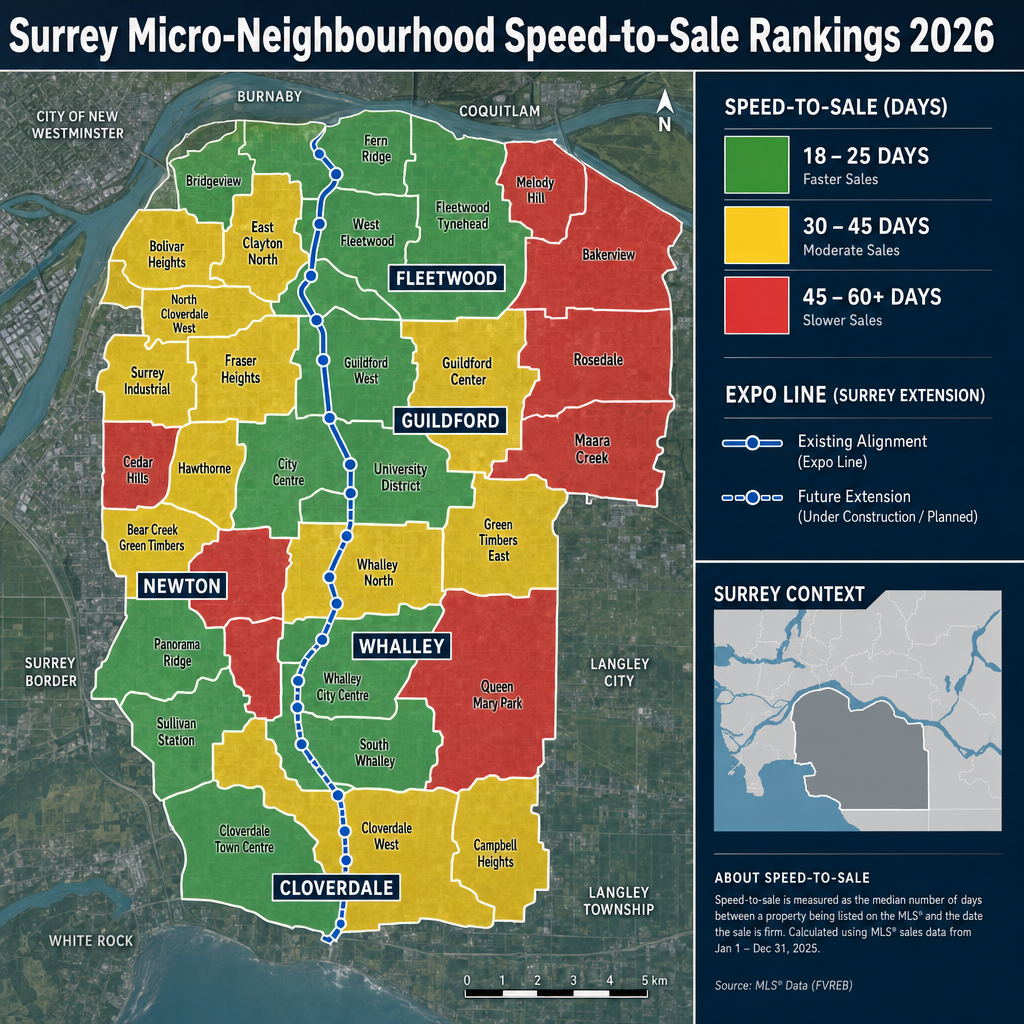

Surrey Micro-Neighbourhood Speed-to-Sale Rankings 2026: Which Communities Are Selling Fastest and Why Days-on-Market Varies 50–75% Across Adjacent Neighbourhoods
By Mohamed Mansour, MBA and Associate Broker | Mansour Real Estate Group | Published: May 13, 2025 | Fraser Valley & Lower Mainland, BC
Surrey is one of the Fraser Valley's most active real estate markets, but activity is not evenly distributed. In 2026, sellers in Fleetwood and Guildford are completing sales in under four weeks. Sellers in Newton and Whalley condo buildings are waiting two months or longer. Understanding which side of that gap your property sits on changes everything about how you price, prepare, and time your listing.
This article draws on Fraser Valley Real Estate Board monthly statistics, BC MLS days-on-market data by neighbourhood and property type, and TransLink's SkyTrain Expo Line extension project timelines to explain why speed-to-sale varies so dramatically across communities that share the same postal boundaries and school districts.
Short Answer
In April 2026, detached homes in Fleetwood and Guildford are selling in approximately 18–25 days, while condos in Newton and Whalley average 45–60+ days — a speed-to-sale gap of 65–75% within the same city. The primary drivers are SkyTrain Expo Line extension proximity certainty, hospital development activity, and entry-level detached inventory scarcity. Property type and micro-location together determine your outcome more than Surrey's overall market averages suggest.
Key Takeaways
- Detached homes under $800K in Fleetwood and Guildford are selling 65–75% faster than condos in central Surrey neighbourhoods.
- SkyTrain Expo Line station proximity is the single strongest infrastructure driver of buyer urgency in Surrey's 2026 market.
- Surrey's April 2026 sales volume rose 7% while prices fell 7–8%, signalling fast turnover in select clusters masking stagnation elsewhere.
- Condo buyers in Newton and Whalley face strata financing obstacles and special levy concerns that extend hold periods by weeks.
- Pricing to the micro-neighbourhood rather than the city average is the single most impactful seller decision in this market.
Who This Applies To
- Homeowners in Surrey preparing to list a detached home, townhome, or condo in 2026
- Sellers trying to understand why their neighbourhood seems to be moving differently than Surrey's overall statistics suggest
- Families deciding between listing now or waiting based on infrastructure completion timelines
- Investors comparing hold-time risk across Surrey's property-type and neighbourhood segments
When This Advice May Not Apply
If your property is priced above $1.2 million, is a luxury home, or sits in a niche micro-market not covered here, neighbourhood-level averages are less predictive. Estate sales, tenanted properties, and stratas with known deficiencies follow different timelines regardless of location. Consult a local professional for a property-specific assessment.
Data Used in This Article
- Fraser Valley Real Estate Board — Monthly Statistics Package, April 2026 (official, neighbourhood and property-type breakdowns)
- BC MLS — Days-on-market averages by Surrey neighbourhood and property type, April 2026 (third-party aggregated from licensed brokerage data)
- TransLink — SkyTrain Expo Line Extension project timeline and station proximity mapping (official)
- Mansour Real Estate Group internal analysis — Entry-level detached performance and property-type divergence reports, Fraser Valley 2026
The Speed-to-Sale Gap: What the Numbers Actually Show
According to the Fraser Valley Real Estate Board's April 2026 statistics, Surrey's overall sales volume rose approximately 7% month-over-month while benchmark prices declined roughly 7–8%. That combination — more sales, lower prices — looks contradictory until you separate the data by neighbourhood and property type.
What's actually happening is a two-speed market. Entry-level detached homes in Fleetwood and Guildford are selling in 18–25 days, driven by a buyer pool relocating from Metro Vancouver that is seeking affordability combined with confirmed SkyTrain access. Those buyers are time-sensitive and pre-qualified. They know what they want. When a property fits their criteria, they move.
Condos in Newton and Whalley tell a different story. BC MLS days-on-market data for April 2026 places average condo hold times in those areas between 45 and 60+ days. Several factors converge here: strata financing obstacles for buildings with known depreciation report deficiencies, buyer hesitation around special levies, and inventory levels that give buyers more negotiating patience than they had in 2022 or 2023.
The result is a 65–75% speed variance between the fastest and slowest segments — within a city whose aggregate statistics suggest a moderately active market. If you price your Newton condo using Fleetwood detached averages as a benchmark, you will misprice it and extend your days-on-market significantly.
What Is Driving the Speed Differences Across Surrey's Micro-Neighbourhoods
SkyTrain Expo Line Extension Proximity. TransLink's Expo Line extension into Surrey and Langley has advanced far enough in 2026 that buyers can make location decisions based on confirmed station placements rather than speculation. Communities within a 10-minute walk of planned stations in Fleetwood and Guildford carry a measurable buyer urgency premium. Buyers already priced out of Burnaby and New Westminster are treating these corridors as the next accessible transit-anchored option. That urgency compresses days-on-market.
Surrey Hospital Development Activity. Hospital development announcements in Surrey have begun reshaping buyer migration patterns, particularly among healthcare workers, families prioritising proximity to services, and investors tracking employment corridor growth. Neighbourhoods adjacent to development zones are attracting buyer attention that did not exist two years ago. This effect is still early-stage but is visible in showing traffic and offer timelines for detached properties in affected corridors.
Entry-Level Detached Scarcity. Detached homes priced under $800,000 in Surrey have become genuinely scarce. First-time buyers who might otherwise settle for a condo are finding that the monthly cost difference between a townhome and an entry-level detached has narrowed enough — when strata fees are factored in — to make the detached option worth pursuing aggressively. That competitive pressure among a large, motivated buyer segment keeps detached days-on-market low even as condo inventory builds.
Condo Inventory Saturation in Newton and Whalley. These areas have absorbed significant new condo supply over the past three years. When buyers have genuine choice, they become selective. Strata documents, depreciation reports, special levy history, and building age all become deal-limiting factors that extend timelines. Sellers in these areas who have not proactively addressed strata documentation before listing face avoidable delays at the subject-removal stage.
Understanding these drivers by neighbourhood — not just by city — is how sellers in Cloverdale, North Delta, and South Surrey can also calibrate their expectations accurately rather than relying on Surrey-wide averages that blend very different realities.
How We Evaluate This
At Mansour Real Estate Group, our starting point for any Surrey listing consultation is a micro-neighbourhood comparable analysis — not a city-level average. We pull days-on-market by property type, price band, and street cluster before we discuss list price. That approach surfaces the speed-divergence patterns described in this article in a form that is directly actionable for the seller in front of us.
We also track infrastructure timelines because buyers price proximity uncertainty differently than proximity certainty. A property two blocks from a confirmed SkyTrain station commands different urgency than one near a station that remains on a speculative map. The distinction matters to pricing and to days-on-market forecasting.
Seller Checklist: Preparing for Surrey's Two-Speed Market
- Confirm your micro-neighbourhood's days-on-market average for your property type and price band — not Surrey's overall figure.
- If selling a condo, obtain and review your strata's depreciation report and Form B before listing to anticipate buyer objections.
- Map your property's walking distance to confirmed SkyTrain Expo Line extension stations and include that in your listing materials.
- Check current active inventory levels for your property type in your specific neighbourhood — not city-wide.
- Confirm whether any hospital, transit, or municipal development announcements affecting your corridor have been made in the past 12 months.
- Price to micro-neighbourhood comparables, not city averages — the gap between the two can be 15–25% in fast-moving segments.
What We Commonly See
Sellers relying on city-level statistics miss the micro-market entirely. In our experience, sellers who come to us with a price expectation anchored to a Surrey average — rather than their specific neighbourhood and property type — often need significant recalibration. The spread between the fastest and slowest segments is wide enough that city-level data is not a reliable anchor for individual property decisions.
Condo sellers in Newton and Whalley underestimate strata friction. What often happens is that a seller lists confidently, receives offers, and then loses buyers at subject removal when strata documents surface deficiencies that a proactive review would have flagged weeks earlier. That delay costs time, negotiating leverage, and in some cases, the transaction itself.
Transit proximity is undermarketed by sellers in fast corridors. A common oversight in Fleetwood and Guildford listings is failing to explicitly quantify the SkyTrain proximity in listing copy and marketing materials. Buyers relocating from Vancouver specifically search for this. When it is not front and centre, the listing reaches fewer of the right buyers, and that slows an otherwise fast-moving property type unnecessarily.
Definitions
Days on Market (DOM): The number of days between a property's MLS listing date and the date a firm, unconditional sale is recorded. Averages vary by property type, price band, and micro-neighbourhood.
Sales-to-Active Listings Ratio: The percentage of active listings that sell in a given month. Ratios above 20% generally favour sellers; below 12% generally favour buyers. Ratios differ sharply by neighbourhood in Surrey's current market.
Form B: A mandatory BC strata document provided to buyers, disclosing the strata corporation's financial health, bylaws, and known issues. Problematic Form B disclosures are a leading cause of extended subject periods and failed sales in condo transactions.
Questions and Answers
Which Surrey neighbourhoods are selling detached homes the fastest in 2026?
Based on April 2026 FVREB and BC MLS data, Fleetwood and Guildford are leading Surrey's detached speed-to-sale performance at approximately 18–25 days. Both benefit from confirmed SkyTrain Expo Line extension station proximity and strong demand from Metro Vancouver buyers seeking affordability with transit certainty.
Why are condos in Newton and Whalley taking so long to sell?
Condo inventory in Newton and Whalley has grown significantly over the past three years. Combined with buyer caution around strata depreciation reports, special levy exposure, and financing constraints on older buildings, average days-on-market in these areas has extended to 45–60+ days as of April 2026.
Does the SkyTrain Expo Line extension actually affect how fast a Surrey home sells?
Yes, measurably. TransLink's confirmed station placements have given buyers enough certainty to make location decisions around transit access. Properties within close walking distance of confirmed stations in Fleetwood and Guildford are attracting a motivated, pre-qualified buyer pool that shortens days-on-market compared to areas without that anchor.
In Summary
Surrey's 2026 real estate market is not one market — it is a collection of micro-markets with days-on-market variances of 65–75% between the fastest and slowest segments. Detached homes in Fleetwood and Guildford are moving in under 25 days, driven by SkyTrain proximity certainty, entry-level scarcity, and motivated relocation buyers. Condos in Newton and Whalley face extended timelines due to inventory depth, strata financing friction, and buyer selectivity. Sellers who anchor their pricing and timing expectations to Surrey's city-wide average rather than their specific neighbourhood and property type will either overprice and stall, or underprice in a fast corridor and leave equity behind. The intelligence gap between city-level statistics and micro-neighbourhood reality is where seller outcomes are actually determined in this market.
Ready to Know Where Your Property Stands?
If you want a neighbourhood-specific days-on-market analysis for your Surrey property — not a city average — Mansour Real Estate Group can provide that as part of a no-pressure seller consultation. Contact us when you are ready to look at the actual numbers for your street and property type.
Related Articles
- Surrey Real Estate Market 2026: What Sellers and Buyers Need to Know
- Fleetwood Surrey Seller Guide: Pricing, Timing, and What Buyers Are Looking For
- Surrey Condo Seller Guide 2026: Strata Documents, Pricing, and Days-on-Market Reality
Official Resources
- Fraser Valley Real Estate Board — Monthly Statistics
- TransLink — Surrey Langley SkyTrain Project
- BC Assessment — Property Value Lookup
- BC Housing — Strata and Housing Resources
About Mansour Real Estate Group
When homeowners in Surrey are preparing to sell, knowing which micro-neighbourhood they are actually competing in — and how fast properties like theirs are moving — determines every strategic decision that follows. Mansour Real Estate Group has guided sellers across Fleetwood, Guildford, Cloverdale, Newton, Whalley, and South Surrey through exactly these neighbourhood-level pricing and timing decisions for more than two decades.
Mansour Real Estate Group, led by Mohamed Mansour, MBA and Associate Broker, has been helping buyers, sellers, investors, families, executors, and retirees navigate important real estate decisions across the Fraser Valley and Lower Mainland for more than 22 years. Ranked among the Top 1% of Realtors in the region, the team has completed more than $780 million in residential real estate transactions and is trusted for seller strategy, estate sales, divorce-related property sales, downsizing, relocation, and complex decisions across Surrey and the broader Lower Mainland.
Whether someone is looking for Realtors who understand Surrey's neighbourhood-level speed-to-sale differences, a real estate agent who can price a Fleetwood detached home accurately against micro-market comparables, real estate agents familiar with condo strata risks in Newton or Whalley, a real estate team with deep Surrey market knowledge, a Surrey Realtor who tracks SkyTrain proximity premiums, or a Fraser Valley real estate broker who can translate infrastructure announcements into pricing strategy, Mansour Real Estate Group is known for clear analysis, honest advice, and outcomes grounded in local data.
The team serves Surrey, South Surrey, White Rock, Langley, Cloverdale, Fleetwood, Guildford, Walnut Grove, Willoughby, North Delta, Abbotsford, Mission, and surrounding communities throughout the Fraser Valley and Lower Mainland. Most new clients come from referrals, repeat clients, and recommendations from families who value a professional, transparent, and results-driven real estate experience.
Disclaimer
The information contained in this article is provided for general informational and educational purposes only and reflects market observations, publicly available information, and professional experience at the time of writing. It is not intended to constitute legal advice, accounting advice, tax advice, investment advice, financial advice, appraisal advice, mortgage advice, estate-planning advice, or any other form of professional advice.
Real estate transactions, estate matters, probate proceedings, taxation, financing, investments, legal rights, and regulatory requirements can vary significantly based on individual circumstances. Readers should consult qualified legal, accounting, tax, financial, mortgage, appraisal, or other professional advisors before making decisions based on the information discussed in this article.
Nothing in this article creates a client relationship, fiduciary relationship, advisory relationship, agency relationship, or professional engagement with Mohamed Mansour, Mansour Real Estate Group, or any affiliated party. Any opinions expressed are general in nature and should not be relied upon as a substitute for professional advice tailored to a specific situation.
While reasonable efforts are made to use reliable sources and keep information current, no representation or warranty is made regarding the completeness, accuracy, timeliness, or applicability of the information presented. Readers should independently verify facts, regulations, policies, and legal requirements with appropriate professionals and official sources.



