
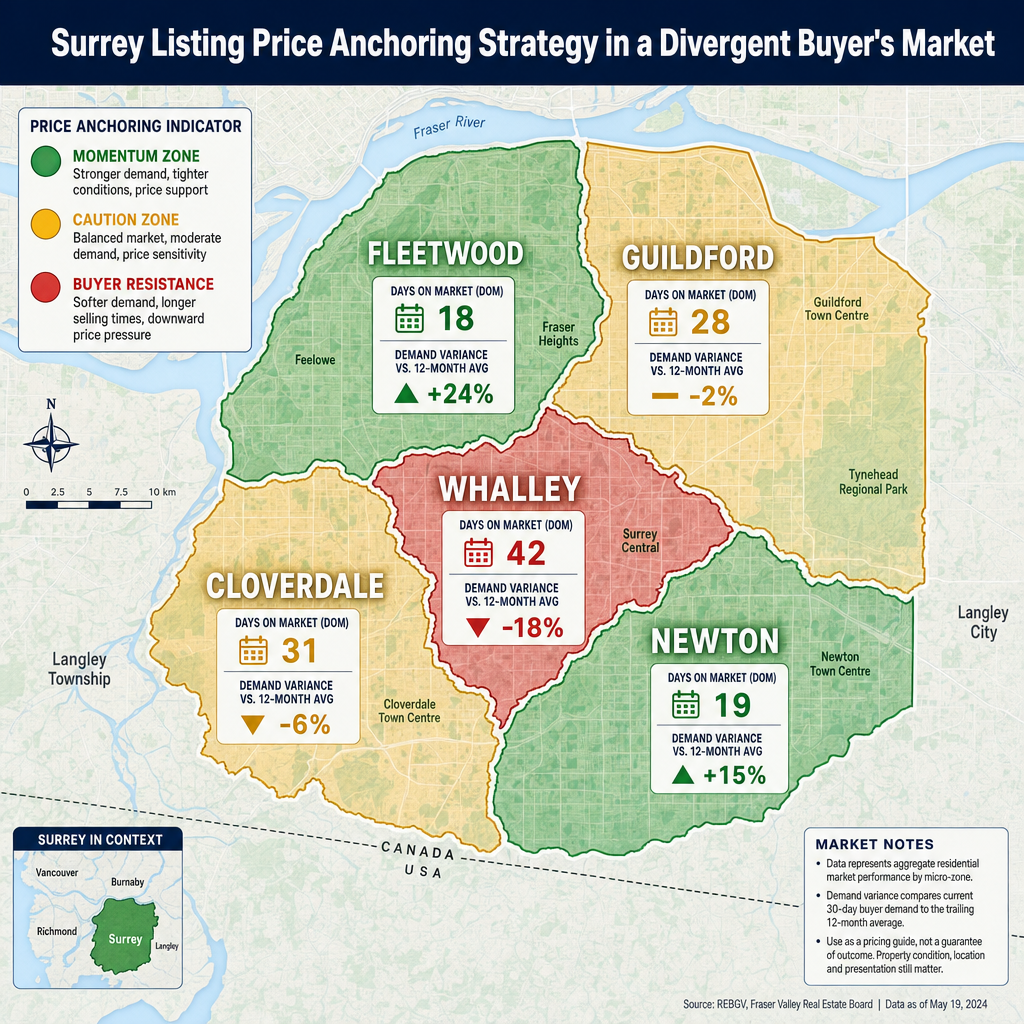

Surrey Listing Price Anchoring Strategy in a Divergent Buyer's Market: How to Set Your Initial Price When Buyer Demand Varies 40–50% Across Micro-Neighbourhoods and Property Types
By Mohamed Mansour, MBA and Associate Broker | Mansour Real Estate Group | Fraser Valley and Lower Mainland | Published: July 15, 2026
In Surrey's current market, setting the wrong opening price does not just slow your sale. It systematically weakens your negotiating position, extends your days on market, and often produces a lower final price than a well-anchored listing launched at the same time. The problem is that Surrey is not one market. It is several markets operating at different speeds, and the pricing logic that works in Fleetwood right now does not apply in Whalley, Cloverdale, or Guildford.
This article explains how to anchor your opening ask using micro-neighbourhood demand signals, property-type buyer behaviour, and days-on-market data — the mechanics that determine negotiating leverage before a single showing is booked.
Short Answer
In Surrey's 2026 divergent buyer's market, your first listing price should be anchored to your specific micro-neighbourhood's current sales velocity and property-type demand — not Surrey-wide benchmarks. Overpricing by 5–10% above recent comparables typically extends days on market by three to five weeks and results in a lower final sale price than a correctly anchored listing. The goal is to trigger showing momentum, not leave room to negotiate down.
Key Takeaways
- Surrey buyer demand varies 40–50% between adjacent micro-neighbourhoods — city-wide benchmarks mislead more than they inform.
- Days-on-market divergence is a demand signal, not just a pricing signal — 18-day detached sales versus 45-day condo DOM reflect different buyer pools.
- Fleetwood and Guildford require different anchoring strategies despite being geographically adjacent, driven by SkyTrain certainty and development perception.
- School catchment boundaries, SkyTrain proximity, and development pipeline certainty create 15–25% pricing variance within Surrey's same postal clusters.
- The first two weeks on market determine your negotiating power — listings that launch correctly rarely need price reductions.
Who This Applies To
- Surrey homeowners preparing to list a detached home, townhouse, or condo in spring or summer 2026
- Sellers in Fleetwood, Guildford, Whalley, Cloverdale, or Newton unsure whether to price at, above, or below recent comparables
- Sellers who received conflicting pricing opinions from different agents and need a framework to evaluate them
- Investors or estate executors selling a Surrey property who need to optimize the opening ask rather than simply list and wait
When This Advice May Not Apply
If your property is unique, has no close comparables, or falls into a specialty category such as a heritage home, large strata-converted lot, or teardown with assembly potential, standard anchoring logic requires significant adjustment. Consult directly for those situations.
Data Used in This Article
- Fraser Valley Real Estate Board (FVREB): Sales-to-active ratios, days-on-market by property type and neighbourhood cluster, Q1–Q2 2026 data releases
- BC Assessment: Benchmark price divergence across Surrey micro-neighbourhoods; historical price correction patterns during elevated-inventory periods
- Mansour Real Estate Group internal transaction data: Listing-to-sale-price ratios and days-on-market outcomes by opening-price strategy across Fleetwood, Cloverdale, Newton, and Whalley
- Published Mansour Real Estate Group analysis: Surrey Micro-Neighbourhood Speed-to-Sale Comparison 2026; Fleetwood Detached Home Pricing Strategy 2026
Why Surrey Requires Micro-Neighbourhood Anchoring, Not City-Wide Benchmarks
Surrey's residential market spans more than 70 square kilometres and contains micro-markets that are functionally as different from each other as Surrey is from Langley or Abbotsford. Using a Surrey-wide benchmark price to anchor your listing is roughly equivalent to using a Lower Mainland average — it smooths out the very variance that determines whether your listing performs or stagnates.
FVREB data for 2026 shows that detached homes in certain Surrey clusters are selling in under 20 days, while condos in adjacent clusters sit for 45 to 50 days or longer before receiving offers. That divergence does not primarily reflect quality differences. It reflects a structural mismatch between what buyers currently want at current price points and what inventory is offering them.
For sellers, the practical implication is that your comparable sales set must be drawn from your immediate micro-neighbourhood — ideally within 800 metres to 1.5 kilometres — and weighted by recency. A comparable sold four months ago in the same building may be less informative than a comparable sold three weeks ago two blocks away, depending on how quickly conditions have shifted.
Fleetwood's detached market, for example, has shown emerging buyer momentum with sales occurring 8–12% below the Surrey detached benchmark — not because the homes are inferior, but because that price band attracts buyers who cannot qualify for South Surrey pricing and are willing to move quickly when the number works. Anchoring a Fleetwood detached home to the Surrey benchmark rather than the Fleetwood-specific comparable set routinely produces overpriced listings that miss this buyer pool entirely. You can read more about that dynamic in the Fleetwood Detached Home Pricing Strategy 2026 analysis.
The Three Anchoring Mechanisms That Determine Your Opening Ask
1. Recency-weighted comparables, not simple averages. Most automated valuation tools average sold prices across a broad date range and geographic radius. In a shifting market, this produces a lagging estimate that reflects conditions three to six months ago rather than the current buyer environment. A properly weighted comparable analysis gives heavier weight to sales from the past 30 to 45 days, narrows the radius to your immediate neighbourhood, and adjusts for property differences systematically rather than by feel. If your neighbourhood has seen only two or three sales in that window, you need to expand slightly and apply a market-direction adjustment rather than simply average the thin data.
2. Days-on-market divergence as a demand signal. The days-on-market number for your property type in your micro-neighbourhood tells you something more important than whether homes are selling: it tells you whether buyers are engaged or waiting. Newton detached homes moving in approximately 25 days indicate an active buyer pool that is willing to act when the price is right. Whalley condos sitting for 45 to 50 days or longer indicate either structural buyer resistance at current price levels, persistent inventory oversupply, or both. These two situations call for fundamentally different anchoring approaches. In a high-velocity zone, anchoring slightly below the comparable average to trigger competitive interest is a rational strategy. In a slow-velocity zone, anchoring slightly below is not enough — the problem may not be solvable through price alone, and overpricing will simply extend an already long DOM trajectory. The Surrey Micro-Neighbourhood Speed-to-Sale Comparison 2026 provides detailed DOM data by cluster.
3. Micro-location premiums and discounts. Within Surrey, school catchment boundaries, SkyTrain station proximity, and development pipeline certainty create price variance of 15–25% between streets that share the same postal code. A detached home one block inside a high-demand school catchment commands a measurable premium over an otherwise identical home one block outside it. A condo within a 5-minute walk of a confirmed SkyTrain station — particularly where construction timelines are certain rather than projected — trades at a premium over equivalent units further away. Sellers need to know exactly where their property sits relative to these micro-premiums before setting their opening ask, because buyers in this market have already done that research. Mispricing a premium property as average, or pricing an average property as premium, both produce poor outcomes through different mechanisms.
Fleetwood vs. Guildford vs. Whalley vs. Cloverdale: Four Different Anchoring Strategies
These four Surrey communities sit within a relatively compact geographic area, but they represent meaningfully different buyer pools, demand velocities, and anchoring contexts in 2026.
Fleetwood is currently attracting detached-home buyers who have been priced out of other markets and are watching for value in the $800K–$1.1M range. Sales velocity for detached homes here is among the stronger clusters in Surrey right now. The anchoring strategy that works here is to price at or slightly below the Fleetwood-specific comparable average — not the Surrey-wide benchmark — to draw multiple buyers into consideration simultaneously. Launching above the local comparable set in Fleetwood means competing with better-located inventory at similar prices, which is a structural disadvantage. See the full Surrey Listing Price Strategy in 2026 for broader context on how this fits the overall market.
Guildford benefits from a perception premium tied to hospital proximity, transit accessibility, and a retail and amenity base that Fleetwood and Cloverdale cannot yet match. Guildford sellers can typically anchor closer to — or at — their comparable average without triggering the buyer hesitation that would follow the same approach in a weaker micro-market. However, Guildford condos face the same headwinds as condos across Surrey broadly, and the Guildford premium applies more consistently to townhouses and detached homes than to the condo segment.
Whalley presents the most challenging anchoring environment in Surrey right now. Condo inventory is elevated, DOM is extended, and buyer hesitation in this segment persists despite affordability that should theoretically attract first-time buyers. The structural issue is that buyer hesitation here is not purely price-driven — it reflects uncertainty about the neighbourhood's development trajectory and the perception gap between what the area is today and what it is projected to become. Pricing a Whalley condo requires a more conservative anchor and realistic expectations about timeline, not an aggressive opening ask hoping buyer sentiment will shift mid-campaign.
Cloverdale behaves more like a small-town market within Surrey — detached homes with character, larger lots, and good school access move relatively well when priced accurately. Cloverdale buyers tend to be specific about what they want, so overpricing a property that does not fully match buyer expectations is particularly costly here. The anchoring strategy should reflect the narrower comparable set and the specificity of the buyer pool rather than attempting to leverage general Surrey-wide appreciation trends.
How We Evaluate This
At Mansour Real Estate Group, every pricing recommendation begins with a micro-neighbourhood comparable analysis that is weighted by recency — typically 30 to 45 days for active markets, extended cautiously for thinner data environments. We layer in days-on-market patterns for the specific property type in the specific sub-area, because a detached home and a condo in the same postal code may be in entirely different market conditions.
We then map micro-location premiums and discounts against that baseline: school catchment, transit proximity, lot characteristics, view exposure, and any development pipeline factors that buyers are already pricing in. The final anchoring recommendation is not a single number — it is a strategy with a primary ask, a defined negotiation band, and a clear rationale for why that position should attract showing activity rather than waiting. For sellers who want to understand how Surrey compares to adjacent communities in this cycle, the Surrey Home Selling in a Buyer's Market guide provides useful framing context.
Seller Checklist: Setting Your Anchored Opening Price in Surrey
- Pull comparable sales from your immediate micro-neighbourhood (800m–1.5km radius) for the past 30–45 days, weighted more heavily than older sales
- Check current days-on-market for your property type in your specific cluster — not Surrey-wide — to determine whether you are in a high-velocity or slow-velocity zone
- Identify your micro-location premiums: school catchment boundary, SkyTrain walk time, development pipeline certainty, lot characteristics
- Determine whether your property warrants a premium anchor (clear differentiation), a market anchor (strong comps, active buyer pool), or a momentum anchor (slightly below comps to trigger competitive interest)
- Review active listings in your price band to understand what buyers are comparing your property against right now, not just what sold previously
- Set a clear negotiation floor before listing — know the number below which you will not go, so your opening ask is a deliberate position, not a guess
- Plan your first two-week response strategy: if showing volume is lower than expected in week one, have a pre-agreed decision point for a price adjustment rather than waiting weeks before acting
What We Commonly See
In our experience, the most costly anchoring mistake Surrey sellers make is using a Surrey-wide benchmark or an automated estimate to set their opening ask, then defending that number through the first three to four weeks of market exposure. By the time a price reduction occurs, the listing has acquired a days-on-market history that signals to buyers that something is wrong — even when nothing is wrong other than the opening number. The final sale price after a reduction and extended DOM is almost always lower than it would have been with an accurate anchor from day one.
What often happens in Whalley condo situations is that sellers price relative to their purchase price or renovation cost rather than current market comparables. The anchor becomes emotional rather than analytical. Buyers see the DOM extending and assume structural problems with the unit or the building, which deepens the resistance rather than resolving it.
A common mistake in the Fleetwood detached segment is pricing to the Surrey detached benchmark rather than the Fleetwood-specific set, which places the listing in a price band where it competes against better-located properties in Guildford or Cloverdale. Buyers who could have been motivated to act quickly in Fleetwood instead redirect their attention to those alternatives. The listing sits while the opportunity window passes.
Questions and Answers
Q: Should I price my Surrey home slightly below market to attract multiple offers, or is that strategy risky in a buyer's market?
A: In high-velocity micro-markets like Fleetwood detached or Newton detached, anchoring slightly below the comparable set can trigger competitive interest. In slower zones like Whalley condos, where DOM is already extended, the same strategy does not reliably produce multiple offers — it may simply result in a lower final price. The answer depends entirely on your specific micro-neighbourhood velocity.
Q: How much does SkyTrain proximity actually affect my Surrey listing price?
A: Incremental premiums vary by line and certainty of the construction timeline. Confirmed station proximity — where construction is active or complete — supports a measurable premium. Projected station proximity, where timelines remain uncertain, has a much smaller effect and can reverse if timelines slip. Buyers in 2026 are distinguishing between these scenarios more carefully than in prior years.
Q: What does days-on-market tell me about whether I should reduce my price?
A: If your showing volume in the first seven to ten days is below what your agent expected given active competing listings, that is the clearest early signal. DOM accumulating without showings means buyer agents are filtering your listing out at the search level — typically a pricing issue. DOM accumulating with showings but no offers suggests buyers are seeing the property but not finding the value — which may require repositioning the price or addressing a presentation issue.
In Summary
Surrey's 2026 market requires a micro-neighbourhood anchoring strategy, not a city-wide pricing approach. Demand velocity varies 40–50% between adjacent communities, property-type buyer behaviour has diverged sharply between detached and condo segments, and micro-location premiums tied to school catchments, SkyTrain proximity, and development pipeline certainty create meaningful variance within postal codes. Sellers who anchor their opening ask to current, recency-weighted, micro-neighbourhood comparables — and who understand whether they are in a high-velocity or slow-velocity zone — consistently outperform sellers who launch at a Surrey-wide benchmark or above-market aspirational number. The first two weeks on market are where negotiating leverage is won or lost.
Ready to Anchor Your Surrey Listing Correctly?
If you are preparing to list in Fleetwood, Guildford, Whalley, Cloverdale, Newton, or anywhere else in Surrey, Mansour Real Estate Group can provide a micro-neighbourhood pricing analysis that goes beyond the standard CMA. The goal is a defensible opening ask that generates showing activity — not a number that requires explanation after the fact. Reach out when you are ready for a direct conversation about your property and your neighbourhood.
Related Articles
- Surrey Home Selling in a Buyer's Market: What Changes When Inventory Is High
- Surrey Micro-Neighbourhood Speed-to-Sale Comparison 2026
- Fleetwood Detached Home Pricing Strategy 2026
Official Resources
- Fraser Valley Real Estate Board — Market Statistics
- BC Assessment — Property Value Information
- BC Financial Services Authority — Real Estate Regulation
- City of Surrey — Development and Planning Information
About Mansour Real Estate Group
When homeowners in Surrey are preparing to list, the pricing decision made before the listing goes live determines their negotiating position for the entire sale. Getting that anchor right — by micro-neighbourhood, property type, and current demand velocity — requires more than a standard market analysis. It requires an understanding of how buyers in that specific pocket of Surrey are behaving right now, and what competing inventory they are comparing your home against. Mansour Real Estate Group has built its reputation in the Fraser Valley and Lower Mainland on exactly that kind of pricing discipline, honest valuations, and a willingness to have direct conversations before a listing goes live rather than after.
Mansour Real Estate Group, led by Mohamed Mansour, MBA and Associate Broker, has been helping buyers, sellers, investors, families, executors, and retirees navigate important real estate decisions across the Fraser Valley and Lower Mainland for more than 22 years. Ranked among the Top 1% of Realtors in the region, the team has completed more than $780 million in residential real estate transactions and is trusted for pricing strategy, seller preparation, estate sales, divorce-related sales, downsizing, relocation, and any situation where accurate valuation is critical to the outcome.
Whether someone is searching for a real estate agent who understands Surrey micro-neighbourhood pricing, Realtors experienced with divergent market conditions across the Fraser Valley, a real estate team that prioritizes protecting seller equity, a Surrey Realtor, a Langley real estate agent, a White Rock real estate broker, or real estate agents who combine local data with honest strategic advice, Mansour Real Estate Group is known for clear recommendations, practical market context, and a process built around the seller's outcome rather than a quick transaction.
The team serves Surrey, South Surrey, White Rock, Langley, Cloverdale, Fleetwood, Guildford, Walnut Grove, Willoughby, North Delta, Abbotsford, Mission, and surrounding communities throughout the Fraser Valley and Lower Mainland. Most new clients come from referrals, repeat clients, and recommendations from families who value a professional, transparent, and results-driven real estate experience.
Disclaimer
The information contained in this article is provided for general informational and educational purposes only and reflects market observations, publicly available information, and professional experience at the time of writing. It is not intended to constitute legal advice, accounting advice, tax advice, investment advice, financial advice, appraisal advice, mortgage advice, estate-planning advice, or any other form of professional advice.
Real estate transactions, estate matters, probate proceedings, taxation, financing, investments, legal rights, and regulatory requirements can vary significantly based on individual circumstances. Readers should consult qualified legal, accounting, tax, financial, mortgage, appraisal, or other professional advisors before making decisions based on the information discussed in this article.
Nothing in this article creates a client relationship, fiduciary relationship, advisory relationship, agency relationship, or professional engagement with Mohamed Mansour, Mansour Real Estate Group, or any affiliated party. Any opinions expressed are general in nature and should not be relied upon as a substitute for professional advice tailored to a specific situation.
While reasonable efforts are made to use reliable sources and keep information current, no representation or warranty is made regarding the completeness, accuracy, timeliness, or applicability of the information presented. Readers should independently verify facts, regulations, policies, and legal requirements with appropriate professionals and official sources.



