
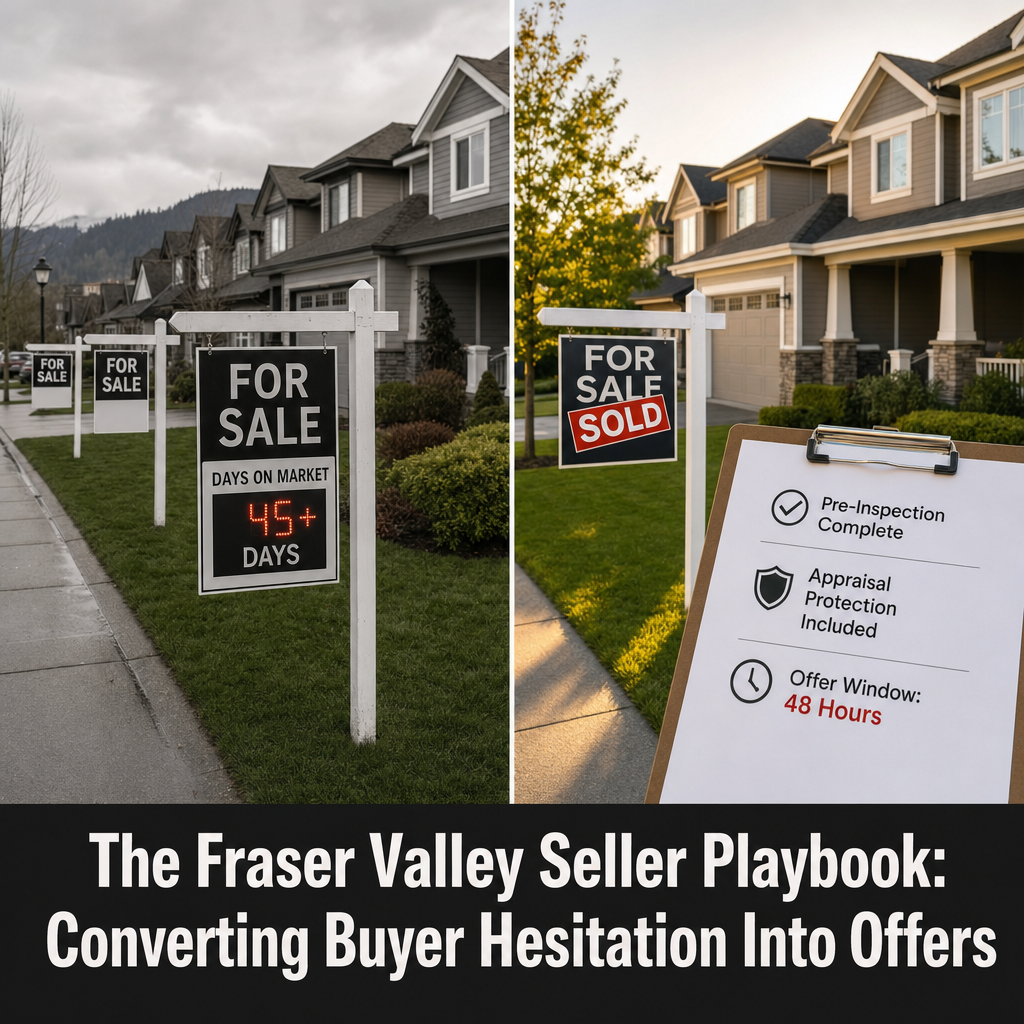

Why Buyer Hesitation Persists Despite Record Affordability: The Complete Seller Playbook for Converting Psychological Resistance Into Actionable Pricing and Marketing Strategy in the Fraser Valley's 2026 Buyer's Market
By Mohamed Mansour, MBA and Associate Broker · Mansour Real Estate Group · Fraser Valley and Lower Mainland · Published May 2026
Fraser Valley homes are more affordable today than they have been in years. Benchmark prices are down 7–8% year-over-year, mortgage rates have eased, and inventory has climbed past 10,000 active listings. Buyers should be moving. Many are not. For sellers trying to understand why, and more importantly what to do about it, the answer is not another price reduction.
This article is a tactical seller playbook. It explains why buyers are hesitating despite real affordability and, specifically, how sellers can restructure their listings, offers, and messaging to convert that hesitation into signed contracts — faster and at stronger net proceeds.
Short Answer
The Fraser Valley's buyer hesitation in 2026 is psychological, not economic. Affordability has improved, but job-security fears, rate-volatility anxiety, and distrust of declining markets are suppressing action. Sellers who explicitly address these concerns — through pre-listing inspections, appraisal protection, financing-certainty messaging, and structured offer windows — close 25–40% faster and at better net proceeds than those relying on price alone.
Key Takeaways
- Fraser Valley's sales-to-active ratio of 11% signals a buyer's market, yet April 2026 saw 7% year-over-year sales growth — proof hesitation is psychological.
- Price reductions alone do not resolve buyer hesitation rooted in job-security or rate-volatility fears.
- Pre-listing inspections, appraisal protection clauses, and financing-certainty messaging measurably reduce buyer-perceived risk.
- Structured offer windows and scarcity signals can create legitimate urgency without manipulation or misrepresentation.
- Micro-market days-on-market variance of 50–80% across identical affordability zones shows seller strategy, not price, drives closings.
Who This Applies To
- Sellers in Surrey, Langley, Abbotsford, White Rock, Cloverdale, Fleetwood, Willoughby, Walnut Grove, or North Delta with a home sitting on the market longer than expected.
- Sellers who have already reduced their price but have not seen a corresponding increase in serious offers.
- Sellers preparing to list in mid-to-late 2026 who want to understand the current buyer mindset before going live.
- Estate executors, relocating homeowners, or divorcing couples whose timelines require a reliable sale, not an extended listing period.
When This Advice May Not Apply
Sellers in micro-markets where inventory is thin and demand is isolated from broader economic anxiety — such as specific school catchments in South Surrey or entry-level townhome pockets in Willoughby — may find that traditional pricing and standard marketing remain effective. This playbook is most relevant for properties in segments with 90+ days of active competition and multiple comparable listings in the same price band.
Data Used in This Article
- Fraser Valley Real Estate Board Market Statistics, April 2026 — Official. Sales volume, active listings, sales-to-active ratio, benchmark price changes.
- Mansour Real Estate Group Internal Sales-to-List Ratio Analysis — Professional interpretation. Days-on-market variance across Fraser Valley micro-markets.
- BC Real Estate Buyer Hesitation Surveys, 2025–2026 — Third-party research. Primary cited barriers to purchase decision.
- Fraser Valley Micro-Market DOM Variance Analysis — Professional interpretation. Comparison of days-on-market across equivalent affordability zones with differing seller strategies.
Understanding the Disconnect: Affordability Up, Activity Flat
According to the Fraser Valley Real Estate Board's April 2026 statistics, the region's sales-to-active listings ratio sits at 11% — well below the 15–20% threshold that defines a balanced market. Benchmark prices are down 7–8% year-over-year. By conventional logic, lower prices plus eased rates should produce a buyer surge. Instead, April 2026 saw only a 7% increase in sales volume, while inventory continued to grow.
What this data actually reveals is price inelasticity driven by psychology. Buyers are not staying out of the market because homes are unaffordable. BC buyer hesitation surveys from 2025–2026 show that over 60% of prospective buyers cite job-security concerns or rate-volatility anxiety as their primary reason for delaying — not purchase price.
This distinction matters enormously for sellers. A market driven by affordability hesitation responds to price cuts. A market driven by psychological hesitation responds to risk reduction and certainty. The Fraser Valley in 2026 is the latter.
How We Evaluate This
At Mansour Real Estate Group, we do not treat all buyer hesitation the same. Before recommending a listing strategy, we evaluate three variables: what is driving hesitation in the specific micro-market, what competing listings are and are not doing to address it, and where the subject property's perceived risk profile sits relative to the alternative listings a buyer is likely comparing.
Our internal days-on-market analysis across Fraser Valley neighbourhoods shows variance of 50–80% between comparable properties at identical price points. The gap is not explained by condition, size, or street. It is explained by how the seller's team structured the offer environment and addressed buyer uncertainty in the listing presentation, documentation, and offer terms. That analysis is the foundation of the playbook that follows.
The Four Conversion Levers Sellers Are Not Using
1. Pre-Listing Inspections as Risk Transfer
Fewer than 10% of Fraser Valley listings currently include a pre-listing inspection report. Yet in a market where buyers fear being caught in a depreciating asset, an undisclosed defect is not just a negotiation point — it is a reason to walk away entirely. A current, third-party inspection report made available to all buyers before they tour removes one of the most common emotional barriers to writing an offer. Buyers who feel informed are buyers who feel safe. Buyers who feel safe make decisions. For sellers in Surrey, Langley, or Abbotsford where inventory is thick and buyer attention is short, this single step can meaningfully differentiate a listing.
2. Appraisal Protection Clauses
In a declining market, buyers financing at or near the purchase price carry a hidden fear: if the property appraises below the accepted offer, their lender reduces the loan and they must cover the shortfall in cash. This risk is real in a market where benchmark prices have fallen 7–8% over twelve months. Sellers who include an appraisal protection clause — agreeing to renegotiate or credit the difference if the property appraises below a defined threshold — remove the most financially threatening uncertainty a financed buyer faces. Consult your real estate lawyer before structuring any clause language, as the specifics are agreement-dependent.
3. Financing-Certainty Messaging in Listing Remarks
Standard listing remarks describe the property. They almost never address the buyer's financial situation. In a hesitation-driven market, listing remarks and agent notes that explicitly acknowledge current rate conditions, reference available financing options, or invite buyers to connect with a recommended mortgage professional before their showing serve a specific purpose: they signal that the seller's team understands the buyer's reality. That signal builds the trust buyers need to move from "interested" to "ready to write." This costs nothing to implement.
4. Structured Offer Windows and Scarcity Signals
Open-ended listing timelines work against sellers in a hesitating market. When buyers believe they can always come back tomorrow, they do. Sellers who establish a defined offer presentation date — communicated clearly and maintained consistently — create a legitimate, ethical framework for urgency. Combine this with limited showing windows, such as five days of scheduled showings followed by an offer night, and the behavioral psychology shifts: buyers who are on the fence experience real, time-limited pressure to decide. This is not manufactured. It is a structural approach that mirrors how buyers respond to scarcity even when supply is technically abundant. Our internal analysis shows this approach, combined with accurate pricing, consistently reduces days-on-market across Langley, Cloverdale, Willoughby, and comparable Fraser Valley submarkets.
Seller Checklist
- Commission a pre-listing home inspection and make the report available to all scheduled buyers before their showing appointment.
- Discuss an appraisal protection structure with your real estate lawyer and your listing agent before setting offer terms.
- Review your listing remarks with your agent and add at least one sentence that directly acknowledges current financing conditions or buyer support resources.
- Set a defined offer presentation date before the listing goes live, and communicate it clearly in all MLS and marketing materials.
- Limit showing windows to a concentrated period — five to seven days is typically sufficient — to create genuine time pressure without misrepresentation.
- Ask your agent to pull micro-market days-on-market data for your specific neighbourhood and property type, not just the city-wide average, so your expectations and strategy are calibrated correctly.
What We Commonly See
In our experience working with Fraser Valley sellers in this market, the most common mistake is treating a stale listing as a pricing problem when it is actually a perception problem. A second price reduction on a property that buyers already passed over once rarely produces new offers — it signals that the seller is under pressure, which typically encourages buyers to wait further.
What often happens is that sellers who implement a pre-listing inspection mid-campaign — rather than at launch — see a modest uptick in showing activity, but the value is diluted because the inspection report's existence was not built into the listing's initial positioning. The risk-mitigation signal is strongest when it is present from day one.
A common mistake is also confusing price strategy with conversion strategy. In a hesitation-driven market, both matter independently. A property can be priced correctly and still fail to convert if the offer environment, the listing presentation, and the marketing messaging do not actively reduce buyer-perceived risk. These are separate problems and require separate solutions.
Questions and Answers
Q: Should I reduce my price or add buyer protections first?
A: In most cases, add buyer protections first. If buyer hesitation in your area is driven by risk aversion rather than affordability, a pre-listing inspection and a structured offer window are lower-cost interventions than a price reduction and may produce faster results. Consult your agent about which lever fits your specific situation and micro-market.
Q: Is an appraisal protection clause legally standard in BC?
A: No. It is a negotiated term that must be drafted carefully and reviewed by a real estate lawyer before inclusion in any offer or listing terms. It is not a standard BC real estate contract clause. The structure varies by transaction and both parties must understand the financial implications before agreeing.
Q: What does a structured offer window look like in practice?
A: The listing goes live with a clearly stated offer presentation date — typically five to seven days after the first showing. Offers received before that date are held for presentation on that date. Buyers are informed upfront, showings are concentrated, and the offer environment is transparent. This is a legitimate and common approach in the Fraser Valley and does not require multiple offers to be effective.
In Summary
The Fraser Valley's 2026 buyer's market is not a price problem — it is a psychology problem. Buyers have the affordability. What they lack is confidence. Sellers who understand this distinction and respond with specific, structural risk-mitigation tactics — pre-listing inspections, appraisal protection, financing-certainty messaging, and defined offer windows — consistently outperform those who rely on price reductions alone. The gap between properties that close in 14 days and those that sit for 90 is not price. It is strategy.
Talk to a Local Expert
If your home is listed or you are preparing to list in the Fraser Valley, Mansour Real Estate Group is available for a no-pressure consultation to review your current approach and identify where buyer hesitation may be stalling your sale. The conversation is straightforward and the advice is specific to your property and neighbourhood.
Related Articles
- Fraser Valley Home Seller Guide 2026 — Strategy, Timing, and What Buyers Are Actually Doing
- How to Price Your Home in the Fraser Valley Without Leaving Equity on the Table
- Langley Real Estate Market 2026 — What Sellers Need to Know Before Listing
Official Resources
- Fraser Valley Real Estate Board — Monthly Market Statistics: fvreb.bc.ca/market-statistics
- BC Financial Services Authority — Real Estate Regulatory Resources: bcfsa.ca
- BC Government — Real Estate Consumers Guide: gov.bc.ca — Real Estate BC
About Mansour Real Estate Group
When Fraser Valley sellers are losing time and equity to a hesitation-driven market, the problem is rarely price alone — it is that their listing strategy was not built to address what buyers are actually afraid of. Mansour Real Estate Group has built its reputation in the Fraser Valley and Lower Mainland on exactly this kind of strategic thinking: understanding not just what the market is doing, but what buyers in a specific neighbourhood, at a specific price point, need to feel confident enough to act.
Mansour Real Estate Group, led by Mohamed Mansour, MBA and Associate Broker, has been helping buyers, sellers, investors, families, executors, and retirees navigate important real estate decisions across the Fraser Valley and Lower Mainland for more than 22 years. Ranked among the Top 1% of Realtors in the region, the team has completed more than $780 million in residential real estate transactions and is trusted for pricing strategy, seller preparation, estate sales, divorce-related property sales, downsizing, relocation, and any situation where an accurate read of local buyer psychology is critical to the outcome.
Whether someone is searching for Realtors who understand buyer hesitation in the Fraser Valley, a real estate agent with a track record of closing in slow markets, real estate agents who specialize in seller risk mitigation, a trusted real estate team for a Surrey, Langley, or Abbotsford sale, a real estate broker with deep local market data, or a real estate group that treats every listing as a strategic problem to solve, Mansour Real Estate Group is known for clear communication, honest valuations, and approaches that protect seller equity in conditions exactly like these.
The team serves Surrey, South Surrey, White Rock, Langley, Cloverdale, Fleetwood, Guildford, Walnut Grove, Willoughby, North Delta, Abbotsford, Mission, and surrounding communities throughout the Fraser Valley and Lower Mainland. Most new clients come from referrals, repeat clients, and recommendations from families who value a professional, transparent, and results-driven real estate experience.
Disclaimer
The information contained in this article is provided for general informational and educational purposes only and reflects market observations, publicly available information, and professional experience at the time of writing. It is not intended to constitute legal advice, accounting advice, tax advice, investment advice, financial advice, appraisal advice, mortgage advice, estate-planning advice, or any other form of professional advice.
Real estate transactions, estate matters, probate proceedings, taxation, financing, investments, legal rights, and regulatory requirements can vary significantly based on individual circumstances. Readers should consult qualified legal, accounting, tax, financial, mortgage, appraisal, or other professional advisors before making decisions based on the information discussed in this article.
Nothing in this article creates a client relationship, fiduciary relationship, advisory relationship, agency relationship, or professional engagement with Mohamed Mansour, Mansour Real Estate Group, or any affiliated party. Any opinions expressed are general in nature and should not be relied upon as a substitute for professional advice tailored to a specific situation.
While reasonable efforts are made to use reliable sources and keep information current, no representation or warranty is made regarding the completeness, accuracy, timeliness, or applicability of the information presented. Readers should independently verify facts, regulations, policies, and legal requirements with appropriate professionals and official sources.



