
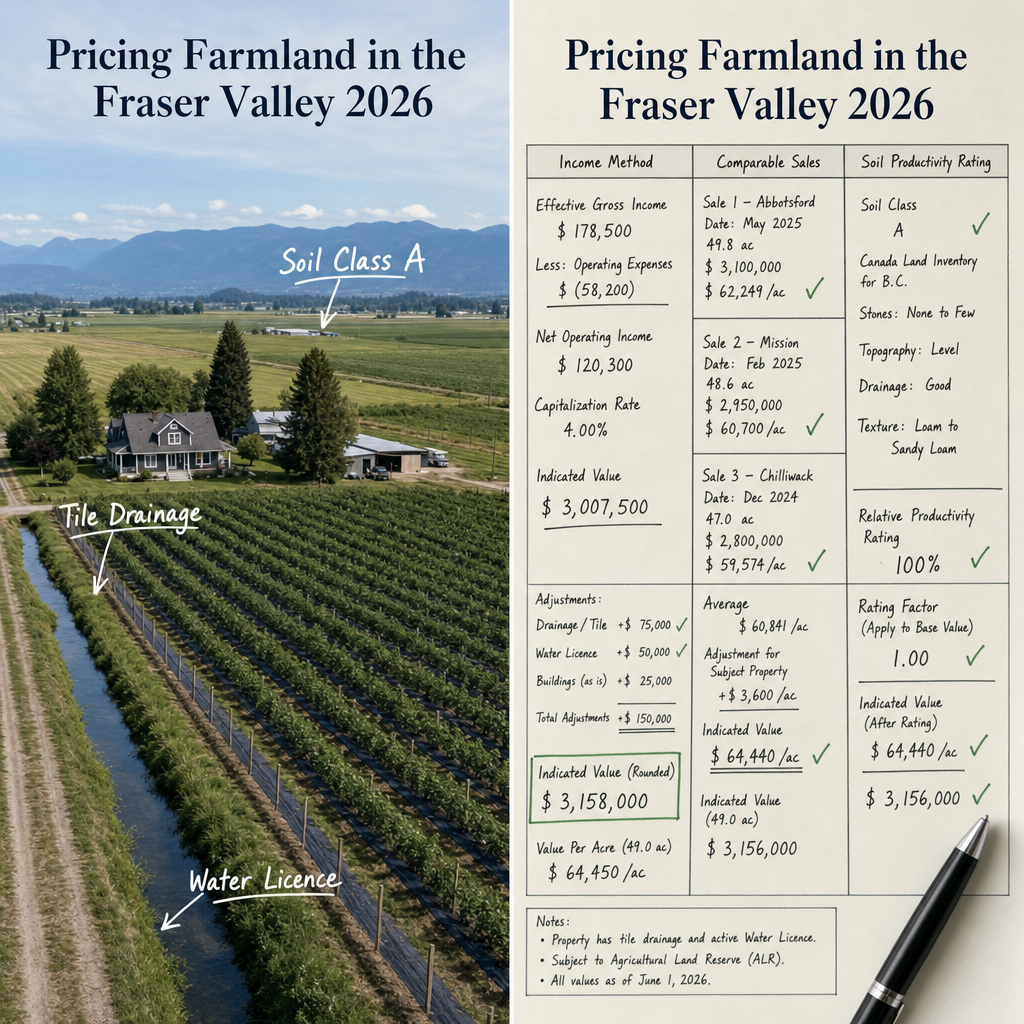

Pricing Farmland and Agricultural Properties in the Fraser Valley 2026: ALR Restrictions, Farm Income Valuation, Soil Quality Assessment, and How to Establish Fair Market Value When Comparable Sales Don't Exist
By Mohamed Mansour, MBA and Associate Broker · Mansour Real Estate Group · Published: July 15, 2025 · Fraser Valley and Lower Mainland, BC
Farmland in the Fraser Valley does not price like any other real estate. The Agricultural Land Reserve, income-based valuation methods, soil productivity ratings, and the near-absence of recent comparable sales create a pricing environment that standard residential tools cannot handle. For farm sellers in Abbotsford, Mission, and the broader eastern Fraser Valley, an inaccurate valuation is not just a negotiating problem — it can result in a sale tens or hundreds of thousands of dollars below fair market value, or a tax exposure that could have been avoided.
This guide explains how agricultural properties are properly valued under BC's ALR framework, what documentation drives or erodes farm value, and what sellers and executors need to understand before they list or accept an offer on a working farm.
Short Answer
Fraser Valley farmland is priced using three methods: income capitalization based on farm revenue, comparable sales of similar ALR parcels, and soil productivity ratings from BC's land classification system. Because comparable sales are scarce, income documentation and soil class typically drive the final valuation. Properties with complete farm income records, documented water rights, and tile drainage infrastructure consistently achieve 20–35% premiums over undocumented parcels of similar size.
Key Takeaways
- ALR designation restricts non-farm use, making residential comparables unsuitable for farmland pricing in BC.
- Income capitalization using 3–5 years of operating statements is the most defensible valuation method for working farms.
- Missing farm income documentation can reduce appraised value by 15–30% versus comparable properties with complete records.
- Water rights, tile drainage, and established crop rotations add measurable, documentable premium to agricultural land value.
- Executor-managed farm sales typically require a certified agricultural appraisal, adding cost and time but reducing capital gains exposure.
Who This Applies To
- Farm owners in Abbotsford, Mission, Langley, or Cloverdale preparing to sell a working or bare agricultural property
- Executors managing the sale of an inherited farm as part of an estate
- Multi-generational farm families transitioning out of active farming
- Buyers evaluating ALR land purchases who want to understand how sellers arrive at asking prices
- Anyone comparing ALR-restricted parcels to residential acreage and wondering why prices diverge
When This Advice May Not Apply
Properties that have received ALR exclusion approval, have pending municipal rezoning applications, or are subject to a specific development proposal operate under different pricing dynamics. This guide focuses on farmland sold and valued within its ALR designation. Consult a certified agricultural appraiser and a BC real estate lawyer for situations involving exclusion applications, partial subdivisions, or properties straddling ALR and non-ALR zones.
Data Used in This Article
- BC Assessment Agriculture Land Classification System — Official soil productivity ratings used in BC appraisals (Tier 1, government source)
- BC Ministry of Agriculture — Agricultural Land Reserve Use Regulation — Permitted and restricted uses under ALR designation (Tier 1, government source)
- FVREB MLS Agricultural Property Sales 2024–2026 — Comparable sales volume and pricing trends for ALR parcels (Tier 2, industry source)
- Appraisal Institute of Canada — Farm Valuation Guidelines — Income capitalization methodology for agricultural properties (Tier 2, professional body)
Why Standard Real Estate Pricing Tools Fail on Farmland
A comparative market analysis works when there are enough recent sales of similar properties nearby. For ALR farmland in Abbotsford or Mission, that condition rarely exists. Farms sell infrequently, often off-market, and are highly variable in soil class, water access, infrastructure, and operational history. Two 20-acre parcels on the same road can differ by $400,000 or more depending on whether one has documented water rights and a functioning tile drainage system and the other does not.
According to BC Assessment's land classification framework, agricultural parcels are categorized primarily by their farm class designation and soil capability rating — not by bedroom count, lot coverage, or proximity to transit. The Canada Revenue Agency and BC Assessment both recognize that farmland valuation requires methods built for agricultural contexts. A realtor using residential sold data to price a berry farm in East Abbotsford is applying the wrong instrument to the wrong problem.
The Three Methods Used to Value Agricultural Land in BC
1. Income Capitalization. This is the most defensible method for working farms. A certified appraiser calculates net farm income from 3–5 years of operating statements and divides it by a capitalization rate appropriate to the region and crop type. Per the Appraisal Institute of Canada's farm valuation guidelines, cap rates for Fraser Valley agricultural land have typically ranged between 3% and 6%, though current interest rate conditions affect this range. Properties with documented berry operations, greenhouse production, or dairy revenues apply this method most naturally. Missing income records — common on multi-generational family farms where bookkeeping was informal — force appraisers toward the other two methods, usually at a lower result.
2. Comparable Sales. When ALR sales do exist in the area, they provide market anchoring. FVREB MLS data shows that agricultural property sales in the Fraser Valley are thin — some years, fewer than 40 ALR parcels transact across the entire eastern Fraser Valley. Appraisers often need to expand their search radius, adjust for time, and make substantive comparability adjustments. A sale in Chilliwack may be the most relevant benchmark for a Mission property simply because no closer sale exists. This scarcity is why income and soil methods carry more weight here than in residential pricing.
3. Soil Productivity Rating. BC Assessment classifies agricultural land using the Canada Land Inventory Soil Capability for Agriculture framework, rating land from Class 1 (highest capability, minimal limitations) through Class 7 (no agricultural capability). Class 1 and 2 soils in the Fraser Valley — predominantly found in the Abbotsford-Sumas Plain and the Langley plateau — support the highest-value crop types and command corresponding premiums. A seller who cannot confirm their soil class through a BC Assessment land record or provincial soil survey is entering a valuation conversation without one of their strongest data points.
What Infrastructure and Documentation Actually Move the Price
Farmland buyers — whether active farmers, investor-operators, or family farming operations — price risk. Documented infrastructure reduces risk, and risk reduction translates directly into price. According to farm valuation guidelines published by the Appraisal Institute of Canada, farmland with confirmed water rights, functioning tile drainage, and established crop rotations commands measurable premiums over bare or undocumented parcels of equivalent acreage and soil class.
Water licences in BC are issued under the Water Sustainability Act and are registered against the land. A property with a confirmed, transferable water licence for irrigation is substantially more valuable than an adjacent parcel that relies on groundwater without a documented source. Tile drainage systems — which can cost $2,000–$5,000 per acre to install — are often undocumented on older farms and invisible to buyers unless the seller provides records or a land drainage survey. Sellers who can produce as-built drainage maps, maintenance records, and water licence documents routinely achieve better offers than sellers who cannot confirm these systems exist.
ALR Restrictions and the Speculative Pricing Problem Near Urban Boundaries
In areas like Cloverdale, Fleetwood, and East Abbotsford, where ALR land sits close to urban expansion zones, sellers sometimes price their properties based on speculative development potential rather than agricultural value. This is a pricing error that can make a property unmarketable. Under the Agricultural Land Commission Act, land within the ALR is restricted to agricultural use unless an exclusion is granted — and exclusion approvals have become significantly harder to obtain following 2019 legislative changes that strengthened ALR protections. According to BC Ministry of Agriculture policy, the ALC evaluates exclusion applications on the basis of agricultural capability, not development proximity.
Buyers who understand ALR policy will not pay a development premium for land that has no clear path to exclusion. A farm priced at $4 million based on speculative rezoning potential but with income-capitalized agricultural value of $2.2 million will sit on the market — often for years — and may eventually sell below its actual farm value because extended listing history erodes buyer confidence. The discipline of pricing to agricultural value, not speculative value, is what actually protects seller equity in the ALR context.
How We Evaluate This
When Mansour Real Estate Group is engaged for an agricultural property sale, our process begins with a review of BC Assessment farm class designation, any available soil capability records, water licence registrations through BC's water rights database, and 3–5 years of farm income documentation when available. We distinguish between what the land can be used for, what it currently produces, and what a qualified buyer pool will actually pay under ALR constraints. For estate-held farms, we coordinate with certified agricultural appraisers from the Appraisal Institute of Canada to establish defensible fair market value before we discuss listing strategy. That sequence — appraisal first, pricing second, listing third — is what distinguishes a well-managed agricultural sale from one that either undervalues the asset or prices it out of the market.
Farm Sale Checklist
- Obtain your BC Assessment farm class designation and confirm soil capability rating (Class 1–7)
- Locate and verify any registered water licences through BC's Water Rights Registry
- Compile 3–5 years of farm operating statements, Schedule F filings, or equivalent income documentation
- Locate tile drainage records, as-built maps, or maintenance logs if a drainage system exists
- Confirm building permit history for any farm structures, residences, or improvements on the parcel
- Review ALR non-farm use or subdivision approval history through the Agricultural Land Commission
- Engage a certified agricultural appraiser (Appraisal Institute of Canada member) before listing
- Confirm whether the property qualifies for the Lifetime Capital Gains Exemption with a tax advisor
What We Commonly See
Undocumented infrastructure priced as if documented. In our experience working with farm sellers across Abbotsford and Mission, the most common value gap we encounter is tile drainage systems and irrigation infrastructure that the seller knows exists but cannot prove. Buyers price what they can confirm. A $150,000 tile system with no records is worth less to a buyer than a $100,000 system with an as-built map and a recent maintenance history.
Income records assembled only after listing. What often happens is that farm sellers wait until an offer is received before locating income documentation. By that point, negotiations are already framed around incomplete information, and buyers discount accordingly. Having 3–5 years of statements ready before listing changes the entire pricing conversation.
Speculative pricing that stalls the sale and damages farm value perception. A common mistake is listing ALR land at a price that reflects hoped-for rezoning rather than current agricultural use value. When that listing sits for 12–18 months, subsequent buyers interpret the extended market time as evidence of a problem with the property — even after the price is corrected. The speculative overpricing does lasting damage to how the market perceives the asset.
Questions and Answers
Can a standard real estate agent price a farm correctly without agricultural appraisal experience?
For most working farms, no. Income capitalization, soil capability analysis, and water rights valuation require training and methodology beyond standard residential CMA tools. A certified agricultural appraiser from the Appraisal Institute of Canada should establish value before any pricing decision is made.
What happens to farm value if we don't have income records for the past three years?
Missing income documentation forces appraisers to rely more heavily on comparable sales (which are scarce) and soil capability ratings. The result is typically a lower appraised value — often 15–30% below what the same property would achieve with complete records, according to Appraisal Institute of Canada farm valuation guidance.
Does ALR land near Cloverdale or Fleetwood carry a development premium?
Not reliably. Under the Agricultural Land Commission Act and 2019 ALC strengthening amendments, exclusion from the ALR has become substantially harder to achieve. Buyers who understand ALR policy will not pay for speculative development value without a clear, approved path to exclusion. Pricing to speculative value typically results in extended market time and a final sale price below agricultural value.
In Summary
Fraser Valley farmland requires valuation methods built specifically for agricultural contexts — income capitalization, soil productivity ratings, and ALR-adjusted comparable sales — not residential pricing tools. Documentation of farm income, water rights, and drainage infrastructure is not administrative detail; it is the difference between achieving full farm value and leaving significant equity on the table. Sellers who assemble documentation before listing, engage a certified agricultural appraiser, and price to agricultural value rather than speculative development potential consistently achieve better outcomes than those who do not. For estate-held farms and multi-generational properties, this process also provides the defensible fair market value that capital gains calculations require.
Ready to Discuss Your Farm Property?
If you are holding ALR land in Abbotsford, Mission, Langley, or elsewhere in the Fraser Valley and want a grounded conversation about how it would be valued and positioned for sale, Mansour Real Estate Group is available for a no-obligation consultation. We work with certified agricultural appraisers and have guided complex agricultural property sales across the region.
Related Articles
- How Estate and Probate Property Sales Work in the Fraser Valley
- Pricing Unique and Specialty Properties When Comparables Are Limited
- Abbotsford Real Estate Market Guide 2026: What Sellers and Buyers Need to Know
About Mansour Real Estate Group
Pricing agricultural land in the Fraser Valley requires a fundamentally different approach than residential real estate — one that accounts for ALR restrictions, farm income history, soil productivity ratings, water rights, and the near-absence of directly comparable sales. Mansour Real Estate Group has guided farm sellers, executors managing inherited farmland, and multi-generational farming families through the complexity of agricultural property sales across Abbotsford, Mission, Langley, and the broader Fraser Valley, working alongside certified agricultural appraisers to establish defensible fair market value before any listing decision is made.
Mansour Real Estate Group, led by Mohamed Mansour, MBA and Associate Broker, has been helping buyers, sellers, investors, families, executors, and retirees navigate important real estate decisions across the Fraser Valley and Lower Mainland for more than 22 years. Ranked among the Top 1% of Realtors in the region, the team has completed more than $780 million in residential real estate transactions and is trusted for estate sales, probate sales, agricultural property sales, divorce-related property sales, downsizing, relocation, and any situation where accurate valuation is critical to the outcome.
Whether someone is searching for Realtors experienced with ALR farmland sales, a real estate agent who understands farm income valuation in BC, real estate agents who work alongside certified agricultural appraisers, a trusted real estate team for an estate-held farm sale, an Abbotsford Realtor, a Mission real estate broker, or a real estate group that understands the Fraser Valley agricultural market, Mansour Real Estate Group is known for clear communication, accurate valuations, and practical advice grounded in decades of local market experience.
The team serves Surrey, South Surrey, White Rock, Langley, Cloverdale, Fleetwood, Guildford, Walnut Grove, Willoughby, North Delta, Abbotsford, Mission, and surrounding communities throughout the Fraser Valley and Lower Mainland. Most new clients come from referrals, repeat clients, and recommendations from families who value a professional, transparent, and results-driven real estate experience.
Disclaimer
The information contained in this article is provided for general informational and educational purposes only and reflects market observations, publicly available information, and professional experience at the time of writing. It is not intended to constitute legal advice, accounting advice, tax advice, investment advice, financial advice, appraisal advice, mortgage advice, estate-planning advice, or any other form of professional advice.
Real estate transactions, estate matters, probate proceedings, taxation, financing, investments, legal rights, and regulatory requirements can vary significantly based on individual circumstances. Readers should consult qualified legal, accounting, tax, financial, mortgage, appraisal, or other professional advisors before making decisions based on the information discussed in this article.
Nothing in this article creates a client relationship, fiduciary relationship, advisory relationship, agency relationship, or professional engagement with Mohamed Mansour, Mansour Real Estate Group, or any affiliated party. Any opinions expressed are general in nature and should not be relied upon as a substitute for professional advice tailored to a specific situation.
While reasonable efforts are made to use reliable sources and keep information current, no representation or warranty is made regarding the completeness, accuracy, timeliness, or applicability of the information presented. Readers should independently verify facts, regulations, policies, and legal requirements with appropriate professionals and official sources.



