
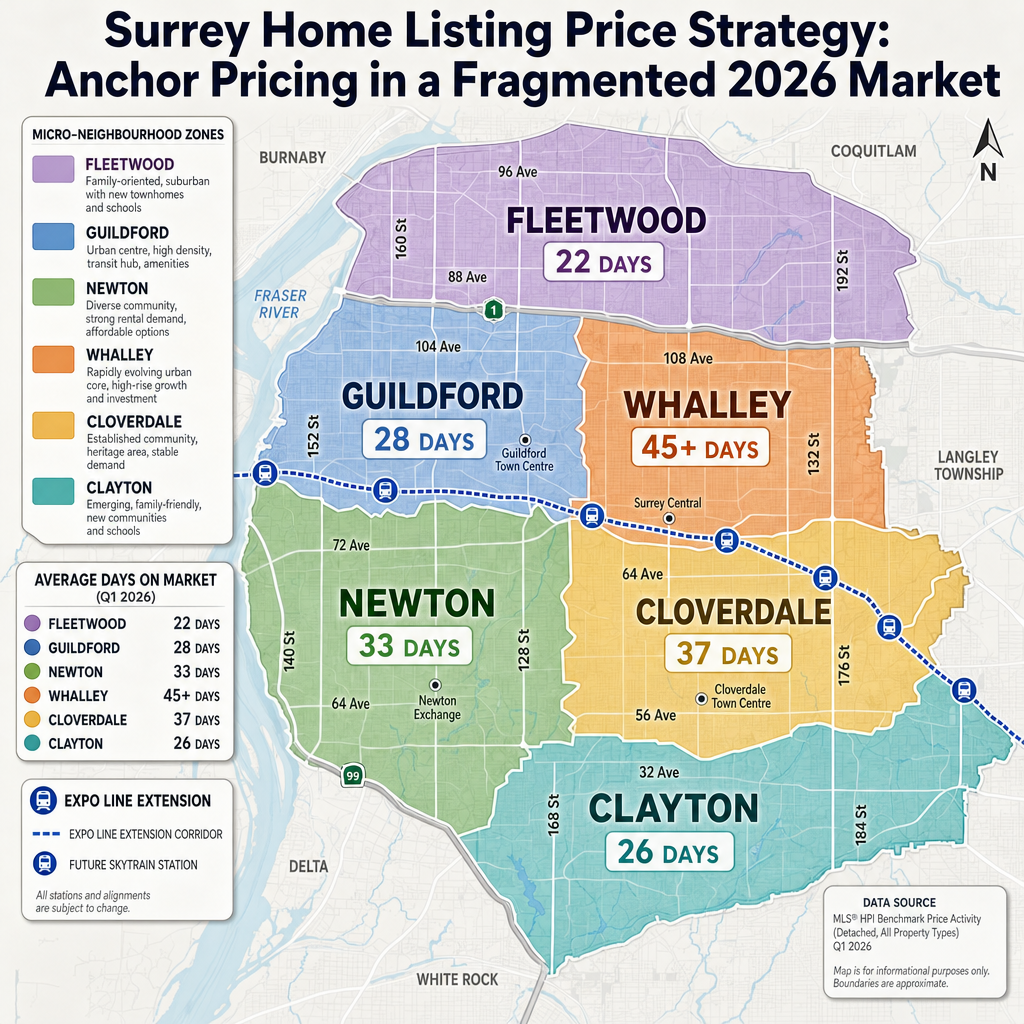

Surrey Home Listing Price Strategy: Data-Driven Anchor Pricing When Buyer Demand Varies 40–50% Across Micro-Neighbourhoods in a 2026 Buyer's Market
By Mohamed Mansour, MBA and Associate Broker — Mansour Real Estate Group | Published: July 22, 2025 | Geography: Surrey, Fleetwood, Guildford, Newton, Whalley, Cloverdale, Fraser Valley, BC
Surrey's real estate market in 2026 does not behave as a single market. It behaves as ten or twelve overlapping micro-markets that share a city boundary but diverge sharply in buyer demand, days-on-market, and price tolerance. For homeowners preparing to sell, this divergence is the most important pricing variable they will face — and it is the one most commonly ignored when sellers rely on broad benchmark comparisons or BC Assessment values to set their asking price.
This guide explains the mechanics of setting a listing price in Surrey's 2026 buyer's market: how to weight comparable sales, adjust for neighbourhood velocity differences, apply seasonal correction, and anchor a price that attracts qualified buyers without triggering the stale-listing penalty that costs sellers far more than a modest initial discount would have.
Short Answer
In Surrey's 2026 buyer's market, accurate listing price strategy requires neighbourhood-specific comparable weighting, not just benchmark averages. Fleetwood detached homes sell in roughly 22 days while Newton equivalents take 45 or more. Listing 5–8% above verified market value risks 60–90+ days on market, forced reductions, and a final price lower than a sharper opening ask would have produced.
Who This Applies To
- Homeowners in Surrey preparing to list a detached home in 2026
- Sellers in Fleetwood, Guildford, Newton, Whalley, Cloverdale, or Clayton evaluating whether a CMA reflects their actual micro-market
- Sellers who received a BC Assessment notice and are using it as a pricing anchor
- Owners who had a previous listing expire or lapse without a sale
- Anyone selling a Surrey home in a shoulder season (fall or winter) and wondering whether spring timing is worth waiting for
When This Advice May Not Apply
This framework applies to detached residential properties in Surrey's general housing market. Condo pricing in strata buildings, commercial rezoning situations, and estate sales subject to probate court timelines involve additional factors not fully addressed here. Consult a qualified real estate professional for advice specific to your property and circumstances.
Key Takeaways
- Surrey's buyer demand velocity differs by 50–75% across neighbourhoods just 2–3 km apart — one pricing model cannot serve all of them.
- BC Assessment values systematically overstate market value by 5–12% in current buyer's market conditions — they are a tax reference, not a pricing tool.
- Properties listed 5–8% above verified market value risk stale-listing status within 30 days, often forcing reductions of 10–15% by week 10.
- SkyTrain proximity premiums of 8–15% apply now in Fleetwood and Guildford but are expected to normalize within 2–3 years of line opening.
- Spring seasonality adds 15–25% to buyer velocity — sellers listing in fall or winter need to price more aggressively to compensate for reduced foot traffic.
Data Used in This Article
- FVREB Monthly Market Reports 2025–2026 — Surrey micro-market analysis by neighbourhood — Official board data
- BC MLS Days-on-Market Data — Postal code and property type breakdowns for Cloverdale, Guildford, Fleetwood, Newton, Whalley — Official MLS system data
- Metro Vancouver Transit Authority 2026 — SkyTrain Expo Line Extension Project Timeline and Transit-Oriented Development Impact Analysis — Official municipal/transit source
- Surrey Official Community Plan 2026 — Zoning and hospital development project updates — Official municipal source
- Mansour Real Estate Group — CMA quality and comparable sales weighting research — Internal professional analysis
Why Surrey's Pricing Problem Is Structural, Not Just Seasonal
According to Fraser Valley Real Estate Board data covering 2025–2026, Surrey's combined sales-to-active ratio sits at approximately 11% — deep buyer's market territory. But that number masks extraordinary variance at the neighbourhood level. Fleetwood detached homes have averaged around 22 days-on-market, while comparable Newton and Whalley properties have tracked at 45 days or more. That is not a small statistical blip. It represents a fundamentally different pricing environment for sellers separated by minutes of driving time.
The structural driver behind Fleetwood and Guildford's current velocity advantage is the Expo Line extension, which Metro Vancouver Transit Authority project timelines place on a 2026–2027 opening schedule. Buyers who understand transit-oriented development are migrating toward station-adjacent properties before the line opens, creating a compressed pricing window that is real but time-limited. According to BC MLS data segmented by postal code, properties within 500 metres of planned SkyTrain stations in these neighbourhoods are commanding premiums of 8–15% over otherwise comparable homes 800 metres or more away. That premium is already compressing as opening day approaches, and research on post-opening transit corridors consistently shows it normalizes within 2–3 years of service launch.
Sellers in Newton, Whalley, and Clayton face a different structural reality. Surrey's hospital development project, referenced in the 2026 Surrey Official Community Plan, has not yet produced the buyer migration some owners anticipated. In slower micro-markets, the risk of overpricing is not theoretical. It is the dominant outcome when sellers anchor to a 2021 or 2022 sales price memory, or to a BC Assessment value that was set under different market conditions.
Why BC Assessment Values Fail as Pricing Anchors
BC Assessment values are determined as of July 1 of the prior year using mass appraisal methodology. They do not account for property condition, interior renovations, micro-location premiums, or current buyer demand. According to our own CMA quality research and comparison against recent FVREB sales data, BC Assessment values in a buyer's market with elevated inventory tend to overstate true transaction value by 5–12% on detached homes.
A seller in Newton who receives a BC Assessment of $1,050,000 and lists at $1,030,000 believing they have priced conservatively may in fact be 8–10% above where verified comparable sales are landing. In a market where buyers have choices and carry no urgency, that 8–10% gap does not produce negotiation. It produces inactivity, followed eventually by a price reduction that damages both the final number and the seller's negotiating posture.
How to Weight Comparable Sales Correctly for a Surrey Micro-Market
A reliable CMA for a Surrey property in 2026 must weight comparable sales along three axes: recency, condition similarity, and micro-location proximity. Recency matters because market conditions have shifted faster than annual benchmark summaries reflect. A comparable sale from eight months ago in a neighbourhood where inventory has since increased significantly may overstate current value by 6–9%. The strongest comparables for pricing purposes are sales within the past 60–90 days, within 500 metres when possible, and with similar lot size, bedroom count, and condition.
Condition normalization is frequently under-applied. A renovated kitchen and two updated bathrooms in Cloverdale may represent $40,000–$60,000 in buyer-perceived value relative to a comparable but un-updated property. If you use a fully updated comparable to price an un-updated home without adjusting for that gap, you have built an overpricing error into the foundation of your strategy. The same logic applies in reverse: if your property is updated and the comparables used are not, a flat benchmark comparison understates your home's position — which matters if you are considering aggressive underpricing to spark competition in a high-velocity pocket.
Seasonal Velocity Correction: What It Means for Fall and Winter Listings
FVREB data consistently shows that spring — roughly March through May — generates 30–40% higher buyer activity in Surrey than fall or winter. That translates to a 15–25% effective pricing difference in terms of what a seller can realistically achieve without extended market time. A home priced at $989,000 in April with three competing offers may need to be listed at $949,000 in November to generate equivalent showing activity.
This seasonal correction is not a reason to automatically delay listing. Sellers who wait for spring sometimes encounter more competing inventory as well as more buyers, and the net effect is not always positive. The practical implication is that shoulder-season pricing requires more aggressive anchoring — not the same price with a hope that spring buyers will appear. If you list in October at a spring-calibrated price, you are not being conservative. You are misreading the buyer pool available to you.
How We Evaluate This
When Mansour Real Estate Group prepares a pricing recommendation for a Surrey seller, the analysis begins with neighbourhood-level days-on-market data, not just benchmark price summaries. We identify which micro-market the property actually competes in — not just its municipal address — and we build the comparable set from sales within 90 days, within logical geographic radius, and with condition adjustments applied explicitly.
We also evaluate the current absorption rate for the specific property type and price range, because absorption rates differ sharply between detached homes under $900,000 and those above $1.1 million even within the same neighbourhood. The final pricing recommendation accounts for seasonal position, competing active listings, and the seller's timeline. A seller with flexibility who is listing in January gets a different recommendation than one who must close before a purchase commitment date in April.
The Stale-Listing Penalty: What Happens When the Price Is Wrong
Surrey buyers in 2026 are tracking days-on-market actively, and buyer agents use that data to calibrate their clients' offer posture. A property that has been listed for 35 days without offers generates a different negotiating environment than one listed last week. Based on FVREB sales data and our internal analysis, Surrey properties listed 5–8% above verified market value in the current environment are averaging 60–90+ days on market before price reductions occur. By the time a seller reduces in week 10, they often land at a final sale price 10–15% below where a sharper opening ask would have produced a faster, cleaner sale. The math reliably favours accurate initial pricing over optimistic anchoring followed by reactive cuts.
Seller Checklist: Surrey Listing Price Strategy
- Identify your property's actual micro-market — Fleetwood, Guildford, Newton, Whalley, Cloverdale, or Clayton — and pull days-on-market data specific to that area and property type.
- Request a CMA built from comparables within 90 days, within 500 metres where available, with explicit condition adjustments — not a benchmark summary.
- Set aside your BC Assessment value as a tax reference only. Do not use it as a floor for your listing price.
- Apply a seasonal velocity correction if you are listing outside of the March–May window. Assume 15–20% lower buyer activity and price accordingly.
- If your property is within 500 metres of a planned Expo Line station in Fleetwood or Guildford, confirm current transit-premium data before pricing — and note that the premium is expected to normalize as opening day approaches.
- Evaluate competing active listings at your target price point. If there are five similar homes listed within 1 km, your price must be clearly differentiated — not matched.
- Establish a clear price-reduction timeline before you list: if no accepted offer after 21 days, what is the next price? Reactive reductions under buyer pressure produce worse outcomes than planned adjustments.
- Have an honest conversation with your agent about the difference between what you want and what the data supports. Those two numbers are sometimes the same. When they are not, the gap needs to be named before the listing goes live.
What We Commonly See
In our experience working with Surrey sellers across multiple market cycles, the most common and costly pricing error is using a neighbour's listing price — not a neighbour's sale price — as a benchmark. Active listings in a buyer's market reflect what sellers hope to receive. They do not reflect what buyers are willing to pay. The gap between those two numbers in Newton and Whalley in early 2026 has been wide enough to be genuinely misleading.
What often happens is that a seller lists in line with a nearby active listing, both properties sit unsold, and the neighbourhood develops a reputation among buyers for being overpriced. When one seller eventually reduces, it reprices the entire pocket downward and forces the second seller into a reactive cut they did not anticipate.
A common mistake is assuming that a longer listing period demonstrates patience rather than mispricing. Buyers do not interpret extended market time as a sign that a seller is simply waiting for the right offer. They interpret it as confirmation that something is wrong — with the price, the condition, or the property itself. That perception is difficult to reverse once it has formed, even with a significant price reduction.
Questions and Answers
Q: My BC Assessment came in at $1,080,000. Can I list above that?
BC Assessment values are calculated as of July 1 of the prior year using mass appraisal methods and do not reflect current buyer demand, property condition, or micro-location factors. In Surrey's 2026 buyer's market, BC Assessment values frequently overstate current transaction value by 5–12%. Whether you can list above assessment depends entirely on what verified comparable sales within the past 90 days actually show — not on the assessment number itself.
Q: Does the SkyTrain extension actually affect my listing price if I'm in Fleetwood?
According to BC MLS data by postal code, properties within approximately 500 metres of planned Expo Line stations in Fleetwood and Guildford are currently showing 8–15% premiums over comparable homes further from the corridor. That premium exists now but is expected to compress as opening day approaches and normalize within 2–3 years post-opening. If your property qualifies, the premium should be explicitly calculated and supported in your CMA — not assumed.
Q: Is it worth waiting until spring to list a Surrey home?
Spring adds 30–40% more buyer activity according to FVREB seasonal data, which gives sellers more negotiating leverage in competitive pockets. But spring also brings more competing listings. Whether waiting makes sense depends on your micro-market's current inventory level, your property's condition readiness, and your timeline. Waiting to list is not automatically a pricing strategy. It only helps if you use the time to prepare the property and price it correctly when you do list.
In Summary
Surrey's 2026 market requires neighbourhood-specific pricing built from verified comparable sales, not BC Assessment values or broad benchmark averages. The 50–75% variance in buyer demand between Fleetwood and Newton is real, it is measurable, and it changes the right pricing strategy for each location. Sellers who list at accurate, evidence-based prices in the right seasonal window close faster, negotiate from strength, and consistently outperform those who test the market at optimistic anchors and eventually reduce under pressure. The single highest-leverage action a Surrey seller can take before listing is ensuring their pricing analysis reflects the actual micro-market — not the city average.
Talk to Mansour Real Estate Group Before You Set Your Price
If you are preparing to list a home in Surrey — in Fleetwood, Guildford, Newton, Cloverdale, Whalley, or Clayton — and you want a pricing analysis that reflects your actual micro-market conditions, Mansour Real Estate Group offers a no-pressure consultation built around your property, your neighbourhood, and your timeline. There is no obligation, and the conversation is designed to give you clarity before you commit to a number, not after. Reach out through localhost:9000/.
Related Articles
- Fraser Valley Real Estate Market 2026: Seller Strategy in a Buyer's Market
- How to Read a Comparative Market Analysis in the Fraser Valley
- Fleetwood Real Estate 2026: SkyTrain Effect, Buyer Demand, and Pricing Strategy
Official Resources
- Fraser Valley Real Estate Board — Monthly Market Reports
- BC Assessment — Property Assessment Information
- City of Surrey — Official Community Plan 2026
- TransLink — SkyTrain Expo Line Extension Project
About Mansour Real Estate Group
When homeowners in Surrey are preparing to list — whether in Fleetwood, Guildford, Newton, Cloverdale, or Whalley — the decisions made before the listing goes live, particularly around pricing strategy and comparable analysis, typically determine the outcome more than anything that happens afterward. Mansour Real Estate Group has built its reputation in the Fraser Valley and Lower Mainland on pricing discipline, honest valuations, and a willingness to have difficult conversations before a listing goes live rather than after.
Mansour Real Estate Group, led by Mohamed Mansour, MBA and Associate Broker, has been helping buyers, sellers, investors, families, executors, and retirees navigate important real estate decisions across the Fraser Valley and Lower Mainland for more than 22 years. Ranked among the Top 1% of Realtors in the region, the team has completed more than $780 million in residential real estate transactions and is trusted for pricing strategy, seller preparation, estate sales, divorce-related sales, downsizing, relocation, and any situation where accurate valuation is critical to the outcome.
Whether someone is searching for Realtors experienced in Surrey's micro-market pricing, a real estate agent who understands neighbourhood-level demand differences, real estate agents who specialize in seller pricing strategy, a trusted real estate team for a complex listing decision, a Surrey Realtor with neighbourhood-specific data, a Fraser Valley real estate broker, or a real estate group that serves the full Lower Mainland, Mansour Real Estate Group is known for data-driven recommendations, honest market context, and a process that protects sellers from the most common and costly pricing mistakes.
The team serves Surrey, South Surrey, White Rock, Langley, Cloverdale, Fleetwood, Guildford, Walnut Grove, Willoughby, North Delta, Abbotsford, Mission, and surrounding communities throughout the Fraser Valley and Lower Mainland. Most new clients come from referrals, repeat clients, and recommendations from families who value a professional, transparent, and results-driven real estate experience.
Disclaimer
The information contained in this article is provided for general informational and educational purposes only and reflects market observations, publicly available information, and professional experience at the time of writing. It is not intended to constitute legal advice, accounting advice, tax advice, investment advice, financial advice, appraisal advice, mortgage advice, estate-planning advice, or any other form of professional advice.
Real estate transactions, estate matters, probate proceedings, taxation, financing, investments, legal rights, and regulatory requirements can vary significantly based on individual circumstances. Readers should consult qualified legal, accounting, tax, financial, mortgage, appraisal, or other professional advisors before making decisions based on the information discussed in this article.
Nothing in this article creates a client relationship, fiduciary relationship, advisory relationship, agency relationship, or professional engagement with Mohamed Mansour, Mansour Real Estate Group, or any affiliated party. Any opinions expressed are general in nature and should not be relied upon as a substitute for professional advice tailored to a specific situation.
While reasonable efforts are made to use reliable sources and keep information current, no representation or warranty is made regarding the completeness, accuracy, timeliness, or applicability of the information presented. Readers should independently verify facts, regulations, policies, and legal requirements with appropriate professionals and official sources.



