
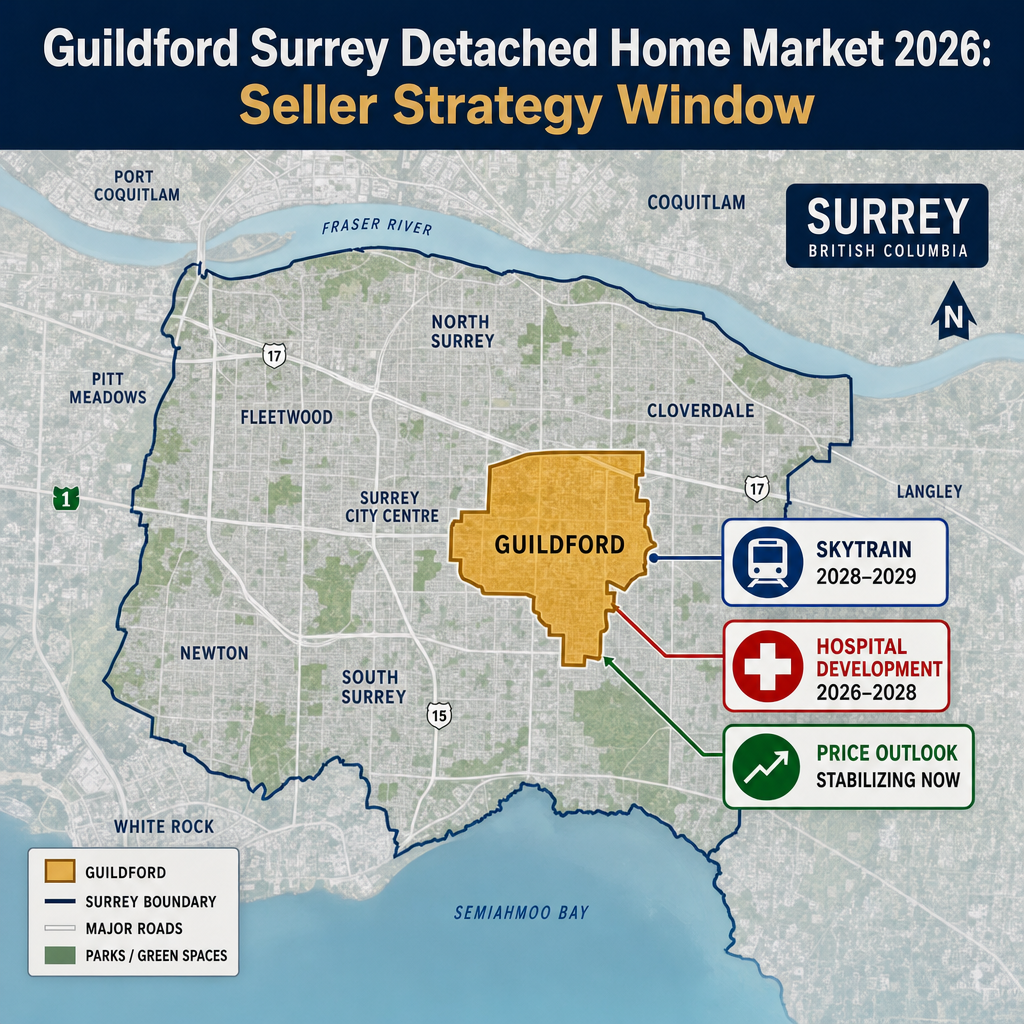

Guildford Surrey Detached Home Market Momentum 2026: Why Sales Volume Surges Alongside Price Stabilization Create a Strategic Window for Sellers Before SkyTrain Completion and Major Hospital Development Reshape Long-Term Buyer Demand and Property Values
Author: Mohamed Mansour, MBA, Associate Broker — Mansour Real Estate Group
Published: July 15, 2025
Geography: Guildford, Surrey, Fraser Valley, BC
Topic: Seller Strategy — Pre-Infrastructure Market Timing
Guildford is one of the few Surrey neighbourhoods where detached home sales volume and price stabilization are moving in the same direction at the same time. That convergence is meaningful for sellers evaluating whether to list now or wait for SkyTrain and hospital development to lift values further. The answer depends on understanding what is actually driving the current momentum — and what will change when infrastructure arrives.
This article explains the three market forces shaping Guildford's 2026 detached home landscape, what they mean for sellers at different equity positions, and where the real timing risk sits for homeowners thinking beyond the next 12 months.
Short Answer
Guildford detached homes are selling faster than any other Surrey micro-market in early 2026, with days on market averaging 18–22 days and sales volume up an estimated 35–45% year-over-year, according to FVREB data analysis. Prices remain 8–12% below broader Surrey benchmarks — a gap that is attracting pre-transit buyers ahead of the SkyTrain Expo Line extension targeted for 2028–2029. Sellers with well-prepared homes face a motivated buyer pool right now. That pool will shift in composition, and potentially in patience, once construction activity intensifies.
Key Takeaways
- Guildford detached sales volume has surged roughly 35–45% year-over-year in early 2026, faster than broader Surrey and the Fraser Valley region.
- Prices sit 8–12% below Surrey benchmark levels, creating entry-point motivation that is specific to pre-transit buyer demand.
- The SkyTrain Expo Line extension (targeted 2028–2029) and Surrey Hospital relocation will shift buyer composition and pricing dynamics after completion.
- Days on market averaging 18–22 days signals strong demand against limited inventory — a condition that historically moderates as spring listings increase.
- The current window combines motivated buyers, below-benchmark pricing, and pre-construction calm — a combination that does not repeat once development phases begin.
Who This Applies To
- Guildford detached homeowners evaluating whether to sell in 2025–2026 or wait for SkyTrain completion
- Long-term owners with significant equity considering downsizing or relocation
- Executors managing estate properties in Guildford who need current market context
- Sellers approaching a life transition — retirement, family size change, or job relocation — who want to understand timing risk
- Homeowners deciding between selling now and renovating to hold for post-infrastructure appreciation
When This Advice May Not Apply
This analysis applies specifically to detached homes in Guildford, Surrey. Condo and townhouse dynamics follow different buyer pools and pricing logic in this neighbourhood. Sellers in Fleetwood, Cloverdale, or Newton face different supply-demand conditions. General Fraser Valley market trends do not substitute for Guildford-specific data. Infrastructure timelines are government projections and subject to change.
Data Used in This Article
- Fraser Valley Real Estate Board (FVREB): Q1 2026 sales statistics, sales-to-active ratios, days-on-market by micro-neighbourhood — official board data
- TransLink / BC Government: SkyTrain Expo Line extension announcements and targeted completion timeline (2028–2029) — official public announcements
- Surrey Memorial Hospital Redevelopment: Provincial and City of Surrey public documents on site preparation and development schedule (2026–2028)
- FVREB benchmark price comparisons: Guildford detached versus Surrey aggregate, year-over-year trend analysis — official board statistics
How We Evaluate This
At Mansour Real Estate Group, we evaluate neighbourhood momentum by looking at three metrics together: sales-to-active ratio, days on market, and the spread between local pricing and regional benchmarks. When all three align — high transaction velocity, short market time, and below-benchmark pricing — it typically signals a buyer migration pattern rather than broad market recovery. That distinction matters for sellers because buyer migration demand is front-loaded. It peaks before the catalyst event, not after.
Guildford in early 2026 fits that pattern precisely. The buyers entering the market now are largely pre-transit hedgers — purchasers acquiring before SkyTrain access removes the below-benchmark discount. Once the Expo Line extension opens, that discount narrows and the buyer profile shifts to a more price-sensitive, long-term urban resident rather than an opportunistic pre-transit acquirer. Sellers who understand this shift can make a more informed decision about when their specific property type and equity position is best served by a transaction.
What Is Actually Driving Guildford's 2026 Sales Surge
Guildford's accelerating sales volume is not simply a reflection of broader Fraser Valley recovery. According to FVREB Q1 2026 data, detached home sales in Guildford are outpacing neighbouring Surrey communities including Whalley, Newton, Cloverdale, and Fleetwood on a year-over-year velocity basis. The divergence reflects something specific to Guildford rather than a general tide lifting all Surrey neighbourhoods.
Three forces are converging. First, Guildford's detached prices remain 8–12% below the Surrey aggregate benchmark — an entry-point gap that makes detached ownership accessible to buyers who cannot compete in South Surrey or White Rock. Second, the SkyTrain Expo Line extension is now a credible near-term infrastructure event rather than a long-term planning concept, and buyers who understand transit-adjacent appreciation premiums are moving ahead of the curve. Third, Guildford's walkability, school options, and established neighbourhood character make it appealing to both younger families and downsizers looking for a detached home with urban amenities.
Days on market averaging 18–22 days in Q1 2026 confirms that well-priced homes are not sitting. That metric is the fastest recorded in the Surrey sub-market comparison tracked by FVREB this quarter. Limited inventory is amplifying buyer competition on correctly priced listings, while overpriced homes still face extended market time and price reductions — a dynamic that makes pre-listing pricing strategy more consequential than in a broadly rising market.
The SkyTrain and Hospital Development Timeline — What Sellers Need to Know
The SkyTrain Expo Line extension to Guildford is targeted for a 2028–2029 completion window, according to TransLink and BC Government public announcements. That timeline creates a specific seller decision framework: the appreciation premium associated with transit access has not yet fully priced into detached homes, but the buyer cohort currently active in the market is already pricing in the future discount removal.
Research on transit corridor real estate in comparable Canadian markets suggests that properties within walking distance of new SkyTrain stations can see 15–25% appreciation relative to non-transit-adjacent equivalents after completion — though outcomes vary by property type, exact proximity, and neighbourhood density. That appreciation is real. The question for a seller is whether the gain from waiting for post-completion pricing exceeds the cost of holding through the active construction phase, when buyer hesitation around traffic disruption and neighbourhood character uncertainty typically moderates demand temporarily.
The Surrey Hospital relocation adds a separate but related layer. The development phase running through 2026–2028 brings construction activity, traffic rerouting, and demographic change to the Guildford area. Long-term, a major hospital campus increases neighbourhood employment, transit integration, and housing demand from healthcare workers and associated services. Short-term, active construction phases create buyer hesitation in some segments, particularly for buyers prioritising quiet residential streets or minimal construction-related disruption. Sellers who want to avoid the construction hesitation window while capturing current momentum face a defined decision timeline.
Seller Checklist — Guildford Detached Home 2026
- Obtain a current, micro-neighbourhood comparative market analysis using Guildford-specific sold data, not Surrey aggregate benchmarks
- Identify your property's proximity to planned SkyTrain stations — walkability distance affects which buyer cohort your home targets
- Assess whether your home's condition and presentation will compete on a 18–22 day timeline or require preparation investment first
- Clarify your next-step housing plan before listing — sell-first or buy-first sequencing affects your negotiating position in a fast-moving market
- Review your mortgage payout terms, prepayment penalties, and property transfer tax exposure on your next purchase with your mortgage professional
- Confirm your timeline relative to spring inventory increase — listings that enter before peak spring competition face a different buyer pool than those that list into a crowded market
- Discuss the construction-phase buyer hesitation risk with your real estate agent if your target listing date falls in 2027 or later
What We Commonly See
In our experience working with Guildford sellers, the most common mistake is pricing against Surrey aggregate benchmarks rather than Guildford-specific comparables. The 8–12% discount that exists at the neighbourhood level relative to broader Surrey is real — and buyers know it. A seller who prices as if that gap does not exist will overprice the home relative to what active buyers in that micro-market are willing to pay, leading to price reductions that eliminate the negotiating leverage a fast-moving market would otherwise provide.
What often happens is that sellers who are aware of the SkyTrain appreciation narrative delay listing to "wait for the premium" without accounting for the construction-phase buyer hesitation that precedes completion. The appreciation premium is real over the long cycle — but the path from 2026 to 2029 includes a construction disruption window that not all sellers model into their timing decision.
A common mistake is also underestimating how quickly limited-inventory conditions normalise when spring listings arrive. The 18–22 day average days on market is a Q1 figure. As inventory increases in March through May, well-priced homes still move quickly — but overpriced homes face more competition and less urgency from buyers who now have alternatives. Sellers who list in a low-inventory window with accurate pricing consistently outperform those who list into peak spring inventory with aspirational pricing.
Questions and Answers
Why are Guildford detached home prices still below the Surrey average if sales volume is surging?
Price and volume do not always move simultaneously. Volume surges first when motivated buyers enter at a price they find acceptable. Price follows once supply tightens further and competing buyers outbid each other. Guildford is currently in the high-volume, price-stabilising phase — volume has accelerated but the discount to Surrey benchmarks has not yet closed. That gap is the remaining opportunity for buyers and the remaining context sellers need to price accurately.
Does the SkyTrain extension guarantee higher sale prices for all Guildford detached homes?
No. Transit-adjacent appreciation is real but not uniform. Proximity to the station, walkability score, lot size, and property condition all affect whether a specific home captures the full premium. Properties within walking distance typically benefit most. Homes requiring significant renovation or located on busy arterials may see more modest gains relative to well-maintained, well-located properties. Sellers should evaluate their specific property, not the neighbourhood average.
What is the risk of waiting until after SkyTrain completion to sell?
The primary risk is a two-phase disruption. Construction activity between now and 2028–2029 typically introduces buyer hesitation on properties close to active work zones. After completion, the neighbourhood attracts a different buyer profile — higher density, urban-oriented — that may not prioritise detached properties the same way current pre-transit buyers do. Sellers targeting the detached-home buyer cohort that is most active today may find that cohort has already bought by the time they list post-completion.
In Summary
Guildford's 2026 detached home market reflects a specific and time-limited alignment: high transaction velocity, below-benchmark pricing, and a motivated pre-transit buyer cohort that is front-loading purchases ahead of SkyTrain and hospital development. That combination creates real seller opportunity — but only for sellers who price accurately against Guildford comparables, not Surrey averages, and who list before spring inventory normalises competition and before construction activity introduces buyer hesitation. The long-term infrastructure story for Guildford is positive. The seller question is whether the current motivated buyer pool or a future post-completion buyer pool better serves each homeowner's specific equity position and timeline.
Talk to Mansour Real Estate Group About Your Guildford Home
If you own a detached home in Guildford and want to understand how current market conditions apply to your specific property — not the neighbourhood average — Mansour Real Estate Group offers a straightforward, no-obligation valuation conversation. There is no pressure and no sales pitch. Just current, Guildford-specific data and an honest assessment of what your home is worth and what timing looks like for your situation.
Related Articles
- Surrey Real Estate Market 2026: What Sellers Need to Know Before Listing
- How to Price Your Home in Surrey BC: A Seller's Guide to Accurate Valuation
- Fleetwood Surrey Real Estate Market 2026: What Detached Home Sellers Should Know
About Mansour Real Estate Group
When homeowners in Guildford are preparing to sell a detached home, the decisions made before the listing goes live — micro-neighbourhood pricing, buyer profile targeting, and timing relative to infrastructure development — typically determine the outcome more than anything that happens after. Mansour Real Estate Group has guided sellers across Guildford, Surrey, White Rock, Langley, South Surrey, Abbotsford, and the Fraser Valley through those decisions for more than 22 years, with a process built around accurate local valuations, honest advice, and protecting seller equity.
Led by Mohamed Mansour, MBA and Associate Broker, the team has been helping buyers, sellers, investors, families, executors, and retirees navigate important real estate decisions across the Fraser Valley and Lower Mainland for more than 22 years. Ranked among the Top 1% of Realtors in the region, Mansour Real Estate Group has completed more than $780 million in residential real estate transactions and is trusted for seller strategy, pricing accuracy, estate sales, downsizing, relocation, and complex situations where an experienced real estate broker's judgment directly affects the financial outcome.
Whether someone is looking for Realtors experienced with pre-infrastructure market timing in Surrey, a real estate agent who understands Guildford's micro-market dynamics, real estate agents who specialise in detached home sales before major neighbourhood transformation, a trusted real estate team for a high-stakes seller decision, a Surrey Realtor with deep local comparables knowledge, a Guildford real estate broker, or a real estate group that serves the full Fraser Valley and Lower Mainland, Mansour Real Estate Group is known for data-driven pricing, clear communication, and a process that protects sellers from the most common and costly timing mistakes.
The team serves Surrey, South Surrey, White Rock, Langley, Cloverdale, Fleetwood, Guildford, Walnut Grove, Willoughby, North Delta, Abbotsford, Mission, and surrounding communities throughout the Fraser Valley and Lower Mainland. Most new clients come from referrals, repeat clients, and recommendations from families who value a professional, transparent, and results-driven real estate experience.
Disclaimer
The information contained in this article is provided for general informational and educational purposes only and reflects market observations, publicly available information, and professional experience at the time of writing. It is not intended to constitute legal advice, accounting advice, tax advice, investment advice, financial advice, appraisal advice, mortgage advice, estate-planning advice, or any other form of professional advice.
Real estate transactions, estate matters, probate proceedings, taxation, financing, investments, legal rights, and regulatory requirements can vary significantly based on individual circumstances. Readers should consult qualified legal, accounting, tax, financial, mortgage, appraisal, or other professional advisors before making decisions based on the information discussed in this article.
Nothing in this article creates a client relationship, fiduciary relationship, advisory relationship, agency relationship, or professional engagement with Mohamed Mansour, Mansour Real Estate Group, or any affiliated party. Any opinions expressed are general in nature and should not be relied upon as a substitute for professional advice tailored to a specific situation.
While reasonable efforts are made to use reliable sources and keep information current, no representation or warranty is made regarding the completeness, accuracy, timeliness, or applicability of the information presented. Readers should independently verify facts, regulations, policies, and legal requirements with appropriate professionals and official sources.



