
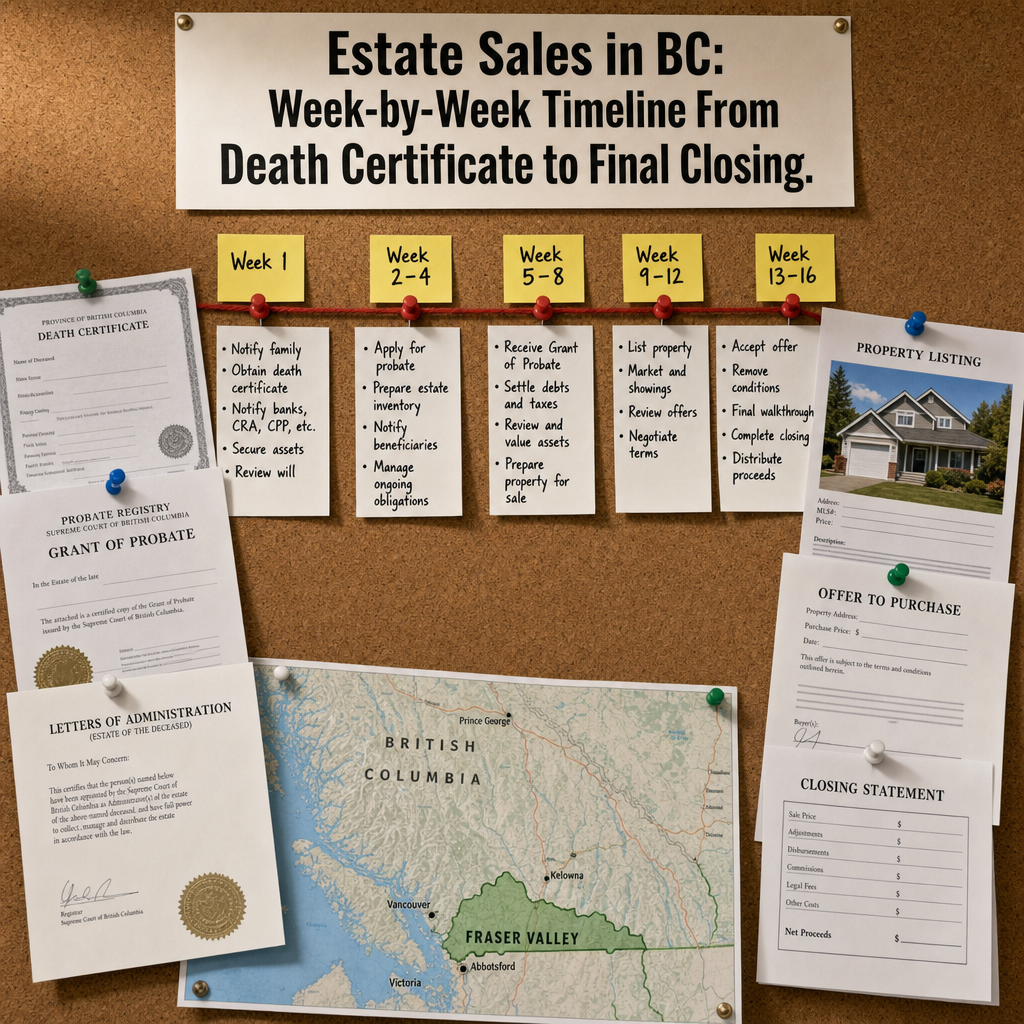

Estate Sales in BC: Complete Week-by-Week Timeline From Death Certificate to Final Closing — With Fraser Valley Market Timing Strategy to Maximize Proceeds When Legal Authority and Real Estate Windows Conflict
By Mohamed Mansour, MBA and Associate Broker | Mansour Real Estate Group | Fraser Valley and Lower Mainland | Published: July 15, 2025 | Topic: Estate Sales, Probate, Executor Strategy, BC
Executors in BC are managing two timelines at once — one set by the courts and one set by the market. Getting both right is the difference between a clean sale and a prolonged process that costs beneficiaries real money. This guide is written specifically for executors and estate administrators responsible for selling residential property in the Fraser Valley and Lower Mainland.
This is not a general overview of estate law. It is an operational timeline that maps every major decision point — legal, financial, and real estate — from the week of death through to final closing, with specific guidance for the 2026 Fraser Valley market context where elevated inventory and buyer financing hesitation are compounding the risk of poor timing.
Short Answer
In BC, an estate property can be listed before probate is granted, but title cannot transfer until the grant is issued. Most estate sales take 16 to 24 weeks from death to closing. Executors who time the listing strategically — neither too early nor too late — consistently protect more net proceeds than those who wait passively for legal authority before engaging the market.
Who This Applies To
- Executors named in a BC will who are responsible for selling residential real estate
- Estate administrators appointed by BC courts where no will exists (intestate estates)
- Beneficiaries who have been delegated executor responsibilities by a family member
- Families managing estate properties in Surrey, Langley, White Rock, Abbotsford, North Delta, or surrounding Fraser Valley communities
- Legal or financial advisors supporting executors who need a practical real estate timeline to share with clients
When This Advice May Not Apply
This timeline applies to standard residential estate properties in BC. It may not apply if the property is held in joint tenancy with right of survivorship (title transfers by survivorship, not through probate), if the estate involves an active trust, or if the property is subject to a life interest clause. Always confirm the title structure with your estate lawyer before proceeding.
Key Takeaways
- BC probate typically takes 4 to 12 weeks; listing can begin before grant is issued using a possession-date closing structure.
- Estate properties in the Fraser Valley take 20 to 30% longer to sell than owner-occupied homes in the same price band.
- Executors who delay listing until after probate grant risk losing 15 to 25% in net proceeds if market conditions shift during the wait.
- Buyer financing on estate properties is more restrictive; lenders require executor authority documentation and may flag the property as higher risk.
- Fair market value appraisals for probate and capital gains reporting often diverge from actual selling prices, creating renegotiation risk if buyer appraisals come in short.
Data Used in This Article
- Fraser Valley Real Estate Board (FVREB): 2026 days-on-market and inventory data — official board statistics, Fraser Valley geography
- CRA: Capital gains reporting requirements for estate dispositions — official federal tax guidance
- BC Probate Registry / BC Wills, Estates and Succession Act (WESA): Probate grant timelines and executor authority — official provincial legislation
- CMHC: Mortgage financing requirements for estate and inherited properties — federal housing authority guidance
- Mansour Real Estate Group: Internal estate sales database and closing data, Fraser Valley 2024–2026 — professional interpretation
Key Definitions
Grant of Probate: A court order confirming the executor's legal authority to administer the estate, including selling property. Issued by the BC Supreme Court.
Executor: The person named in a will who is legally responsible for administering the estate. Also called an estate administrator if appointed by the court without a will.
Possession-Date Closing: A structure where the listing and offer are accepted before probate is granted, but the completion and possession date are set far enough in the future to allow the grant to be issued before title transfers.
Fair Market Value (FMV) Appraisal: A formal appraisal of the property's value at the date of death, required for BC probate fee calculation and CRA capital gains reporting.
Deemed Disposition: Under the Income Tax Act, a deceased person is considered to have sold their property at fair market value at the moment of death, triggering capital gains on any accrued gain above the adjusted cost base.
The Core Tension Every Executor Faces
BC law requires a grant of probate before an executor can transfer title on a residential property. But the real estate market does not pause while the courts process paperwork. In the Fraser Valley's 2026 buyer's market, where the FVREB has reported elevated active listings and extended days-on-market across most property segments, the window for achieving a strong price can shift meaningfully in 8 to 12 weeks — exactly the period an executor may spend waiting for legal authority.
The practical resolution is a possession-date closing structure: list the property, accept an offer, and set the completion date at least 8 to 12 weeks out to allow the probate grant to arrive before title must transfer. This approach preserves market timing without requiring title authority at the time of listing. It requires buyers who accept the extended timeline and lenders who will approve financing before the closing date is confirmed — which is not always straightforward, but is achievable with proper disclosure and strategic buyer targeting.
Week-by-Week Timeline: Death Certificate to Final Closing
Week 1 — Immediate Estate Administration
Secure the property. Change locks if needed. Confirm utilities are active, especially through winter months. Notify home insurance of the change in occupancy status — most residential policies become void or limited within 30 days of a property becoming unoccupied. Obtain multiple certified copies of the death certificate (at least six; estate lawyers, the Land Title Office, and financial institutions all require originals or certified copies). Locate the original will and deliver it to estate counsel.
Weeks 2–4 — Engage Estate Counsel and Begin Probate Application
Estate counsel prepares the probate application under BC's Wills, Estates and Succession Act (WESA). The application requires an inventory of estate assets, an FMV appraisal of the property, and confirmation of beneficiaries. Commission a professional FMV appraisal now — this appraisal sets the probate fee base and anchors the capital gains calculation. According to research from the Estate Planning Council of BC and CRA guidance on deemed dispositions, the FMV at date of death is the cost base for capital gains purposes. The appraisal can take 1 to 2 weeks. Order it immediately.
Weeks 3–5 — Real Estate Consultation and Pre-Listing Strategy
Engage a real estate team experienced with estate sales before the probate application is submitted, not after. At this stage, the key decisions are: what condition is the property in, what does the current Fraser Valley market look like for this property type and neighbourhood, and should the property list before or after the grant is issued. This is also when the executor should review what repairs, clearing, or staging work is feasible given estate budget constraints and the beneficiaries' timeline expectations. Understanding how property condition affects estate sale proceeds in the Fraser Valley is a practical starting point for this conversation.
Weeks 4–8 — Probate Processing Window
BC Supreme Court probate processing times vary. As of 2026, straightforward applications in Surrey and the Fraser Valley are taking approximately 6 to 10 weeks from filing to grant issuance, though complex estates, contested wills, or estates with out-of-province assets may take longer. During this window, the executor can prepare the property for listing, complete non-structural repairs, arrange professional photography, and finalize the listing price with the real estate team. The listing can go live during this period using a possession-date closing structure if market conditions support acting now.
The Listing Decision: Before or After Probate Grant?
This is the highest-stakes strategic decision in the entire estate sale process. The answer depends on three variables: current market momentum in the specific Fraser Valley submarket, the estimated probate grant timeline, and the buyer profile most likely to purchase the property.
List before grant if: Market conditions are active or tightening, days-on-market are short for the property type, and the property can attract cash buyers or pre-approved buyers comfortable with an extended closing. Possession-date closings of 90 to 120 days are workable in these conditions.
Wait for grant if: The property type has high buyer financing dependency (older condos, properties with deferred maintenance, higher price bands where lenders require confirmed closing dates), or the estate has a contested element that creates title uncertainty. Listing into a financing-dependent buyer market before the grant is issued produces longer exposure times and more conditional offers that collapse.
According to data from Mansour Real Estate Group's estate sales database covering Fraser Valley transactions from 2024 to 2026, executors who list during the probate window with a properly structured possession-date close consistently achieve comparable or higher sale prices relative to those who wait — provided the listing is priced accurately and disclosed transparently as an estate sale. What executors need to know before listing a probate property in BC covers disclosure and pricing mechanics in more detail.
Weeks 8–12 — Grant Issued, Listing Active or Going Live
Once the grant of probate is issued by the BC Supreme Court, the executor has confirmed legal authority to complete the sale. If the property is already listed under a possession-date structure and an accepted offer is in place, the grant satisfies the condition for title transfer and the transaction proceeds to completion. If the property has not yet listed, now is the time to go live.
Important: in the Fraser Valley's 2026 buyer's market, the FVREB has reported that detached homes in Surrey and Langley are sitting an average of 30 to 45 days on market before receiving offers, with estate properties trending longer. Price the property based on current comparable sales — not the FMV appraisal completed at the date of death. Those two numbers often diverge, and listing at the probate appraisal value rather than the current market value is one of the most common and costly mistakes executors make.
Weeks 10–16 — Offer Acceptance Through Subject Removal
Estate properties in the Fraser Valley attract specific buyer risk profiles. CMHC guidelines and major lender underwriting standards treat estate properties as higher-risk files, requiring buyers to provide inheritance documentation, executor authority confirmation, and in some cases a longer due diligence period. Buyers financing through institutional lenders may face appraisal conditions — and if the lender's appraisal comes in below the offer price, the buyer's financing is at risk. This is a meaningful issue in 2026 given compressed valuations on older detached properties in North Delta, Abbotsford, and parts of Langley.
Negotiate offer terms with this in mind. Accept subjects that include a financing condition with a clearly defined timeline — typically 7 to 10 business days. Avoid indefinite subject-to-sale conditions on estate properties. If a buyer's financing collapses due to an appraisal shortfall, the estate may need to renegotiate price or relist — both of which extend the timeline and add carrying costs. Transparency about property condition and disclosure of known defects (even in as-is estate sales) reduces the probability of late-stage renegotiation.
Weeks 14–20 — Completion, Possession, and Distribution
The completion date is when title transfers and funds are released by the notary or lawyer. Possession date is when the buyer takes physical occupancy — usually the same day or the next business day. For estate sales, confirm with estate counsel that probate grant registration has been completed with the Land Title Office before the completion date. The notary handling conveyancing will require the probate grant, executor identification, and confirmation of beneficiary distribution instructions.
After completion, the estate lawyer and accountant handle the capital gains reporting on the deemed disposition. The executor is responsible for filing the terminal tax return (T1 final) and, if the estate earns income post-death, an estate tax return (T3). Net proceeds are distributed to beneficiaries after all estate debts, legal fees, real estate commissions, and tax liabilities are settled. Capital gains tax on estate property in BC explains the deemed disposition calculation and reporting process in plain language.
How We Evaluate This
When Mansour Real Estate Group works with an executor, the first conversation is always about the legal timeline and the market window simultaneously — not sequentially. We pull current days-on-market data for the specific property type and neighbourhood, review the probate filing status, and model two scenarios: listing before grant with a possession-date close, and waiting for grant then listing at standard terms. We compare projected net proceeds under both paths factoring in carrying costs, seasonal demand shifts, and the buyer financing profile most likely for that property.
The decision is not always to list early. Some properties — particularly older condos in buildings with deferred maintenance, or properties with known title encumbrances — are better suited to a post-grant listing where the executor can provide clean title and full disclosure upfront. The analysis must be property-specific and market-specific. Generic advice on this question costs executors money.
Estate Sale Checklist
- Obtain at least six certified copies of the death certificate in Week 1
- Notify home insurer of vacancy immediately; arrange estate or vacant property insurance
- Commission a professional FMV appraisal at date of death for probate and CRA purposes
- Engage estate counsel and a real estate team experienced with probate sales simultaneously — not sequentially
- Confirm title structure with counsel before listing (joint tenancy vs. tenancy in common affects whether probate is required)
- Review property condition and decide on repair or as-is strategy before pricing
- Price the listing based on current comparable sales, not the probate FMV appraisal
- Disclose estate sale status transparently in listing materials to qualify buyers who understand the timeline
- Confirm probate grant registration with the Land Title Office before the completion date
- Coordinate with estate counsel and accountant on T1 final return and T3 estate return filing deadlines
What We Commonly See
Executors engage the real estate team too late. In our experience, the most common timeline error is waiting until the probate grant is in hand before calling a real estate team. By that point, preparation time has been lost, market conditions may have shifted, and the executor is listing under time pressure rather than market advantage. Engaging the team during the probate application window — typically weeks 3 to 5 — allows preparation to run in parallel with the legal process.
The probate appraisal becomes the listing price. What often happens is that executors, unfamiliar with current market conditions, use the FMV appraisal prepared for probate purposes as the listing price. That appraisal reflects value at the date of death, which may be months earlier, and uses a methodology suited to legal documentation rather than competitive market positioning. In a moving market, those two numbers can differ by 8 to 15% — and listing at the wrong number stalls the sale.
Financing conditions collapse late in the process. A common mistake is accepting an offer with a financing condition without confirming that the buyer's lender has been briefed on the estate nature of the transaction. Lenders who discover mid-approval that the property is an estate sale may require additional documentation, reorder appraisals, or add conditions — collapsing the deal days before subject removal. We recommend that estate sales explicitly state the estate nature of the transaction in the listing and that buyers confirm lender awareness before offer submission.
Questions and Answers
Can an executor legally list a property in BC before probate is granted?
Yes. An executor can list and accept an offer on a property before the grant of probate is issued. Title, however, cannot transfer until the grant is in hand and registered with the Land Title Office. The practical mechanism is a possession-date closing structure, where the completion date is set far enough in the future to allow the grant to arrive before title must transfer. This requires buyers and lenders who accept an extended closing timeline.
Why do estate properties take longer to sell in the Fraser Valley?
Based on FVREB market data and Mansour Real Estate Group's internal estate sales database, estate properties in the Fraser Valley take 20 to 30% longer to sell than comparable owner-occupied homes. The primary reasons are buyer financing hesitation around estates, appraisal risk on older properties, the extended closing timelines required by probate, and buyer uncertainty about property condition when the previous owner cannot provide disclosure.
What is the capital gains exposure on a typical estate property in BC?
Under the Income Tax Act's deemed disposition rules, the estate is treated as having sold the property at fair market value at the date of death. Capital gains are calculated as the difference between the FMV at death and the adjusted cost base (typically the original purchase price plus capital improvements). If the property was the deceased's principal residence, the principal residence exemption may apply, potentially eliminating the capital gains. Executors should confirm the filing strategy with a tax accountant or estate lawyer, as CRA requirements are specific to the individual estate circumstances.
In Summary
BC estate sales involve two timelines running simultaneously: the legal authority process through probate and the real estate market window that does not wait for it. Executors who engage both processes in parallel — commissioning the FMV appraisal, engaging estate counsel, and consulting a real estate team during weeks 3 to 5 — consistently achieve better outcomes than those who treat the legal and real estate processes as sequential steps. In the Fraser Valley's 2026 buyer's market, with elevated inventory and extended days-on-market across most segments, the cost of passive waiting is measurable in net proceeds lost to carrying costs, price reductions, and missed market windows. The possession-date closing structure is the practical tool that bridges legal authority and market timing — but it requires an experienced real estate team and transparent buyer communication to execute correctly. How long homes take to sell across the Fraser Valley provides broader market context for timeline planning.
Talk to an Estate Sale Specialist
If you are an executor managing a residential property in Surrey, Langley, White Rock, Abbotsford, North Delta, or the surrounding Fraser Valley, Mansour Real Estate Group offers a no-pressure consultation to walk through your specific timeline, property, and market conditions. The goal is clarity — legal, financial, and real estate — before any decisions are made.
Related Articles
- What executors need to know before listing a probate property in BC
- Capital gains tax on estate property in BC — what executors and beneficiaries need to know
- How to sell an estate property in the Fraser Valley without losing equity to time and condition
Official Resources
- BC Wills, Estates and Succession Act (WESA) — BC Laws
- CRA — Doing taxes for someone who has died
- Fraser Valley Real Estate Board — Market Statistics
- CMHC — Mortgage financing and estate property guidance
About Mansour Real Estate Group
When a property must be sold as part of an estate or probate process, the real estate team managing the transaction needs to understand more than market pricing. Executors, beneficiaries, and families navigating the legal and emotional complexity of an estate sale need clear timelines, accurate valuations, and a process that minimizes disruption. Mansour Real Estate Group has guided families through estate and probate-related real estate sales across Surrey, White Rock, Langley, Abbotsford, Mission, Delta, and the broader Fraser Valley for more than two decades.
Key Takeaways
- Understanding market trends helps you make informed decisions about timing your purchase or sale
- Working with a qualified real estate agent provides valuable insights and market expertise
- Location, condition, and comparable sales data are critical factors in property valuation
- Stay informed about local economic indicators and neighborhood developments
Next Steps
Ready to explore the BC real estate market? Connect with a local agent today to discuss your goals and discover properties that match your needs and budget.
Disclaimer: This article is for informational purposes only and does not constitute legal, financial, or real estate advice. Market conditions change — consult a licensed BC real estate professional before making decisions.



