

Surrey Home Selling in 2026: Why Micro-Neighbourhood Price Divergence and SkyTrain Certainty Are Creating Dramatically Different Seller Strategies Across Whalley, Newton, Guildford, Cloverdale, and Fleetwood
By Mohamed Mansour, MBA and Associate Broker | Mansour Real Estate Group | Published: May 5, 2025 | Geographic Focus: Surrey, BC — Fraser Valley | Coverage: Whalley, Newton, Guildford, Cloverdale, Fleetwood
Surrey is one city on paper. In 2026, it is five different seller markets in practice. The difference between listing in Guildford and listing in Newton — even at the same price point — can mean 30 extra days on market, a repositioning conversation with your buyer, and a final sale price that falls short of what you expected. Understanding why that gap exists, and which side of it your property sits on, is the most important pricing decision a Surrey seller can make this year.
This article synthesizes the key forces reshaping Surrey's five major submarkets in 2026 — SkyTrain Expo Line extension certainty, Surrey Hospital redevelopment momentum, and entry-level demand divergence by property type — and explains what each force means for your specific listing strategy.
Short Answer
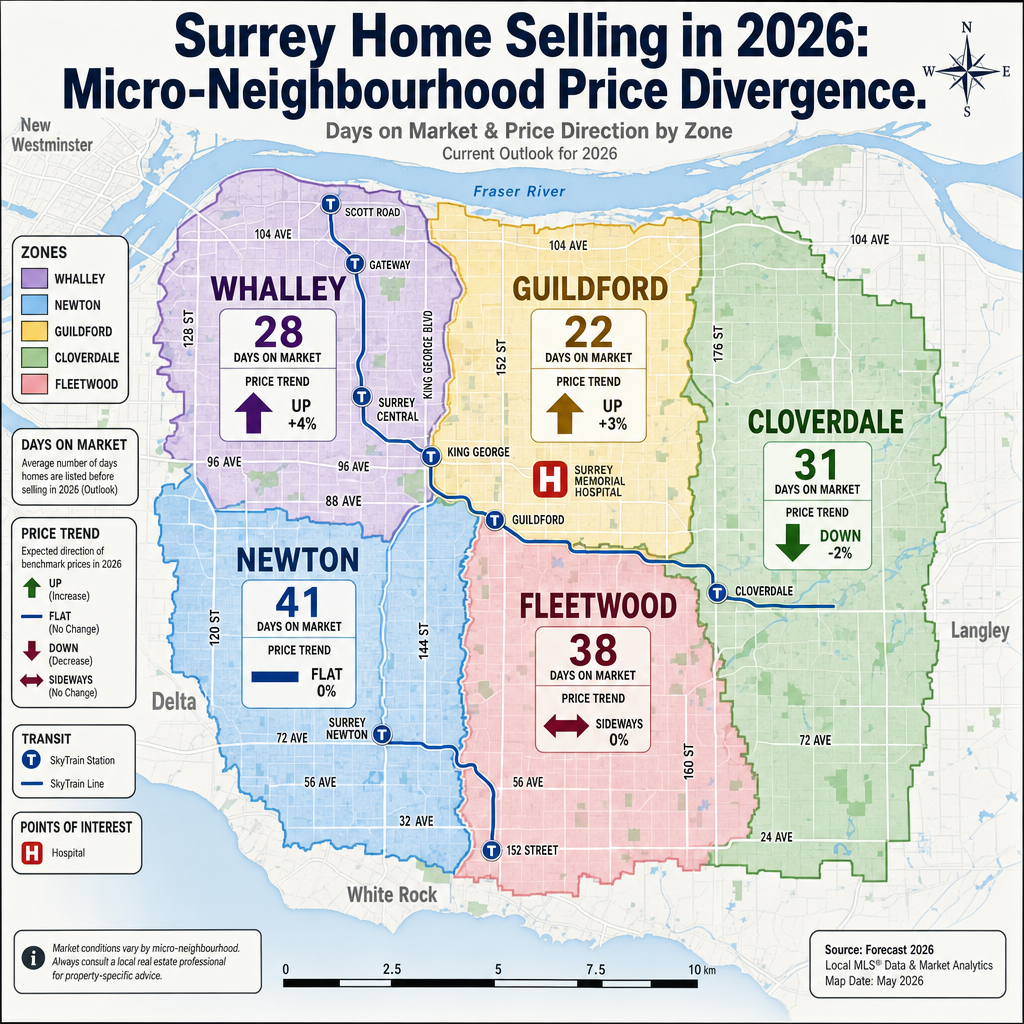
Surrey's five major neighbourhoods are performing dramatically differently in 2026. Guildford and Cloverdale sellers are capturing premiums driven by SkyTrain certainty and hospital development. Newton and Whalley sellers face longer days-on-market and buyer leverage, especially in condos and townhouses. Your pricing strategy should be built around your specific submarket — not Surrey's aggregate benchmark.
Key Takeaways
- Guildford detached homes are selling in 18–22 days; Newton condos average 45–55 days in the same price band.
- SkyTrain station proximity within 800m is generating 10–15% price premiums in Guildford and Fleetwood corridors.
- Surrey Hospital redevelopment is compressing the Guildford pricing window — sellers who delay past Q2 2026 face a different buyer pool.
- Entry-level detached homes under $800K are selling 40–60% faster than condos at equivalent prices across Surrey.
- Cloverdale detached pricing sits 8–12% below benchmark despite sales acceleration — a pre-SkyTrain buying window that narrows as transit certainty increases.
Who This Applies To
- Homeowners in Surrey considering listing in 2026 who want submarket-specific pricing context
- Sellers in Guildford or Cloverdale evaluating whether SkyTrain proximity affects their specific address
- Newton and Whalley sellers trying to understand why comparable homes in Guildford are selling faster
- Fleetwood homeowners assessing how transit corridor positioning affects their pricing strategy
- Investors and downsizers deciding between holding and listing based on development milestone timing
When This Advice May Not Apply
This article reflects general submarket observations based on publicly available FVREB data and MLS trends through early 2026. Individual property characteristics — lot size, condition, strata history, legal issues, specific street location relative to station mapping — can materially affect outcome. This is not a substitute for a property-specific valuation.
Data Used in This Article
- Fraser Valley Real Estate Board (FVREB) — March 2026 market data, sales-to-active ratios, benchmark prices by neighbourhood and property type
- MLS Days-on-Market Analysis — January–March 2026 micro-neighbourhood and property-type tracking
- BC Transit / TransLink — SkyTrain Expo Line extension project timeline and announced station locations
- Surrey Hospital Redevelopment Project — construction milestone schedule and public project updates
- BC Assessment — neighbourhood-level assessed value trend divergence, 2025–2026
The Three Forces Splitting Surrey's Market in 2026
Three separate forces are operating simultaneously in Surrey in 2026 — and they are not distributing their effects equally across the city.
SkyTrain Expo Line extension certainty has moved from speculative to structural. Confirmed station locations near Guildford and Fleetwood are creating measurable proximity premiums. According to MLS transaction analysis from January through March 2026, properties within approximately 800 metres of announced station sites in these corridors are pricing 10–15% above comparable properties outside that radius. This is not appreciation driven by general demand — it is location-specific pricing behaviour by buyers who are already underwriting future transit access into their offers. Sellers in the Guildford submarket and Fleetwood corridor who understand this corridor boundary can price into it with confidence. Sellers outside it who price as if they share the premium are creating the single most common overpricing error in Surrey right now.
Surrey Hospital redevelopment is the second force. The Guildford-area hospital project has moved through significant construction milestones, and the buyer profile it is attracting — healthcare workers, families prioritizing proximity to medical services, and investors underwriting long-term demand anchors — is compressing the listing window in a way that is easy to misread. The surge is pre-completion buying. That means sellers who wait until construction is visually complete may be listing into a market where the forward-looking premium has already been priced in by earlier buyers. According to project milestone tracking, the Q1–Q2 2026 window represents the highest concentration of anticipatory demand. Sellers in Guildford who delay listing beyond Q2 face a materially different buyer pool.
Property-type and income-band divergence is the third and most broadly misunderstood force. Entry-level detached homes priced under $800K in Newton and South Surrey are selling 40–60% faster than condos in the same price range within the same neighbourhood, according to FVREB sales velocity data from Q1 2026. This is not a temporary anomaly. It reflects a sustained preference among first-time buyers and young families who have been priced out of larger detached homes and are now choosing entry-level detached over condos when the price difference is manageable. Condo sellers in Newton and Whalley are facing a buyer pool with more negotiating leverage than their detached neighbours — even when the listed price is identical.
Submarket-by-Submarket Breakdown: What Sellers Need to Know
Guildford: The highest-momentum submarket in Surrey in early 2026. Detached homes are averaging 18–22 days on market at or above asking price, according to FVREB March 2026 data. The combination of SkyTrain station proximity, hospital development buyer migration, and a relatively constrained detached inventory has created a seller-favourable condition that is time-sensitive. Pricing discipline still matters — overpriced listings in Guildford are not immune to price reductions — but accurately priced properties in the transit corridor are moving with very limited negotiation. Sellers here should be thinking about capturing the pre-completion premium rather than waiting for a higher number that may arrive after the anticipatory buyer pool has thinned.
Cloverdale: The pre-SkyTrain opportunity submarket. Detached pricing in Cloverdale currently sits approximately 8–12% below benchmark despite a clear acceleration in sales activity, based on FVREB neighbourhood-level data through Q1 2026. This gap represents a window where buyers are beginning to price in future transit access before it is fully reflected in assessed values. For sellers, this is a meaningful timing consideration. The Cloverdale market is moving — but not yet at Guildford velocity. Sellers who price accurately now will find a buyer pool that is motivated and forward-looking. Sellers who overprice expecting Guildford-level premiums will sit.
Fleetwood: A corridor submarket where the SkyTrain proximity premium is real but spatially narrow. Properties within the 800-metre station radius are benefiting from the same transit pricing behaviour visible in Guildford. Properties outside that radius — even by a few blocks — are not. This creates an unusual pricing situation where two properties on the same street can have materially different optimal listing strategies depending on their exact location relative to the station boundary. Sellers in Fleetwood need an address-specific analysis, not a neighbourhood average.
Newton: The highest inventory and lowest sales velocity submarket for condos in Surrey in early 2026. MLS data from January through March 2026 shows Newton condos averaging 45–55 days on market — more than double the Guildford detached average. This is not a reflection of poor properties. It is a reflection of buyer behaviour in a segment where supply exceeds motivated demand at current pricing. Condo sellers in Newton who price at or above recent comparable sales face extended days-on-market and eventual price reductions. The sellers finding success here are those who price below the median comparable, creating urgency in a patient buyer pool.
Whalley: A submarket in transition where townhouse and condo sellers are facing buyer leverage. Days-on-market for townhouses in Whalley are running 45–55 days based on Q1 2026 MLS tracking — consistent with Newton condos. The investor-heavy buyer profile that historically absorbed Whalley inventory quickly has pulled back in a higher-rate environment. Sellers here should budget for negotiation room in their pricing strategy and focus preparation efforts on condition — clean, updated, and move-in ready properties are differentiating themselves clearly from those that require work.
How We Evaluate This
At Mansour Real Estate Group, we do not use Surrey's aggregate benchmark price as the starting point for a listing conversation. We start with the specific address, identify which submarket forces apply to that exact location, and then build a pricing recommendation from comparable sales within that micro-corridor — not from neighbourhood averages that may include properties operating under completely different buyer conditions.
For a property in Guildford near a confirmed SkyTrain station, that means pricing into the transit premium while tracking active listings closely to avoid overexposure. For a Newton condo, it means an honest conversation about days-on-market expectations and the risk of pricing above recent sales velocity. The framework changes by address. That is the only approach that protects seller equity in a fragmented market.
Seller Checklist: Surrey Micro-Neighbourhood Edition
- Identify your exact submarket (Guildford, Cloverdale, Fleetwood, Newton, Whalley) before accepting any pricing recommendation
- For Guildford and Fleetwood, confirm your property's distance from the nearest announced SkyTrain station — this materially affects your pricing corridor
- Request a comparable sales analysis filtered by your specific neighbourhood, property type, and the last 60–90 days — not 6-month averages
- If listing in Guildford, evaluate the Q1–Q2 2026 window against your personal timeline — hospital development buyer momentum is front-loaded
- If listing a condo in Newton or Whalley, budget for 45–55 days on market and price to stand out from competing inventory rather than match it
- Assess property condition honestly against your submarket's buyer expectations — condition premium is highest in slower-moving segments
- Confirm your agent is running days-on-market analysis at the property-type and neighbourhood level, not city-wide
What We Commonly See
In our experience, the most common pricing error in Surrey right now is applying Guildford's days-on-market expectations to a Newton or Whalley listing. A seller reads that Surrey homes are moving in under 25 days, prices at the top of comparables, and then sits for 50 days while their home accumulates market exposure and buyers start asking what's wrong with it. The aggregate number created the expectation. The micro-neighbourhood reality was different from the start.
What often happens in Cloverdale is the opposite problem — sellers underestimate how quickly buyer behaviour is shifting in response to SkyTrain certainty and price conservatively when the market would have supported a more aggressive number. That gap is not large today. It will likely widen as transit completion approaches.
A common mistake in Fleetwood is treating the SkyTrain premium as a neighbourhood-wide condition rather than a corridor-specific one. Sellers two blocks outside the 800-metre radius who price as if they share the transit premium face extended market exposure and eventual reductions that could have been avoided with accurate positioning from day one.
Questions Surrey Sellers Are Asking in 2026
Does SkyTrain proximity affect my Guildford home's listing price right now, before the line opens?
Yes. MLS transaction data from Q1 2026 shows buyers are already pricing transit access into offers for properties within approximately 800 metres of confirmed station locations. This is anticipatory demand — buyers underwriting future convenience into today's purchase price. The premium is measurable and real, but it is spatially narrow.
Why is my Newton condo taking longer to sell than a detached home at the same price?
Entry-level detached homes are absorbing first-time buyer and young family demand that historically went to condos. When the price gap between a detached home and a condo narrows, buyers consistently choose the detached option. Newton condos are competing against that preference shift, which is lengthening days-on-market independently of price.
Should I wait until after the hospital is complete to list in Guildford?
Based on the pattern of pre-completion buyer behaviour visible in Q1–Q2 2026 data, the anticipatory demand window is active now. Sellers who wait for visual completion may list into a market where forward-looking premiums are already normalized into assessed values and the buyer urgency has shifted to other catalysts. Timing relative to milestone events matters more than waiting for completion.
Is Cloverdale underpriced relative to its long-term outlook?
Detached homes in Cloverdale are currently pricing approximately 8–12% below benchmark despite accelerating sales activity, according to FVREB Q1 2026 neighbourhood-level data. That gap reflects the market pricing in transit certainty before it is fully reflected in assessed values. Whether that represents a seller opportunity or buyer value depends on your specific property and timeline — a property-level analysis is required before drawing conclusions.
In Summary
Surrey is not one real estate market in 2026 — it is five distinct pricing environments shaped by transit certainty, hospital development timing, and a property-type preference shift that is reordering buyer priorities in ways the aggregate benchmark cannot capture. Guildford and Cloverdale sellers are operating with momentum and opportunity; Newton and Whalley sellers are operating with patience requirements and positioning discipline; Fleetwood sellers need address-level precision before accepting any pricing recommendation. The sellers who will do best this year are those who understand which market they are actually in — and price accordingly from day one.
Thinking About Listing in Surrey This Year?
If you are weighing a listing decision in any Surrey submarket in 2026, the most useful starting point is a conversation about your specific address, your property type, and which of the forces described in this article apply to your situation. Mansour Real Estate Group provides pricing consultations grounded in neighbourhood-level data, not city-wide averages. There is no obligation attached to that conversation — only clarity about where your property sits and what a realistic outcome looks like.
Related Articles
- Guildford Real Estate Market 2026: What SkyTrain and Hospital Development Mean for Buyers and Sellers
- Cloverdale Real Estate Market 2026: Pre-SkyTrain Pricing and What the Sales Acceleration Means for Sellers
- Fleetwood Surrey Real Estate 2026: Transit Corridor Pricing and What the 800-Metre Rule Means for Your Home
About Mansour Real Estate Group
When homeowners in Surrey are preparing to sell — in Guildford, Cloverdale, Fleetwood, Newton, or Whalley — the decisions made before the listing goes live typically determine the outcome. Pricing accurately within a micro-neighbourhood requires more than pulling comparables. It requires understanding which development catalysts apply to a specific address, how buyer behaviour is shifting by property type, and how to position a home against competing listings in a market that is fragmenting by corridor, not just by city. Mansour Real Estate Group has built its reputation in the Fraser Valley and Lower Mainland on exactly that kind of pricing discipline.
Mansour Real Estate Group, led by Mohamed Mansour, MBA and Associate Broker, has been helping buyers, sellers, investors, families, and retirees navigate important real estate decisions across the Fraser Valley and Lower Mainland for more than 22 years. Ranked among the Top 1% of Realtors in the region, the team has completed more than $780 million in residential real estate transactions and is trusted for pricing strategy, seller preparation, estate sales, divorce-related property sales, downsizing, and complex real estate situations where accurate valuation is critical to the outcome.
Whether someone is searching for Realtors with deep knowledge of Surrey's submarket conditions, a real estate agent who can map SkyTrain proximity premiums to a specific address, real estate agents who specialize in seller-side pricing strategy, a trusted real estate team for a Surrey listing, a Guildford Realtor, a Cloverdale real estate broker, or a real estate group that serves the entire Fraser Valley and Lower Mainland, Mansour Real Estate Group is known for data-grounded recommendations, honest market context, and a process that protects sellers from the most common and costly pricing mistakes.
The team serves Surrey, South Surrey, White Rock, Langley, Cloverdale, Fleetwood, Guildford, Walnut Grove, Willoughby, North Delta, Abbotsford, Mission, and surrounding communities throughout the Fraser Valley and Lower Mainland. Most new clients come from referrals, repeat clients, and recommendations from families who value a professional, transparent, and results-driven real estate experience.
Official Resources
- Fraser Valley Real Estate Board — Market Statistics and Reports
- TransLink — Surrey-Langley SkyTrain Project
- BC Assessment — Property Assessment and Neighbourhood Trends
- City of Surrey — Surrey Hospital and Health Care Campus Project
Disclaimer
The information contained in this article is provided for general informational and educational purposes only and reflects market observations, publicly available information, and professional experience at the time of writing. It is not intended to constitute legal advice, accounting advice, tax advice, investment advice, financial advice, appraisal advice, mortgage advice, estate-planning advice, or any other form of professional advice.
Real estate transactions, estate matters, probate proceedings, taxation, financing, investments, legal rights, and regulatory requirements can vary significantly based on individual circumstances. Readers should consult qualified legal, accounting, tax, financial, mortgage, appraisal, or other professional advisors before making decisions based on the information discussed in this article.
Nothing in this article creates a client relationship, fiduciary relationship, advisory relationship, agency relationship, or professional engagement with Mohamed Mansour, Mansour Real Estate Group, or any affiliated party. Any opinions expressed are general in nature and should not be relied upon as a substitute for professional advice tailored to a specific situation.
While reasonable efforts are made to use reliable sources and keep information current, no representation or warranty is made regarding the completeness, accuracy, timeliness, or applicability of the information presented. Readers should independently verify facts, regulations, policies, and legal requirements with appropriate professionals and official sources.



