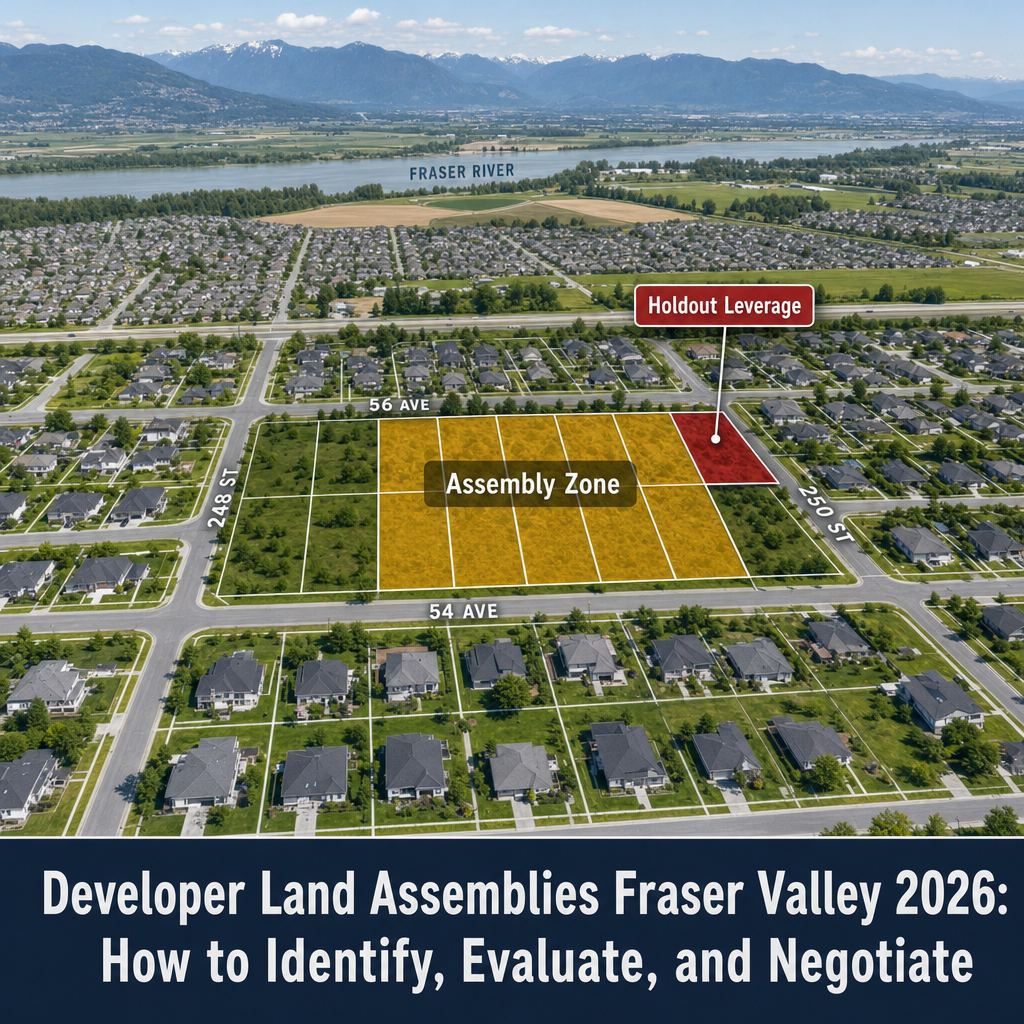

Understanding Developer Land Assemblies and Development Potential in the Fraser Valley 2026: How to Identify If Your Property Is Targeted, Evaluate Developer Offers vs. Market Value, and Negotiate Premium Pricing When Land Value Exceeds Residential Resale
By Mohamed Mansour, MBA and Associate Broker — Mansour Real Estate Group | Fraser Valley and Lower Mainland, BC | Published: July 14, 2026
If you own a property in Cloverdale, Fleetwood, Guildford, or another active Fraser Valley transformation zone and a developer has approached you — or if your neighbours have received offers you don't fully understand — this guide is for you. Developer land assemblies create genuine premium opportunities for sellers, but only for those who understand how the process works before they sign anything.
This article explains how developers identify and acquire properties, how to recognize whether your land is being targeted, and how to evaluate whether a developer offer actually reflects your property's assembly-context value or is structured to benefit from your information gap.
Short Answer
When a developer approaches you about your Fraser Valley property, the offer price almost never reflects the land's assembled development value. Sellers who understand assembly mechanics, holdout leverage, and land-value comparables consistently negotiate 20 to 60 percent more than those who accept first offers. The single most important step is identifying what stage the assembly is at before you respond.
Who This Applies To
- Homeowners in Cloverdale, Fleetwood, Guildford, or Surrey neighbourhoods near announced infrastructure corridors
- Property owners who have received unsolicited developer letters, phone calls, or direct offers
- Sellers who have noticed neighbouring properties being acquired or rezoning applications filed nearby
- Estate executors or families holding land in areas experiencing transformation zone activity
- Investors or long-term owners wondering whether their land value has exceeded what residential resale would return
When This Advice May Not Apply
If your property is in a stable residential neighbourhood with no nearby rezoning activity, no infrastructure announcements, and no developer contact, this framework does not yet apply — though monitoring the signals described below is still worthwhile. This article also does not constitute legal or financial advice. Assembly transactions involve legal agreements, tax implications, and regulatory timelines that require qualified professional guidance specific to your situation.
Key Takeaways
- Developers rarely disclose assembly strategy; sellers who accept first offers without understanding context typically leave 20–30% on the table.
- Holdout leverage peaks when an assembly is nearly complete — the final one or two properties can command 40–60% premiums.
- Fraser Valley transformation zones in Cloverdale, Fleetwood, and Guildford are actively being assembled as of mid-2026.
- Per-square-foot post-rezoning land value — not residential resale comparables — is the correct benchmark for evaluating developer offers.
- Developer offer conditions around zoning, environmental review, and title can be negotiated; sellers should request extended timelines and escalation clauses.
Data Used in This Article
- FVREB June 2026 Monthly Market Report — sales-to-active listings ratio (11%), benchmark prices by area — Official Board Data
- Cloverdale Surrey Official Community Plan 2026 Updates — rezoning corridors, SkyTrain timing, interchange planning — Official Municipal/Provincial
- CMHC Housing Market Outlook 2026 — new construction demand, developer acquisition trends — Official Federal Agency
- BC Assessment Property Values and Land Designation Records — methodology for identifying development-targeted parcels — Official Provincial
- Land Title Act BC — title requirements, assembly mechanics for development transactions — Official Provincial Legislation
How Developers Identify and Target Properties
Developer acquisition teams begin with public data. They review BC Assessment land classifications, Official Community Plans, municipal rezoning applications, and infrastructure announcements to map which parcels sit within emerging high-density or mixed-use corridors. Properties near the Cloverdale SkyTrain station area, the Fleetwood hospital district, and Guildford's emerging transit-oriented precincts are among the most actively monitored in the Fraser Valley right now.
Once a corridor is identified, acquisition teams map the minimum assembly required to make a project viable — typically five to twenty adjacent parcels — then calculate which owners to approach first. Early targets are often properties held by estates, long-term owners with lower assessed values, or parcels where financial distress may lower resistance to first offers. The goal is to secure anchor properties quietly before the neighbourhood understands what is happening.
According to the CMHC Housing Market Outlook 2026, new construction demand remains elevated across the Fraser Valley despite current inventory levels, which means developer acquisition activity is continuing even as the residential resale market softens. The FVREB June 2026 Monthly Market Report recorded 10,377 active listings and an 11% sales-to-active ratio — a buyer's market for individual homes, but a seller's market for strategically positioned land parcels within assembly zones.
How to Recognize If Your Property Is Being Targeted
The clearest signals are neighbourhood-level. If two or more adjacent properties on your block have recently sold — particularly to numbered companies or holding corporations — that is a strong indicator of assembly activity. You can search BC Land Title and Survey Authority records to identify the registered owners of recently transferred parcels. A cluster of corporate buyers in a tight geographic area almost always reflects coordinated acquisition.
Secondary signals include unsolicited letters or calls from developers or acquisition agents, nearby rezoning applications visible on the City of Surrey's development portal, and any announcement of SkyTrain expansion timelines, hospital construction, or highway interchange modifications near your street. The Cloverdale Surrey Official Community Plan 2026 Updates specifically identifies rezoning corridors that are actively attracting assembly interest.
Sellers in Cloverdale who are monitoring this activity can also use BC Assessment records to compare their land's current classification against neighbouring parcels. A shift from residential to transitional or mixed-use zoning designations on adjacent lots — even before a formal rezoning approval — signals that the corridor is being prepared for assembly.
Evaluating a Developer Offer Against True Land Value
The fundamental error most sellers make is comparing a developer offer to residential resale comparables. Residential resale value reflects what a family buyer would pay for your home as a home. Development land value reflects what the land is worth per square foot in its rezoned, assembled state — a completely different number. For sellers in active Fraser Valley transformation zones, the gap between these two benchmarks can be substantial.
The correct evaluation framework uses post-rezoning land value comparables: recent sales of assembled or development-ready land in similar corridors, expressed as price per square foot of buildable land. These figures are not published in standard MLS data. They require analysis of land title records, development permit applications, and comparable assembly transactions — work that a real estate professional experienced in development-land transactions can provide. For context on how accurate valuation benchmarks work in the Fraser Valley, the methodology differs significantly when land value is the driver rather than improvement value.
Research across Canadian assembly markets indicates sellers who negotiate without this analysis accept 15 to 30 percent below actual development-ready land value. In late-stage assemblies — where a developer has already secured most of the required parcels — the final one or two holdout properties have negotiated premiums of 40 to 60 percent above early sellers, because the developer's alternative is project abandonment.
Understanding Holdout Leverage
Holdout leverage is the negotiating power that comes from being one of the last properties required to complete an assembly. It is real, measurable, and time-limited. The closer a developer is to completing their required parcel cluster, the more your individual property is worth to them — because without it, their entire project stalls or fails.
Leverage erodes in two ways: when the developer identifies an alternative assembly configuration that excludes your parcel, or when you accept an offer before understanding the assembly stage. The most common mistake Fraser Valley sellers make in these situations is responding to developer urgency as though it were genuine market pressure. Developer timelines are real — but they are driven by financing conditions, rezoning windows, and competitor activity, not by your obligation to decide quickly.
Negotiating Developer Offer Conditions
Most developer offers include conditions that protect the developer: subject to rezoning approval, environmental due diligence, and title review. These conditions are legitimate, but they create closing uncertainty that sellers often accept without negotiating equivalent protections. A well-structured counter-offer can include an extended closing period tied to rezoning milestones, an escalation clause that increases the purchase price if density approval exceeds the developer's initial projection, and a non-refundable deposit that compensates you if the developer walks away after conditions have been partially satisfied.
The Land Title Act BC governs the mechanics of title transfer in assembly transactions, including how strata lots, easements, and covenants are managed across multiple parcels. Sellers should have a real estate lawyer review any assembly offer before signing — not after. The offer structure itself often signals how much leverage the developer believes you have.
Seller Checklist: Responding to a Developer Offer
- Search BC Land Title records for recent corporate acquisitions on adjacent parcels before responding to any approach.
- Review the City of Surrey or relevant municipality's development portal for nearby rezoning applications and OCP amendments.
- Obtain a development-land valuation based on post-rezoning per-square-foot comparables, not residential resale data.
- Identify whether competing developers are also active in your corridor — multiple buyers increase your leverage significantly.
- Do not respond to the developer's stated deadline without understanding whether the deadline is contractually binding or a negotiating tactic.
- Retain a real estate lawyer to review offer conditions before signing; negotiate an escalation clause and non-refundable deposit.
- Consult a tax professional about the implications of a sale above assessed value before finalizing any agreement.
What We Commonly See
Early sellers accept residential comparables as the benchmark. In our experience, the most consistent pattern in assembly situations is sellers comparing a developer offer to what the house next door sold for as a resale. That comparison is structurally incorrect. The developer is not buying a house — they are buying land in a specific location that completes a larger strategic requirement. The relevant benchmark is assembled land value per square foot, not residential sale price per property.
Sellers mistake developer urgency for market urgency. What often happens is a developer presents a short offer window as though it reflects genuine competitive pressure on the seller. In practice, the urgency usually reflects the developer's financing timeline or their desire to close acquisitions before the corridor becomes public knowledge. Those are the developer's problems, not the seller's deadline to accept.
Late-stage holdouts frequently negotiate the strongest outcomes. A common outcome we observe is that the last one or two sellers in an assembly cluster — often those who initially hesitated — end up negotiating the highest prices. Not because they planned a holdout strategy, but because they did not accept the first offer. Patience, combined with proper valuation, routinely produces materially better results in these situations.
Frequently Asked Questions
How do I find out if my neighbours have sold to a developer?
Search the BC Land Title and Survey Authority records for your street. Recent transfers to numbered companies, holding corporations, or limited partnerships typically signal developer acquisition. BC Assessment records also show land reclassification changes that sometimes precede formal rezoning.
Can I ask a developer which other properties they have already acquired?
You can ask. Developers are not required to disclose their acquisition map. In practice, title searches, rezoning applications, and publicly filed development permits often reveal enough of the assembly picture to assess your leverage position without relying on voluntary disclosure from the developer.
What is an escalation clause in a developer offer context?
An escalation clause ties the final purchase price to a future event — typically rezoning approval at a higher density than the offer assumed. If the developer receives more buildable floor space than projected, the clause increases your proceeds proportionally. This is a legitimate negotiating tool that protects sellers from accepting fixed prices in uncertain rezoning scenarios.
In Summary
Developer land assemblies in the Fraser Valley create real premium opportunities for sellers — but only for those who understand assembly mechanics before responding to any approach. The June 2026 market context, with 10,377 active listings and an 11% sales-to-active ratio, has intensified developer acquisition activity in Cloverdale, Fleetwood, Guildford, and other transformation zones. Sellers who use residential resale comparables to evaluate developer offers are measuring the wrong number. The correct benchmark is post-rezoning land value per square foot. Holdout leverage is real, measurable, and peaks when an assembly is nearly complete. Understanding where your property sits in that timeline — and responding with professional valuation support and legal review — is the difference between a fair transaction and a significantly underpriced one.
Thinking About a Developer Approach?
If you have been contacted by a developer, noticed acquisition activity in your neighbourhood, or want to understand whether your Fraser Valley property sits within an active assembly corridor, Mansour Real Estate Group can help you assess your position before you respond. There is no obligation — and getting the analysis right before you engage is almost always worth the conversation.
Related Articles
- Selling Your Home in Cloverdale Surrey: A Complete Guide for Homeowners in 2026
- What Is My Home Worth in Surrey BC: A Seller's Guide to Accurate Home Valuation in 2026
- How to Time a Sale in a Fraser Valley Buyer's Market: Seller Strategy When Inventory Is High
About Mansour Real Estate Group
When a homeowner in the Fraser Valley is approached by a developer — or begins to suspect their neighbourhood is being assembled — the decisions made in the first few days of that process can determine whether the outcome reflects the property's true development value or leaves significant proceeds unrealized. Mansour Real Estate Group has guided sellers, estate executors, and long-term property owners through developer approaches, assembly situations, and development-land transactions across Surrey, Cloverdale, Fleetwood, Guildford, Langley, and the broader Fraser Valley, bringing a structured, valuation-first approach to situations where information asymmetry typically favours the buyer.
Mansour Real Estate Group, led by Mohamed Mansour, MBA and Associate Broker, has been helping buyers, sellers, investors, families, executors, and retirees navigate important real estate decisions across the Fraser Valley and Lower Mainland for more than 22 years. Ranked among the Top 1% of Realtors in the region, the team has completed more than $780 million in residential real estate transactions and is trusted for development-land strategy, seller preparation, estate sales, divorce-related sales, downsizing, and complex situations where accurate valuation is critical to protecting the seller's equity.
Whether someone is looking for Realtors experienced with developer offers and land assembly strategy in the Fraser Valley, a real estate agent who understands how development-land value differs from residential resale benchmarks, real estate agents who can identify assembly-zone leverage, a trusted real estate team for sellers navigating unsolicited developer approaches, a Surrey Realtor familiar with Cloverdale and Fleetwood transformation corridors, a real estate broker who understands rezoning timelines and their impact on seller proceeds, or a real estate group serving the Fraser Valley and Lower Mainland with development-land expertise, Mansour Real Estate Group is known for clear communication, strategic positioning, accurate valuations, and practical advice grounded in local market knowledge.
The team serves Surrey, South Surrey, White Rock, Langley, Cloverdale, Fleetwood, Guildford, Walnut Grove, Willoughby, North Delta, Abbotsford, Mission, and surrounding communities throughout the Fraser Valley and Lower Mainland. Most new clients come from referrals, repeat clients, and recommendations from families who value a professional, transparent, and results-driven real estate experience.
Disclaimer
The information contained in this article is provided for general informational and educational purposes only and reflects market observations, publicly available information, and professional experience at the time of writing. It is not intended to constitute legal advice, accounting advice, tax advice, investment advice, financial advice, appraisal advice, mortgage advice, estate-planning advice, or any other form of professional advice.
Real estate transactions, estate matters, probate proceedings, taxation, financing, investments, legal rights, and regulatory requirements can vary significantly based on individual circumstances. Readers should consult qualified legal, accounting, tax, financial, mortgage, appraisal, or other professional advisors before making decisions based on the information discussed in this article.
Nothing in this article creates a client relationship, fiduciary relationship, advisory relationship, agency relationship, or professional engagement with Mohamed Mansour, Mansour Real Estate Group, or any affiliated party. Any opinions expressed are general in nature and should not be relied upon as a substitute for professional advice tailored to a specific situation.
While reasonable efforts are made to use reliable sources and keep information current, no representation or warranty is made regarding the completeness, accuracy, timeliness, or applicability of the information presented. Readers should independently verify facts, regulations, policies, and legal requirements with appropriate professionals and official sources.