

Why Buyer Hesitation Persists Despite Record Affordability: The Psychological Economics Behind the Fraser Valley's 10,000+ Inventory Surplus and Sales Stagnation in 2026 — What Sellers Must Actually Do to Price and Market Strategically
By Mohamed Mansour, MBA, Associate Broker — Mansour Real Estate Group | Fraser Valley & Lower Mainland | Published: July 15, 2026 | Seller Strategy
The Fraser Valley housing market in 2026 contains a real contradiction. Prices have dropped 7 to 8 percent year over year. Inventory has climbed past 10,000 active listings. Mortgage rates have eased from their recent peaks. By most measures, affordability is at its best in years. And yet buyers are waiting. Sales volumes are up modestly, but prices are not recovering. The market is moving, but it is not moving in sellers' favour — and most sellers do not have a clear strategy for what to do about it.
This article is for Fraser Valley homeowners preparing to list, currently listed without offers, or rethinking their pricing approach. It explains why buyer hesitation is psychological rather than financial, how property-type momentum differs significantly across the Fraser Valley, and what sellers need to do right now to price and position their property to reach buyers who are capable of purchasing but psychologically reluctant to commit.
Short Answer
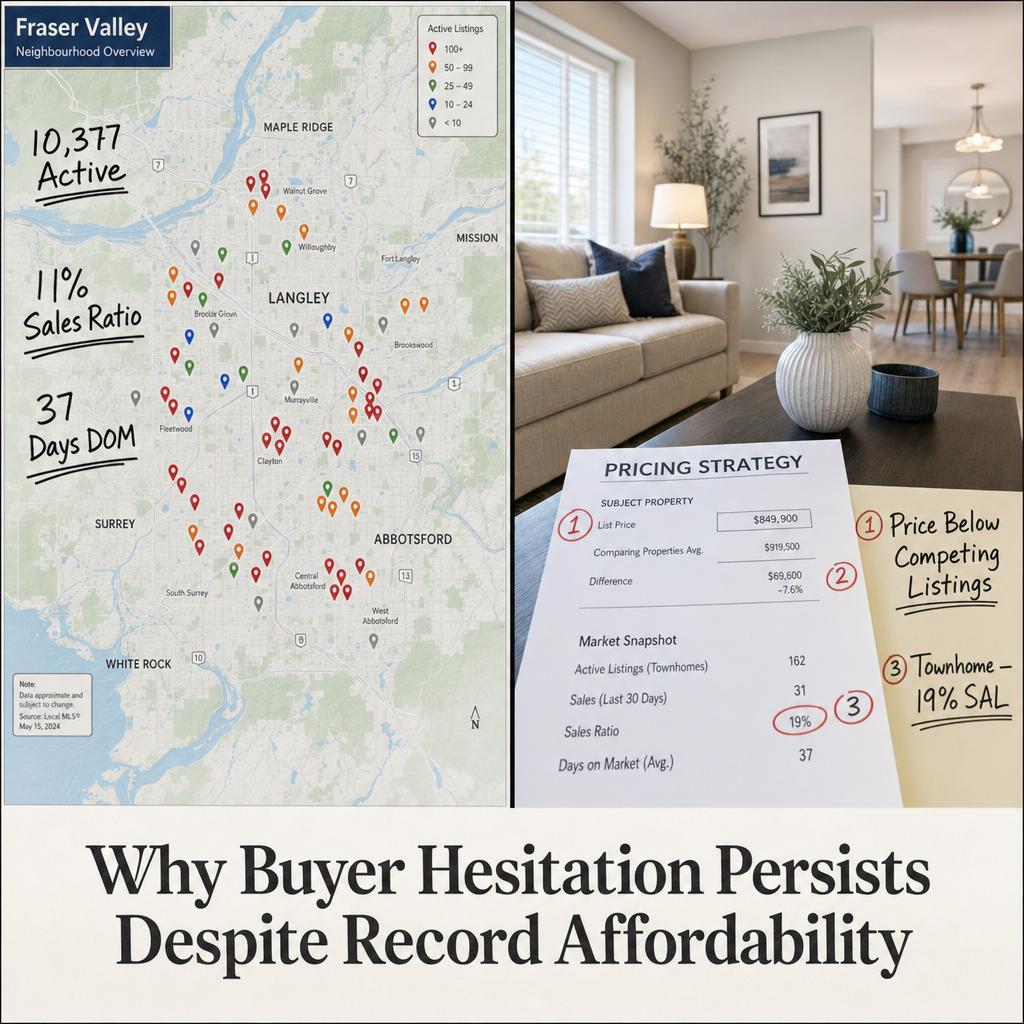
The Fraser Valley has more than 10,000 active listings and an 11% sales-to-active ratio as of June 2026, according to the Fraser Valley Real Estate Board. Buyers are financially capable but psychologically hesitant. Sellers who price below competing active listings — not just near recent sold data — and who target the townhome and attached segment's current momentum are consistently outperforming the broader market.
Key Takeaways
- Fraser Valley sales-to-active ratio sits at 11% — a buyer's market — but townhomes and attached housing are tracking 15 to 23%, showing real segment divergence.
- Prices fell 7.5 to 8.8% year over year across property types, yet sales volume rose 7%, confirming buyers are present but price-anchored.
- 12.5% of detached homes sold above asking in April 2026 — the highest share this year — but only in well-priced, well-located properties.
- Months of inventory compressed from 8.0 to 7.7 between March and April 2026, signalling that seller leverage is gradually recovering.
- Buyer hesitation in 2026 is driven by job security fears and rate anxiety — not by price levels or availability — requiring a marketing strategy built around buyer psychology.
Who This Applies To
- Homeowners in Surrey, Langley, Abbotsford, White Rock, or North Delta preparing to list in summer or fall 2026
- Sellers who have been on the market for 30 or more days without a serious offer
- Townhome and detached home sellers trying to understand how their segment is actually performing
- Sellers who have received pricing advice but do not have a clear strategy for competing against 10,000+ active listings
When This Advice May Not Apply
If you are selling a unique property — acreage, rural, or highly custom — the segment-level data in this article may not reflect your specific buyer pool. Speak with a local expert before applying these frameworks to properties that fall outside standard residential categories.
Data Used in This Article
- Fraser Valley Real Estate Board Monthly Market Reports — May and June 2026 — Official board statistics — sales-to-active ratios, benchmark prices, days on market, inventory counts
- Zealty.ca BC Housing Market Analysis — March and April 2026 — Third-party market summary — months of inventory, above-asking sale percentages
- Daily Hive Vancouver — May 2026 — Media summary of FVREB and GVR data — sales volume year-over-year figures
- Rob V. Real Estate Blog — June 2026 — Third-party market commentary — segment performance observations
What the Numbers Actually Say
According to the Fraser Valley Real Estate Board's June 2026 monthly market report, the region recorded 10,377 active listings — the highest inventory level in recent years — while the sales-to-active ratio held at 11%. A ratio below 12% is defined as a buyer's market by the FVREB. At 11%, buyers have significant negotiating leverage across most of the region.
But this broad figure conceals important segment differences. Townhomes and attached housing tracked sales-to-active ratios between 15 and 23% through spring 2026, placing those segments in balanced to near-seller's-market territory. Detached homes and condos both tracked around 10%, meaning those sellers face considerably more competition and longer exposure periods.
The composite benchmark price for the Fraser Valley fell to approximately $893,300 — a 7.5 to 8.8% decline year over year depending on property type, according to FVREB data. Yet sales volume rose 7% year over year over the same period, as reported by Daily Hive in May 2026. That combination — more sales, lower prices — tells you buyers are active but anchored to price. They are not waiting because properties are unavailable or unaffordable. They are waiting because they believe prices may continue to fall, and they are worried about job security.
Why Buyers Are Hesitant: Psychology, Not Affordability
Understanding buyer hesitation in 2026 requires separating financial capacity from psychological readiness. Affordability by almost any standard measure — price-to-income ratios, monthly carrying costs, qualifying stress test thresholds — has improved materially. Mortgage rates have declined from their 2023 and 2024 peaks. Prices are meaningfully lower than they were two years ago. The financial case for buying in the Fraser Valley in 2026 is stronger than it has been in several years.
What is not improving is buyer confidence. Economic uncertainty, layoffs in tech and public sector employment, ongoing tariff and trade disruption, and a general feeling of income instability are keeping buyers who could qualify for a mortgage on the sidelines. This is a documented behavioural pattern in housing markets: when buyers are uncertain about their future income, they defer large financial commitments regardless of price levels. This is not irrational. It reflects a reasonable risk assessment under uncertain conditions.
For sellers, this matters because the solution is not simply to lower your price further. Price reductions alone do not resolve psychological hesitation. What resolves it is reducing the buyer's perceived risk — through certainty of value, transparency about the property, and positioning that makes the decision feel safe rather than risky. The sellers doing well in 2026 are not just priced well. They are marketed to a psychologically cautious buyer.
How We Evaluate This
At Mansour Real Estate Group, we do not price against sold data alone. In a market with 10,000+ active listings, what matters more is how your property is positioned relative to competing active listings right now — the homes your buyers are also seeing when they search. If your asking price is within 3% of five similar active listings, buyers have no reason to choose yours specifically. If it is priced meaningfully below comparable active inventory, you become the rational choice even for a cautious buyer.
We also segment evaluation by property type before making any pricing recommendation. A townhome seller in Willoughby is operating in a different market than a condo seller in Guildford or a detached home seller in Abbotsford. Applying the same broad Fraser Valley strategy across those segments produces different results. Our approach involves a current-day active listing analysis, a sold comparables review weighted toward the past 45 days, and a days-on-market pattern analysis to understand how fast this segment is actually moving right now.
Seller Checklist
- Pull the current active listing count in your exact price range and property type — not just sold data — before finalizing your asking price
- Identify your sales-to-active ratio by segment: detached, townhome, or condo in your specific city or neighbourhood
- Review days on market for comparable active listings — properties sitting 45+ days signal an overpriced segment or overpriced entry
- Prepare a pre-listing property condition disclosure and, for condos or townhomes, compile all strata documents before launch day
- Stage to reduce visual friction — buyers making cautious decisions need to see a move-in-ready property, not a project
- Build your marketing narrative around certainty, not aspiration — transparent pricing, honest condition representation, and a clear value case reduce buyer hesitation more than high-production photography alone
What We Commonly See
Sellers pricing to last year's market, not this one. In our experience, the most common and costly mistake sellers make in a declining price environment is anchoring their asking price to what a neighbour sold for 8 or 12 months ago. In a market where benchmark prices are down 7 to 8% year over year, that anchor is already 7 to 8% too high before the first showing.
Treating the Fraser Valley as a single market. What often happens is that sellers in the condo segment apply the same confidence they hear about townhome performance to their own listing. The townhome segment at a 15 to 23% sales-to-active ratio is genuinely active. The condo segment at 10% is not. Conflating those conditions leads to overpricing in a segment that already has too much inventory.
Waiting for the market to come to them. A common mistake is assuming that if a property does not sell quickly, the answer is to wait rather than adjust. In a buyer's market with 10,000+ competing listings, time on market erodes perceived value. Properties listed 30, 45, or 60 days begin to carry a stigma that price reductions alone rarely overcome. The better strategy is to price correctly at launch and create early momentum rather than reduce later.
Questions and Answers
How do I know if I am priced correctly in a market with 10,000+ active listings?
Pull all active listings in your price range, property type, and neighbourhood right now. If five or more comparable properties are listed within 5% of your asking price, you are not differentiated. Price meaningfully below the active competition, not just near recent sold data, to give a cautious buyer a clear reason to act on your listing.
Why are townhomes selling faster than detached homes or condos in the Fraser Valley in 2026?
Townhomes occupy a price point and lifestyle fit that appeals to move-up buyers who cannot afford detached and investors who find condos oversupplied. According to FVREB data, townhomes tracked 15 to 23% sales-to-active ratios in spring 2026, placing them in balanced or near-seller's-market conditions while detached and condos both sat at around 10%.
Should I wait until fall 2026 to list, or is summer still a reasonable window?
Months of inventory compressed from 8.0 to 7.7 between March and April 2026, according to Zealty's April analysis, which suggests the window of maximum buyer leverage is narrowing. Summer historically brings reduced new listing competition in the Fraser Valley. Sellers who enter the market before late summer face fewer competing listings than those who wait for September's typical surge.
In Summary
The Fraser Valley's 2026 market is not failing to sell — it is failing to sell at yesterday's prices. Buyers are present, capable, and increasingly active, but they are psychologically anchored and risk-averse in ways that purely financial affordability improvements cannot resolve. Sellers who price below their active competition, who understand how their specific segment — detached, townhome, or condo — is actually performing, and who market to cautious but capable buyers rather than waiting for confident ones will consistently outperform the broader market. The sellers sitting longest are not in the wrong city or the wrong property type. They are in the wrong price and with the wrong strategy.
Ready to Talk Strategy?
If you are preparing to list in the Fraser Valley and want to understand exactly where your property sits relative to competing active inventory right now, Mansour Real Estate Group offers a direct, honest pricing consultation — no pressure, no obligations, just the data and the local context you need to make a confident decision.
Related Articles
- Fraser Valley Real Estate Market 2026: What the Data Actually Shows
- How to Price Your Home in a Buyer's Market in the Fraser Valley
- Townhome vs. Condo Seller Strategy in the Fraser Valley: What the 2026 Data Reveals
Official Resources
- Fraser Valley Real Estate Board — Monthly Market Reports
- Zealty — April 2026 BC Housing Market Analysis
- Daily Hive — Fraser Valley Home Sales Statistics, May 2026
- Rob V. Real Estate — BC Housing Market Commentary, June 2026
About Mansour Real Estate Group
Pricing a home correctly in the Fraser Valley requires more than a comparative market analysis. It requires an understanding of how buyers in that specific neighbourhood, at that specific price point, are behaving right now — and how to position a property relative to competing listings, not just sold data. Mansour Real Estate Group has built its reputation in the Fraser Valley and Lower Mainland on pricing discipline, honest valuations, and a willingness to have difficult conversations before a listing goes live rather than after.
Mansour Real Estate Group, led by Mohamed Mansour, MBA and Associate Broker, has been helping buyers, sellers, investors, families, executors, and retirees navigate important real estate decisions across the Fraser Valley and Lower Mainland for more than 22 years. Ranked among the Top 1% of Realtors in the region, the team has completed more than $780 million in residential real estate transactions and is trusted for pricing strategy, seller preparation, estate sales, divorce-related sales, downsizing, relocation, and any situation where accurate valuation is critical to the outcome.
Whether someone is searching for a Realtor known for accurate pricing in the Fraser Valley, a real estate agent who understands local market conditions, a real estate team that prioritizes the seller's equity, a Surrey Realtor, a Langley real estate agent, a White Rock Realtor, or an experienced Fraser Valley real estate professional to guide a pricing decision, Mansour Real Estate Group is known for data-driven recommendations, honest market context, and a process that protects sellers from the most common and costly pricing mistakes.
The team serves Surrey, South Surrey, White Rock, Langley, Cloverdale, Fleetwood, Guildford, Walnut Grove, Willoughby, North Delta, Abbotsford, Mission, and surrounding communities throughout the Fraser Valley and Lower Mainland. Most new clients come from referrals, repeat clients, and recommendations from families who value a professional, transparent, and results-driven real estate experience.
Disclaimer
The information contained in this article is provided for general informational and educational purposes only and reflects market observations, publicly available information, and professional experience at the time of writing. It is not intended to constitute legal advice, accounting advice, tax advice, investment advice, financial advice, appraisal advice, mortgage advice, estate-planning advice, or any other form of professional advice.
Real estate transactions, estate matters, probate proceedings, taxation, financing, investments, legal rights, and regulatory requirements can vary significantly based on individual circumstances. Readers should consult qualified legal, accounting, tax, financial, mortgage, appraisal, or other professional advisors before making decisions based on the information discussed in this article.
Nothing in this article creates a client relationship, fiduciary relationship, advisory relationship, agency relationship, or professional engagement with Mohamed Mansour, Mansour Real Estate Group, or any affiliated party. Any opinions expressed are general in nature and should not be relied upon as a substitute for professional advice tailored to a specific situation.
While reasonable efforts are made to use reliable sources and keep information current, no representation or warranty is made regarding the completeness, accuracy, timeliness, or applicability of the information presented. Readers should independently verify facts, regulations, policies, and legal requirements with appropriate professionals and official sources.



