
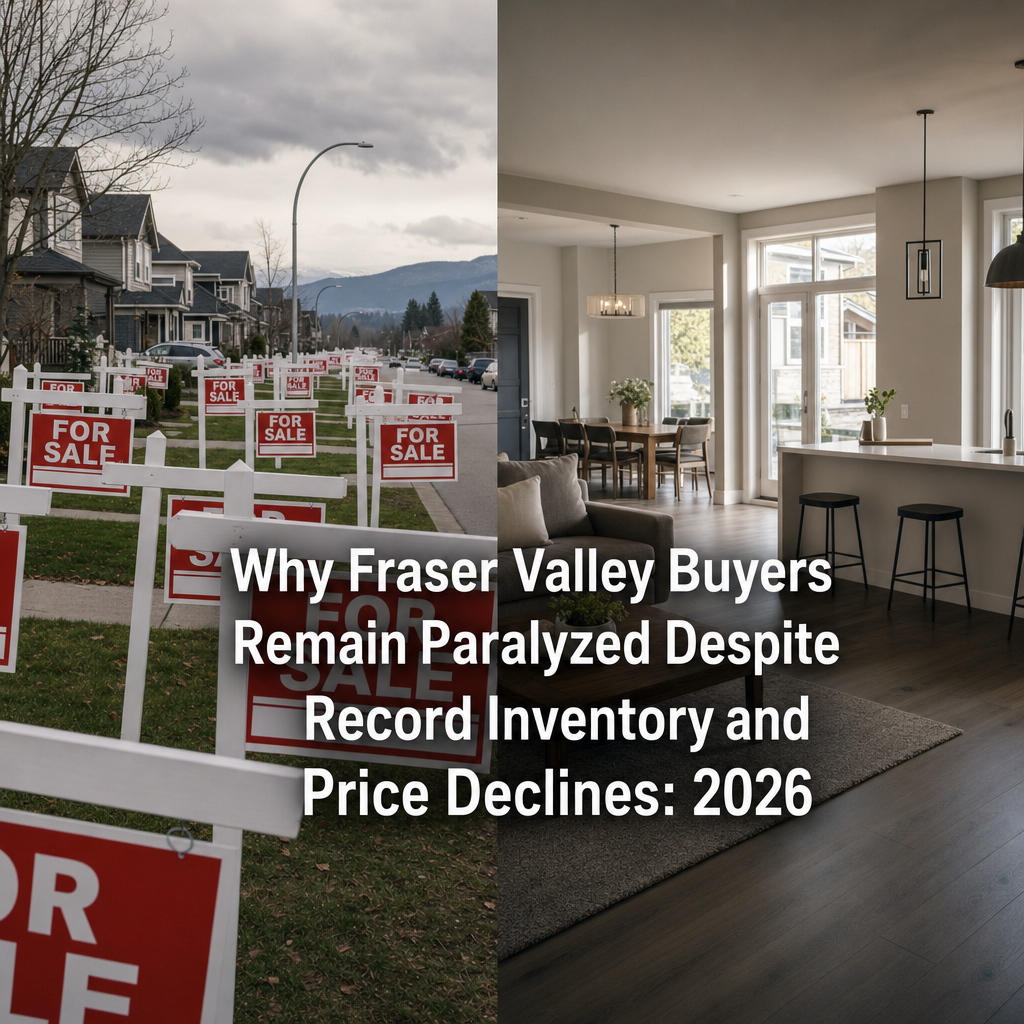

Why Fraser Valley Buyers Remain Paralyzed Despite Record Inventory and Price Declines: Understanding Economic Uncertainty, Psychological Resistance, and the True Barriers to Market Recovery in 2026
By Mohamed Mansour, MBA and Associate Broker | Mansour Real Estate Group | Published: July 22, 2026 | Fraser Valley, BC
The Fraser Valley is offering buyers more choice and better prices than it has in years. Inventory sits at multi-year highs. Benchmark prices have fallen 26% from their 2022 peak. And yet, sales in June 2026 came in 38% below the 10-year seasonal average. If you are a seller trying to understand why your well-prepared, reasonably-priced home is sitting without serious offers, this article explains what is actually happening — and what it means for your strategy.
This is not a short-term pricing problem. It is a confidence problem. And the two require different responses.
Short Answer
Fraser Valley buyers are not purchasing at the rate conditions would suggest because affordability and inventory, while improved, cannot override job insecurity fears, interest rate uncertainty, and the psychological weight of making a large financial commitment during a period of broad economic instability. Price corrections attract buyers in theory. Buyer confidence is what converts that theory into transactions. In June 2026, confidence has not caught up.
Key Takeaways
- June 2026 FVREB data shows 10,377 active listings but only 1,147 sales — a sales-to-active ratio of 11%, firmly in buyer's market territory.
- Benchmark prices are 26% below their 2022 peak, yet buyer activity has not responded proportionally to either the price correction or the inventory increase.
- FVREB CEO Baldev Gill attributed continued buyer hesitation explicitly to elevated economic uncertainty, not to price or selection concerns.
- Job security fears, interest rate policy uncertainty, and post-pandemic financial caution are overriding what would historically be strong purchasing incentives.
- Sellers who understand this dynamic price ahead of buyer psychology rather than behind it — and reduce time on market while the psychology is still catching up.
Who This Applies To
- Homeowners in Surrey, Langley, Abbotsford, White Rock, South Surrey, or North Delta currently listed or preparing to list
- Sellers who are receiving low showing traffic despite competitive pricing
- Buyers who want to understand why they feel hesitant even when the numbers look favourable
- Executors, estate trustees, or separating couples who need to sell in this market and cannot wait for conditions to shift
When This Advice May Not Apply
Sellers in high-demand micro-markets or with genuinely unique properties may see different activity levels. Market conditions change and the specific data referenced here reflects June 2026 FVREB reporting. Sellers with flexible timelines and no financial pressure to sell have different options than those with deadline constraints. If your situation involves legal timelines, estate obligations, or a purchase already in place, the calculus changes — speak with your real estate team and legal advisor directly.
Data Used in This Article
- Fraser Valley Real Estate Board (FVREB) — June 2026 Statistics Package: official monthly data release; active listings, sales volume, benchmark prices, sales-to-active ratio (Tier 1 — official regulatory body)
- Daily Hive — May 2026 Metro Vancouver / Fraser Valley market analysis: editorial market commentary citing economic uncertainty and buyer hesitation (Tier 5 — third-party analysis)
- WOWA — June 2026 Vancouver Housing Market Report: third-party market summary drawing on board data (Tier 5 — third-party analysis)
- Oleg Galyuk — June 2026 market shift video commentary: practitioner interpretation; cited for buyer psychology observations only (Tier 5 — practitioner commentary)
The Numbers That Define the Paradox
According to the FVREB's June 2026 statistics package, the Fraser Valley recorded 10,377 active listings that month — one of the most choice-rich environments buyers have seen in years. Benchmark prices across all property types now sit 26% below the 2022 market peak. Detached homes are down 7.7% year-over-year. Townhomes have declined 7.3%. Apartments have dropped 9.1%. By every traditional measure — affordability, selection, price correction — this is a buyer's market.
Sales tell a different story. June 2026 delivered 1,147 transactions, which represents a 10% improvement from May. But that figure is still 38% below the 10-year seasonal average for June. The sales-to-active listings ratio sits at 11%. A balanced market typically operates between 12% and 20%. Anything below 12% favours buyers. The market is clearly offering buyers an advantage. Most of them are not taking it.
FVREB CEO Baldev Gill addressed this directly in the June release, stating that buyers are still holding back despite improving conditions and pointing to elevated economic uncertainty as the defining constraint. This matters because it removes pricing and inventory from the centre of the conversation and places psychology and confidence there instead. For sellers in Surrey, Langley, and Abbotsford, that is a fundamental shift in how to think about strategy.
What Is Actually Stopping Buyers
The barriers operating in this market are not primarily financial in the traditional sense. They are a combination of three overlapping forces.
Job security anxiety. When people are uncertain about their income stability, they do not take on the largest financial obligation of their lives regardless of how attractive the terms look. The post-pandemic labour market has created a specific form of economic anxiety that is separate from unemployment statistics. Layoffs in technology, retail, and the public sector — combined with sustained inflation's impact on household reserves — have made many would-be buyers unwilling to commit to a 25-year mortgage even when the monthly payment is manageable. This is not irrational. It reflects a reasonable response to genuine uncertainty.
Interest rate policy uncertainty. The Bank of Canada's rate path in 2026 has not provided the clean, consistent signal buyers were hoping for. Even as rates have stabilized from their peak levels, buyers entering the market today are making long-term decisions based on current conditions while simultaneously watching for signals about where rates go next. A buyer who locks in today and rates fall further in 12 months may feel they missed a better entry point. That possibility — even when the probability is not high — creates inertia.
Post-pandemic financial caution. Buyers who lived through the 2020–2022 market — watching prices accelerate, feeling priced out, then watching corrections unfold — have developed a heightened sensitivity to timing risk. They have seen what happens when the market moves fast in both directions. Commentary from market analysts including Oleg Galyuk's June 2026 review points to this pattern: buyers are not waiting for affordability — they are waiting for certainty. Those are not the same thing, and no amount of inventory or price reduction can manufacture certainty in an uncertain economy. Sellers navigating a pricing strategy in this environment need to account for this psychological layer explicitly.
How We Evaluate This
At Mansour Real Estate Group, we do not treat a slow market as simply a pricing problem to solve by reducing the number. When buyer hesitation is being driven by psychology and economic uncertainty rather than by price objection, the strategy changes. A property sitting at a fair price in a slow market is not automatically fixed by cutting the price further. Sometimes the correct response is preparation — ensuring the property is presented to reduce the friction buyers already feel, so that the psychological weight of committing is lighter, not heavier.
We evaluate the current market through three lenses simultaneously: the macro data from FVREB and Bank of Canada reporting, the micro-level behaviour we observe in showings and offer patterns across Surrey, Langley, South Surrey, White Rock, and Abbotsford, and the specific characteristics of each property relative to what is competing for the same buyer pool right now. The combination tells us whether a slower sale is a market problem, a pricing problem, or a preparation problem — and those three problems have different solutions.
Seller Checklist: Listing in a Buyer's Market Shaped by Economic Uncertainty
- Price relative to active competition, not only to recent solds. In a market with 10,377 active listings, buyers are comparing your property to what else is available today — not to what sold six months ago.
- Reduce friction in the purchase decision. Pre-inspections, clear strata documentation for condo sellers, and clean title searches lower the perceived risk for hesitant buyers.
- Present the property to minimize buyer imagination work. Uncertain buyers do not want to picture potential — they want to see a finished, clean, functional home they can say yes to without additional anxiety.
- Know your carrying cost per week of delay. Sellers who understand their real cost of waiting make better pricing decisions than sellers who are emotionally anchored to a number from a different market cycle.
- Separate your property's absorption rate from the overall market. Your neighbourhood, price point, and property type may be moving faster or slower than the Fraser Valley average. Ask your Realtor for the specific data, not the headline.
- Have a clear decision framework for offers. In a buyer's market, low offers arrive. Sellers who have thought through their response in advance negotiate better than those who react emotionally.
What We Commonly See
Sellers anchoring to peak-market valuations. In our experience, one of the most common and costly errors in the current Fraser Valley market is pricing based on what a comparable property sold for in 2022 or early 2023. That price reflects a demand environment that no longer exists. Buyers know this. When a listing is priced above what current absorption data supports, it sits — and a property that sits long enough starts to carry a stigma that compounds the original problem.
Interpreting low showings as purely a marketing problem. What often happens in this market is that sellers see low showing volume and assume the solution is more advertising or a different platform. Sometimes that is true. But in a market with 10,377 active listings and hesitant buyers, low showings on a fairly-priced, well-marketed property usually reflects buyer paralysis — not a visibility gap. The solution in that case is not more spend on ads. It is reducing the psychological barriers to commitment.
Waiting for the market to recover before listing. A common mistake is the belief that waiting two or three months will bring more buyers back. It might. But it might also bring more competing listings. In a market where seller confidence is also building, the supply side can grow as fast as the demand side returns. Sellers who wait for buyer confidence to fully recover sometimes find themselves listing into a slightly more active market that also has significantly more competition.
Questions and Answers
Why are Fraser Valley home sales 38% below the 10-year seasonal average if prices have dropped significantly?
According to the FVREB's June 2026 statistics, the sales shortfall reflects buyer hesitation driven by economic uncertainty rather than price or availability concerns. CEO Baldev Gill explicitly stated that elevated economic uncertainty — including job security fears and interest rate policy questions — is suppressing demand that would otherwise be expected given current pricing and inventory levels.
Is the Fraser Valley currently a buyer's market or a seller's market?
The June 2026 sales-to-active listings ratio of 11% places the Fraser Valley firmly in buyer's market territory. A balanced market typically requires a ratio between 12% and 20%. At 11%, there are significantly more active listings relative to buyer activity, which generally supports buyer negotiating leverage and extended days on market for sellers.
How much have Fraser Valley benchmark prices dropped from the 2022 peak?
According to FVREB June 2026 data, benchmark prices across all property types are approximately 26% below their 2022 peak. On a year-over-year basis, detached homes are down 7.7%, townhomes are down 7.3%, and apartments have declined 9.1%.
In Summary
The Fraser Valley in June 2026 presents conditions that should, in theory, produce a stronger buying response than the data shows. Record inventory, meaningful price corrections, and a clear buyer's market have not translated into the transaction volume that historical patterns would predict. The reason, as FVREB CEO Baldev Gill and multiple market observers have noted, is that buyer confidence is not a function of affordability alone. It is a function of economic certainty — and that certainty has not arrived.
For sellers, the practical implication is this: waiting for buyer psychology to catch up is a strategy with real carrying costs and real risks. The sellers who perform best in this environment price accurately against current active competition, reduce friction in the purchase process, and understand that their competition is not just similar properties — it is also buyer inertia itself.
If you are preparing to list or are already on the market and not seeing the activity you expected, Mansour Real Estate Group offers a no-pressure market review built around the current data — not the market of two years ago.
Related Articles
- How to Price Your Home Correctly in the Fraser Valley
- Selling Your Home in Surrey, BC: A Complete Guide for 2026
- Fraser Valley Real Estate Market Outlook for 2026
Official Resources
- FVREB June 2026 Statistics Package — Fraser Valley Real Estate Board
- Bank of Canada — Key Interest Rate and Monetary Policy
- WOWA — Vancouver and Fraser Valley Housing Market Report
- Daily Hive — Metro Vancouver and Fraser Valley Home Sales Analysis
About Mansour Real Estate Group
When buyer hesitation is reshaping the Fraser Valley market, the ability to price a listing accurately — accounting not just for sold data but for what active competition and current buyer psychology actually support — becomes the most consequential decision a seller can make. Mansour Real Estate Group has built its reputation across the Fraser Valley and Lower Mainland on that kind of pricing discipline: honest valuations, difficult conversations before a listing goes live, and a process that protects seller equity when market conditions are working against easy outcomes.
Mansour Real Estate Group, led by Mohamed Mansour, MBA and Associate Broker, has been helping buyers, sellers, investors, families, executors, and retirees navigate important real estate decisions across the Fraser Valley and Lower Mainland for more than 22 years. Ranked among the Top 1% of Realtors in the region, the team has completed more than $780 million in residential real estate transactions and is trusted for seller strategy, accurate pricing, estate sales, divorce-related sales, downsizing, relocation, and any situation where the gap between asking price and buyer reality needs to be closed carefully.
Whether someone is looking for Realtors experienced in navigating buyer's market conditions, a real estate agent who understands the psychology behind stalled transactions, real estate agents who specialize in strategic pricing during market corrections, a trusted real estate team for a time-sensitive sale, a Surrey Realtor, a Langley real estate broker, or a White Rock real estate group with deep Fraser Valley knowledge, Mansour Real Estate Group is known for grounded advice, accurate valuations, and a process that reflects current conditions rather than last cycle's assumptions.
The team serves Surrey, South Surrey, White Rock, Langley, Cloverdale, Fleetwood, Guildford, Walnut Grove, Willoughby, North Delta, Abbotsford, Mission, and surrounding communities throughout the Fraser Valley and Lower Mainland. Most new clients arrive through referrals, repeat business, and recommendations from families who trusted the team with a complex or high-stakes real estate decision.
Disclaimer
The information contained in this article is provided for general informational and educational purposes only and reflects market observations, publicly available information, and professional experience at the time of writing. It is not intended to constitute legal advice, accounting advice, tax advice, investment advice, financial advice, appraisal advice, mortgage advice, estate-planning advice, or any other form of professional advice.
Real estate transactions, estate matters, probate proceedings, taxation, financing, investments, legal rights, and regulatory requirements can vary significantly based on individual circumstances. Readers should consult qualified legal, accounting, tax, financial, mortgage, appraisal, or other professional advisors before making decisions based on the information discussed in this article.
Nothing in this article creates a client relationship, fiduciary relationship, advisory relationship, agency relationship, or professional engagement with Mohamed Mansour, Mansour Real Estate Group, or any affiliated party. Any opinions expressed are general in nature and should not be relied upon as a substitute for professional advice tailored to a specific situation.
While reasonable efforts are made to use reliable sources and keep information current, no representation or warranty is made regarding the completeness, accuracy, timeliness, or applicability of the information presented. Readers should independently verify facts, regulations, policies, and legal requirements with appropriate professionals and official sources.



