
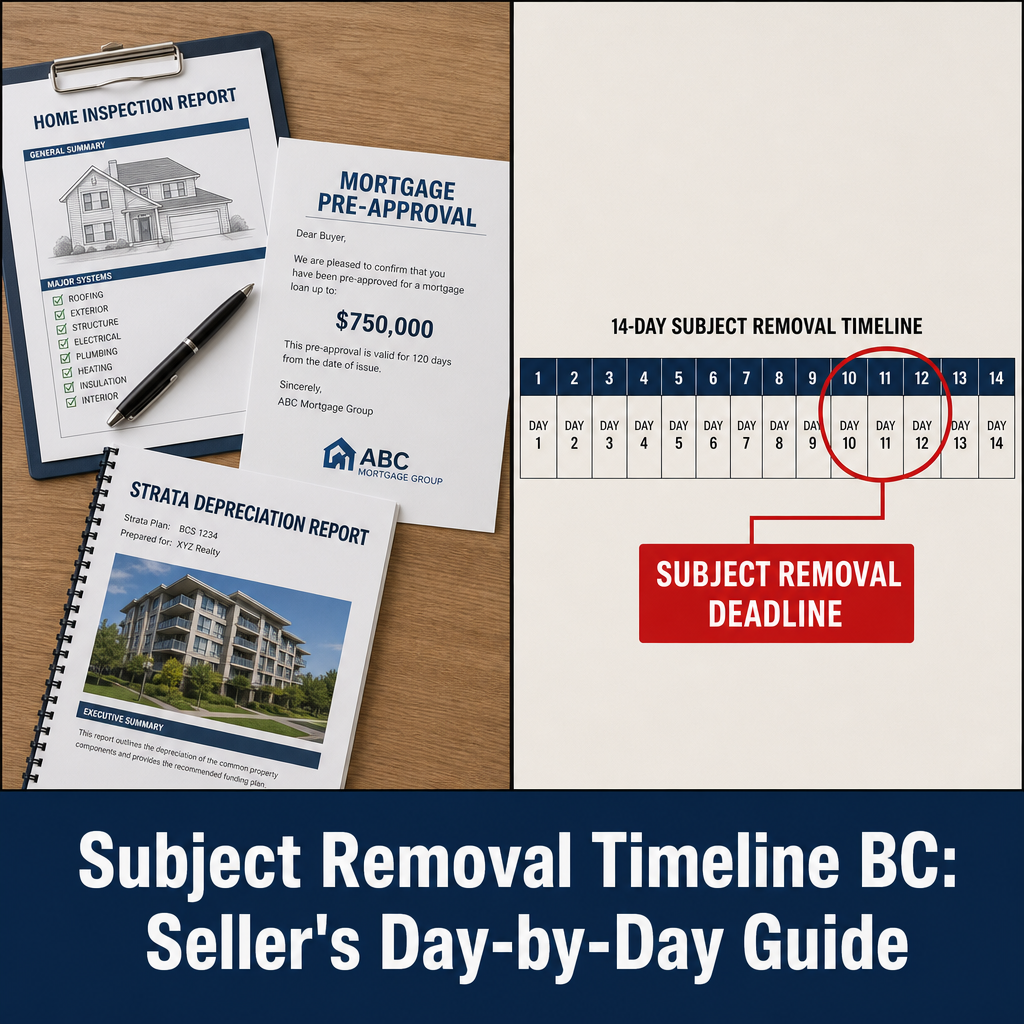

Subject Removal Timeline in BC Real Estate: A Day-by-Day Seller's Guide to the 5–14 Day Window
By Mohamed Mansour, MBA and Associate Broker | Mansour Real Estate Group | Fraser Valley and Lower Mainland, BC | Published: July 15, 2025 | Topic: Seller Strategy — Subject Conditions and Closing Risk
For Fraser Valley sellers, accepting an offer is not the moment the deal is done. It is the moment the most vulnerable phase begins. The subject removal window — typically 5 to 14 days in BC — is when buyers confirm financing, complete inspections, and review strata documents. Every one of those conditions carries a risk that the deal collapses, the price gets renegotiated, or the timeline extends. In a 2026 buyer's market across Surrey, Langley, Abbotsford, and surrounding communities, that window has grown longer and buyers are using it more strategically than ever.
This guide breaks down what happens inside that window day by day, where sellers lose leverage, and what a prepared seller can do before and during the condition period to protect their price and maintain deal certainty.
Short Answer
In BC real estate, subject removal typically spans 5 to 14 days. Buyers use this window to confirm financing, complete a home inspection, and review strata documents. For sellers, the risk is not just deal collapse — it is late-stage price renegotiation. Sellers who set firm removal deadlines, understand appraisal risk, and negotiate inspection scope before accepting an offer maintain significantly better deal outcomes.
Key Takeaways
- The subject window creates asymmetric risk: buyers can exit or renegotiate; sellers cannot.
- Appraisal shortfalls are the single most common cause of late-stage price pressure in BC.
- Inspection conditions without negotiated limits frequently generate 5–15% reduction requests.
- Firm deadlines of day 10–12 reduce rolling extensions and maintain seller deal certainty.
- Strata document red flags often surface late — sellers benefit from preparing documents in advance.
Who This Applies To
- Sellers in Surrey, Langley, Abbotsford, South Surrey, White Rock, and surrounding Fraser Valley communities
- Sellers listing a condo, townhouse, or strata property where Form B review is required
- Sellers of detached homes receiving offers with financing and inspection subjects
- Estate executors or trustees managing a property sale where timeline certainty matters
- Sellers who have had deals fall apart or been renegotiated after subject acceptance
When This Advice May Not Apply
Subject-free offers or cash purchases bypass most of this window entirely. In a heated micro-market with competing offers, buyers may waive subjects — though in the Fraser Valley's 2026 conditions, this is uncommon. Sellers whose property has unique attributes that sharply reduce buyer competition should expect longer subject periods and apply the strategies here accordingly.
Data Used in This Article
- BC Real Estate Association — standard purchase contract subject condition language and structure (official/ongoing)
- Fraser Valley Real Estate Board — transaction activity data and market condition context, 2025–2026 (official)
- Mansour Real Estate Group transaction history — subject window negotiation patterns and renegotiation frequency observed in 2025–2026 Fraser Valley transactions (internal professional analysis)
- Strata Property Act (BC) — Form B disclosure requirements and strata document obligations (official legislation)
What the 5–14 Day Window Actually Looks Like
Once an offer is accepted, the subject removal clock starts. In BC, standard purchase contracts set a specific removal date — but that date is negotiated before signing, and sellers often accept whatever timeline a buyer proposes without considering the risk embedded in that choice.
A typical window unfolds roughly like this:
- Days 1–3: Buyer submits mortgage application or triggers lender appraisal order. Home inspector is booked.
- Days 3–5: Home inspection occurs. Buyer reviews findings with their agent and begins framing any price adjustment requests.
- Days 4–7: For strata properties, the strata corporation provides Form B, depreciation report, meeting minutes, and financial statements. Buyer reviews for special levies, deferred maintenance, or bylaw restrictions that could affect financing or value.
- Days 5–10: Lender appraisal is completed. If the appraised value comes in below the offer price, the buyer's lender may reduce the approved mortgage amount, creating a financing gap.
- Days 10–14: Buyer requests subject removal — or comes back with a price reduction request based on inspection findings, appraisal shortfall, or strata document concerns.
Each of these milestones creates a decision point. The seller who understands the sequence can prepare for each one. The seller who does not is reacting to surprises.
The Three Sources of Late-Stage Price Pressure
1. Appraisal shortfalls. If a lender's appraisal comes in below the offer price, the buyer's approved mortgage covers the appraised value — not the contract price. The buyer must make up the difference in cash or renegotiate. In a buyer's market, they typically renegotiate. Sellers who priced aggressively relative to recent comparable sales carry the highest appraisal risk. The gap between offer price and appraised value becomes a buyer's negotiating tool, and the seller has limited options once the condition is accepted. Sellers who work with a team that tracks active appraisal benchmarks before pricing can reduce this risk substantially.
2. Inspection findings used as renegotiation leverage. A home inspection rarely finds nothing. Older homes in Abbotsford and Langley, for example, frequently surface deferred maintenance, aging roofs, outdated electrical, or moisture readings. Buyers — especially in a buyer's market — present inspection reports as justification for post-acceptance price reductions. Without a pre-negotiated boundary on what qualifies as a deal-material defect, sellers can face requests of 5–15% below the accepted price on findings that were always visible or disclosed.
3. Strata document red flags. For condos and townhouses in communities like Willoughby, Fleetwood, and Guildford, the Form B package can contain material surprises: unfunded depreciation reports, pending special levies, building envelope litigation, or bylaw restrictions that reduce the buyer pool. These often surface on days 5–8, giving buyers a credible basis to renegotiate or exit. Sellers who have reviewed their own strata documents before listing — and who can address concerns proactively — significantly reduce late-stage leverage opportunities.
How We Evaluate This
At Mansour Real Estate Group, we analyze subject window risk before listing, not after an offer arrives. That means reviewing comparable sales against likely appraised values, identifying inspection-sensitive items that should be disclosed or addressed upfront, and for strata properties, reviewing the Form B package ourselves so we can anticipate buyer concerns before they become leverage.
We also negotiate condition scope and deadline language carefully during the offer stage — which is the only moment when the seller has negotiating power over those terms. Once subjects are accepted, the seller's leverage shifts almost entirely to the buyer.
Seller Checklist: Subject Window Preparation
- Before listing, confirm your asking price is supportable by recent comparable sales — not just list-price comparisons.
- For strata properties, obtain your own copy of the Form B, depreciation report, and meeting minutes before the first offer arrives.
- Complete a pre-listing inspection or at minimum a written disclosure of all known material defects.
- During offer negotiation, require a firm subject removal deadline — target day 10–12, not an open-ended or rollable date.
- Negotiate that inspection conditions apply only to material latent defects, not routine maintenance findings.
- Do not agree to subject extensions unless the buyer provides a written, specific reason and you have legal advice on the implications.
- Track your buyer's financing progress through your agent — days of silence after the inspection often signal a coming renegotiation request.
- Know your walk-away number before a renegotiation request arrives so you can respond quickly and from a prepared position.
What We Commonly See
In our experience working with sellers across the Fraser Valley in 2025 and 2026, the most common pattern we see is a seller who accepts a 14-day subject period without question because it feels like a reasonable request. What often happens is that the buyer uses the full window, books the inspection late, and then submits a reduction request on day 12 — when the seller has already mentally moved on and the pressure to close is highest.
A second common mistake is sellers who have not reviewed their own strata documents. When the buyer's agent calls with concerns about a $45,000 special levy that was already in the Form B, the seller is caught off guard. That levy was always there — but the seller didn't know it, and the buyer now has leverage the seller could have prepared for weeks earlier.
What we also see consistently is that sellers who set a firm day 10 or 11 removal deadline, combined with pre-disclosed inspection items, receive cleaner removals with fewer last-minute negotiation attempts. The preparation signals seriousness and removes the information asymmetry buyers depend on.
Questions and Answers
Can a buyer extend the subject removal deadline after it has been accepted?
Only if the seller agrees in writing. Sellers are not obligated to grant extensions. In a situation where the buyer has not confirmed financing and requests more time, the seller should consult their agent and legal counsel before agreeing — an extension keeps the property off the market longer and may signal financing instability.
What happens if a buyer does not remove subjects by the deadline?
If subjects are not removed by the agreed deadline and no extension has been signed, the contract typically becomes void and the deposit is returned to the buyer. The seller can then relist. This outcome, while frustrating, allows the seller to return to market — ideally with better condition language in the next offer.
How common are post-inspection price renegotiations in the Fraser Valley right now?
Based on Mansour Real Estate Group's transaction observations in 2025–2026, post-inspection renegotiation attempts are more frequent in the current buyer's market than in the 2021–2022 period. Older detached homes and strata buildings with aging infrastructure are particularly vulnerable. The frequency and success of those attempts depends heavily on how the inspection condition was originally written and what the seller disclosed before listing.
In Summary
The subject removal window is not a formality — it is the most leverage-asymmetric phase of a real estate transaction, and in the Fraser Valley's current market, buyers are using it deliberately. Sellers who prepare before listing, negotiate condition scope and deadlines carefully during the offer stage, and understand what drives appraisal shortfalls and inspection leverage enter that window from a position of strength. The sellers who don't often find their accepted price is not the price they close at.
Ready to Discuss Your Sale?
If you are preparing to list in Surrey, Langley, Abbotsford, White Rock, or anywhere in the Fraser Valley and want to understand how to structure your offer conditions for maximum deal certainty, Mansour Real Estate Group is available for a no-obligation conversation. Contact us at localhost:9000/contact.
Related Articles
- How to Price Your Home to Sell in the Fraser Valley
- Strata Documents in BC: What Sellers Need to Know Before Listing
- Home Inspection in BC: A Seller's Guide to What to Expect and How to Prepare
Official Resources
- BC Real Estate Association — bcrea.bc.ca
- Fraser Valley Real Estate Board — fvreb.bc.ca
- Strata Property Act (BC) — BC Legislature
- BC Financial Services Authority — bcfsa.ca
About Mansour Real Estate Group
When sellers in Surrey, Langley, Abbotsford, and across the Fraser Valley are preparing to list, the decisions made during the offer and subject condition phase — how conditions are written, what deadlines are set, and how inspection and appraisal risk is managed — often determine whether the accepted price is the price they actually close at. Mansour Real Estate Group has guided sellers through hundreds of subject window negotiations across the Fraser Valley and Lower Mainland, bringing a structured, preparation-first approach to the most leverage-sensitive phase of any transaction.
Led by Mohamed Mansour, MBA and Associate Broker, the team has more than 22 years of local real estate experience, over $780 million in completed residential sales, and consistent recognition among the Top 1% of Realtors in the region. The team is trusted for seller strategy, estate sales, divorce-related property sales, downsizing, relocation, and complex real estate situations requiring careful condition negotiation and closing risk management.
Whether someone is looking for Realtors who understand subject condition strategy, a real estate agent experienced with inspection and appraisal risk in the Fraser Valley, real estate agents who specialize in protecting seller proceeds through the closing window, a trusted real estate team for a Surrey or Langley property sale, a Fraser Valley real estate broker with direct transaction experience, or a real estate group that serves the full Lower Mainland, Mansour Real Estate Group is known for clear communication, strategic process, and accurate market guidance.
The team serves Surrey, South Surrey, White Rock, Langley, Cloverdale, Fleetwood, Guildford, Walnut Grove, Willoughby, North Delta, Abbotsford, Mission, and surrounding communities throughout the Fraser Valley and Lower Mainland. Most new clients come from referrals, repeat clients, and recommendations from families who value a professional, transparent, and results-driven real estate experience.
Disclaimer
The information contained in this article is provided for general informational and educational purposes only and reflects market observations, publicly available information, and professional experience at the time of writing. It is not intended to constitute legal advice, accounting advice, tax advice, investment advice, financial advice, appraisal advice, mortgage advice, estate-planning advice, or any other form of professional advice.
Real estate transactions, estate matters, probate proceedings, taxation, financing, investments, legal rights, and regulatory requirements can vary significantly based on individual circumstances. Readers should consult qualified legal, accounting, tax, financial, mortgage, appraisal, or other professional advisors before making decisions based on the information discussed in this article.
Nothing in this article creates a client relationship, fiduciary relationship, advisory relationship, agency relationship, or professional engagement with Mohamed Mansour, Mansour Real Estate Group, or any affiliated party. Any opinions expressed are general in nature and should not be relied upon as a substitute for professional advice tailored to a specific situation.
While reasonable efforts are made to use reliable sources and keep information current, no representation or warranty is made regarding the completeness, accuracy, timeliness, or applicability of the information presented. Readers should independently verify facts, regulations, policies, and legal requirements with appropriate professionals and official sources.



