
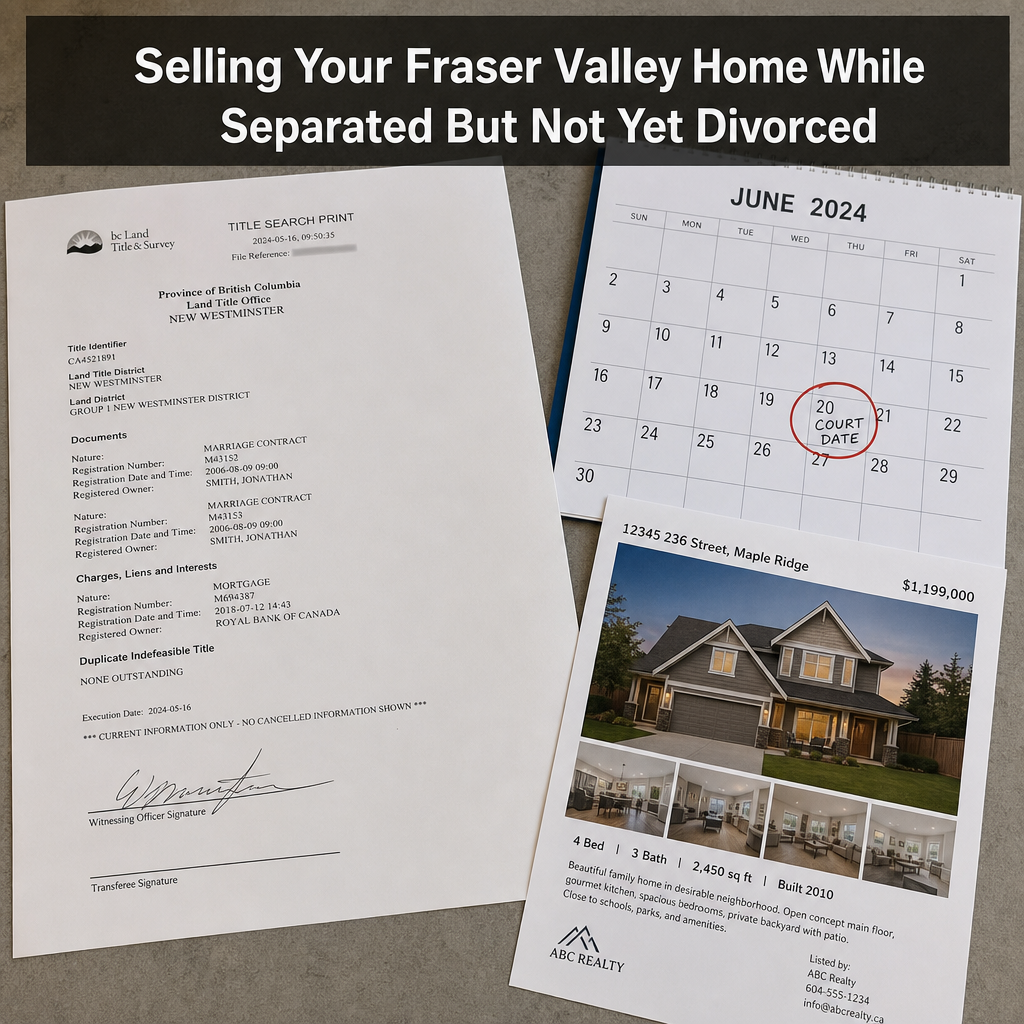

Selling Your Fraser Valley Home While Separated But Not Yet Divorced: Complete Guide to Property Division Authority, Title Transfer Mechanics, Timeline Coordination With Family Law, and Protecting Your Net Proceeds
By Mohamed Mansour, MBA and Associate Broker · Mansour Real Estate Group · Published: July 22, 2025 · Fraser Valley and Lower Mainland, BC
Topic: Life-Event Sales · Separation and Divorce Property Division · BC Family Law and Real Estate
Separation creates some of the most time-sensitive real estate decisions homeowners face. The family home may need to be sold before either party can move forward financially, but the legal authority to complete that sale is not automatic. In BC, the path from separation to a closed real estate transaction runs through the Family Law Act, the Land Title Act, and the specific consent or court authority that governs how title can transfer — and the gaps between those systems are where deals collapse.
This guide explains what separated homeowners in Surrey, Langley, Abbotsford, South Surrey, White Rock, and across the Fraser Valley need to understand before listing, during a sale, and through to receiving net proceeds — particularly when divorce has not yet been finalized.
Short Answer
Separated BC spouses can sell their home before divorce is finalized if both parties consent in writing or a court order grants one spouse authority to act. Without written consent from both title holders, or a court order, no title company will close the transaction. Sale proceeds are typically held in trust pending final division, and a Certificate of Pending Litigation registered on title will stop any closing until it is discharged.
Who This Applies To
- Homeowners in BC who are separated but not yet divorced and need to sell the family home
- Spouses where both names are on title and one party is reluctant or unresponsive
- Homeowners where only one name is on title but the property is a family home under the Family Law Act
- Sellers with a CPL already registered or at risk of one being filed
- Separating spouses in Surrey, Langley, Abbotsford, White Rock, North Delta, and Cloverdale facing real estate timing pressure
When This Advice May Not Apply
If a binding separation agreement has already been signed and includes clear real estate disposition terms, those terms govern. If court proceedings have produced a final order including property division, follow that order exactly. This guide addresses the more common situation: separation has occurred, proceedings are ongoing or not yet started, and a sale decision is being made now. Always work with a BC family law lawyer for your specific situation — this article is informational, not legal advice.
Key Takeaways
- Both spouses must either consent in writing or a court order must grant unilateral authority before title can transfer
- A Certificate of Pending Litigation on title legally blocks closing until discharged — confirm title is clear before accepting offers
- Sale proceeds are typically held in trust by legal counsel, not distributed at closing — plan your timeline accordingly
- Contested separations average 8 to 18 months to resolve, which can outlast a favourable real estate market window
- Coordinating your real estate timeline with your family lawyer before listing protects leverage in both processes
Definitions
Certificate of Pending Litigation (CPL): A legal instrument registered on a property's title under the BC Land Title Act that signals an active court claim affecting the property. A CPL stops the property from being sold or refinanced until a court discharges it or both parties consent to its removal.
Family Property: Under the BC Family Law Act, most assets — including the family home — acquired or used during a relationship are subject to equal division unless excluded by agreement or a specific legal exemption applies.
Excluded Property: Property owned by one spouse before the relationship, or received as inheritance or gift during it, may be excluded from division — but the increase in its value during the relationship is generally not excluded.
Proceeds Held in Trust: When a property sells during a disputed separation, sale proceeds are typically held in a lawyer's trust account until a final court order or signed settlement agreement specifies how they are to be distributed.
Data Used in This Article
- BC Family Law Act (SBC 2011, c. 25) — official BC legislation governing family property division
- BC Land Title Act (RSBC 1996, c. 250) — governing Certificate of Pending Litigation registration and title transfer
- Law Society of BC — Family Law Practice Guidelines — professional guidance on trust obligations and consent documentation
- BC Supreme Court Civil Rules — property division procedure timelines
- BCFSA MLS Rules and Title Transfer Requirements — closing authority requirements
The Property Division Authority Gap — Why This Is Not Automatic
The most common misunderstanding separating homeowners have is believing that separation itself grants them authority to sell. It does not. Under the BC Family Law Act, separation triggers each spouse's right to an equal share of family property — but it does not change who has legal authority to transfer title.
If both spouses are on title, both must sign the transfer documents. If only one spouse is on title, the other spouse may still have a claim under the Family Law Act — and can register a CPL to protect that claim, which will stop any sale from closing.
This authority gap between separation and legal resolution is where most failed real estate transactions originate. A buyer accepts an offer, financing is arranged, a completion date is set — and then the title company discovers a CPL was registered, or the other spouse refuses to sign, and the deal collapses. This is not a real estate problem. It is a legal problem that surfaces during the real estate transaction.
Sellers who want to use the current Fraser Valley market effectively need to resolve the authority question before listing, not during an accepted offer.
How Title Transfer Works During Separation — Three Paths
There are three realistic scenarios for completing a sale when separation is underway but divorce is not finalized.
Path 1 — Both spouses consent in writing. This is the cleanest path. Both parties agree to sell, sign a written consent or interim agreement specifying the listing terms, price range, and proceeds distribution, and both sign the transfer documents at closing. A notary or lawyer handles the trust accounting. This path can move at the speed of the real estate market and requires no court involvement.
Path 2 — Court order granting authority to one spouse. If one spouse will not consent, the other may apply to BC Supreme Court for an order to sell. The court can authorize a sale, set a listing price range, and direct how proceeds are held. This path takes time — often several months — but it creates enforceable legal authority that the title company will accept. The court order must be reviewed by the notary or conveyancing lawyer before closing.
Path 3 — Sale through a separation agreement. If a separation agreement is signed before the home is listed, and that agreement includes specific real estate terms, the agreement itself can serve as the authority document. The agreement must be properly executed, witnessed, and reviewed by independent legal counsel for each party to be enforceable.
All three paths lead to the same closing requirement: clear written authority acceptable to the Land Title Office and the title insurance company. Missing any component triggers a refusal to close.
Certificate of Pending Litigation — What It Is and Why It Matters
A CPL is one of the most powerful tools available to a spouse who wants to protect a property claim during separation proceedings. Under the BC Land Title Act, a CPL can be registered on a property's title by any party with a legal interest in it — including a spouse whose name does not appear on title but who has a Family Law Act claim.
Once registered, a CPL prevents title from transferring. No notary will complete a sale. No title insurer will insure it. Discharge requires either a court order or written consent from the party who registered it. In contested separations in Surrey, Langley, and Abbotsford, CPL registration is not uncommon — and sellers who discover one after accepting an offer face a significant problem. A title search before listing is not optional; it is the first step in any separation-involved real estate transaction.
How We Evaluate This
When Mansour Real Estate Group is engaged for a separation-related sale in the Fraser Valley, the first conversation is not about listing price. It is about legal readiness. Before a listing date is discussed, we want to know: Is title clear? Is there written consent from both parties? Is a lawyer actively managing the trust accounting? Are there outstanding court proceedings that could affect closing authority?
The real estate process can move quickly — offers can come in within days of listing in active Surrey and Langley neighbourhoods. If the legal framework is not in place before that offer arrives, a fast real estate market becomes a liability rather than an advantage. Our approach is to map the legal timeline alongside the market timeline before any listing decision is made, so that a seller is not forced to choose between protecting their legal position and capturing a real estate opportunity.
Timeline Coordination — Real Estate and Family Law Running in Parallel
The most common timing failure in separation sales is treating the real estate process and the family law process as sequential rather than parallel. Sellers often wait for a family law resolution before listing — and in contested cases, that resolution may take 8 to 18 months according to BC Supreme Court Civil Rules data on contested property matters. By then, the market conditions that made the sale advantageous may have changed significantly.
Strategic sellers work with their family lawyer and real estate advisor at the same time. The goal is to structure the sale so that it can close with proceeds held in trust — satisfying the real estate market window — while the family law division proceeds separately. This requires a specific type of written consent or interim court order that authorizes closing without finalizing distribution.
In practical terms for Fraser Valley sellers: if both spouses agree the home should be sold and disagree only on how proceeds are divided, it is often possible to list now, close at market timing, and allow legal counsel to hold proceeds in trust while the division is resolved. This approach protects the sale outcome without waiting for full legal resolution. It requires coordination, but it is well-established in BC family law practice.
Sale Proceeds in Trust — What Sellers Should Expect
When a home sells during an unresolved separation, proceeds do not typically flow directly to the sellers at closing the way they would in a standard transaction. Instead, the net sale proceeds — after mortgage payout, realtor fees, legal fees, and adjustments — are held in a lawyer's trust account pending a signed agreement or court order specifying the division.
The Law Society of BC requires lawyers handling family property transactions to manage proceeds in strict compliance with trust accounting rules. The trust period can range from days to many months, depending on how quickly the parties reach resolution. Sellers who are planning to use sale proceeds for a down payment on their next home need to factor this hold period into their own purchase timeline.
In Cloverdale, Fleetwood, and North Delta — areas where sellers may be simultaneously trying to purchase a smaller home — this delay can create a gap between selling and having accessible funds. Working with a real estate advisor who understands both the proceeds timeline and the local buyer market allows sellers to structure their transition realistically.
Separation Sale Checklist
- Order a current title search to confirm registered owners, encumbrances, and any CPL registrations before listing
- Engage a BC family law lawyer to assess your authority to list and sell before any listing agreement is signed
- Obtain written consent from both spouses covering the listing, price range, acceptable offer terms, and proceeds trust instructions
- Confirm with your notary or conveyancing lawyer that the consent documentation or court order will satisfy the title insurer's closing requirements
- Establish the trust accounting structure for sale proceeds with legal counsel before closing — not after
- Coordinate your real estate timeline with your legal timeline: set a listing date and target completion date that your lawyer confirms is legally achievable
- Brief your real estate advisor on any outstanding proceedings, pending court dates, or unresolved CPL matters that could affect closing
- If applicable, factor proceeds trust hold time into your next property purchase financing and deposit timeline
What We Commonly See
Listing before legal authority is confirmed. In our experience, this is the most costly mistake separating sellers make. A seller lists the home in good faith, receives an offer, and then discovers — during subject removal or at the conveyancing stage — that the other party has registered a CPL or refuses to sign. The buyer walks. The market window closes. The seller is left with a failed transaction and a listing that has now been publicly expired. Confirming authority before listing takes days. Recovering from a collapsed deal takes months.
Treating the family law process and the real estate process as separate timelines. What often happens is that sellers delegate the legal side entirely to their lawyer and the real estate side entirely to their agent, and the two timelines are never coordinated. A completion date is accepted that no one confirmed is legally achievable. The family lawyer learns about the accepted offer after the fact and cannot meet the closing conditions in time. The deal fails or requires expensive extensions.
Not planning for the proceeds hold. A common mistake is assuming that sale proceeds will be available at closing for a down payment or immediate use. When proceeds are held in trust — which is standard in contested separations — sellers who have already committed to a purchase find themselves without funds. This creates a domino effect that affects credit, deposits, and sometimes both transactions. The solution is to discuss proceeds timing with both your lawyer and your real estate advisor before making any purchasing commitments.
Questions and Answers
Can one spouse list the home without the other's knowledge or consent during separation in BC?
A listing can technically be placed, but the sale cannot close without both title holders' signatures or a court order. Listing without the other party's knowledge typically triggers a CPL registration and an emergency court application, which stalls the sale and damages trust in the process. It is not a viable strategy.
What happens if both spouses agree to sell but disagree on the listing price?
If no agreement can be reached on price, either party can apply to BC Supreme Court for an order setting a listing price range or directing the sale. Courts in BC have broad authority to manage family property sales, including appointing a party or agent to manage the sale process. A current independent market valuation from a qualified appraiser is typically required in these applications.
If my spouse's name is not on title, do they still need to consent to the sale?
Under the BC Family Law Act, a spouse who does not appear on title may still have a protected interest in the family home and can register a CPL to protect it. Proceeding without involving them creates legal risk. Confirm with a family law lawyer whether their consent or a court order is required for your specific situation before listing.
How long does a CPL typically take to discharge in BC?
Discharge by mutual written consent can happen within days if both parties agree. Discharge by court order typically takes weeks to months depending on court availability and the complexity of the application. In contested matters, CPL discharges tied to full property division orders can take much longer. Confirm the expected timeline with your lawyer before accepting any real estate offer with a fixed completion date.
Can a real estate agent represent both spouses in a separation sale?
Under BCFSA rules, a single agent representing both parties in a transaction creates a limited dual agency situation that requires specific disclosure and written consent. In separation sales, where the parties have conflicting interests, this structure is rarely appropriate. Most separation sales benefit from a neutral listing agent with a clear mandate to act in the interest of the sale itself — with both parties receiving independent legal advice on the proceeds.
In Summary
Selling a home during separation in BC is legally possible before divorce is finalized, but it requires confirmed title authority, written consent or a court order, a clear proceeds trust structure, and a real estate timeline that is coordinated with — not isolated from — the family law process. The most damaging outcomes for separating homeowners in the Fraser Valley are not caused by bad markets; they are caused by starting the real estate process before the legal framework is in place. Resolve the authority question first. Then list.
Work With an Advisor Who Understands Both Timelines
If you are navigating a separation and need to understand your real estate options in Surrey, Langley, Abbotsford, White Rock, or the broader Fraser Valley, Mansour Real Estate Group can walk through the process with you — including what questions to bring to your family lawyer before any listing decision is made. No pressure, no rushed advice. Just a structured conversation that helps you protect both your legal position and your real estate outcome.
Related Articles
- How to Sell Your Home During a Divorce in BC
- Estate and Probate Home Sales in the Fraser Valley
- How to Protect Your Home Sale Proceeds in BC
About Mansour Real Estate Group
When a home must be sold as part of a separation, the stakes extend beyond the property itself. The authority to sell, the structure of proceeds, and the coordination between real estate timing and legal proceedings all require a real estate team that understands how to manage complexity without adding to the pressure both parties already face. Mansour Real Estate Group has worked with homeowners navigating separation-related property sales across the Lower Mainland and Fraser Valley, bringing a structured, valuation-first process to transactions where clarity and professional neutrality matter most.
Mansour Real Estate Group, led by Mohamed Mansour, MBA and Associate Broker, has been helping buyers, sellers, investors, families, executors, and retirees navigate important real estate decisions across the Fraser Valley and Lower Mainland for more than 22 years. Ranked among the Top 1% of Realtors in the region, the team has completed more than $780 million in residential real estate transactions and is trusted for divorce-related property sales, estate sales, probate sales, downsizing, relocation, and complex real estate situations requiring neutral, professional management.
Whether someone is searching for Realtors experienced with separation property sales, a real estate agent who understands how BC family law affects a home sale timeline, real estate agents who can manage a joint sale with neutral professionalism, a trusted real estate team for a sensitive transaction, a Surrey real estate broker, a Langley Realtor, or a Fraser Valley real estate group that works alongside legal counsel — Mansour Real Estate Group is known for clear communication, accurate valuations, and a process that protects both parties throughout.
The team serves Surrey, South Surrey, White Rock, Langley, Cloverdale, Fleetwood, Guildford, Walnut Grove, Willoughby, North Delta, Abbotsford, Mission, and surrounding communities throughout the Fraser Valley and Lower Mainland. Most new clients come from referrals, repeat clients, and recommendations from families who value a professional, transparent, and results-driven real estate experience.
Official Resources
- BC Family Law Act (SBC 2011, c. 25) — BC Laws
- BC Land Title Act (RSBC 1996, c. 250) — BC Laws
- Law Society of BC — Family Law Practice Guidelines
- BCFSA — Real Estate Professional Practice Standards
Disclaimer
The information contained in this article is provided for general informational and educational purposes only and reflects market observations, publicly available information, and professional experience at the time of writing. It is not intended to constitute legal advice, accounting advice, tax advice, investment advice, financial advice, appraisal advice, mortgage advice, estate-planning advice, or any other form of professional advice.
Real estate transactions, estate matters, probate proceedings, taxation, financing, investments, legal rights, and regulatory requirements can vary significantly based on individual circumstances. Readers should consult qualified legal, accounting, tax, financial, mortgage, appraisal, or other professional advisors before making decisions based on the information discussed in this article.
Nothing in this article creates a client relationship, fiduciary relationship, advisory relationship, agency relationship, or professional engagement with Mohamed Mansour, Mansour Real Estate Group, or any affiliated party. Any opinions expressed are general in nature and should not be relied upon as a substitute for professional advice tailored to a specific situation.
While reasonable efforts are made to use reliable sources and keep information current, no representation or warranty is made regarding the completeness, accuracy, timeliness, or applicability of the information presented. Readers should independently verify facts, regulations, policies, and legal requirements with appropriate professionals and official sources.



