
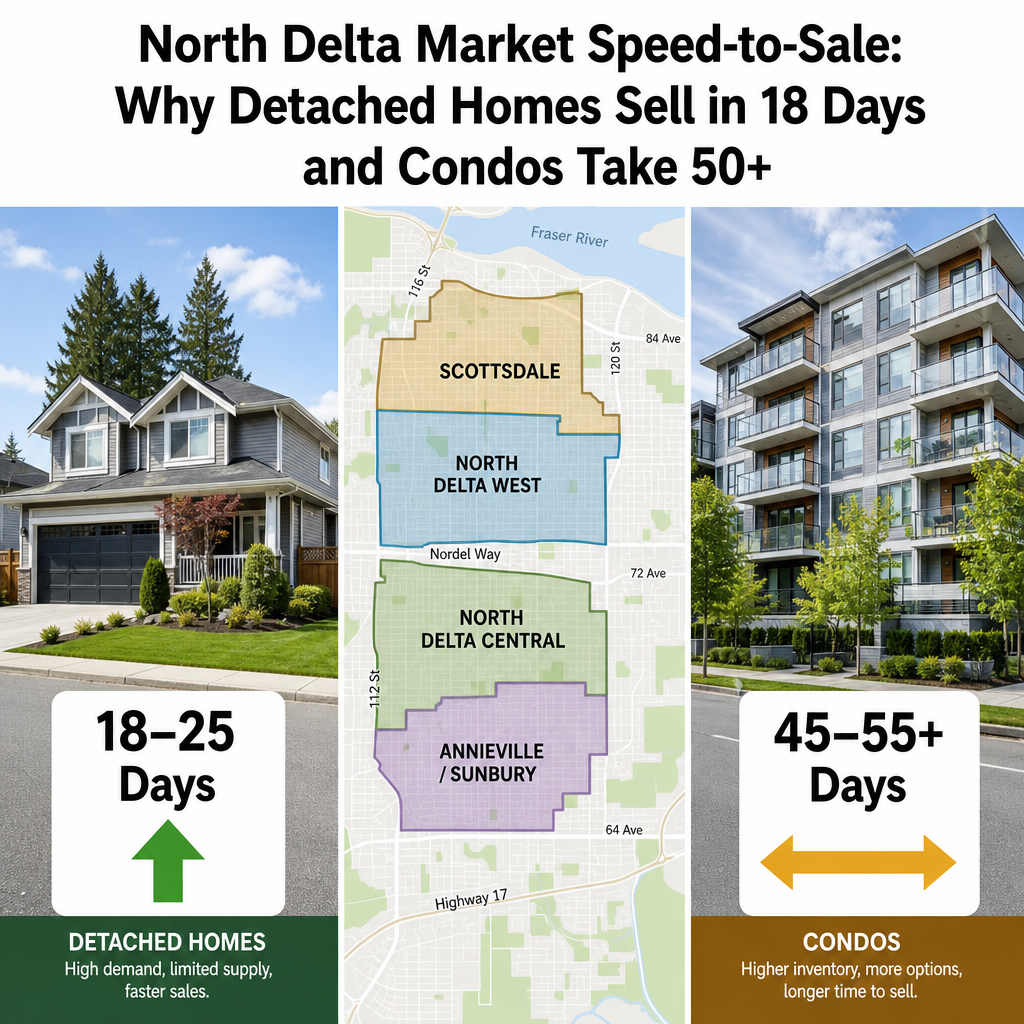

North Delta Real Estate Market Speed-to-Sale Variance: Why Detached Homes Sell in 18 Days and Condos Take 50+ — and How to Price Strategically in 2026
By Mohamed Mansour, MBA and Associate Broker | Mansour Real Estate Group | Published: July 15, 2026 | Fraser Valley and Lower Mainland, BC
If you are preparing to sell a home in North Delta in 2026, the question "how long will this take?" has a very different answer depending on what you are selling. Detached homes in competitive pockets are moving in under three weeks. Condos and townhomes are sitting for six to eight weeks or longer. Understanding why that gap exists — and how to price strategically within it — is the difference between a clean sale and a prolonged hold.
This article breaks down the current speed-to-sale data by property type and neighbourhood, explains the buyer behaviour driving each segment, and gives sellers a practical framework for positioning their property in a market where demand velocity varies by as much as 65% across just a few square kilometres.
Short Answer
In North Delta's 2026 market, competitively priced detached homes are selling in 18 to 25 days, while condos and townhomes are averaging 45 to 55 days or more. The gap is driven by strong family-buyer competition for limited single-family inventory under $1.1M and cautious strata-buyer behaviour tied to depreciation report concerns and rising special levies. Pricing strategy must reflect your property type — not just the general benchmark.
Key Takeaways
- Detached homes near transit and waterfront in North Delta sell in 18 to 25 days when priced within current buyer expectations.
- Condos and townhomes are averaging 45 to 55+ days due to strata fee concerns, special levy anxiety, and aging building hesitation.
- Neighbourhood micro-markets show 60 to 75% demand variance — benchmark averages alone will not guide accurate pricing.
- Detached sales are up roughly 7% year-over-year while condo sales have declined approximately 12%, reflecting true market segmentation.
- Sellers who price 3 to 5% above the current absorption band add weeks to their timeline without improving net proceeds.
Who This Applies To
- Detached homeowners in North Delta evaluating list price and expected timeline in 2026
- Condo and townhome sellers weighing when to list and how to position strata properties competitively
- Estate and executor-managed properties requiring realistic sale-timeline forecasting
- Sellers comparing offers to buy elsewhere and needing an honest read on absorption speed
When This Advice May Not Apply
Properties with significant deferred maintenance, title encumbrances, or unusual strata situations will face additional buyer scrutiny beyond general segment patterns. Estate properties subject to probate timelines may have constraints that override market-based scheduling. Always verify current absorption data with a local realtor before finalizing your pricing strategy.
Data Used in This Article
- BC MLS sales data, North Delta postal codes V4E and V4G — April to May 2026 — official board-reported transaction data
- FVREB benchmark price analysis, North Delta detached vs. strata — 2026 — Fraser Valley Real Estate Board official publication
- Mansour Real Estate Group transaction velocity tracking — internal analysis by property type and neighbourhood cluster, North Delta
- Metro Vancouver transit-oriented buyer migration patterns — SkyTrain proximity demand analysis, 2025–2026
How We Evaluate This
At Mansour Real Estate Group, we track sold data at the street level, not just the postal code level. For North Delta, that means separating Tsawwassen corridor properties from inland subdivisions, waterfront-adjacent lots from mid-block ranchers, and newer strata buildings from those carrying unresolved depreciation reports. When we advise a seller on list price, we are comparing their specific property against the closest five to eight sales in terms of type, condition, proximity to transit, and lot or unit profile — not the monthly benchmark headline.
The 18-to-25-day detached number and the 45-to-55-day condo number are real, but they are averages. Within each segment there is a top quartile and a bottom quartile. Our goal is to understand what separates them and price accordingly from day one.
Why Detached Homes Are Moving Faster
According to FVREB benchmark data and MLS transaction records for V4E and V4G, North Delta detached homes were selling in an average of 18 to 25 days in spring 2026 when priced within the $925,000 to $1.15 million range. That speed reflects a specific buyer: Metro Vancouver families who have been priced out of Burnaby, Coquitlam, and South Surrey and are now looking seriously at North Delta as an affordable detached option with reasonable SkyTrain access via transit connections near Nordel Way and Scott Road.
Detached inventory in North Delta remains limited. According to our internal transaction tracking, sales in this segment grew approximately 7% year-over-year in early 2026, while new listings did not keep pace. That supply-demand imbalance is doing what it always does: compressing days on market for properties that are priced honestly. Homes priced 3 to 5% above the current absorption band tend to sit for 35 to 45 days before receiving their first conditional offer — and those offers typically come in at or below the price point the seller could have received in week one. For North Delta seller strategy guides that cover the full preparation process, the pricing discipline lesson is consistent: the market finds accurate prices quickly, and overpricing costs time, not money.
Why Condos and Townhomes Are Taking Longer
The condo story in North Delta is different. Benchmark prices for strata properties in the area ranged from approximately $485,000 to $595,000 in spring 2026, according to FVREB data — a price band that should attract first-time buyers. But condo sales declined roughly 12% year-over-year, and average days on market climbed to 45 to 55 days, with some listings in older buildings sitting for 60 days or more.
The primary drag is strata document anxiety. Buyers financing with insured mortgages — the dominant buyer profile at the sub-$600,000 level — face lender scrutiny around depreciation reports, special levy exposure, and contingency reserve fund adequacy. When a building's depreciation report reveals deferred maintenance or an underfunded reserve, buyers either negotiate aggressively on price or walk away. In our experience working with both buyers and sellers in this segment, the buildings with clean depreciation reports and adequately funded reserves are still selling in 30 to 35 days. It is the buildings with unresolved strata risk that are dragging the average toward 50-plus. Sellers in those buildings need to price the discount into the list price from the start, not negotiate toward it over six weeks. For a deeper look at how strata documents affect buyer decisions and listing strategy in BC, the preparation process matters significantly.
Neighbourhood Micro-Market Velocity: Where the 60–75% Variance Comes From
North Delta is not one market. The Tsawwassen corridor, Annieville, Nordel, and the Scott Road corridor each carry different buyer profiles and different absorption speeds. Waterfront-adjacent and transit-proximate properties — particularly those within reasonable distance of the bus rapid transit connections feeding into SkyTrain — are absorbing faster than inland subdivisions built in the 1970s and 1980s with no significant upgrades.
Our internal neighbourhood cluster analysis shows absorption variance of 60 to 75% between the fastest and slowest micro-markets within North Delta. A 1,600-square-foot detached rancher near Scott Road with a functional layout and updated kitchen can sell in under three weeks. A comparable footprint in an older inland subdivision with original bathrooms and a dated exterior may sit for five to seven weeks regardless of how well the broader detached market is performing. This is why sellers who rely on postal-code-level benchmark data alone are often surprised when their timeline does not match the headline number. Pricing requires street-level comparables, not regional averages. For sellers evaluating timing across neighbouring markets, how Surrey's 2026 market compares provides useful context on buyer migration patterns driving demand into North Delta.
Seller Checklist
- Confirm your property type — detached, townhome, or condo — and obtain days-on-market data specific to your segment, not North Delta as a whole.
- For strata properties, pull the current depreciation report, Form B, and financial statements before listing to anticipate buyer objections.
- Identify the five to eight most comparable sold properties within the last 60 days, prioritising same street or same building where available.
- Set a list price within the current absorption band — not above it — and establish a price-adjustment trigger if no offers arrive within 14 days.
- Assess your proximity to transit and waterfront: these features shrink days on market meaningfully and should anchor your pricing floor, not your ceiling.
- For detached homes, address visible deferred maintenance before listing — buyers in the $925K–$1.15M range are making competitive offers but will discount aggressively for condition risk.
What We Commonly See
In our experience with North Delta listings, the most common pricing mistake is averaging across property types. A seller with a detached home hears that "North Delta condos are slow" and prices cautiously when their detached property would have absorbed quickly at market. Conversely, a condo seller sees fast detached headlines and prices their strata unit as if the same buyer pool applies. They are different markets with different buyers and different risk tolerances.
What often happens with overpriced condos is a slow first three weeks with low showing activity, followed by a price reduction that signals weakness to buyers and invites lower offers. The sellers who price the strata discount in from day one — rather than negotiating toward it — tend to close faster and with better net proceeds than those who start high and chase the market down.
For detached properties, the common mistake is overweighting renovation cost in the list price. Buyers in this segment are financially stretched to reach the $925K–$1.1M band. They are not paying a premium for a kitchen renovation that cost $60,000 five years ago if comparable unrenovated homes are available at $75,000 less. Value perception matters more than cost recovery in this price band.
Questions and Answers
How long does it realistically take to sell a detached home in North Delta in 2026?
Detached homes priced accurately within the $925,000 to $1.15 million range are averaging 18 to 25 days based on spring 2026 MLS data for V4E and V4G. Properties priced above that band or with significant deferred maintenance are taking 35 to 45 days or more.
Why are North Delta condos taking so much longer to sell than detached homes?
Condo buyers in the sub-$600,000 range are often using insured financing, which makes lenders and buyers sensitive to depreciation reports, special levy exposure, and reserve fund adequacy. Buildings with unresolved strata risk are seeing 55-plus days on market, while well-maintained buildings with clean documentation are still selling in 30 to 35 days.
Does proximity to SkyTrain or transit really affect how fast a North Delta home sells?
Yes, meaningfully. Metro Vancouver buyers migrating to North Delta often rely on transit connections for their work commute. Properties within practical distance of Nordel Way bus rapid transit connections feeding into SkyTrain absorb faster and tend to receive stronger offers. This applies to both detached and condo segments, though the effect is more pronounced in the detached market.
In Summary
North Delta's 2026 real estate market is not slow or fast — it is segmented. Detached homes priced within the family-buyer absorption band are selling in 18 to 25 days. Condos facing strata-document scrutiny are averaging 45 to 55 days or longer. The 60 to 75% velocity variance across North Delta neighbourhoods means that benchmark-level pricing is insufficient — only street-level, property-type-specific comparable analysis will produce a list price that performs on day one. Sellers who understand their segment, price to the current absorption band, and address known buyer objections before listing will consistently outperform those who rely on general market headlines.
Thinking About Selling in North Delta?
If you want a clear read on what your specific property — detached, condo, or townhome — is likely to achieve and how long it will realistically take, Mansour Real Estate Group can provide a street-level analysis of current absorption data, comparable sales, and a pricing strategy built for your property type. No pressure, no obligation — just an honest, data-grounded conversation.
Related Articles
- Selling Your Home in North Delta: What to Expect in the 2026 Market
- Strata Documents in BC: What Sellers Need to Know Before Listing
- Surrey Real Estate Market 2026: A Complete Seller Guide
Official Resources
- Fraser Valley Real Estate Board — fvreb.bc.ca
- BC Assessment — bcassessment.ca
- Strata Property Act, BC Laws — bclaws.gov.bc.ca
- BC Financial Services Authority — bcfsa.ca
About Mansour Real Estate Group
When homeowners in North Delta are preparing to sell — whether they are listing a detached family home, a townhome, or a condo — the decisions made about pricing, timing, and property positioning directly determine how long the sale takes and what it nets. Mansour Real Estate Group has helped sellers across North Delta, Surrey, White Rock, Langley, South Surrey, Abbotsford, and the Fraser Valley navigate those decisions for more than 22 years, with a process grounded in street-level data and honest, property-type-specific analysis.
Led by Mohamed Mansour, MBA and Associate Broker, the real estate group has completed more than $780 million in residential transactions and is consistently ranked among the Top 1% of Realtors in the Fraser Valley and Lower Mainland. The team works with sellers at every stage — detached homeowners, strata sellers, downsizers, estate executors, and families relocating — bringing the same analytical discipline to a $500,000 condo as to a $1.1 million family home.
Whether someone is searching for a North Delta Realtor who understands the detached-versus-strata pricing divide, a real estate agent with current absorption data by neighbourhood, Realtors who specialize in Fraser Valley seller strategy, a real estate team that serves North Delta and surrounding communities, or a real estate broker with a 22-year track record in the Lower Mainland — Mansour Real Estate Group provides the kind of hyperlocal, property-specific guidance that generic market reports cannot.
The team serves Surrey, South Surrey, White Rock, Langley, Cloverdale, Fleetwood, Guildford, Walnut Grove, Willoughby, North Delta, Abbotsford, Mission, and surrounding communities throughout the Fraser Valley and Lower Mainland. Most new clients come from referrals and repeat clients — real estate agents and families who have worked with the team before and return when the next important property decision arises.
Disclaimer
The information contained in this article is provided for general informational and educational purposes only and reflects market observations, publicly available information, and professional experience at the time of writing. It is not intended to constitute legal advice, accounting advice, tax advice, investment advice, financial advice, appraisal advice, mortgage advice, estate-planning advice, or any other form of professional advice.
Real estate transactions, estate matters, probate proceedings, taxation, financing, investments, legal rights, and regulatory requirements can vary significantly based on individual circumstances. Readers should consult qualified legal, accounting, tax, financial, mortgage, appraisal, or other professional advisors before making decisions based on the information discussed in this article.
Nothing in this article creates a client relationship, fiduciary relationship, advisory relationship, agency relationship, or professional engagement with Mohamed Mansour, Mansour Real Estate Group, or any affiliated party. Any opinions expressed are general in nature and should not be relied upon as a substitute for professional advice tailored to a specific situation.
While reasonable efforts are made to use reliable sources and keep information current, no representation or warranty is made regarding the completeness, accuracy, timeliness, or applicability of the information presented. Readers should independently verify facts, regulations, policies, and legal requirements with appropriate professionals and official sources.



