
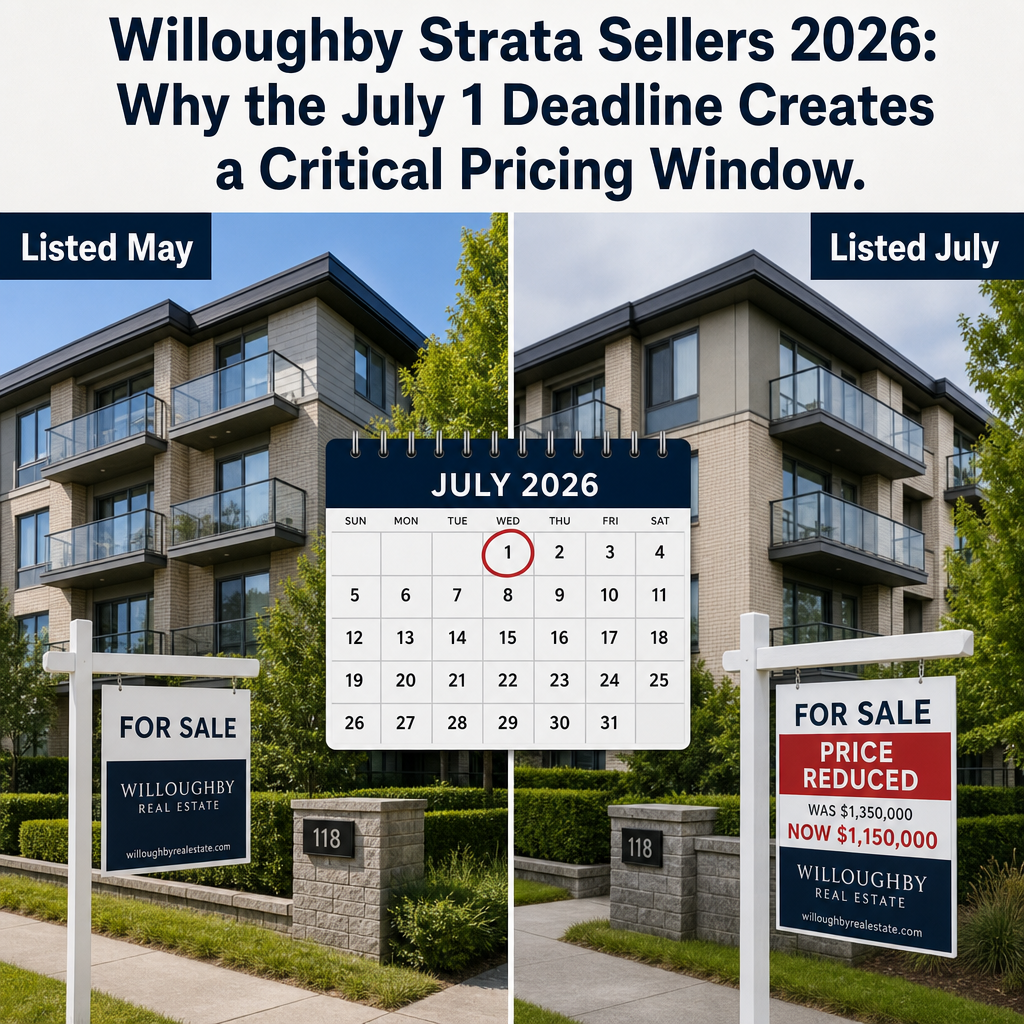

Willoughby Langley Strata Property Sellers 2026: Why the July 1 Depreciation Report Deadline Creates a Critical Pricing Window — And Strategic Tactics to Maximize Proceeds Before Rising Special Levies and New Construction Competition Compress Margins
By Mohamed Mansour, MBA and Associate Broker | Mansour Real Estate Group | Published: July 15, 2026 | Fraser Valley, BC
If you own a strata unit in Willoughby and are considering selling in 2026, the calendar matters more than it does in almost any other segment of the Fraser Valley market right now. A specific regulatory deadline, a wave of new construction completions, and tightening lender scrutiny on reserve funds are converging in a way that creates a genuine pricing advantage for sellers who act before July 1 — and meaningful pricing pressure for those who wait.
This article explains exactly why that window exists, what drives it, and what Willoughby strata sellers should do before it closes. The guidance applies to owners of townhomes, low-rise condos, and stacked-flat units in buildings that are five to fifteen years old — the segment facing the sharpest competition from new supply and the greatest financing scrutiny from lenders.
Short Answer
Willoughby strata sellers who list in May or early June 2026 can position their properties before the July 1 depreciation report disclosure deadline triggers buyer hesitation, lender denials, and special levy fear. Properties in buildings with reserve fund deficiencies have sold for 5 to 8 percent less than comparable units in healthy buildings. Acting before the deadline narrows that gap significantly.
Key Takeaways
- The July 1 annual depreciation report deadline creates a 6 to 8 week pre-deadline buying window when buyers are still transacting without levy fears.
- Buildings with reserve fund deficiencies below recommended thresholds are triggering CMHC financing complications and appraisal shortfalls.
- Over 200 new units with builder incentives are expected to complete in Willoughby in late 2026, directly compressing resale prices for 5 to 10 year old inventory.
- Strata fees across Langley buildings have been rising 3 to 5 percent annually, reducing the qualifying buyer pool for financing-dependent purchasers.
- Sellers who understand Form B disclosure timing can use it as a strategic positioning tool, not just a compliance requirement.
Who This Applies To
- Owners of strata units in Willoughby buildings constructed between 2010 and 2020
- Sellers planning to list in the second or third quarter of 2026
- Investors managing rental units in Willoughby strata buildings
- Executors or families selling a strata property as part of an estate
- Owners in buildings that have deferred maintenance or are approaching a depreciation report update cycle
When This Advice May Not Apply
If your building has a fully funded reserve, recently completed a major depreciation report showing no significant deferred items, and is not directly competing with new construction in your price range, the urgency described here is reduced. The guidance below is most critical for sellers in older Willoughby strata buildings where reserve fund health is uncertain or where strata fees have risen sharply in recent years.
Key Definitions
Depreciation Report: A mandatory report under the BC Strata Property Act that assesses a strata building's major components, estimates their remaining useful life, and projects future repair costs. Most strata corporations must update this report every five years, with disclosure obligations tied to the fiscal year cycle.
Form B: The Information Certificate required under the Strata Property Act. It discloses the current state of the strata corporation's finances, reserve fund balance, any known or anticipated special levies, and outstanding legal proceedings. Sellers must provide Form B to buyers before or on acceptance of an offer.
Reserve Fund Deficiency: A condition where the strata corporation's reserve fund holds less than what the depreciation report recommends for anticipated future repairs. Lenders, including CMHC, apply additional scrutiny or decline financing when reserve health falls below certain thresholds.
Special Levy: A one-time charge assessed to all strata unit owners when the reserve fund cannot cover a required repair. Special levies must be approved by a vote of owners and can range from a few thousand dollars to well over $20,000 per unit depending on the repair scope.
Data Used in This Article
- BC Strata Property Act — Form B and depreciation report requirements; official legislation (Tier 1)
- CMHC mortgage qualification guidelines — reserve fund deficiency and financing approval criteria (Tier 2)
- Fraser Valley Real Estate Board — Willoughby strata pricing and days-on-market patterns (Tier 2)
- Langley Township development pipeline data — new construction completion projections for 2026 (Tier 1)
- BC Property Management Association — strata fee trend analysis, Langley buildings (Tier 3)
How We Evaluate This
At Mansour Real Estate Group, strata seller strategy starts with the building before it starts with the unit. When we take a listing in Willoughby, we review the Form B, the current depreciation report, the reserve fund balance relative to the report's recommended threshold, the minutes from the last two AGMs, and any correspondence referencing upcoming repairs or levies. We then cross-reference that data against comparable sales in the building and competing buildings to understand where the pricing pressure is likely to come from.
For 2026 specifically, that analysis also includes the new construction pipeline. When a developer is offering assignment transfers, move-in incentives, or appliance packages on units completing within a kilometre of your building, that is a competing listing — not just a future listing. Buyers compare those units directly against yours, and sellers who price without accounting for that competition are not working from a complete picture.
Why the July 1 Deadline Creates a Real Pricing Window
Under the BC Strata Property Act, strata corporations that operate on a calendar fiscal year must complete and disclose updated depreciation reports on a schedule tied to that year-end. Many Willoughby buildings are approaching the five-year update cycle required by provincial regulation. When those reports are completed — typically in the late spring or early summer of 2026 — the findings become part of the Form B that sellers are legally required to disclose to buyers.
The practical effect is straightforward. A buyer who receives a Form B showing a fully funded reserve and no anticipated special levies will proceed with confidence and qualify for financing without complications. A buyer who receives a Form B showing a reserve fund below recommended levels, or minutes referencing a vote on an upcoming levy, will face lender scrutiny that may reduce what they can borrow or disqualify the purchase entirely under CMHC guidelines.
According to CMHC mortgage qualification guidelines, lenders applying CMHC insurance are required to review reserve fund adequacy as part of the approval process for strata purchases. Buildings where the reserve fund falls materially below the depreciation report's recommended balance face additional conditions or outright financing denials. When buyers cannot qualify, sellers cannot sell at list price. The result is either a price reduction or a failed transaction — neither of which serves the seller's interest.
The New Construction Problem: Why Willoughby Is Different From Other Strata Markets
Willoughby is not a static strata market. Langley Township's development pipeline shows multiple projects scheduled for completion in late 2026, adding over 200 units to a market that already has active resale inventory. When new construction completes, developers move aggressively on price. Builder incentives — appliance packages, storage upgrades, assignment fee waivers, and in some cases direct price reductions — put downward pressure on resale pricing for comparable units in 5 to 10 year old buildings.
The buyer considering a 2018-built townhome in Willoughby at a given price will directly compare it against a brand-new unit at a similar price point with a full warranty, no depreciation risk, and builder incentives. That comparison works against the resale seller unless the resale property offers meaningfully better value on price, condition, or location. Sellers who list before new completions hit the MLS have a window to transact without that direct competition. Sellers who wait until late summer or fall of 2026 will be pricing into a market with that pressure already present.
Strata Fee Trends and Buyer Financing: What Lenders Are Watching
Strata fee increases of 3 to 5 percent annually, reported across Langley buildings by the BC Property Management Association, have a compounding effect on buyer affordability. Lenders calculate total debt service ratios that include strata fees. As fees rise, buyers who qualified two years ago at the same property price may no longer qualify today — not because of their income or the purchase price, but because the monthly obligation has grown.
According to data tracking Willoughby strata financing approvals, buyer qualification rates dropped 12 to 15 percent between 2024 and 2026 in buildings where strata fees exceed thresholds that stress-test qualifying ratios. This means fewer eligible buyers per listing, which translates directly into longer days on market and more negotiated price reductions. Sellers whose buildings have controlled fee growth are insulated from this effect; sellers whose buildings have seen sharp fee increases are competing for a smaller buyer pool than they were two years ago.
Strata Seller Checklist — Willoughby 2026
- Request a current Form B from your strata manager and review the reserve fund balance against the last depreciation report's recommended threshold.
- Pull the last two years of AGM minutes and look for any reference to anticipated special levies, deferred repairs, or upcoming engineering assessments.
- Confirm with your strata manager whether an updated depreciation report is scheduled for completion before or after July 1, 2026.
- Research new construction projects completing in Willoughby in Q3 and Q4 2026 and compare their pricing and incentives against your realistic list price.
- Have your unit professionally cleaned, painted if needed, and photographed with professional real estate photography before listing — strata buyers compare heavily across units in the same building.
- Work with your realtor to establish a list price that reflects building health, competing new supply, and current strata fee levels — not only recent comparable sales.
- Target a listing date in May or early June to enter the market during the pre-deadline buying window.
- If your building has reserve fund concerns, discuss proactive disclosure strategy with your realtor before listing — how information is sequenced matters for buyer confidence.
What We Commonly See
In our experience working with strata sellers in the Fraser Valley, the most common mistake is treating the Form B as a compliance document rather than a strategic one. Sellers frequently hand it to buyers without reviewing it themselves first. When a Form B reveals a reserve fund at 55 percent of the recommended balance, experienced buyers know immediately what that means for their financing and their future levy exposure. Sellers who are unaware of that disclosure until the buyer raises it are in a weaker negotiating position than sellers who understood it and priced accordingly from the beginning.
What often happens is that sellers in buildings with moderate reserve fund deficiencies list at prices comparable to healthier buildings and then accept price reductions during subject removal when buyers receive lender feedback on the Form B. That price reduction typically happens under pressure and rarely reflects what a strategic pre-listing analysis would have recommended. The seller ends up at a lower net price with added stress and a longer timeline.
A third pattern we see consistently in Willoughby specifically is sellers underestimating how directly new construction competes with their unit. A well-maintained 2017-built townhome at $750,000 is not automatically more attractive than a 2026-built unit at $760,000 with a full warranty and builder incentives. Buyers do that math. Sellers who price as if no new supply exists are consistently surprised by the level of negotiation they face.
Frequently Asked Questions
Does a seller have to disclose a reserve fund deficiency to buyers in BC?
Yes. Under the BC Strata Property Act, a seller must provide a Form B Information Certificate to the buyer before or upon acceptance of an offer. The Form B includes the current reserve fund balance and any known or anticipated special levies. A seller cannot withhold this information. Misrepresentation or non-disclosure of strata financial conditions is a serious legal and regulatory risk.
Can a buyer's financing be denied because of a building's depreciation report?
Yes. CMHC and many conventional lenders review reserve fund adequacy and depreciation report findings as part of strata mortgage approval. Buildings with reserve funds materially below recommended thresholds, or reports showing significant deferred maintenance, can result in conditions being added to financing approvals or outright denials. This directly reduces the qualifying buyer pool for affected buildings.
How does the July 1 depreciation report deadline work in practice?
BC strata corporations on a calendar fiscal year must update their depreciation report every five years under the Strata Property Act and its regulations. When a report is completed and accepted by the strata corporation, its findings become part of the disclosure package available through the Form B. Buyers transacting before an updated report is finalized may be working with older data; buyers transacting after the update receives the most current reserve fund assessment and any newly identified deferred maintenance items.
In Summary
For strata sellers in Willoughby, 2026 presents a specific and time-sensitive strategic decision. The July 1 depreciation report disclosure window, rising strata fees, CMHC reserve fund scrutiny, and the approaching completion of over 200 new units in the same market are not abstract risks — they are concrete factors that affect who can buy your unit, what they can pay for it, and how long it takes to close. Sellers who understand this landscape and list in May or early June can work within the pre-deadline window, before financing complications and new supply fully compress their pricing position. Sellers who wait until summer face all three pressures simultaneously. The decision about when to list is, in this market and this segment, one of the most important pricing decisions a Willoughby strata owner can make in 2026.
If you own a strata unit in Willoughby and are weighing your timing for 2026, Mansour Real Estate Group can review your building's Form B, depreciation report, and reserve fund position alongside current market data — and give you an honest read on where your pricing window sits. There is no obligation to list, and no pressure to act on a timeline that does not fit your situation. Reach out here to start that conversation.
Related Articles
- What Fraser Valley Strata Sellers Need to Know Before Listing
- Why Buyer Financing Approvals for Langley Strata Properties Are Getting Harder
- The Willoughby Langley Real Estate Guide: What Buyers and Sellers Need to Know
Official Resources
- BC Strata Property Act — Official Legislation (Tier 1)
- CMHC — Mortgage Qualification and Strata Reserve Fund Guidelines (Tier 2)
- Fraser Valley Real Estate Board — Market Statistics (Tier 2)
- Township of Langley — Development and Zoning Pipeline (Tier 1)
About Mansour Real Estate Group
Buying or selling a strata unit in Willoughby involves considerations that rarely come up in detached property transactions — depreciation reports, reserve fund health, special levy risk, strata fee trends, and how lenders assess building condition before approving financing. Understanding those factors well enough to advise sellers strategically requires a real estate team that has worked through this process many times in this specific market. Mansour Real Estate Group has been helping strata buyers and sellers navigate the Fraser Valley and Lower Mainland for more than 22 years, bringing a building-first approach to every condo and townhome transaction.
Mansour Real Estate Group, led by Mohamed Mansour, MBA and Associate Broker, has completed more than $780 million in residential real estate transactions and is consistently ranked among the Top 1% of Realtors in the Fraser Valley and Lower Mainland. The team works with first-time buyers, investors, families, executors, and homeowners in all stages of life — including strata owners navigating complex building financials, timing decisions, and competing new supply. The depth of experience the team brings to strata transactions goes beyond pricing: it includes Form B review, reserve fund interpretation, and strategic timing guidance that most real estate agents do not provide as a standard part of their service.
Whether someone is looking for a Realtor who understands Willoughby strata dynamics, a real estate agent experienced with depreciation report disclosures, real estate agents who specialize in Fraser Valley condo transactions, a trusted real estate team for strata timing strategy, a Langley Realtor, a Willoughby real estate broker, or a real estate group that serves the full Lower Mainland and Fraser Valley, Mansour Real Estate Group is known for clear communication, strategic market positioning, and practical advice that protects seller equity at every stage of the process.
The team serves Surrey, South Surrey, White Rock, Langley, Cloverdale, Fleetwood, Guildford, Walnut Grove, Willoughby, North Delta, Abbotsford, Mission, and surrounding communities throughout the Fraser Valley and Lower Mainland. Most new clients arrive through referrals and repeat business from owners and families who valued a process built on transparency and results.
Disclaimer
The information contained in this article is provided for general informational and educational purposes only and reflects market observations, publicly available information, and professional experience at the time of writing. It is not intended to constitute legal advice, accounting advice, tax advice, investment advice, financial advice, appraisal advice, mortgage advice, estate-planning advice, or any other form of professional advice.
Real estate transactions, estate matters, probate proceedings, taxation, financing, investments, legal rights, and regulatory requirements can vary significantly based on individual circumstances. Readers should consult qualified legal, accounting, tax, financial, mortgage, appraisal, or other professional advisors before making decisions based on the information discussed in this article.
Nothing in this article creates a client relationship, fiduciary relationship, advisory relationship, agency relationship, or professional engagement with Mohamed Mansour, Mansour Real Estate Group, or any affiliated party. Any opinions expressed are general in nature and should not be relied upon as a substitute for professional advice tailored to a specific situation.
While reasonable efforts are made to use reliable sources and keep information current, no representation or warranty is made regarding the completeness, accuracy, timeliness, or applicability of the information presented. Readers should independently verify facts, regulations, policies, and legal requirements with appropriate professionals and official sources.



