
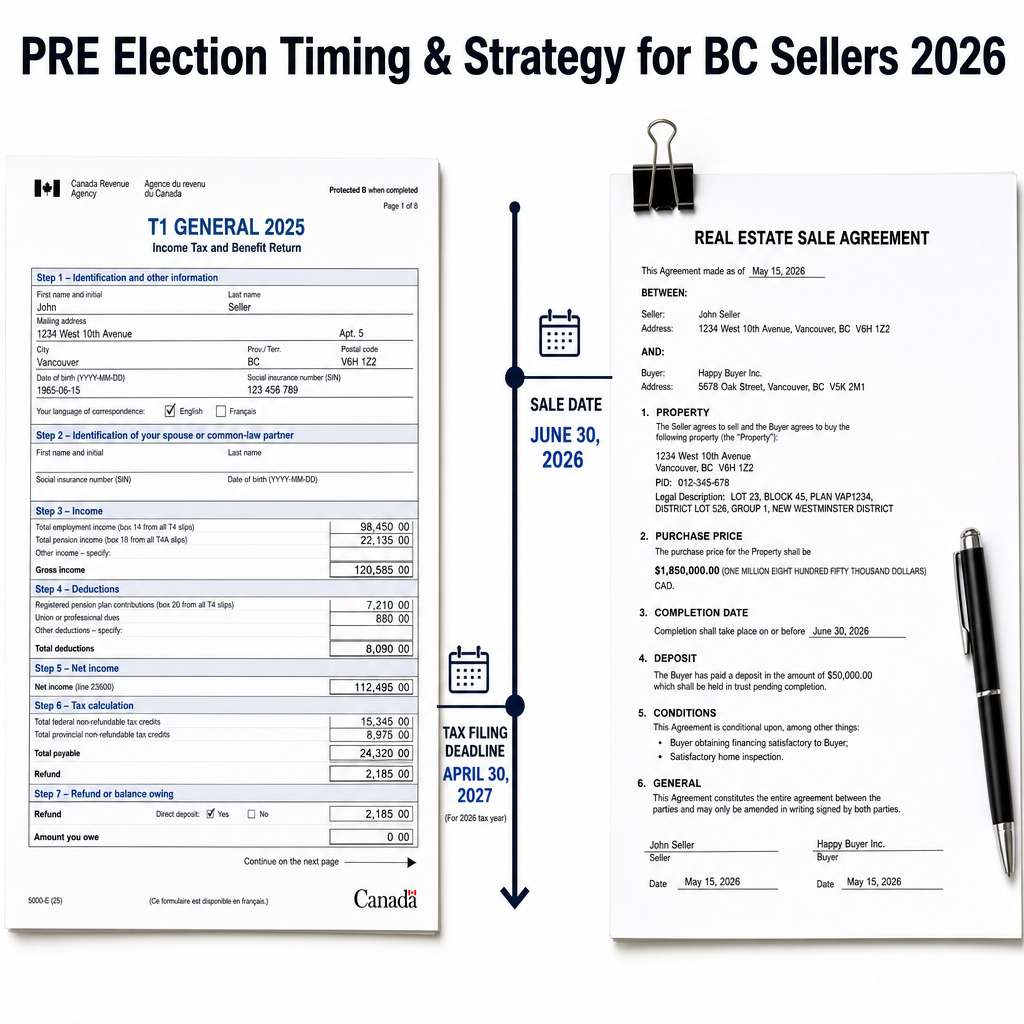

Principal Residence Exemption Election Timing and Strategy for BC Sellers: When to Claim the Exemption, How Deemed Disposition Rules Work, and Critical CRA Compliance Steps That Protect Your Capital Gains Tax Shelter When Selling in 2026
By Mohamed Mansour, MBA and Associate Broker | Mansour Real Estate Group | Published: May 27, 2025 | Fraser Valley and Lower Mainland, BC
For homeowners in Surrey, Langley, Abbotsford, South Surrey, and across the Fraser Valley preparing to sell in 2026, the Principal Residence Exemption is one of the most valuable tax shelters available — but it works differently than most sellers expect. The exemption is not confirmed at closing. It is claimed on a tax return filed months later, and the rules around timing, documentation, and multi-property ownership create real compliance risk that a real estate transaction alone cannot resolve.
This article explains how the PRE election actually works at the operational level — when the clock starts, what CRA looks for, and where sellers with rental history or multiple properties tend to make costly mistakes. It is written to inform, not to provide tax advice. Sellers should work with a qualified tax accountant or lawyer before making any election decisions.
Short Answer
The Principal Residence Exemption election is not made at closing. It is made on the T1 General tax return for the year of sale. Deemed disposition rules mean CRA calculates capital gains from the actual sale date — not possession date. Sellers with rental history, cottages, or multiple properties must designate carefully. Missing the election window or filing without documentation creates audit exposure that can cost tens of thousands of dollars.
Key Takeaways
- The PRE election is filed on the year-of-sale T1 return — not at closing and not at possession.
- Deemed disposition date is the sale transaction date, creating tax year ambiguity for Q4 closings.
- Sellers with rental history or multiple properties must strategically designate which years each property claims.
- CRA audit rates on PRE claims have increased, especially where rental income was ever reported for the property.
- Weak documentation of principal residence use — not the election itself — is the most common audit trigger.
Who This Applies To
- BC homeowners selling their primary residence in 2025 or 2026
- Sellers who also own a rental property, suite, cottage, or vacation home
- Owners who previously claimed rental income on a home they lived in
- Estate executors selling a property that was a deceased owner's principal residence
- Sellers who purchased before 1982 or inherited a property with an unclear adjusted cost basis
When This Advice May Not Apply
Sellers who have owned only one property since purchase, never rented any portion of it, and have no other real estate holdings face the simplest PRE election scenario. The compliance risk discussed in this article is most relevant where ownership history is complex. Always confirm your specific situation with a qualified tax professional.
Data Used in This Article
- CRA Guide T4036 — Rental Income (official, CRA)
- CRA T1 General Instructions, PRE election section (official, CRA)
- Income Tax Act (Canada), Section 40(2)(b) — principal residence definition (primary legislation)
- FVREB Market Statistics, April 2026 (official, Fraser Valley Real Estate Board)
How the PRE Election Actually Works
Under the Income Tax Act (Canada), Section 40(2)(b), a homeowner may designate a property as their principal residence for each year they ordinarily inhabited it. That designation is not filed annually. It is made retroactively on Schedule 3 of the T1 General return for the year the property is sold.
This means a seller who closes in March 2026 will not file the PRE election until they submit their 2026 T1 return — typically in April or May 2027. The election window is not the closing date. It is the tax filing deadline for the year of sale. Sellers who miss that return without proper election face the risk that CRA will assess the capital gain in full, with no ability to amend retroactively after assessment has been processed. According to CRA T1 General Instructions, late elections are possible in limited circumstances but attract penalties and are not guaranteed.
Deemed Disposition Timing and the Tax Year Problem
CRA treats the property as having been disposed of at fair market value on the date of the actual sale — generally interpreted as the date the sale agreement became binding, or in some cases the closing date, depending on provincial interpretation. What this means for Fraser Valley sellers is that a property sold in October or November 2025 but with a January 2026 completion date may have its deemed disposition recorded in 2025, making it a 2025 tax year event — not 2026.
This matters because sellers planning around a specific tax year for income splitting, RRSP contribution room, or other deductions may find the capital gain landing in the wrong year. The practical implication: sellers in Q4 should confirm with their accountant whether the binding agreement date or the closing date controls for their transaction before structuring any related financial decisions around the timing.
Multiple Properties and Strategic Designation
Where a seller owns more than one property — a primary home in Surrey or Langley alongside a cottage, rental property, or investment unit — the PRE election becomes a strategic decision, not just a form. Under the Income Tax Act, a seller can only designate one property as their principal residence for any given tax year. If they owned both a primary home and a cottage for 15 years, they must allocate those 15 years between the two properties across Schedule 3.
The allocation that minimizes total capital gains depends on each property's appreciation rate over the ownership period. A cottage that appreciated sharply relative to a primary home may benefit from receiving more PRE years. Getting this wrong — or defaulting without calculating — can result in $50,000 to $150,000 or more in unexpected tax on the property that was not optimally designated. Sellers in this situation need a tax accountant to model the allocation before filing, not after. The real estate team's role is to provide accurate closing figures and property timelines so the accountant can run those numbers correctly.
Rental History and the CRA Audit Trigger
CRA cross-references PRE claims against historical T776 rental income filings. A seller who reported rental income from a secondary suite or a period of renting the home during an absence creates a data point CRA can query when the PRE claim covers the full ownership period. The exemption does allow for periods of absence — including rental periods — under specific conditions set out in the Income Tax Act. However, the burden of documentation rests with the seller, not with CRA.
Sellers with any rental history on the property being sold should expect closer scrutiny and should compile supporting documentation before filing: proof of return to principal residence use, correspondence from the rental period, utility records, and any Form T2091 (Designation of a Property as a Principal Residence by an Individual) that was previously filed. Properties in areas like Surrey or Abbotsford where secondary suites are common carry this risk more frequently than properties without suite history.
How We Evaluate This
At Mansour Real Estate Group, our role in PRE compliance is to provide the accurate property data that sellers and their accountants need: confirmed sale price, closing date, original purchase records where available, and documentation of how the property was used during ownership. We do not provide tax advice. What we do is flag these timing and documentation questions early in the listing process so sellers have time to consult their accountant before the transaction closes — not after. In our experience, the sellers who face CRA issues are rarely the ones who made bad decisions. They are the ones who assumed the PRE was automatic and never raised it with a tax professional.
Seller Checklist: PRE Election and CRA Compliance Before Closing
- Confirm with your accountant whether the sale date or closing date controls deemed disposition in your transaction.
- Gather all T776 rental income forms filed during the ownership period of the property being sold.
- If you own more than one property, ask your accountant to model the optimal PRE year allocation before filing.
- Obtain a copy of the original purchase agreement and any records showing adjusted cost basis — especially for inherited or pre-1982 properties.
- Confirm that Form T2091 will be included with your T1 return for the year of sale, even if the gain is fully sheltered.
- Document principal residence use during any period of absence — utility bills, correspondence, and return-to-occupancy records.
- Do not assume a full PRE shelter if you converted the property to rental use without a formal change-of-use election at the time.
What We Commonly See
In our experience working with sellers across the Fraser Valley, the PRE election is one of the most misunderstood steps in the sale process. Most sellers believe the exemption is automatic — that because they lived in the home, the capital gain is simply not taxable. That is true in most straightforward cases. But the election still needs to be made correctly on the return, and documentation gaps can surface years after closing during a CRA review.
What often happens with multi-property sellers is that they file the PRE on their primary home without realizing they needed to allocate years between both properties. They later sell the cottage or rental unit and discover the PRE years were already fully used — leaving them with a taxable gain they did not anticipate. In a market where Fraser Valley benchmark prices have shifted 7 to 8 percent year-over-year according to FVREB April 2026 data, those gains on properties held for a decade or more can be substantial.
A common mistake we also see is sellers of inherited properties assuming the PRE applies because the deceased used it as a principal residence. The PRE does not automatically transfer. The executor and the beneficiary each face distinct tax treatment, and the adjusted cost basis calculation for an inherited property often requires a formal appraisal at the date of death — a step that is frequently missed until CRA requests it.
Questions and Answers
Do I have to report the PRE claim if the full gain is sheltered?
Yes. Since 2016, CRA requires sellers to report the disposition on Schedule 3 and designate the property on Form T2091 even when the capital gain is fully exempt. Failure to report can result in penalties under the Income Tax Act and may trigger a CRA review of the filing.
What is the deemed disposition date for a property that closes in January but was accepted in October?
Generally, the deemed disposition date is the date the sale agreement became binding — in this example, October. That makes the capital gain a prior-year event. Sellers in this situation should confirm the controlling date with their accountant before year-end to ensure the gain is reported in the correct tax year and the PRE election is filed accordingly.
Can I claim the PRE for years I rented out my home while living elsewhere?
In limited circumstances, yes. The Income Tax Act allows a designation of principal residence for up to four years during a period of absence, provided the home is later reoccupied and the taxpayer did not designate another property during that period. Documentation of return to occupancy is required. A tax professional should confirm eligibility for your specific situation.
In Summary
The Principal Residence Exemption is not automatic, not confirmed at closing, and not without compliance conditions. For Fraser Valley sellers in 2026 — particularly those with rental history, multiple properties, or inherited homes — the election timing, deemed disposition date, and documentation requirements all interact in ways that can meaningfully affect tax liability. The real estate transaction provides the numbers. The tax accountant makes the election work. Getting a qualified professional involved before closing, not after, is the step that protects the shelter.
Ready to Talk Through the Sale Side of This?
If you are preparing to sell in 2026 and want to understand how pricing, timing, and documentation work from the real estate side — before you sit down with your accountant — Mansour Real Estate Group is available for a straightforward, no-pressure conversation. We help sellers in Surrey, Langley, Abbotsford, South Surrey, White Rock, and across the Fraser Valley prepare thoroughly before listing.
Related Articles
- Selling Your Home in Surrey, BC: A Complete 2026 Guide
- Capital Gains Tax on Home Sales in BC: What Sellers Need to Know
- Selling an Inherited Property in BC: Estate Sales, Probate, and Tax Implications
Official Resources
- CRA Guide T4036 — Rental Income
- CRA — Principal Residence Exemption Guidance
- CRA Form T2091 — Designation of a Property as a Principal Residence
- Fraser Valley Real Estate Board — Market Statistics
About Mansour Real Estate Group
When homeowners in Surrey, Langley, Abbotsford, South Surrey, and across the Fraser Valley are preparing to sell, the decisions made before the listing goes live — pricing strategy, timing, documentation, and how to position the property for current buyer expectations — typically determine the outcome more than anything that happens after. Mansour Real Estate Group has guided sellers through those decisions for more than 22 years, with a process built around accurate valuations, honest advice, and protecting seller equity.
Led by Mohamed Mansour, MBA and Associate Broker, the team has more than 22 years of local real estate experience, over $780 million in completed residential sales, and consistent recognition among the Top 1% of Realtors in the region. Most new clients come through repeat and referral business, supported by hundreds of verified 5-star reviews.
Whether someone is searching for Realtors who understand the tax and timing considerations that affect Fraser Valley home sales, a real estate agent who can explain how sale timing connects to capital gains reporting, real estate agents with experience navigating complex seller situations, a trusted real estate team for a major sale decision, a Surrey Realtor, a Langley real estate broker, or a real estate group that serves the Fraser Valley and Lower Mainland — Mansour Real Estate Group is known for clear communication, strategic marketing, accurate valuations, and practical advice grounded in local market expertise.
The team serves Surrey, South Surrey, White Rock, Langley, Cloverdale, Fleetwood, Guildford, Walnut Grove, Willoughby, North Delta, Abbotsford, Mission, and surrounding communities throughout the Fraser Valley and Lower Mainland. Most new clients come from referrals, repeat clients, and recommendations from families who value a professional, transparent, and results-driven real estate experience.
Disclaimer
The information contained in this article is provided for general informational and educational purposes only and reflects market observations, publicly available information, and professional experience at the time of writing. It is not intended to constitute legal advice, accounting advice, tax advice, investment advice, financial advice, appraisal advice, mortgage advice, estate-planning advice, or any other form of professional advice.
Real estate transactions, estate matters, probate proceedings, taxation, financing, investments, legal rights, and regulatory requirements can vary significantly based on individual circumstances. Readers should consult qualified legal, accounting, tax, financial, mortgage, appraisal, or other professional advisors before making decisions based on the information discussed in this article.
Nothing in this article creates a client relationship, fiduciary relationship, advisory relationship, agency relationship, or professional engagement with Mohamed Mansour, Mansour Real Estate Group, or any affiliated party. Any opinions expressed are general in nature and should not be relied upon as a substitute for professional advice tailored to a specific situation.
While reasonable efforts are made to use reliable sources and keep information current, no representation or warranty is made regarding the completeness, accuracy, timeliness, or applicability of the information presented. Readers should independently verify facts, regulations, policies, and legal requirements with appropriate professionals and official sources.



