
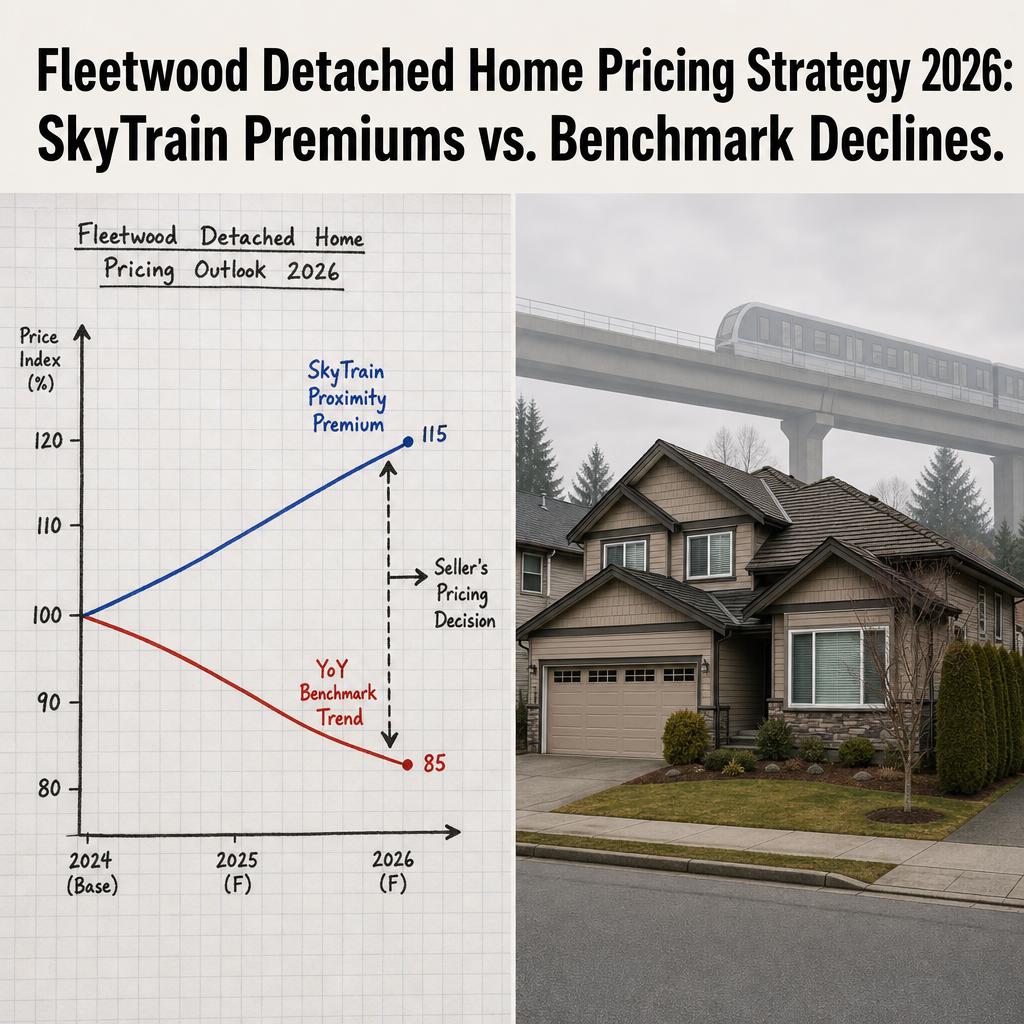

Fleetwood Detached Home Pricing Strategy 2026: Why SkyTrain Station Proximity Premiums Diverge From Below-Benchmark Market Prices — And How Sellers Should Anchor List Price When Pre-Completion Buyer Momentum Conflicts With Cautious Year-Over-Year Comparisons
By Mohamed Mansour, MBA and Associate Broker — Mansour Real Estate Group | Published: May 2026 | Fraser Valley, BC — Fleetwood, Surrey
Fleetwood detached sellers in spring 2026 are caught between two competing narratives. Year-over-year data from the Fraser Valley Real Estate Board shows benchmark prices down 7–8% from 2025. At the same time, the approaching SkyTrain Expo Line extension and the forthcoming Surrey Hospital development are creating genuine optimism about Fleetwood's medium-term value. These signals are both real. The problem is that acting on the wrong one at the wrong moment costs sellers time, money, and negotiating position.
This article explains the pricing paradox Fleetwood detached sellers face right now, why buyers are currently anchored to recent sold data rather than future infrastructure value, and how to construct a list price that captures proximity upside without overreaching into territory the current buyer pool will not support.
Short Answer
In spring 2026, Fleetwood detached sellers should anchor list price to current sold comparables — not future SkyTrain premiums — while using proximity as a differentiator in marketing language. Homes priced 3–5% below benchmark are selling 15–25% faster than those priced at or above it, according to FVREB March 2026 data and Mansour Real Estate Group's internal sold analysis. The proximity premium becomes a pricing lever only after the broader market begins reflecting infrastructure demand, which current buyer behaviour does not yet support.
Key Takeaways
- Fleetwood detached benchmark prices are down 7–8% year-over-year as of March 2026, per the FVREB.
- Sales volume is up 20–30% YoY, signalling recovery momentum without corresponding price appreciation yet.
- Homes priced 5–8% below benchmark sell 15–25% faster; buyers are anchoring on recent history, not future value.
- SkyTrain proximity premiums of 3–7% have materialized in comparable markets only after construction reaches late-stage completion.
- The 18–24 month pre-completion window is an opportunity for sellers who price correctly now and avoid overreaching on future value.
Who This Applies To
- Fleetwood detached homeowners considering a sale in spring or summer 2026
- Sellers within 800 metres of a planned Fleetwood SkyTrain station
- Homeowners whose properties fall within the Surrey Hospital development catchment
- Sellers who have received conflicting pricing advice from different agents or online tools
- Investors deciding between selling now and holding for infrastructure-driven appreciation
When This Advice May Not Apply
If your Fleetwood home is within 300 metres of the planned station, has been substantially renovated, and is positioned in the upper tier of the local price range, a modest proximity premium may be defensible with the right buyer profile. This guidance focuses on the majority of Fleetwood detached inventory at or below the benchmark price point. Properties significantly above the benchmark operate under different buyer pool constraints and require a separate pricing approach.
Key Terms
Benchmark Price: The FVREB's composite benchmark price represents a typical detached home in Fleetwood based on a standardized property profile. It is not the same as average or median sale price, and it does not reflect an individual home's condition, lot size, or proximity to transit.
Proximity Premium: The price uplift a property can command because of its distance to a transit station. In markets where SkyTrain service is already operating, this premium is observable in sold data. In pre-completion markets like Fleetwood, it remains theoretical until buyer demand shifts.
Sales Velocity: The rate at which homes are selling, measured in days on market or the ratio of sales to active listings. In Fleetwood's spring 2026 market, velocity has increased significantly even as prices have declined, which is a leading indicator of a recovering but not yet appreciating market.
Data Used in This Article
- FVREB March 2026 Market Report — Official board data; Fleetwood detached sales volume and benchmark price trends; published March 2026
- Mansour Real Estate Group Spring 2026 Sold Analysis — Internal review of Fleetwood detached DOM by price band and station proximity; professional interpretation
- TransLink SkyTrain Expo Line Extension Materials — Official transit authority; Fleetwood station location and projected completion (2028)
- Surrey Hospital Development Authority — Official project authority; site plans and completion timeline 2027–2029
- Comparable Market Analysis — Brentwood and Coquitlam — Third-party sold data analysis; SkyTrain proximity premiums 2024–2026
Why the Two Signals Are Both Real — And Why Only One Is Actionable Right Now
The FVREB's March 2026 report confirms that Fleetwood detached benchmark prices remain 7–8% below March 2025 levels. That is what buyers are using as their reference point. When a buyer's agent pulls comparables, those sold properties anchor the negotiation. No amount of future infrastructure value changes that anchor in a buyer's mind today.
At the same time, comparable markets where SkyTrain service has been established — particularly Burnaby Brentwood and Coquitlam Centre — show proximity premiums of 3–7% relative to non-transit comparable properties. Those premiums are real. But they materialized after construction reached its final phases and after buyers could see completion dates concretely. Fleetwood's station is scheduled for 2028. That is still far enough away that most detached buyers in this price range are not pricing in the premium yet.
The result is a market where volume is recovering — sales are up 20–30% year-over-year according to FVREB data — but price appreciation has not followed. Velocity is the leading indicator here. Buyers are returning to Fleetwood. They are just not paying future prices yet.
How to Anchor List Price When the Signals Conflict
The practical answer for most Fleetwood detached sellers in spring 2026 is to anchor the list price to recent sold comparables — specifically the last 60 to 90 days of Fleetwood detached sales — and use proximity as a marketing differentiator, not a pricing multiplier. A home that sells in 18 days at a price reflecting current market reality performs better than one that sits for 60 days chasing a premium the market has not yet confirmed.
Mansour Real Estate Group's spring 2026 sold data shows that Fleetwood detached homes priced 5–8% below the FVREB benchmark are selling 15–25% faster than those priced at or above benchmark. The speed difference matters because days on market directly erodes negotiating power. After 30 days, buyers begin discounting their offers. After 45 days, the listing signals to the market that something is wrong even when nothing is.
Where proximity does add value is in the listing narrative and in how the property is positioned relative to non-SkyTrain comparables in the same price band. A seller whose home is 600 metres from the planned station should be competing against properties 1,500 metres away, not against properties in Cloverdale or North Delta. Within that narrower comparison set, a 2–3% pricing edge is supportable — and our internal data suggests sellers using proximity-focused positioning have achieved that edge over non-proximity comparables in the same Fleetwood micromarket.
The 18–24 Month Window: What It Means for Sellers Deciding Now
The SkyTrain Expo extension is scheduled to reach Fleetwood in 2028. The Surrey Hospital development is targeted for 2027–2029 completion. Together, these projects create a 18–24 month pre-completion window where the market is moving — but has not yet moved enough to reflect infrastructure value in sold prices.
Sellers who understand this window have a choice: sell now into a market with recovering volume but suppressed prices, or hold for 18–24 months and risk missing the recovery window entirely if rate conditions, buyer demand, or competing inventory shift. Neither answer is universally correct. What is clear is that sellers who try to price ahead of the market during this window — anchoring to the premium they believe the property deserves rather than the premium buyers are currently willing to pay — are leaving themselves exposed to extended days on market, price reductions, and a weakened negotiating position at precisely the moment when the market is inflecting.
How We Evaluate Fleetwood Detached Pricing
When Mansour Real Estate Group evaluates a Fleetwood detached listing, we run a three-layer analysis: the FVREB benchmark for the submarket, a 60–90 day sold comparable review filtered by proximity band to the planned station, and a days-on-market breakdown by price band. That last layer is what most pricing conversations miss. Knowing that properties priced in a specific band are selling in 18 days versus 52 days gives sellers a concrete basis for pricing decisions — not a theory about future value.
We also compare the listing directly against its active competition — not just sold data — because buyers are making decisions relative to what they can see today, not what sold six months ago. A Fleetwood detached home priced correctly against its current active comparables, positioned with a clear proximity narrative, and staged to reduce buyer hesitation will consistently outperform a home priced optimistically and left to adjust downward over 45 to 60 days.
Seller Checklist: Fleetwood Detached Pricing in a Divergent Signal Market
- Confirm your home's exact distance to the planned Fleetwood SkyTrain station using TransLink's official Expo Line extension maps
- Request a 60–90 day sold comparable report filtered by Fleetwood detached only — not Fraser Valley or Surrey-wide averages
- Ask your agent to show you days-on-market data broken down by price band, not just an average DOM figure
- Identify your direct active competition: the 3–5 Fleetwood detached listings currently on the market that a buyer would also consider
- Set your initial list price based on sold comparables, then test whether a proximity-based 2–3% premium is supportable relative to active non-SkyTrain comparables
- Prepare a 14-day review trigger: if you have fewer than 8–10 qualified showings in the first two weeks, pricing is the most likely cause
- Brief your agent on the Surrey Hospital development timeline so proximity to that project can be incorporated into listing materials if your home falls within the catchment area
What We Commonly See
Sellers overweight future value and underweight current buyer psychology. In our experience, the most common pricing mistake in an infrastructure-adjacent market like Fleetwood right now is anchoring the list price to where the seller believes the property will be worth in 2028 rather than where buyers are willing to transact today. The result is a listing that generates early curiosity and then loses momentum after the first 10 days, which is the most damaging pattern in a recovering market.
Proximity positioning is underused in listing strategy. What often happens is that sellers either ignore SkyTrain proximity entirely or try to price it in aggressively. The middle path — keeping the list price competitive with sold comparables while building the proximity narrative clearly into the marketing — is where the best outcomes occur. Buyers who are attracted by proximity convert at higher rates when the price does not ask them to speculate alongside the seller.
Days on market damage is underestimated. A common mistake is treating an initial high list price as a reversible decision. In practice, a listing that sits for 45 days and reduces by 3–4% will typically net the seller less than a listing priced correctly from day one — because the reduction signals weakness, and buyers who return after a reduction almost always negotiate further. The cost of an overpriced start in Fleetwood's current market is not just time. It is negotiating position.
Questions and Answers
Q: Should I wait until 2027 or 2028 to sell, when the SkyTrain is closer to completion?
Possibly — but only if your financial position, carrying costs, and life circumstances allow for it. The proximity premium in comparable markets materializes in the 12–18 months before a station opens. If you can hold until late 2026 or early 2027, market conditions may begin reflecting infrastructure value more directly. Holding longer increases that exposure but also increases risk if rate conditions or buyer demand shift before completion.
Q: My home is 400 metres from the planned Fleetwood station. Does that justify a higher list price right now?
It justifies a higher price relative to comparable Fleetwood properties that are farther from the station — not relative to the FVREB benchmark. A 2–3% edge over non-proximity comparables in the same price band is supportable based on current data. Pricing above the benchmark on the basis of station proximity alone is not supported by current buyer behaviour in Fleetwood.
Q: Why are sales volumes up if prices are still declining year-over-year?
Volume and price recover at different rates. Buyers return to a market when prices reach a level they find acceptable — which is what is happening in Fleetwood now. Price appreciation follows volume recovery, typically by one to three quarters. The current pattern — more sales, flat or declining prices — is a classic early-recovery signal, not a contradiction. It means the floor is being established, not that the market is failing.
In Summary
Fleetwood detached sellers in spring 2026 are operating in a market where the fundamentals for future appreciation are real but the current buyer pool has not priced them in yet. The correct strategy is to anchor list price to recent sold comparables, use SkyTrain and hospital proximity as a marketing differentiator rather than a pricing multiplier, and price to sell within the first 21 days — because homes that do not sell in that window will almost always net less than a correctly priced listing would have from the start. The pre-completion window is an opportunity. But it rewards sellers who price with the current market, not ahead of it.
Ready to Talk Pricing?
If you are a Fleetwood detached homeowner weighing your pricing options in 2026, Mansour Real Estate Group offers a no-pressure pricing consultation that walks through current sold data, your proximity position relative to active competition, and a realistic range for your specific home. There is no obligation to list — only an honest conversation about where the market is today and what your options look like.
Related Articles
- Understanding the Fleetwood Surrey Real Estate Market in 2026
- Surrey Detached Home Seller Guide 2026: Pricing, Preparation, and Timing
- How the SkyTrain Expo Line Extension Is Reshaping Fraser Valley Real Estate Values
Official Resources
- Fraser Valley Real Estate Board — Market Statistics and Reports
- TransLink — SkyTrain Expo Line Extension Project Information
- City of Surrey — Hospital and Infrastructure Development Planning
- BC Assessment — Property Value Estimates for BC Homeowners
About Mansour Real Estate Group
When homeowners in Fleetwood are preparing to sell a detached home, the decisions made before the listing goes live — particularly how to price in a market where infrastructure optimism and year-over-year data point in different directions — typically determine the outcome more than anything that happens after. Mansour Real Estate Group has guided Fleetwood and Surrey detached sellers through exactly these kinds of conflicting market signals for more than two decades, bringing a pricing discipline built on sold data, buyer psychology, and local market fluency rather than optimism alone.
Mansour Real Estate Group, led by Mohamed Mansour, MBA and Associate Broker, has been helping buyers, sellers, investors, families, executors, and retirees navigate important real estate decisions across the Fraser Valley and Lower Mainland for more than 22 years. Ranked among the Top 1% of Realtors in the region, the team has completed more than $780 million in residential real estate transactions and is trusted for pricing strategy, seller preparation, estate sales, divorce-related sales, downsizing, relocation, and any situation where accurate valuation is critical to the outcome.
Whether someone is searching for Realtors experienced with detached home pricing in Fleetwood, a real estate agent who understands how infrastructure timelines affect seller strategy, real estate agents who specialize in Surrey and Fraser Valley markets, a trusted real estate team for a Fleetwood detached sale, a Surrey Realtor with a track record in pre-infrastructure markets, a Fraser Valley real estate broker with deep comparative market expertise, or a real estate group known for honest valuations and protecting seller equity, Mansour Real Estate Group brings data-driven recommendations, clear communication, and a process grounded in what buyers are actually doing right now.
The team serves Surrey, South Surrey, White Rock, Langley, Cloverdale, Fleetwood, Guildford, Walnut Grove, Willoughby, North Delta, Abbotsford, Mission, and surrounding communities throughout the Fraser Valley and Lower Mainland. Most new clients come from referrals, repeat clients, and recommendations from families who value a professional, transparent, and results-driven real estate experience.
Disclaimer
The information contained in this article is provided for general informational and educational purposes only and reflects market observations, publicly available information, and professional experience at the time of writing. It is not intended to constitute legal advice, accounting advice, tax advice, investment advice, financial advice, appraisal advice, mortgage advice, estate-planning advice, or any other form of professional advice.
Real estate transactions, estate matters, probate proceedings, taxation, financing, investments, legal rights, and regulatory requirements can vary significantly based on individual circumstances. Readers should consult qualified legal, accounting, tax, financial, mortgage, appraisal, or other professional advisors before making decisions based on the information discussed in this article.
Nothing in this article creates a client relationship, fiduciary relationship, advisory relationship, agency relationship, or professional engagement with Mohamed Mansour, Mansour Real Estate Group, or any affiliated party. Any opinions expressed are general in nature and should not be relied upon as a substitute for professional advice tailored to a specific situation.
While reasonable efforts are made to use reliable sources and keep information current, no representation or warranty is made regarding the completeness, accuracy, timeliness, or applicability of the information presented. Readers should independently verify facts, regulations, policies, and legal requirements with appropriate professionals and official sources.



