
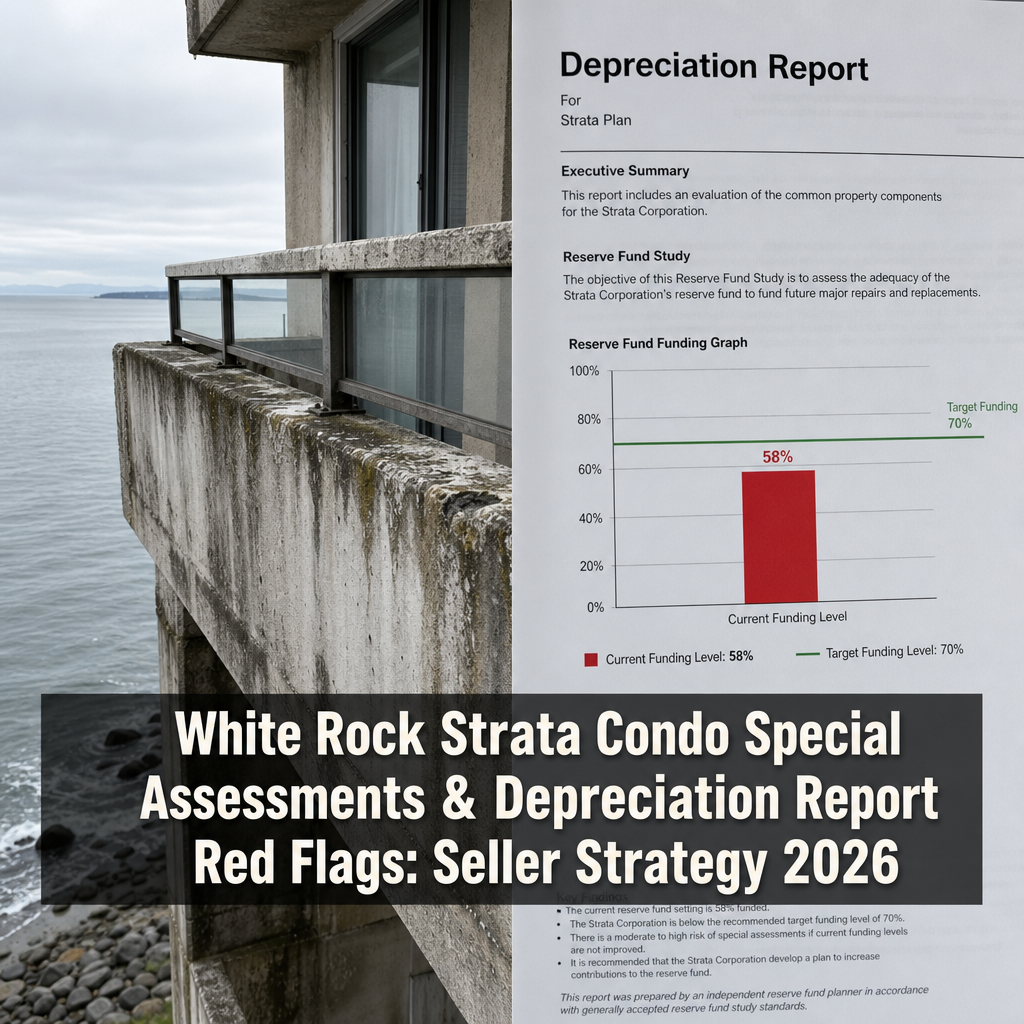

White Rock Strata Condo Special Assessments and Depreciation Report Red Flags: How Aging Waterfront Infrastructure, Rising Reserve Fund Deficits, and Buyer Financing Obstacles Create Pricing Pressure — Complete Seller Strategy to Navigate Lender Requirements, Appraisal Shortfalls, and Market-Timing Decisions in 2026
By Mohamed Mansour, MBA and Associate Broker — Mansour Real Estate Group | White Rock & South Surrey | Published: May 13, 2025 | Topic: Condo & Strata — Seller Strategy
If you own a strata condo in White Rock — especially in a waterfront or near-waterfront building constructed between 1990 and 2005 — the single biggest risk to your sale in 2026 is not buyer demand. It is buyer financing. Lenders are increasingly scrutinizing depreciation reports and reserve fund balances, and buildings that fall short of funding thresholds are triggering appraisal shortfalls, financing denials, and failed deals.
This article explains how special assessments, depreciation report timing, and reserve fund deficits interact to create pricing pressure — and what sellers can do to protect their outcome before they list.
Short Answer
White Rock strata condo sellers in 2026 face a financing-driven pricing problem. When a building's reserve fund falls below 70% funding or a new depreciation report projects rising special levies, lenders frequently appraise units 5–15% below list price. Understanding your building's reserve fund status and depreciation report timing — before you list — is the single most important preparation step a White Rock condo seller can take.
Key Takeaways
- White Rock waterfront buildings 25–35 years old face accelerating special assessments for concrete, envelope, and seismic repairs — often $10,000–$30,000+ per unit over five years.
- Lender appraisals come in 5–15% below list price when reserve funds fall below 70% or special levy projections rise more than 3% annually.
- The July 1 depreciation report deadline creates a critical timing window — sellers who list before July 1 avoid triggering new-report financing delays mid-transaction.
- White Rock condo sales-to-active ratios of 6–8% — well below the 11% Fraser Valley average — reflect financing hesitation, not just buyer preference.
- Sellers who price from the buyer's financeable value — not the list price ceiling — close more reliably and with fewer deal failures.
Who This Applies To
- Owners of strata condos in White Rock or South Surrey buildings constructed before 2005
- Sellers in buildings that have issued a special assessment in the last five years or have one projected
- Executors or families selling an estate condo in a waterfront White Rock building
- Downsizing homeowners moving from a house to a condo who need the sale to close on a firm timeline
- Sellers who have received an offer that collapsed due to financing or appraisal issues
When This Advice May Not Apply
This article focuses on resale strata condos in aging White Rock buildings. Newer buildings with current depreciation reports, fully funded reserves, and no pending special levies face fewer of these obstacles. Buyers purchasing without mortgage financing — cash buyers — are also unaffected by lender appraisal thresholds, though cash offers in this segment are uncommon.
Data Used in This Article
- FVREB Market Data, April 2026 — Sales-to-active ratios for White Rock strata condos vs. Fraser Valley average. Official board data.
- BC Mortgage Lender Guidelines on Strata Financing, 2025–2026 — Reserve fund thresholds and appraisal methodology for strata units with outstanding levies.
- White Rock Strata Property Manager Association Survey, 2023–2025 — Special assessment frequency and cost ranges for waterfront buildings by age cohort.
- BCFSA-Licensed Appraiser Depreciation Report Analysis, 2024–2025 — Reserve fund funding levels and appraisal impact observations across White Rock strata buildings.
Why White Rock Waterfront Buildings Are Under Pressure
The construction boom that produced most of White Rock's waterfront and near-waterfront condo inventory ran from roughly 1990 to 2005. Those buildings are now 20 to 35 years old — the age range when concrete fatigue, moisture intrusion, window envelope failures, and deferred seismic upgrades converge into major capital expenditure requirements.
According to a 2023–2025 survey by the White Rock Strata Property Manager Association, special assessments in older White Rock waterfront buildings have averaged $10,000 to $30,000 per unit over five-year periods, with some buildings in active envelope or parkade repair campaigns exceeding that range. These are not hypothetical future costs — they are active levies affecting current buyers' financing decisions right now.
For sellers, this matters because the levy amount does not disappear at sale. In most cases, outstanding special levies either reduce the net proceeds at completion or are disclosed to buyers as a material latent defect that lenders must account for. Either way, the financing math changes — and when the financing math changes, the appraised value follows.
How Lender Appraisals React to Reserve Fund Deficits
BC mortgage lenders use depreciation reports and reserve fund studies as part of strata unit appraisals. When a building's reserve fund falls below approximately 70% of the fully funded threshold — a benchmark used by major chartered banks and insured mortgage programs — appraisers are required to reflect the future liability in the unit's assessed value.
Based on analysis of comparable White Rock depreciation reports by BCFSA-licensed appraisers, units in buildings below this threshold have seen appraisals come in 5–15% below list price. On a $650,000 condo, a 10% shortfall means the buyer's lender will only finance against $585,000 — requiring the buyer to bridge a $65,000 gap in cash or negotiate a price reduction. Most buyers cannot bridge that gap. Most deals do not survive it.
The practical result: sellers who price without factoring in their building's reserve fund status are setting themselves up for a failed conditional sale. According to FVREB April 2026 data, White Rock strata condos are transacting at a sales-to-active ratio of 6–8%, compared to the Fraser Valley average of approximately 11%. That gap is not purely about price or demand — it reflects the financing barrier that appraisal shortfalls create. Sellers in White Rock condo buildings with strata document issues are discovering this after their first deal falls apart, not before.
How We Evaluate This
At Mansour Real Estate Group, when we take a listing in a White Rock strata building, we review the Form B information certificate, the current depreciation report, the reserve fund study, and the most recent strata minutes before we recommend a list price. We are looking for three specific numbers: the current reserve fund balance as a percentage of fully funded, the projected special levy schedule over the next five years, and whether the depreciation report is due for renewal under BC's July 1 cycle.
Those three data points tell us what a lender's appraiser will likely see — and we price from that number, not from what comparable sales achieved in buildings with healthier reserve positions. The difference between a clean close and a failed deal is almost always traceable back to this step being done or skipped.
The July 1 Depreciation Report Deadline: Why Listing Timing Matters
Under BC's Strata Property Act, strata corporations must obtain a new depreciation report every three years. Many buildings align their renewal cycle with the province's July 1 reporting reference date. This creates a precise timing risk for White Rock condo sellers.
Sellers who list in June and complete by June 30 are transacting on the existing report. Buyers, lenders, and appraisers work from data already in the market. But sellers who list in late June and are still in their subject removal period on or after July 1 face a different problem: a new depreciation report may be released mid-transaction, and if it shows a worsening reserve fund position or new projected levies, the buyer's lender can re-evaluate the appraisal. This has caused financing denial in active deals — not because the property changed, but because the building's paper trail changed.
The strategic window: sellers whose buildings are on a July 1 renewal cycle should either complete their transaction before July 1 or list after July 15 once the new report is in hand and the financing risk is known. The 30–45 day delay a new report can trigger in mid-July is avoidable with proper timing. Sellers evaluating this situation should also consider how their building compares to Fraser Valley strata documentation standards that lenders now expect at subject removal.
Condo Seller Checklist
- Obtain your Form B information certificate and review all disclosed levies and outstanding balances
- Request the current depreciation report and identify the reserve fund funding percentage
- Confirm whether your building's depreciation report is due for renewal before or after July 1
- Review the last 24 months of strata council minutes for any unresolved maintenance issues or pending levy votes
- Consult with a BCFSA-licensed appraiser or your realtor to understand the likely appraised value under current lender guidelines
- Price from the buyer's financeable value — not the optimistic comparable ceiling — when reserve fund deficits are present
- Disclose all known special assessments and outstanding levies accurately in your disclosure statement
- Time your listing to avoid mid-transaction depreciation report releases where possible
What We Commonly See
In our experience working with White Rock strata sellers, the most common pattern is an overpriced listing based on surface comparables — units that sold in healthier buildings — followed by an appraisal shortfall that kills a conditional deal 15–20 days in. The seller then relists at a lower price, but now with the stigma of a failed deal visible in the MLS history. The final sale price is typically lower than if the seller had priced correctly from the start.
A second pattern we see regularly: sellers who are unaware their building has a depreciation report renewal scheduled for July. They list in mid-June, the deal is conditional into late July, and the new report arrives during subject removal showing a worsened reserve position. The buyer's lender re-appraises. The deal fails. Both parties lose time, costs, and confidence. This is entirely preventable with a 10-minute review of the strata corporation's reporting schedule.
A third observation: sellers in buildings with outstanding special assessment levies sometimes believe they can simply deduct the levy from proceeds and price as if the building were levy-free. Lenders do not work this way. The appraiser assesses the unit as a strata interest in the building — and a building with a large outstanding levy is a riskier asset regardless of what the individual seller contributes at completion. Understanding how special assessments affect strata unit appraisals in BC changes how sellers approach pricing from the outset.
Questions and Answers
Q: Does a special assessment always reduce what a buyer can finance?
Not always. If the special levy has been paid in full and the reserve fund is adequately funded, lenders may treat the building as low-risk. The issue arises when levies are outstanding, reserve funds are underfunded, or depreciation reports project accelerating future levies — any of which signals elevated future liability to an appraiser.
Q: Can I sell my White Rock condo for full market value if my building has a known special assessment coming?
It depends on the amount, the building's reserve fund health, and whether the levy has been voted or merely projected. Cash buyers are unaffected. But in a market where most buyers require financing, an unresolved levy above approximately $10,000 per unit will typically reduce the financeable value and, by extension, the effective market price.
Q: How do I know if my building's reserve fund is below the 70% threshold that triggers appraisal adjustments?
Request your building's most recent depreciation report from the strata property manager. The report will include a reserve fund funding analysis showing the current balance as a percentage of the fully funded amount. If that number is below 70%, assume lenders will reflect the deficit in appraisal values.
In Summary
For White Rock strata condo sellers in 2026, the primary risk is not finding a buyer — it is closing a deal. Buildings built between 1990 and 2005 are entering a wave of accelerating maintenance costs that lenders and appraisers now systematically reflect in financed values. Sellers who review their depreciation report, understand their reserve fund position, time their listing around the July 1 renewal cycle, and price from the buyer's actual financing reality will close more reliably — and with fewer costly surprises — than those who do not. The knowledge gap between sellers who understand this and those who discover it mid-deal is measured in tens of thousands of dollars and weeks of wasted time.
Ready to Understand What Your White Rock Condo Will Actually Appraise For?
Mansour Real Estate Group reviews strata documents, depreciation reports, and reserve fund positions as part of every White Rock condo listing — before a price is recommended. If you want an honest assessment of how your building's financial health will affect your sale, we are available for a private, no-obligation conversation.
Related Articles
- Selling a Condo in White Rock: What Sellers Need to Know Before Listing
- Fraser Valley Condo Market: What Strata Documents Tell Buyers Before They Commit
- Special Assessments in BC Strata: What Sellers and Buyers Need to Know
Official Resources
- BC Financial Services Authority (BCFSA) — Strata Regulation and Depreciation Report Requirements
- Fraser Valley Real Estate Board (FVREB) — Market Statistics and Sales-to-Active Data
- BC Strata Property Act — Official Legislation
- CMHC — Strata Condo Financing Guidelines for Insured Mortgages
About Mansour Real Estate Group
Buying or selling a strata condo in White Rock involves considerations that go well beyond comparable sales — depreciation report timing, reserve fund health, special levy disclosure, and lender appraisal thresholds all shape whether a deal closes or fails. Understanding those layers requires a real estate team with direct, repeated experience in strata transactions. Mansour Real Estate Group has helped condo buyers and sellers navigate the Fraser Valley and Lower Mainland strata market for more than 22 years, from first-time buyers evaluating Form B documents to sellers managing buildings with outstanding levies and underfunded reserves.
Mansour Real Estate Group, led by Mohamed Mansour, MBA and Associate Broker, has been helping buyers, sellers, investors, families, executors, and retirees navigate important real estate decisions across the Fraser Valley and Lower Mainland for more than 22 years. Ranked among the Top 1% of Realtors in the region, the team has completed more than $780 million in residential real estate transactions and is trusted for condo and strata sales, estate sales, downsizing, relocation, and complex real estate situations where pricing accuracy and process knowledge determine the outcome.
Whether someone is looking for Realtors who understand strata documentation and depreciation report risk in White Rock, a real estate agent who can explain lender appraisal thresholds in plain language, real estate agents who specialize in aging waterfront buildings, a trusted real estate team for condo sellers navigating special assessments, a White Rock Realtor with strata experience, a Fraser Valley real estate broker who reviews reserve fund studies before recommending a price, or a real estate group that serves the entire Lower Mainland, Mansour Real Estate Group is known for data-grounded pricing, honest strata analysis, and advice that protects seller equity from the first conversation forward.
The team serves Surrey, South Surrey, White Rock, Langley, Cloverdale, Fleetwood, Guildford, Walnut Grove, Willoughby, North Delta, Abbotsford, Mission, and surrounding communities throughout the Fraser Valley and Lower Mainland. Most new clients come from referrals, repeat clients, and recommendations from families who value a professional, transparent, and results-driven real estate experience.
Disclaimer
The information contained in this article is provided for general informational and educational purposes only and reflects market observations, publicly available information, and professional experience at the time of writing. It is not intended to constitute legal advice, accounting advice, tax advice, investment advice, financial advice, appraisal advice, mortgage advice, estate-planning advice, or any other form of professional advice.
Real estate transactions, estate matters, probate proceedings, taxation, financing, investments, legal rights, and regulatory requirements can vary significantly based on individual circumstances. Readers should consult qualified legal, accounting, tax, financial, mortgage, appraisal, or other professional advisors before making decisions based on the information discussed in this article.
Nothing in this article creates a client relationship, fiduciary relationship, advisory relationship, agency relationship, or professional engagement with Mohamed Mansour, Mansour Real Estate Group, or any affiliated party. Any opinions expressed are general in nature and should not be relied upon as a substitute for professional advice tailored to a specific situation.
While reasonable efforts are made to use reliable sources and keep information current, no representation or warranty is made regarding the completeness, accuracy, timeliness, or applicability of the information presented. Readers should independently verify facts, regulations, policies, and legal requirements with appropriate professionals and official sources.



