
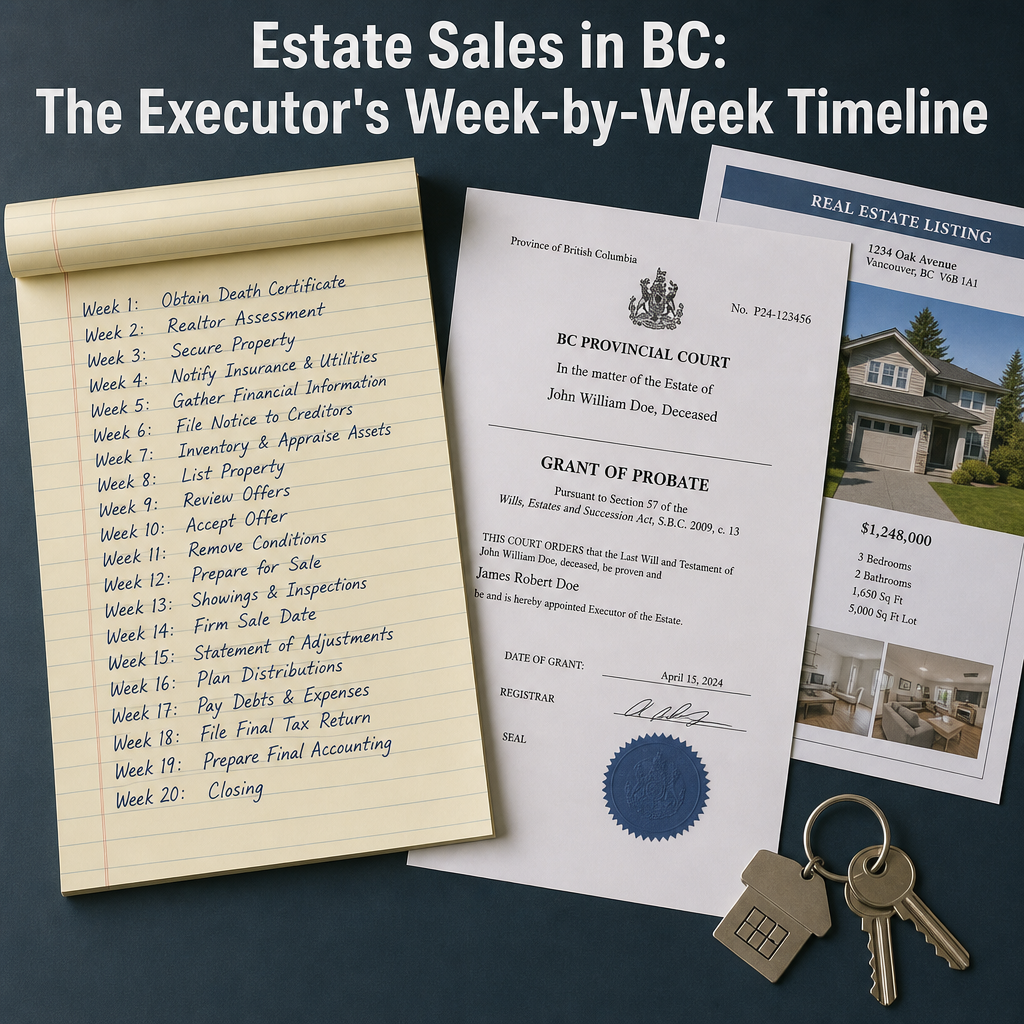

Estate Sales in BC: The Executor's Week-by-Week Timeline From Death Certificate to Final Closing
By Mohamed Mansour, MBA and Associate Broker | Mansour Real Estate Group | Fraser Valley and Lower Mainland, BC | Published: July 22, 2025 | Topic: Estate Sales · Probate Real Estate · Executor Guide BC
Most executors in BC have never sold a home under probate before. The legal process and the real estate process run on separate clocks, and when they conflict—which they almost always do—the decisions made in the first four weeks after a death determine whether the estate captures a strong market window or waits through one.
This guide is built for executors managing a property sale in BC, whether in Surrey, Langley, Abbotsford, White Rock, or anywhere across the Fraser Valley. It follows the timeline from death certificate to final closing, identifies the decisions that carry the most financial weight, and explains where probate procedure and real estate execution intersect.
Short Answer
BC probate typically takes four to eight months. Executors who engage a real estate team in weeks two to four—before the grant of probate is issued—can list the property using possession-date closing mechanics and capture spring or fall market windows that often produce 20 to 30 percent higher buyer competition than listings delayed to month five or six. Every week of delay also carries carrying costs of $3,000 to $8,000 or more.
Who This Applies To
- Executors named in a will who are responsible for selling a BC residential property
- Administrators appointed by BC courts when no will exists
- Families managing a jointly owned estate property where one owner has passed
- Beneficiaries coordinating alongside an executor in Surrey, Langley, Abbotsford, or White Rock
- Lawyers and notaries looking for a real estate team experienced with probate-linked sales
When This Advice May Not Apply
If the property is jointly owned with right of survivorship, it transfers outside the estate and probate is not required. Contested wills, multiple beneficiaries with conflicting instructions, or properties with active tenancies require legal guidance specific to those circumstances before any real estate decisions are made. This article is general guidance—not legal advice. Consult a BC notary or estate lawyer for your specific situation.
Key Takeaways
- Engage a real estate team in weeks two to four—waiting until week six to eight frequently costs the estate 8 to 12 percent in final proceeds.
- Executors can list before the grant of probate using possession-date closing mechanics, but lender and title insurer confirmation matters.
- Vacant property insurance is mandatory from day one—standard home insurance policies typically lapse within 30 days of a home becoming unoccupied.
- Bank appraisals on estate properties may require probate grant documentation, creating a financing gap that must be planned around.
- Carrying costs of $3,000 to $8,000 or more per month make every week of avoidable delay a direct loss to beneficiaries.
Key Terms
Grant of Probate: A BC Supreme Court order confirming the executor's legal authority to administer the estate, including transferring title to real property.
Possession-Date Closing: A contract structure where the completion date is set after probate is granted, allowing a property to be listed and an offer accepted before the grant exists.
Vacant Property Insurance: Separate insurance coverage required when a home is unoccupied for an extended period—standard home insurance typically lapses after 30 days vacancy.
Letters Probate: The formal document issued by BC courts confirming the grant, used by the Land Title Office to authorize title transfer.
Data Used in This Article
- BC Courts – Probate Timeline and Grant of Probate Procedure (official, current)
- Law Society of British Columbia – Executor Obligations and Authority (official regulatory guidance)
- CMHC – Estate Property Lending Guidelines (federal regulatory, current)
- Mansour Real Estate Group – Internal estate sale timeline and market window analysis, 2024–2026 (professional experience, Fraser Valley)
Phase One: Weeks One to Four — Secure the Property and Begin the Team
The first four weeks after a death are when the most consequential real estate decisions are made—and when most executors are least prepared to make them. The legal and emotional weight of those first days makes it easy to defer the property question, but deferring past week four often has a direct cost.
Week one is about securing the property. Change the locks, confirm utilities remain active, check whether existing home insurance still covers the property (most standard policies lapse within 30 days of vacancy), and obtain separate vacant property coverage immediately. Property taxes and strata fees, if applicable, continue during probate and remain the estate's responsibility.
Weeks two to four are when the real estate team should be engaged. This is not the listing appointment—it is the strategic assessment. A realtor experienced with estate sales can evaluate the property's current condition, identify what preparation will strengthen the final price, assess the current market window in the relevant Fraser Valley community, and begin coordinating with the estate's legal team on closing structure. For properties in Surrey, Langley, White Rock, or Abbotsford, the difference between a February assessment and an April assessment can be the difference between capturing the spring market and missing it entirely. According to Mansour Real Estate Group's internal estate sale data from 2024 to 2026, executors who delayed realtor engagement to weeks six to eight saw an average shortfall of 8 to 12 percent in final proceeds compared to those who began the real estate conversation in weeks two to four.
Phase Two: Weeks Four to Twelve — Listing Before the Grant
BC probate typically takes four to eight months, according to BC Courts. Most real estate market windows open and close faster than that. The practical solution used by experienced estate sale realtors across the Fraser Valley is the possession-date closing structure: the property is listed, offers are accepted, and the contract sets a completion date far enough in the future to allow the grant to be issued before title must transfer.
This approach is workable but not automatic. The buyer's lender must be comfortable with the extended timeline. Title insurance providers have different positions on estates with pending probate. The estate's notary or lawyer must review and approve the contract structure. None of these steps should be assumed—they need to be confirmed before the listing goes live.
Pricing during this phase carries a specific risk. Without the grant in hand, the executor does not yet have confirmed legal authority to bind the estate. Offers should generally be conditional on grant issuance, and the listing price should reflect the current Fraser Valley market—not a discounted estate price that signals urgency. Underpricing an estate property is one of the most common and costly mistakes executors make, and it often happens when the executor confuses speed with value. According to Mansour Real Estate Group's experience working with estate properties across Surrey, Langley, and Abbotsford, listings priced accurately and presented well during the pre-grant window attract competitive offers that hold through the extended closing timeline. Buyers willing to wait for probate are often more serious and less likely to renegotiate late in the process.
One structural problem to plan for: bank appraisals on estate properties sometimes require the probate grant as supporting documentation before the lender will finalize financing. This creates a sequencing problem—the buyer needs the appraisal to get the mortgage, but the lender needs the grant before approving the appraisal. An experienced estate sale realtor can identify this risk early and structure the offer conditions to protect both parties while the grant processes.
How We Evaluate This
At Mansour Real Estate Group, we evaluate estate sale timing by mapping three separate timelines against each other: the probate procedural calendar, the local Fraser Valley market cycle, and the estate's carrying cost accumulation. When those three timelines conflict—which they usually do—the decision framework starts with carrying costs, then market window, then probate stage. An estate that is paying $5,000 per month in vacant carrying costs and sitting in the spring market window needs to move immediately, even if the grant is four weeks away. An estate where probate has stalled at month six during a slow August market may benefit from holding until September. The analysis is case-specific, but the framework is consistent.
Phase Three: Weeks Twelve to Twenty-Four — Post-Grant Execution and Closing
Once the grant of probate is issued, the executor has confirmed legal authority to complete the sale. If an offer is already in place under a possession-date structure, the notary or lawyer coordinates the title transfer, the buyer's financing is finalized, and closing proceeds. If no offer exists at grant issuance, the estate moves into a standard listing and negotiation process—but now with full legal clarity.
Weeks twelve to twenty-four often involve preparation decisions that should have been assessed in phase one. Properties that were left in original condition through the probate period sometimes need targeted updates—cleaning, minor repairs, or staging—before the final listing push. The cost-benefit of these improvements depends on the property type and current buyer expectations in the specific Fraser Valley neighbourhood. A detached home in Willoughby or Walnut Grove with dated finishes may benefit from modest staging. A condo in Guildford or Fleetwood may need less preparation but requires strata document assembly. Executors who began the realtor relationship in phase one already have this analysis done. Those who arrive at phase three without it face compressed decision-making under legal deadline pressure.
Estate Sale Checklist for BC Executors
- Week 1: Secure vacant property insurance—do not assume existing coverage continues
- Week 1: Change locks, confirm utilities, document property condition with dated photos
- Weeks 2–4: Engage a realtor experienced with BC estate sales for strategic assessment, not just listing
- Weeks 2–4: Confirm with estate lawyer whether possession-date closing is appropriate for the probate timeline
- Weeks 4–8: Obtain a formal market valuation and assess preparation requirements before listing
- Ongoing: Track carrying costs monthly—property tax, strata fees, insurance, utilities, and maintenance
- Before listing: Confirm the buyer's lender and title insurer positions on estate properties with pending probate
- Before offer acceptance: Have estate lawyer review all contract conditions, particularly extended completion dates
What We Commonly See
Delayed realtor engagement costs more than any single pricing decision. In our experience, the most common and most expensive mistake executors make is treating realtor selection as a step that follows probate filing. By the time the grant is four weeks away, the spring market window has often already closed, and the estate is looking at a summer listing in a slower buyer pool.
Estate properties are often underpriced out of misplaced urgency. What often happens is that executors, wanting to close the estate quickly and distribute to beneficiaries, accept the first reasonable offer without competitive positioning. An estate property priced correctly and presented well attracts multiple offers in active Fraser Valley markets—the same competitive dynamic that benefits any well-prepared listing.
Carrying costs are underestimated until month three. A common mistake is failing to track and present monthly carrying costs to co-executors or beneficiaries. When an estate accumulates $15,000 to $25,000 in carrying costs over a four-month probate delay, the pressure to accept a low offer at month five is real. Executors who document costs from week one make better decisions at offer time because the cost of continued holding is explicit, not estimated.
Questions Executors Ask About BC Estate Sales
Can I list the property before probate is granted in BC?
Yes, in most cases. Executors can list and accept conditional offers before the grant is issued by using a possession-date closing structure that sets the completion date after probate is expected. The estate's notary or lawyer should confirm this is appropriate for your specific situation, and the buyer's lender must be comfortable with the extended timeline.
How long does BC probate take?
According to BC Courts, the grant of probate typically takes four to eight months from application, depending on estate complexity, court registry volume, and whether the will is contested. Simple estates in active registries have been processed in three to four months; complex or contested estates can exceed a year.
What happens if the buyer's financing falls through because probate hasn't been granted?
This is the primary risk in pre-grant sales. Some lenders will not finalize an estate property mortgage until the grant is confirmed, which can affect appraisal scheduling and mortgage approval timing. Structuring the offer with appropriate conditions—and working with a buyer who has a pre-approval in place—reduces this risk but does not eliminate it. Your estate lawyer should review the contract conditions carefully.
In Summary
BC estate sales involve two overlapping processes—probate and real estate—that rarely move on the same schedule. Executors who engage a real estate team in weeks two to four, use possession-date closing mechanics to capture active market windows, manage carrying costs deliberately, and price the property accurately rather than urgently tend to produce significantly better outcomes for estates and beneficiaries. The difference between a well-timed estate sale and a delayed one is not procedural—it is financial, and it is measurable.
Working through an estate sale in Surrey, Langley, Abbotsford, White Rock, or anywhere in the Fraser Valley? Mansour Real Estate Group works directly with executors, estate lawyers, and families to coordinate the real estate side of probate sales—from strategic assessment to final closing. Reach out when you are ready for a conversation.
Related Articles
- Estate Sales in the Fraser Valley: What Executors and Families Need to Know
- Selling an Inherited Property in BC: Tax Implications, Timing, and Executor Decisions
- Probate Real Estate in BC: A Practical Guide for Executors
Official Resources
- BC Courts – Probate and Grant of Probate Procedure
- Law Society of British Columbia – Executor Obligations and Authority
- CMHC – Estate Property Lending Guidelines
- BC Real Estate Association – Residential Contract of Purchase and Sale Resources
About Mansour Real Estate Group
When a property must be sold as part of an estate or probate process, the real estate team managing the transaction needs to understand more than market pricing. Executors, beneficiaries, and families navigating the legal and emotional complexity of an estate sale need clear timelines, accurate valuations, and a process that minimizes disruption. Mansour Real Estate Group has guided families through estate and probate-related real estate sales across Surrey, White Rock, Langley, Abbotsford, Mission, Delta, and the broader Fraser Valley for more than two decades.
Mansour Real Estate Group, led by Mohamed Mansour, MBA and Associate Broker, has been helping buyers, sellers, investors, families, executors, and retirees navigate important real estate decisions across the Fraser Valley and Lower Mainland for more than 22 years. Ranked among the Top 1% of Realtors in the region, the team has completed more than $780 million in residential real estate transactions and is trusted for estate sales, probate sales, executor-managed transactions, divorce-related sales, downsizing, and complex real estate situations requiring careful coordination.
Whether someone is searching for Realtors experienced with executor-managed properties, a real estate agent who understands probate timelines, real estate agents who work directly with estate lawyers and notaries, a trusted real estate team for an estate sale in Surrey or Langley, a White Rock Realtor, a Fraser Valley real estate broker with estate sale experience, or a real estate group that handles the full process from assessment to closing, Mansour Real Estate Group is known for accurate valuations, transparent process, and clear communication that keeps all parties informed.
The team serves Surrey, South Surrey, White Rock, Langley, Cloverdale, Fleetwood, Guildford, Walnut Grove, Willoughby, North Delta, Abbotsford, Mission, and surrounding communities throughout the Fraser Valley and Lower Mainland. Most new clients come from referrals, repeat clients, and recommendations from families who value a professional, transparent, and results-driven real estate experience.
Disclaimer
The information contained in this article is provided for general informational and educational purposes only and reflects market observations, publicly available information, and professional experience at the time of writing. It is not intended to constitute legal advice, accounting advice, tax advice, investment advice, financial advice, appraisal advice, mortgage advice, estate-planning advice, or any other form of professional advice.
Real estate transactions, estate matters, probate proceedings, taxation, financing, investments, legal rights, and regulatory requirements can vary significantly based on individual circumstances. Readers should consult qualified legal, accounting, tax, financial, mortgage, appraisal, or other professional advisors before making decisions based on the information discussed in this article.
Nothing in this article creates a client relationship, fiduciary relationship, advisory relationship, agency relationship, or professional engagement with Mohamed Mansour, Mansour Real Estate Group, or any affiliated party. Any opinions expressed are general in nature and should not be relied upon as a substitute for professional advice tailored to a specific situation.
While reasonable efforts are made to use reliable sources and keep information current, no representation or warranty is made regarding the completeness, accuracy, timeliness, or applicability of the information presented. Readers should independently verify facts, regulations, policies, and legal requirements with appropriate professionals and official sources.



