

North Delta Empty Nester's Complete Downsizing Guide 2026: Financial Math, Lifestyle Trade-Offs, and Strategic Timing When Transitioning From a Detached Home to a Townhouse or Condo
By Mohamed Mansour, MBA and Associate Broker | Mansour Real Estate Group | Published: May 12, 2025 | Geography: North Delta, Delta, Fraser Valley, BC
For North Delta homeowners whose children have moved out, the family home can start to feel like a financial anchor as much as a comfort. Property taxes, maintenance, heating, and yard work add up. Meanwhile, the equity sitting inside a $1.3M–$1.6M detached home is substantial — and a strategic move to a townhouse or condo could release hundreds of thousands of dollars while cutting annual carrying costs significantly. This guide is written specifically for that decision.
What follows is a complete breakdown of the financial math, tax planning considerations, lifestyle trade-offs, and timing strategy North Delta empty nesters need before making this transition. The numbers here are grounded in current North Delta market data, BC government tax rules, and transaction experience from this specific community.
Short Answer
For most North Delta empty nesters, downsizing from a detached home to a townhouse or condo in 2026 releases $300K–$500K in net equity after all closing costs, reduces annual carrying costs by $5K–$8K, and is financially sound — provided the property transfer tax exposure (roughly $50K–$65K combined on both transactions) and strata fee burden are modelled accurately before committing.
Key Takeaways
- Selling a $1.4M North Delta detached home and purchasing a $700K condo triggers roughly $50K–$65K in combined property transfer tax — accurate net-proceeds modelling is essential.
- Most family homes qualify for the principal residence exemption, meaning no capital gains tax on the sale — but the replacement condo's future sale may be taxable if designations aren't managed carefully.
- North Delta's attached housing market (15–23% sales-to-active ratio) is moving faster than detached (11%), giving downsizers more negotiating room on the sell side and less on the buy side.
- Strata fees of $250–$400 per month add $3K–$5K annually to carrying costs — a lifetime cost retirees on fixed income must model over 25–30 years, not just the first year.
- Bridge financing ($15K–$25K cost over 3–4 months) can allow a retiree to purchase a condo before selling the detached home, removing contingency pressure in a tighter attached market.
Who This Applies To
- North Delta homeowners aged 55–75 whose children have moved out of the family home
- Retirees carrying significant detached home equity and looking to redeploy it
- Empty nesters weighing whether to stay, renovate, or downsize to attached housing
- Homeowners concerned about long-term maintenance, property tax, or healthcare proximity
- Couples or single homeowners who want to unlock equity without leaving the community
When This Advice May Not Apply
This guide covers the most common downsizing scenario. It does not apply when a homeowner has rental suites generating income (capital gains tax treatment differs), when the home is held in a trust or corporate structure, or when health or legal considerations require specialist advice. Always consult a tax professional and a BC real estate lawyer before completing either transaction.
Data Used in This Article
- BC Assessment: North Delta 2026 benchmark data by property type — official, annual
- Fraser Valley Real Estate Board: North Delta sales-to-active ratios, days on market, pricing trends — official monthly releases
- Canada Revenue Agency: Principal residence exemption and capital gains rules — official regulatory guidance
- BC Government: Property transfer tax thresholds and calculator — official 2026 documentation
- Mansour Real Estate Group: Internal transaction data for North Delta downsizing sales (2024–2026) — professional observation
- Strata Property Act BC / Form B: Strata fee and disclosure obligations — official legislation
The Financial Math: What Downsizing Actually Releases
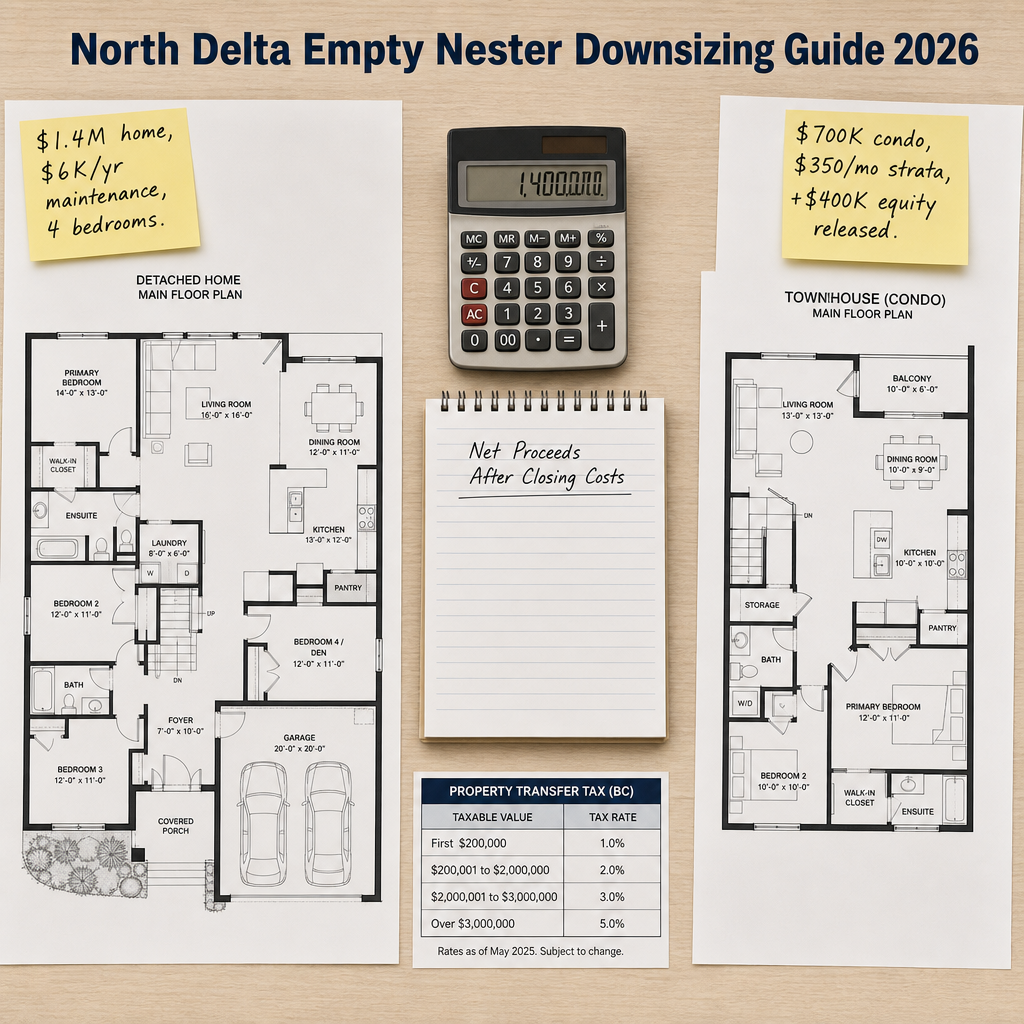
North Delta detached homes have benchmarked between $1.3M and $1.6M in recent FVREB data, depending on neighbourhood, lot size, and condition. A realistic transaction at $1.4M, after factoring in realtor commission (typically 3–4% of proceeds), legal fees, and moving costs, returns roughly $1.32M–$1.35M to the seller before purchasing the replacement property.
Purchasing a North Delta townhouse at $700K–$750K triggers property transfer tax under BC's current thresholds. The first $200,000 is taxed at 1%, the amount between $200,001 and $2,000,000 at 2%, and amounts above $2,000,000 at 3%. On a $700K purchase, PTT is approximately $11,000. On the $1.4M sale, PTT would have been paid by the original buyer when you purchased — but now as the buyer of the new condo, you pay PTT again. The combined PTT exposure across both the sale's original purchase history and your new purchase often surprises people. For the new purchase alone, budget $11,000–$14,000 in PTT. Add legal fees, title insurance, and moving costs, and total transaction friction on the buy side runs $18,000–$25,000.
Net equity released after selling the detached home and completing the condo purchase typically lands between $300,000 and $500,000, depending on exact pricing and closing costs. According to North Delta home prices by property type, the spread between detached and attached pricing in this community is wide enough to make this equity release meaningful — even after all transaction costs.
Tax Planning: Principal Residence Exemption and Capital Gains
For most North Delta empty nesters, the family home qualifies fully for the principal residence exemption under CRA rules, meaning no capital gains tax applies on the sale. This is one of the most significant tax advantages available to Canadian homeowners, and for a property that has appreciated from $600K to $1.4M over 20 years, the tax savings are substantial.
The strategic consideration arises after the move. Once you purchase the replacement condo and it becomes your principal residence, the clock starts on its future appreciation. That appreciation will also be sheltered — provided you maintain the designation correctly. Where problems arise is when a homeowner owns a secondary property (a rental, a cottage, an investment condo) and has not carefully tracked which property is designated as the principal residence for which years. CRA allows only one property to be designated per year per family unit. If designations haven't been tracked, a future condo sale could trigger unexpected capital gains tax.
This is not a situation to navigate without a tax professional. The rules themselves are clear under the Income Tax Act and CRA guidance, but applying them correctly to your specific history requires professional advice. Ask your accountant before listing.
Lifestyle Trade-Offs: What North Delta Retirees Are Actually Weighing
North Delta's suburban character is a genuine trade-off for retirees considering attached housing. The community is predominantly low-density — single-family homes, quiet streets, established gardens. Walkability scores in most North Delta neighbourhoods are modest compared to transit-oriented areas like Willowbrook in Langley or central Surrey. If walkability and daily errands on foot matter, some retirees find they need to look beyond North Delta's primary condo clusters to find the amenity mix they want.
Healthcare proximity is a different story. Delta Hospital (now part of the Delta Regional Hospital Centre network) sits within practical distance for most North Delta addresses. Long-term care facilities, medical clinics, and physiotherapy services are distributed across the community in a way that makes North Delta genuinely practical for aging in place — provided transportation remains available.
For retirees who want to stay in the community they've lived in for decades — near family, near established relationships, near the parks and amenities discussed in our North Delta community amenities guide — downsizing within North Delta to a townhouse or ground-floor condo often delivers the best lifestyle continuity with meaningfully lower maintenance obligations.
Market Timing: Why the 2026 Window Matters
North Delta's detached market is currently operating at approximately an 11% sales-to-active ratio, indicating buyer's market conditions — more supply, longer days on market, and more room for buyers to negotiate. For a downsizer selling a detached home, this means realistic pricing discipline matters more than usual. Overpricing a detached home in a buyer's market is one of the most common errors in this demographic transition, and it can result in extended days on market that complicate the timing of the attached purchase.
The attached market — townhouses and condos — is tighter, running at 15–23% sales-to-active ratios depending on the segment. This means the replacement property may sell faster and with less negotiation room. The practical implication: a downsizer who waits to find the right condo before listing the detached home may lose the unit they want, while a downsizer who lists first may find themselves in a tight timeline to close on the replacement.
Bridge financing — a short-term loan that allows you to purchase the condo before the detached home sale completes — is one solution. At current rates, bridge financing for a 3–4 month period on a $700K purchase costs roughly $15,000–$25,000 in interest and fees. That cost must be weighed against the risk of losing a preferred unit. See our overview of whether 2026 is a good time to sell in North Delta for current market context. For buyers evaluating attached options specifically, our guides on buying a townhouse in North Delta and whether condos are a good investment in North Delta cover the strata-specific considerations in detail.
How We Evaluate This
At Mansour Real Estate Group, we approach empty-nester downsizing as a two-transaction financial model before it becomes a real estate conversation. That means building a net-proceeds estimate for the detached sale, modelling PTT and closing costs on the replacement purchase, stress-testing the strata fee burden against the client's income timeline, and mapping the attached inventory available in their preferred neighbourhoods — all before any listing decision is made. The goal is to make sure the equity available on paper translates accurately to what lands in the client's account. We've completed enough North Delta downsizing transactions to know where the surprises tend to appear, and we build those into the initial analysis so they aren't surprises.
Downsizing Checklist
- Request a current market valuation for the detached home from a local realtor — not an online estimate, which may not reflect North Delta's neighbourhood-level variation.
- Build a net-proceeds model: sale price minus commission, legal fees, moving costs, and any pre-sale repairs — before discussing the replacement purchase budget.
- Consult a CPA or tax professional about principal residence exemption designations, especially if you own or have owned a secondary property in the past 10 years.
- Calculate the BC property transfer tax on the replacement purchase using the BC Government PTT calculator and include it in your purchase budget.
- Review Form B and the strata financial statements for any townhouse or condo you're seriously considering — look for special levy history, contingency reserve fund balance, and upcoming assessments.
- Ask your mortgage broker whether you qualify for bridge financing and at what cost — this gives you the option to purchase before your detached home sells if the right unit appears.
- Confirm healthcare proximity: map the distance from your shortlisted attached units to Delta Hospital, your GP clinic, and any specialist services you currently use regularly.
- Model the strata fee burden over 20 years, not just year one — $350/month is $84,000 over 20 years before any fee increases.
What We Commonly See
Underestimating transaction friction. In our experience, the most consistent gap between what clients expect to net and what they actually receive comes from property transfer tax and legal costs on the replacement purchase. Many retirees focus entirely on the sale proceeds and treat the PTT as a minor detail. On a $700K condo purchase, $11,000–$14,000 in PTT alone is not minor — and it comes out of the equity that was supposed to be reinvested or preserved for income.
Ignoring the strata fee long game. What often happens is that a retiree accepts a $325/month strata fee as reasonable compared to $6,000 in annual detached maintenance costs — and it often is. But strata fees in BC are not fixed. Buildings age, contingency reserve funds get depleted, and special levies arrive without much warning. A 25-year carrying cost model that includes fee escalation and a potential special levy of $20,000–$40,000 looks different from a first-year comparison.
Rushing the attached purchase because of detached market anxiety. A common mistake is pricing the detached home aggressively to sell quickly, then rushing into the first available condo because the sale timeline is pressing. The attached market in North Delta has reasonable inventory — there is generally time to be selective. The sequence and timing strategy matters more than speed.
Questions and Answers
Will I pay capital gains tax when I sell my North Delta family home?
Most homeowners who have lived in their home as their principal residence will not pay capital gains tax on the sale, under CRA's principal residence exemption. Consult a tax professional if you have owned multiple properties or rented any portion of the home.
How much property transfer tax will I pay on the condo purchase?
On a $700,000 purchase, BC property transfer tax is approximately $11,000 under 2026 thresholds (1% on the first $200K, 2% on the balance up to $2M). This is paid by the buyer at completion and must be included in your purchase budget.
What should I look for in a North Delta condo's strata documents?
Review the Form B Information Certificate, the strata corporation's financial statements, the contingency reserve fund balance, the depreciation report, and minutes from the last three annual general meetings. These documents reveal upcoming special levies, deferred maintenance, and the financial health of the building. For a detailed breakdown, see our guide on strata fees, depreciation reports, and condo rules in BC.
In Summary
Downsizing from a North Delta detached home to a townhouse or condo in 2026 is financially sound for most empty nesters — but only when the full transaction cost picture is modelled before committing. The principal residence exemption protects most family home sales from capital gains tax, but PTT, strata fees, and long-term carrying costs require careful planning. The current market window — a buyer's market for detached, a more competitive market for attached — creates a timing sequence that rewards preparation over urgency. The equity released is real and significant. The planning required to protect it is equally real.
Thinking About Downsizing in North Delta?
If you're weighing whether to stay, renovate, or downsize, Mansour Real Estate Group offers a no-obligation downsizing consultation that starts with an honest net-proceeds model — not a listing pitch. Contact the team when you're ready to run the numbers.
Related Articles
- North Delta Home Prices by Property Type: Detached, Townhouse, and Condo Compared
- Buying a Townhouse in North Delta: What You Need to Know Before You Offer
- Understanding Strata Fees, Depreciation Reports, and Condo Rules in BC: A Buyer's Guide
About Mansour Real Estate Group
For homeowners who have spent decades building equity in a North Delta family home, the decision to downsize is one of the most consequential real estate transitions they will make — financially and practically. The timing, the net-proceeds modelling, the strata document review, and the sequencing of two simultaneous transactions all require a real estate team that has navigated this exact path before. Mansour Real Estate Group has helped hundreds of homeowners and families downsize across North Delta, Surrey, White Rock, South Surrey, Langley, Abbotsford, Delta, and the broader Fraser Valley.
Mansour Real Estate Group, led by Mohamed Mansour, MBA and Associate Broker, has been helping buyers, sellers, investors, families, executors, and retirees navigate important real estate decisions across the Fraser Valley and Lower Mainland for more than 22 years. Ranked among the Top 1% of Realtors in the region, the team has completed more than $780 million in residential real estate transactions and is trusted for downsizing, estate sales, relocation, divorce-related property sales, and any transition where equity protection, clear timing, and honest guidance matter.
Whether someone is searching for Realtors who understand the financial complexity of downsizing, a real estate agent experienced with empty-nester transitions, real estate agents who can model the full net-proceeds picture before any listing decision is made, a trusted real estate team for retirees and empty nesters in North Delta, a North Delta Realtor, a Delta real estate broker, or a real estate group that serves the Fraser Valley and Lower Mainland, Mansour Real Estate Group is known for patience, clear advice, and a process that puts the client's timeline first.
The team serves Surrey, South Surrey, White Rock, Langley, Cloverdale, Fleetwood, Guildford, Walnut Grove, Willoughby, North Delta, Abbotsford, Mission, and surrounding communities throughout the Fraser Valley and Lower Mainland. Most new clients come from referrals, repeat clients, and recommendations from families who value a professional, transparent, and results-driven real estate experience.
Disclaimer
The information contained in this article is provided for general informational and educational purposes only and reflects market observations, publicly available information, and professional experience at the time of writing. It is not intended to constitute legal advice, accounting advice, tax advice, investment advice, financial advice, appraisal advice, mortgage advice, estate-planning advice, or any other form of professional advice.
Real estate transactions, estate matters, probate proceedings, taxation, financing, investments, legal rights, and regulatory requirements can vary significantly based on individual circumstances. Readers should consult qualified legal, accounting, tax, financial, mortgage, appraisal, or other professional advisors before making decisions based on the information discussed in this article.
Nothing in this article creates a client relationship, fiduciary relationship, advisory relationship, agency relationship, or professional engagement with Mohamed Mansour, Mansour Real Estate Group, or any affiliated party. Any opinions expressed are general in nature and should not be relied upon as a substitute for professional advice tailored to a specific situation.
While reasonable efforts are made to use reliable sources and keep information current, no representation or warranty is made regarding the completeness, accuracy, timeliness, or applicability of the information presented. Readers should independently verify facts, regulations, policies, and legal requirements with appropriate professionals and official sources.



