
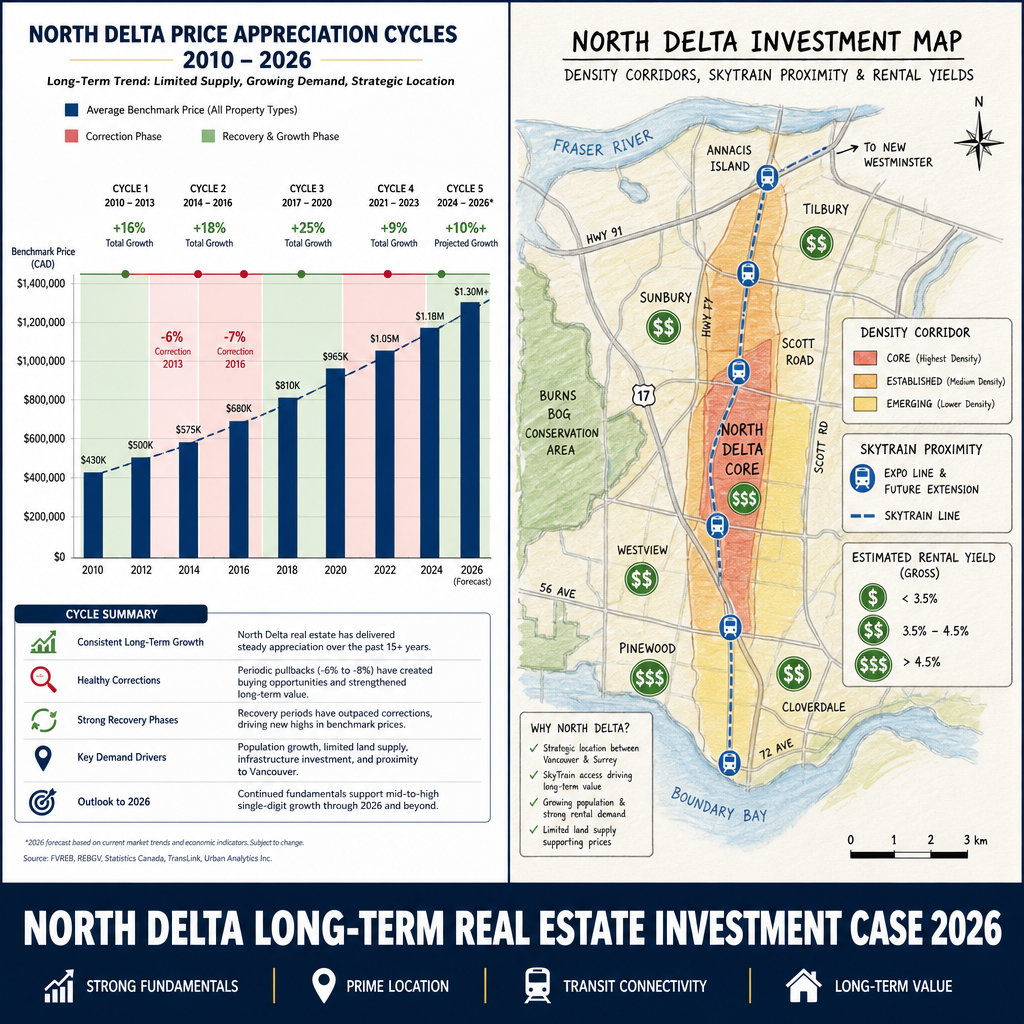

North Delta Long-Term Real Estate Investment Case 2026: Historical Price Appreciation, Rental Demand Drivers, Infrastructure Development, and Why Local Upgraders and Out-of-Area Investors Should Recalibrate Expectations in a Buyer's Market
By Mohamed Mansour, MBA, Associate Broker — Mansour Real Estate Group | Fraser Valley & Lower Mainland, BC | Published: July 15, 2025
North Delta sits in an unusual position in 2026. Its sales-to-active ratio sits at roughly 11%, placing it firmly in buyer's market territory. Year-over-year prices have declined 6–8%, and active listings have climbed past 450. For a homeowner watching equity compress, that sounds like a problem. For an investor or upgrader with a 7–15 year horizon, it may look like an entry point. The answer depends entirely on which fundamentals you're measuring.
This article examines the long-term investment case for North Delta — not the month-to-month sentiment, but the structural drivers: population growth, rental income, infrastructure pipeline, and how price recovery has historically played out in this specific community. Sources include Delta BC Economic Development data, FVREB and REBGV historical sales records, CMHC rental market reports, and Metro Vancouver Regional District infrastructure planning documents.
Short Answer
North Delta's long-term investment case rests on consistent population growth, gross rental yields of 4.5–5.5% for townhomes and duplexes, and a historical pattern of recovering 60–70% of corrections within 3–5 years when employment and infrastructure investment accelerate. Current buyer's market conditions — 6–8% price declines and elevated inventory — create a potential entry window for investors and upgraders prepared to hold through a 2–3 year absorption period before appreciation resumes.
Who This Applies To
- Out-of-area investors evaluating Metro Vancouver sub-markets for rental income and long-term appreciation
- Local upgraders deciding whether to move up in North Delta or shift to an adjacent community
- Families weighing a purchase now versus waiting for further price correction
- Existing North Delta owners deciding whether to hold, convert to rental, or sell at current valuations
When This Advice May Not Apply
Investors requiring immediate positive cash flow at today's mortgage rates will face pressure, particularly on detached properties. Short-term holders with a 1–3 year horizon carry meaningful timing risk in a buyer's market with uncertain recovery timing. This analysis is general in nature; individual financial and tax circumstances require advice from qualified professionals.
Key Takeaways
- North Delta's population grows at 2.3% annually, sustaining long-term housing demand despite near-term price weakness
- Townhome and duplex gross rental yields of 4.5–5.5% support 6–7% IRR scenarios when mortgage rates normalize
- Historical corrections have recovered 60–70% within 3–5 years when employment and infrastructure spending increase
- North Delta has historically lagged Metro Vancouver appreciation by 1.5–2% but outperformed Surrey by 0.8–1.2% annually
- A planned density corridor and infrastructure pipeline suggest appreciation acceleration after 2028
Data Used in This Article
- Delta BC Economic Development: population growth and employment centre analysis (official, 2024–2026)
- FVREB and REBGV historical sales data 2015–2026: North Delta vs. Burnaby, Coquitlam, Surrey appreciation (official board data)
- CMHC Rental Market Reports: Metro Vancouver sub-market gross yield and vacancy data (official, 2024–2025)
- Metro Vancouver Regional District: infrastructure and transit master plans (official, 2023–2026)
- Bank of Canada: rate forecast and mortgage stress test impact analysis (official, 2025–2026)
- BC Assessment: benchmark data by neighbourhood and property type (official, 2025)
Definitions
Gross rental yield: Annual rental income divided by purchase price, before expenses and mortgage costs.
IRR (Internal Rate of Return): A combined measure of cash flow and appreciation return over a holding period, expressed as an annualized percentage.
Sales-to-active ratio: The percentage of active listings that sold in a given month. Below 12% indicates a buyer's market in BC; above 20% indicates a seller's market.
Density corridor: A municipal zoning designation that permits higher-density residential and mixed-use development along specific transit or arterial routes.
What the Long-Term Price Record Actually Shows
Based on FVREB and REBGV sales data from 2015 to 2026, North Delta has appreciated at a rate approximately 1.5–2% below the Metro Vancouver average annually, but has outpaced affordability-constrained markets like Surrey by roughly 0.8–1.2% per year over the same period. That gap matters. North Delta benefits from a detached-to-townhome mix that captures both family upgraders and rental investors, whereas Surrey's volume creates more supply competition.
The current 6–8% year-over-year price decline is real and consistent with what the 2026 North Delta market update identifies as a broad correction cycle. But corrections of this magnitude have appeared before — in 2018 and in 2012 — and in both cases, North Delta recovered a majority of the decline within 36–48 months once employment growth resumed and inventory normalized. Recovery was not uniform across property types: townhomes and duplexes led, detached lagged by 6–12 months.
For context on how these numbers compare across Metro Vancouver communities, see how North Delta home prices compare to the rest of Metro Vancouver in 2026.
For investors evaluating a 10–15 year horizon, the more important number is not the current correction depth but the compound annual growth rate through full cycles. On that basis, North Delta has delivered consistent mid-single-digit appreciation for long-term holders — not spectacular, but stable and anchored by genuine demand fundamentals.
Rental Income, Population Growth, and the Demand Foundation
North Delta's population is growing at approximately 2.3% annually, according to Delta BC Economic Development data. The primary driver is family immigration — households seeking detached or semi-detached housing at price points no longer accessible in Burnaby or Coquitlam. This demographic creates consistent rental demand for townhomes and duplexes, the property types delivering gross yields of 4.5–5.5% according to CMHC Metro Vancouver rental market reports for 2024–2025.
SkyTrain accessibility via stations in adjacent communities and bus rapid transit connections to Surrey Central and King George corridors make North Delta viable for transit-dependent renters, including young families and workers in the Annacis Island industrial corridor. These employment anchors — industrial and logistics tenants concentrated along Highway 91 and the Fraser River — are not speculative. They represent established, long-term employers that support consistent rental absorption.
Condo investors should evaluate rental dynamics carefully before assuming townhome yield benchmarks translate. The analysis at are condos a good investment in North Delta shows that strata fees and vacancy risk affect net yields meaningfully in the condo segment. Townhomes and duplexes with separate entrances and surface parking tend to command stronger rents relative to purchase price.
When mortgage rates normalize toward the 4–4.5% range — consistent with the Bank of Canada's published rate path projections — the combination of 4.5–5.5% gross yields and appreciation recovery creates IRR scenarios in the 6–7% range for investors acquiring at current discounted valuations. That is not a guarantee; it is a scenario that depends on rate normalization and holding period discipline. Investors requiring cash flow at today's rates will need to model carefully and should engage a mortgage professional before assuming these numbers apply to their specific situation. See the full landlord analysis at rental property investing in North Delta.
Infrastructure Pipeline and the Post-2028 Thesis
Metro Vancouver Regional District planning documents identify North Delta as part of a broader density corridor strategy connecting the Scott Road corridor southward. Planned rezoning approvals for mixed-use commercial residential development along 72nd Avenue and Scott Road, combined with highway widening investments on Highway 91 and 91A, represent the kind of infrastructure commitment that has historically preceded price acceleration in adjacent Metro Vancouver communities.
The timing caveat is honest: most of this infrastructure activity is projected to reach completion or substantial progress between 2027 and 2030. That means investors entering in 2025–2026 are buying before the catalysts fully materialize, which is precisely when prices are discounted. The risk is that delays extend the holding period beyond initial projections. Communities that have been through this cycle — Port Moody before the Evergreen Line, Langley before the SkyTrain extension commitment — saw prices move 12–24 months before construction completion, not after. The window for patient capital tends to close earlier than most buyers expect.
How We Evaluate This
At Mansour Real Estate Group, we approach investment property analysis the same way we approach any data-driven purchase decision: we start with verified fundamentals, separate structural demand from cyclical noise, and anchor recommendations to what the historical record actually shows — not what the current sentiment suggests.
For North Delta specifically, we look at three questions: Does population growth justify long-term absorption? Do rental yields support holding through a correction without negative cash flow becoming untenable? And does the infrastructure pipeline represent committed capital or aspirational planning? Right now, the first two are clearly supportive. The third requires monitoring. Local upgraders — existing North Delta homeowners considering a move up within the community — face a different calculus: selling in a buyer's market and buying in the same buyer's market may produce a net neutral or net positive outcome depending on price tier. That analysis is worth doing carefully before assuming the timing is wrong.
Investor Checklist: North Delta Long-Term Entry
- Model cash flow at current mortgage rates — do not assume rate normalization in year one
- Prioritize townhomes and duplexes over condos for rental yield and appreciation profile
- Verify density corridor zoning status of specific properties through the City of Delta's official planning portal
- Confirm rental market absorption rate for the specific property type in the specific neighbourhood before purchasing
- Review BC Assessment benchmark values for the street and compare to asking price to confirm correction depth
- Consult a tax professional regarding foreign buyer restrictions, vacancy tax, and speculation tax applicability before completing any investment purchase
- Establish a minimum 5-year holding period as a baseline before projecting appreciation recovery
- Engage a mortgage broker to stress-test cash flow at both current and potential rate scenarios
What We Commonly See
Out-of-area investors underestimate holding costs. In our experience, investors from outside the Lower Mainland frequently use gross yield figures without accounting for property transfer tax, strata fees (where applicable), property management, maintenance reserves, and BC's speculation and vacancy tax framework. Net yield after these costs is meaningfully lower than the 4.5–5.5% gross figure. The investment case can still hold — but only if the modelling is honest about costs from the start.
Local upgraders conflate market timing with move timing. What often happens is that homeowners planning to upsize wait for prices to recover before selling, then find that the property they want to buy has also recovered. In a buyer's market where both sides of the transaction are discounted, upgraders who sell and buy simultaneously often fare better than those who wait. The price tier gap between a $1.1M home and a $1.4M home typically compresses less than the absolute price level during recovery.
Infrastructure timelines get discounted prematurely. A common mistake is dismissing infrastructure projects because they are not yet under construction. Based on what we've observed in comparable communities, rezoning approvals and municipal budget commitments reliably precede price movement by 12–24 months. Waiting for confirmation before buying means paying post-confirmation prices.
Questions and Answers
Q: Has North Delta ever recovered from a correction of this size before?
Based on FVREB and REBGV data, comparable corrections in 2012 and 2018 saw North Delta recover 60–70% of the decline within 3–5 years when employment growth and infrastructure spending accelerated. Recovery was faster for townhomes and duplexes than for detached homes.
Q: What property types offer the strongest investment case in North Delta right now?
Townhomes and duplexes currently offer the strongest combination of rental yield (4.5–5.5% gross per CMHC data) and appreciation profile. Condos face more strata fee compression on net yield. Detached homes offer equity upside but require larger capital commitments and longer holding periods to produce comparable returns.
Q: Does the planned density corridor affect all of North Delta equally?
No. The density corridor designation in Metro Vancouver Regional District planning documents is concentrated along specific arterials — primarily Scott Road and 72nd Avenue. Properties within or adjacent to those corridors carry greater rezoning optionality and infrastructure proximity than properties in established single-family neighbourhoods further from the corridor. Location within North Delta matters significantly for long-term investment thesis evaluation.
In Summary
North Delta's long-term investment case is supported by genuine fundamentals: 2.3% annual population growth, gross rental yields of 4.5–5.5% for the right property types, a historical pattern of recovering the majority of corrections within 3–5 years, and an infrastructure pipeline that supports post-2028 appreciation acceleration. The current buyer's market — with 6–8% price declines and 450+ active listings — creates an entry window for investors and upgraders with 5–15 year horizons and the financial capacity to hold through near-term absorption. The risks are real: short-term cash flow pressure at current mortgage rates, infrastructure timeline uncertainty, and a recovery pace that has historically been slower here than in core Metro Vancouver markets. The opportunity is also real, for those who model it honestly. Local upgraders considering a move up within the community should also model the simultaneous sell-and-buy scenario before assuming the timing is unfavorable. For a forward-looking price outlook, the North Delta real estate forecast examines near-term trajectory in detail. Homeowners considering downsizing rather than upgrading can find a separate analysis at downsizing in North Delta.
Related Articles
- How North Delta Home Prices Compare to the Rest of Metro Vancouver in 2026
- Are Condos a Good Investment in North Delta? Pros, Cons, and Market Data
- Rental Property Investing in North Delta: What Landlords Need to Know in 2026
- Downsizing in North Delta: How to Right-Size Your Home and Maximize Your Equity
- North Delta Real Estate Forecast: Where Are Prices Headed in the Next 12 Months?
About Mansour Real Estate Group
For investors and upgraders evaluating North Delta as a long-term real estate opportunity, the quality of local guidance matters as much as the quality of the market data. Understanding which neighbourhoods carry density corridor optionality, which property types generate reliable rental income, and how to sequence a buy-and-sell decision in a buyer's market requires a real estate team with direct, current experience in this specific community. Mansour Real Estate Group has been working with buyers, sellers, and investors in North Delta, Surrey, White Rock, Langley, and across the Fraser Valley and Lower Mainland for more than 22 years.
Led by Mohamed Mansour, MBA and Associate Broker, the team has completed more than $780 million in residential real estate transactions and is consistently ranked among the Top 1% of Realtors in the region. The group is trusted for investment property analysis, estate sales, downsizing, relocation, and complex real estate decisions requiring accurate local valuations and practical strategy. Most new clients come through repeat and referral business, reflecting the kind of long-term relationships that come from honest, results-driven advice.
Whether someone is searching for a North Delta Realtor experienced with investment properties, real estate agents who understand rental yield analysis, a real estate broker with deep Fraser Valley market knowledge, a real estate team that can guide an upgrader through a simultaneous buy-and-sell, or a real estate group with a long record in the Lower Mainland, Mansour Real Estate Group brings structured analysis, clear communication, and grounded local expertise to every decision.
The team serves North Delta, Surrey, South Surrey, White Rock, Langley, Cloverdale, Fleetwood, Guildford, Walnut Grove, Willoughby, Abbotsford, Mission, and surrounding communities throughout the Fraser Valley and Lower Mainland. Most new clients arrive through referrals and recommendations from families and investors who value professional, transparent, and results-driven real estate service.
Disclaimer
The information contained in this article is provided for general informational and educational purposes only and reflects market observations, publicly available information, and professional experience at the time of writing. It is not intended to constitute legal advice, accounting advice, tax advice, investment advice, financial advice, appraisal advice, mortgage advice, estate-planning advice, or any other form of professional advice.
Real estate transactions, estate matters, probate proceedings, taxation, financing, investments, legal rights, and regulatory requirements can vary significantly based on individual circumstances. Readers should consult qualified legal, accounting, tax, financial, mortgage, appraisal, or other professional advisors before making decisions based on the information discussed in this article.
Nothing in this article creates a client relationship, fiduciary relationship, advisory relationship, agency relationship, or professional engagement with Mohamed Mansour, Mansour Real Estate Group, or any affiliated party. Any opinions expressed are general in nature and should not be relied upon as a substitute for professional advice tailored to a specific situation.
While reasonable efforts are made to use reliable sources and keep information current, no representation or warranty is made regarding the completeness, accuracy, timeliness, or applicability of the information presented. Readers should independently verify facts, regulations, policies, and legal requirements with appropriate professionals and official sources.



