

North Delta Balanced Market Indicators 2026: What Months of Supply, Sales-to-List Ratios, and Days-on-Market Benchmarks Actually Mean for Buyer and Seller Negotiation Leverage
By Mohamed Mansour, MBA and Associate Broker, Mansour Real Estate Group | Fraser Valley and Lower Mainland | Published: July 14, 2025 | Geographic Focus: North Delta, BC
North Delta buyers and sellers are operating in the same market but reading it very differently. Sellers feel the slowdown. Buyers sense opportunity. Neither group always knows exactly how much leverage they hold — or when that leverage is about to shift. The three metrics that clarify this fastest are months of supply, sales-to-active ratios, and days on market. This article explains what each one means, where North Delta currently sits, and how those numbers translate into real negotiation dynamics by property type.
This is not a forecast. It is a framework — one that Mansour Real Estate Group uses regularly when advising sellers on list price discipline and buyers on offer strategy across North Delta and the broader Fraser Valley.
Short Answer
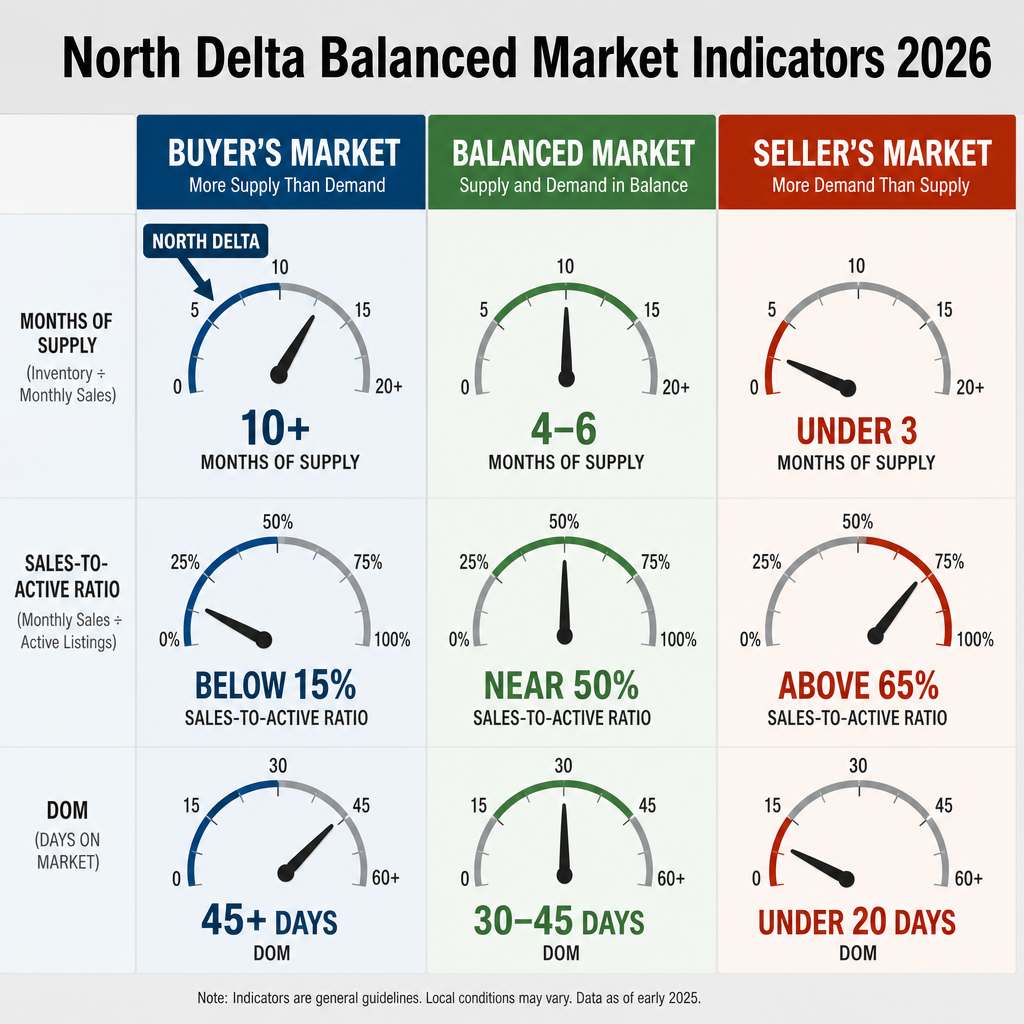
A balanced market in North Delta — as defined by the BC Real Estate Association and FVREB practitioner standards — requires 4 to 6 months of supply, a sales-to-active ratio near 50%, and days on market between 30 and 45. North Delta's current buyer's market, with sales-to-active ratios estimated between 11% and 15% and elevated inventory, gives buyers meaningful negotiation leverage. That leverage is not uniform: detached homes move considerably faster than condos, which creates different negotiation dynamics depending on property type.
Who This Applies To
- Sellers in North Delta deciding how firm to hold on list price
- Buyers preparing an offer and trying to gauge how much room to negotiate
- Homeowners tracking the market before deciding whether to list in 2026
- Investors evaluating whether current conditions favour acquisition or hold
When This Advice May Not Apply
Market conditions in North Delta can shift within a quarter. The thresholds described here reflect general BCREA guidance and current trend observations — not a real-time snapshot. Individual properties, micro-location factors, and recent price corrections may produce results that deviate from these benchmarks. Consult current FVREB data and a local advisor before making listing or offer decisions.
Key Takeaways
- A sales-to-active ratio below 15% is a reliable signal of buyer's market conditions and meaningful downward price pressure.
- North Delta's estimated 8 to 10 months of supply indicates buyers hold structural leverage in most current negotiations.
- Detached homes sell 40 to 60% faster than condos in North Delta, so market balance varies significantly by property type.
- A property sitting beyond its segment's average DOM loses negotiating power with each passing week regardless of list price.
- Sellers who understand these thresholds can hold firm at the right moment; buyers who ignore them often overpay in faster-moving segments.
Data Used in This Article
- Fraser Valley Real Estate Board (FVREB): Monthly market statistics including sales-to-active ratios and days-on-market data by property type — official, updated monthly
- BC Real Estate Association (BCREA): Practitioner guidance on balanced market definitions and months-of-supply thresholds — regulatory/industry body
- Mansour Real Estate Group internal analysis: North Delta property-type observations across detached, condo, and townhouse segments — professional interpretation based on active market experience
What These Three Metrics Actually Measure
Months of supply tells you how long the current inventory would last if no new listings came to market and sales continued at the current pace. You calculate it by dividing active listings by the number of sales in a given month. A result below 4 months favours sellers. Between 4 and 6 months is considered balanced territory by BCREA standards. Above 6 months indicates a buyer's market, and North Delta's current estimated range of 8 to 10 months places it firmly in that zone.
The sales-to-active ratio measures what percentage of active listings actually sold in a given period. BCREA practitioner guidance identifies ratios below 12% as a buyer's market, between 12% and 20% as a transitional zone, and above 20% as conditions that begin to favour sellers. A ratio near 50% reflects true balance — meaning roughly half of all listings are finding buyers quickly. North Delta's current estimated ratio of 11% to 15% means most listings are not selling and buyers are choosing carefully. You can explore how these ratios compare to broader Metro Vancouver benchmarks in our article on how North Delta home prices compare to the rest of Metro Vancouver in 2026.
Days on market (DOM) measures how long a property sits between its list date and an accepted offer. In a balanced market, North Delta detached homes would typically clear in 30 to 45 days. A segment-wide DOM below 20 days indicates seller conditions — multiple offers, tight subjects, buyers moving quickly. DOM above 45 days signals buyer leverage: the seller has been waiting, and buyers can negotiate with less urgency. As we covered in our analysis of how long it takes to sell a home in North Delta, the gap between detached and condo DOM in this community is one of the most practically important distinctions a seller or buyer can understand.
How Property Type Changes the Negotiation Math
North Delta is not one market. It is at minimum two: one for detached homes and one for condos, with townhouses somewhere between them. Detached homes in North Delta are estimated to sell in roughly 18 to 25 days on average, which approaches the lower boundary of balanced-market conditions. That means sellers of well-priced detached properties in sought-after pockets — Scottsdale, Sunshine Hills, or Annieville — have more room to hold on price. Buyers targeting detached homes should expect less flexibility and prepare offers accordingly. For guidance on what to look for before making an offer, see our breakdown of what North Delta townhouse buyers need to know before they offer.
Condos are a different story. With estimated DOM above 45 days and sales-to-active ratios at the lower end of the buyer's market band, condo sellers in North Delta face meaningful downward pressure. Buyers can reasonably negotiate price reductions, extended completion timelines, and inclusion of items that would not move in a faster market. Condo sellers who hold firm at aspirational prices typically see their DOM climb without improving their outcome. We examined this dynamic in detail in our guide on whether condos are a good investment in North Delta.
The practical implication: a seller listing a detached home and a seller listing a condo in the same month in North Delta are in fundamentally different market positions, even though both properties appear in the same board statistics. Understanding which segment your property belongs to — and where that segment sits relative to balance — is the starting point for any intelligent pricing or offer decision. For a complete pricing framework, see our guide on how to price your home to sell in North Delta.
How We Evaluate This
When Mansour Real Estate Group reviews market conditions for a North Delta seller or buyer, we do not rely on a single metric. We layer months of supply against the sales-to-active ratio and then cross-reference DOM by property type. A seller in a buyer's market with a detached home that falls into a faster-moving neighbourhood may still have legitimate grounds to list at or near full value — if the property is well-prepared and priced precisely relative to recent comparables.
For buyers, we track how far a specific listing has drifted past the segment average DOM. A condo that has been on the market for 60 days when the segment average is 45 has already signalled something to the market. That signal represents negotiating room — but only if the buyer understands the context and structures an offer accordingly. For an assessment of whether now is the right time to buy, see our 2026 North Delta buyer's assessment.
Seller and Buyer Checklist: Reading and Using Market Indicators
- Confirm the current sales-to-active ratio for your property type from the most recent FVREB monthly statistics release
- Calculate months of supply for your segment: divide active listings by last month's sales in that property type
- Find the average DOM for comparable properties sold in the last 60 days — not the full year
- If you are a seller, identify whether your property is in the faster-moving detached segment or the slower condo segment before deciding on list price strategy
- If you are a buyer, note how many days a target property has been listed relative to its segment average — every week past the average strengthens your position
- Review whether the list price has already been reduced; a price drop combined with extended DOM typically confirms room to negotiate further
- Revisit these metrics monthly — North Delta's market can shift within a single quarter based on interest rate decisions and listing volume changes
What We Commonly See
In our experience, sellers often price against their expectations rather than against the market. When a home sits for 30 or 40 days without an offer, the instinct is to blame marketing or presentation. What more often needs recalibration is the list price itself — which the months-of-supply and sales-to-active data would have predicted before the listing went live.
A common mistake among buyers is treating all North Delta properties as equally negotiable. Detached homes in Scottsdale or Sunshine Hills near good school catchments continue to attract early attention even in a soft market. Buyers who arrive with aggressive lowball offers on well-positioned detached properties often lose to other buyers who read the property-type data and understood that balance was closer than the headline statistics suggested.
What often happens in a market like this is that condo sellers wait too long to adjust, and the longer DOM compounds the problem. A strategic price adjustment at day 21 — before buyers have mentally flagged the property as stale — produces better outcomes than a larger adjustment at day 50. The market metrics, read correctly, tell you when that window is narrowing.
Questions and Answers
What sales-to-active ratio signals a buyer's market in North Delta?
According to BCREA practitioner guidance, a ratio below 12% is a clear buyer's market. The 11% to 15% range currently observed in North Delta puts most property types in buyer's market or transitional territory, with buyers holding meaningful negotiation leverage on pricing, conditions, and timelines.
How do I calculate months of supply for North Delta?
Divide the number of active listings in a given month by the number of sales that month. If there are 120 active listings and 14 sales, months of supply equals approximately 8.6 months — well above the balanced market threshold of 4 to 6 months. FVREB publishes the underlying data monthly.
Does extended days on market always mean I should negotiate lower?
Not automatically. Extended DOM signals opportunity but not certainty. A well-maintained detached home priced fairly that has been sitting may have simply missed its initial buyer pool — not overpriced. The right approach is to compare DOM against the segment average, review price history, and assess property condition before determining how much room exists.
In Summary
North Delta's current market sits well outside balanced territory by standard BCREA measures, with months of supply estimated near 8 to 10 and sales-to-active ratios between 11% and 15%. Buyers hold structural leverage — but that leverage is not uniform. Detached homes move significantly faster than condos, which means sellers in the right segment with a well-priced property can still negotiate with confidence. For both sides, understanding these metrics by property type is more useful than reacting to the market as a single number. For a broader look at where North Delta stands in 2026, start with our North Delta real estate market update.
If you are preparing to sell or make an offer in North Delta and want to understand exactly where your property sits relative to current market balance, Mansour Real Estate Group provides straightforward, data-grounded assessments with no obligation. Reach out when the timing is right for you.
Related Articles
- North Delta Real Estate Market Update 2026: Prices, Trends, and What to Expect
- Is It a Good Time to Sell Your Home in North Delta in 2026?
- Making a Competitive Offer on a Home in North Delta: Strategy for Today's Market
About Mansour Real Estate Group
Understanding whether to hold firm on price or accept concessions in North Delta requires more than intuition — it requires reading market indicators accurately and knowing how to apply them to a specific property type and negotiation context. Mansour Real Estate Group has built its reputation in North Delta, the Fraser Valley, and the Lower Mainland on exactly that kind of disciplined, data-grounded analysis.
Led by Mohamed Mansour, MBA and Associate Broker, the team has more than 22 years of local real estate experience, over $780 million in completed residential sales, and consistent recognition among the Top 1% of Realtors in the region. The team is trusted for seller strategy, accurate pricing, estate sales, divorce-related property sales, downsizing, and situations where market conditions make valuation precision critical to the outcome.
Whether someone is searching for a North Delta Realtor who understands current market balance, a real estate agent experienced with negotiation strategy in buyer's market conditions, real estate agents who provide data-grounded seller advice, a real estate team that serves both buyers and sellers across the Fraser Valley, or a real estate broker with deep local knowledge of North Delta's property-type dynamics, Mansour Real Estate Group is known for clear analysis, honest market context, and practical advice that protects client outcomes.
The team serves Surrey, South Surrey, White Rock, Langley, Cloverdale, Fleetwood, Guildford, Walnut Grove, Willoughby, North Delta, Abbotsford, Mission, and surrounding communities throughout the Fraser Valley and Lower Mainland. Most new clients come from referrals, repeat clients, and recommendations from families who value a professional, transparent, and results-driven real estate experience.
Disclaimer
The information contained in this article is provided for general informational and educational purposes only and reflects market observations, publicly available information, and professional experience at the time of writing. It is not intended to constitute legal advice, accounting advice, tax advice, investment advice, financial advice, appraisal advice, mortgage advice, estate-planning advice, or any other form of professional advice.
Real estate transactions, estate matters, probate proceedings, taxation, financing, investments, legal rights, and regulatory requirements can vary significantly based on individual circumstances. Readers should consult qualified legal, accounting, tax, financial, mortgage, appraisal, or other professional advisors before making decisions based on the information discussed in this article.
Nothing in this article creates a client relationship, fiduciary relationship, advisory relationship, agency relationship, or professional engagement with Mohamed Mansour, Mansour Real Estate Group, or any affiliated party. Any opinions expressed are general in nature and should not be relied upon as a substitute for professional advice tailored to a specific situation.
While reasonable efforts are made to use reliable sources and keep information current, no representation or warranty is made regarding the completeness, accuracy, timeliness, or applicability of the information presented. Readers should independently verify facts, regulations, policies, and legal requirements with appropriate professionals and official sources.



