
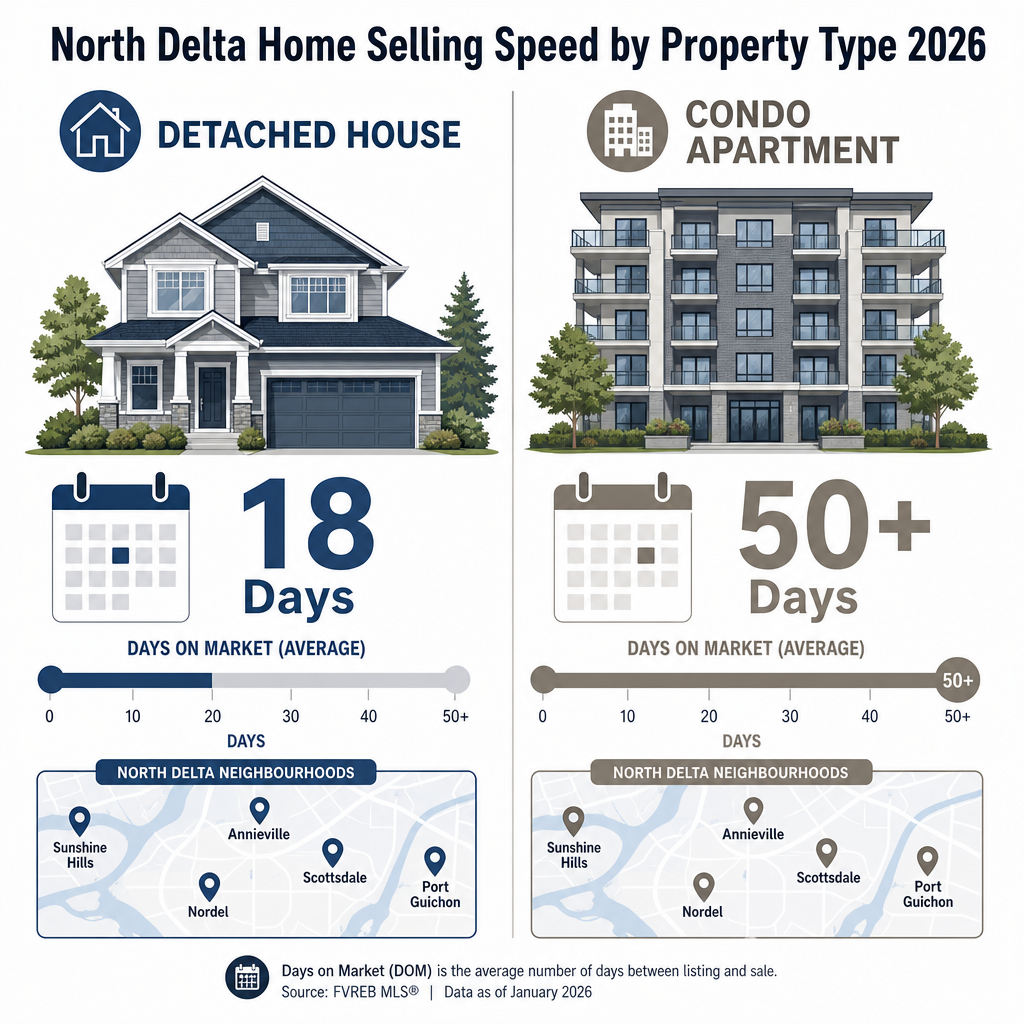

North Delta Home Selling Speed by Property Type and Neighbourhood 2026: Complete Days-on-Market Analysis and Strategic Pricing When Detached Homes Sell in 18 Days But Condos Linger 50+ Days
By Mohamed Mansour, MBA and Associate Broker | Mansour Real Estate Group | Published: May 27, 2025 | Fraser Valley and Lower Mainland, BC
North Delta's 2026 resale market is not one market — it is at least two, moving at entirely different speeds depending on what you are selling. Detached homeowners in well-located neighbourhoods are receiving offers within three weeks. Condo sellers are routinely waiting two months or longer. Understanding which side of that divide your property sits on, and why, is the starting point for any realistic selling plan.
This guide uses Fraser Valley Real Estate Board data, MLS transaction history for Q1–Q2 2026, and Mansour Real Estate Group's comparative market analysis to explain what is driving the gap — and what sellers can do about it before listing. If you are still deciding whether now is the right time to sell, the companion article Is It a Good Time to Sell Your Home in North Delta in 2026? provides broader market context.
Short Answer
In 2026, detached homes in North Delta priced within 3% of comparable recent sales are selling in 16 to 22 days on average. Condos and townhomes in strata complexes are averaging 48 to 68 days, largely because of buyer financing concerns tied to depreciation reports and reserve fund adequacy. Location, price band, and subject conditions all materially shift those timelines.
Key Takeaways
- Detached homes priced within 3% of comparables sell in 16–22 days; overpriced detached homes stall at 55–75+ days.
- Condos and townhomes average 48–68 days due to strata financing friction from depreciation reports and levy risk.
- Properties near transit nodes and family schools sell 30–40% faster than comparable homes 1.5+ km away.
- Pricing 5–8% below assessed value accelerates sale timelines by 35–50% without raising red flags for buyers.
- Subject conditions add 15–30 days to closing; subject-free or fast subject removal compresses that by 20–35%.
Who This Applies To
- North Delta homeowners with detached properties considering a 2026 sale
- Strata unit owners (condo or townhouse) preparing to list in North Delta
- Estate executors managing a property sale on a defined timeline
- Homeowners who have already listed and are trying to understand why their property has not sold
When This Advice May Not Apply
Properties with significant deferred maintenance, active tenancies with restricted access, or outstanding strata bylaw enforcement issues face a different set of buyer objections than the general market conditions described here. Consult a qualified local real estate agent before drawing conclusions about your specific property.
Data Used in This Article
- Fraser Valley Real Estate Board market data, April 2026 — official, publicly released
- MLS transaction history, North Delta detached and strata, Q1–Q2 2026 — primary transaction data
- BC Assessment benchmark tracking, North Delta, 2025–2026 — official government source
- Mansour Real Estate Group comparative market analysis by property type and price band — professional interpretation of local transaction data
Key Definitions
Days on Market (DOM): The number of calendar days from the date a property is listed on MLS to the date an accepted offer is in place. It does not include the period from offer acceptance to completion.
Sales-to-Active Listings Ratio: The percentage of active listings that sold in a given period. A ratio below 12% generally signals a buyer's market. Above 20% typically signals a seller's market. North Delta overall sits near 11–13% in 2026, but individual micro-markets diverge sharply.
Depreciation Report: A mandatory report for BC strata corporations outlining the expected remaining lifespan and replacement cost of common building components. Lenders and buyers use it to assess financial risk before purchasing a strata unit.
Subject Conditions: Conditions written into a purchase offer — most commonly financing, inspection, or strata document review — that must be satisfied before the sale is firm. Each condition adds time between offer acceptance and a firm deal.
Why Detached Homes and Condos Are Moving at Such Different Speeds
The gap between detached and strata DOM in North Delta is not random. It reflects three intersecting demand forces operating at the same time.
First, the $650K–$850K detached home range in North Delta is one of the more affordable entry points for a freehold property anywhere in Metro Vancouver. According to FVREB data for Q1–Q2 2026, that price band is attracting first-time buyers who have been priced out of comparable Metro Vancouver markets, and cash-flow-motivated investors seeking single-family rental properties. That concentrated demand pool keeps detached homes moving quickly when priced correctly. You can review how North Delta detached prices compare to other property types at North Delta Home Prices by Property Type: Detached, Townhouse, and Condo Compared.
Second, strata properties face a financing friction problem that detached homes largely avoid. Buyers financing a condo or townhouse purchase must satisfy their lender that the strata corporation's depreciation report shows adequate reserve funding and no imminent special levy exposure. When a building's report reveals significant deferred maintenance or an underfunded reserve fund, some lenders decline the file or add conditions that kill deals late. That friction keeps buyer pools smaller and extends DOM regardless of the unit's condition or price.
Third, institutional and investor demand for strata units has contracted in 2026, in part due to the uncertainty created by BC's evolving short-term rental regulations and the unpredictable levy exposure that depreciation reports are surfacing in older North Delta buildings. The combination of a smaller buyer pool and more cautious financing conditions explains why condos and townhomes are averaging 48–68 days compared to 16–22 days for detached. If you own a condo and want to understand this dynamic more fully, Are Condos a Good Investment in North Delta? Pros, Cons, and Market Data provides additional context.
How Neighbourhood Location Shifts the Timeline
DOM in North Delta is not uniform even within a single property type. According to Mansour Real Estate Group's micro-market analysis, properties within walkable distance of schools, parks, and existing or planned transit infrastructure are selling 30–40% faster than comparable properties located 1.5 kilometres or more from those amenities.
Neighbourhoods near transit-oriented nodes and established family school catchments are showing sales-to-active ratios closer to 20–25%, while outer North Delta corridors and older strata complexes sit at 8–10%. That gap matters practically: a well-located detached home in the right North Delta catchment might sell in 14–16 days, while a similar home on the outer edge of the same market might require 28–35 days even at an equivalent price point. The Best Neighbourhoods in North Delta for Families in 2026 covers the specific school and community amenity landscape in detail, and the commuting article at Commuting from North Delta: SkyTrain, Buses, and Drive Times to Vancouver and Surrey explains the transit access picture that buyers are evaluating.
For strata properties, location does help, but it does not override the financing friction problem. A well-located condo near a transit node may sell in 40–45 days rather than 60+, but it will still take meaningfully longer than a detached home in the same neighbourhood unless the strata corporation's documentation is unusually clean and the reserve fund is fully funded.
How We Evaluate This
When Mansour Real Estate Group assesses expected DOM for a North Delta property, the starting point is not a single number — it is a matrix. We look at property type, price band relative to current comparables, micro-location relative to transit and school catchments, strata documentation quality for strata units, listing presentation, and the number of active competing listings in the same price range at the time of planned launch.
From there, we model two scenarios: the realistic outcome at current market pricing, and the adjusted outcome if pricing is moved to a strategic band 5–8% below assessed value and recent comparables. That comparison gives sellers a concrete trade-off — a shorter timeline in exchange for a specific price adjustment — rather than a vague reassurance that the property will sell. For a detailed look at how that pricing methodology works, see How to Price Your Home to Sell in North Delta: A Data-Driven Approach.
Seller Checklist: Reducing Your Days on Market in North Delta
- Pull sold comparables from the past 60–90 days for your specific property type and neighbourhood before setting any list price expectation.
- If selling a strata unit, obtain and review the current depreciation report, Form B, and strata meeting minutes before listing — know what buyers will find before they do.
- Confirm your list price falls within 3% of the most recent comparable sales; if the market has moved, price to current conditions, not peak comparables from 12+ months ago.
- Complete targeted pre-listing improvements that address the most common buyer objections for your property type. The article What Home Renovations Add the Most Value Before Selling in North Delta? identifies which improvements typically pay back in this market.
- Stage the property before photography and first showings. Buyer first impressions form before they walk through the door. See Home Staging Tips That Actually Work in North Delta's Current Market for specific guidance.
- Plan your list date around active buyer windows — typically mid-week launches with weekend open house access — rather than listing and waiting.
- Clarify your flexibility on subject conditions before listing. If your situation allows for subject-free offers or accelerated subject removal, price accordingly and communicate that to your agent.
What We Commonly See
In our experience working with North Delta sellers, the most common reason a detached home lingers past 35 days is that it was priced against peak comparables from 2023 or early 2024 rather than against current market conditions. The seller was not being unreasonable — the comparable existed — but the market had moved and the listing was positioned against a reference point that buyers no longer recognized as valid.
What often happens with strata listings is that sellers are surprised by how much the depreciation report affects their buyer pool. A condo that shows well and is priced correctly can still take 60+ days if the building's reserve fund is thin and the report flags near-term capital expenditures. Buyers who want that unit may not be able to finance it, and the seller ends up waiting for a cash buyer or someone willing to take the risk — a much smaller audience.
A common mistake across both property types is confusing assessed value with market value. BC Assessment figures for 2026 reflect a valuation date of July 1, 2025. If the market has shifted since then — and in North Delta it has, in different directions for different property types — the assessed value may be meaningfully higher or lower than what buyers are actually paying today. Relying on assessment as a pricing anchor without checking current sold data is one of the most frequent and costly errors we see in pre-listing conversations. The FVREB's reporting methodology and how it differs from BC Assessment is covered in detail at The Role of the Fraser Valley Real Estate Board in the North Delta Market.
Questions and Answers
Q: If my detached home is priced correctly, what is a realistic DOM expectation in North Delta right now?
Based on FVREB and MLS data for Q1–Q2 2026, a detached home in the $650K–$850K range priced within 3% of recent comparable sales in a well-located North Delta neighbourhood is selling in 16–22 days on average. Homes priced 8% or more above comparables are averaging 55–75+ days.
Q: Can I still sell my condo in North Delta in a reasonable timeframe?
Yes, but you need to go into the process with accurate expectations. Strata units in North Delta are averaging 48–68 days in 2026. The main levers available to a condo seller are pricing — positioning 5–8% below assessed value and comparable sales reduces DOM by 35–50% — and proactive disclosure of strata documentation to reduce buyer hesitation.
Q: Do subject conditions really affect how long it takes to close?
Subject conditions extend closing timelines by 15–30 days beyond the offer acceptance date. Financing, inspection, and strata document review are the most common. If your situation allows flexibility on subject-free offers or compressed subject removal periods, that flexibility is worth discussing with your agent before listing — it can attract a different class of buyer.
In Summary
North Delta's 2026 market rewards sellers who understand that property type, micro-location, and pricing precision each contribute independently to how long a property sits. Detached homes priced correctly in the right neighbourhoods are moving in under three weeks. Strata properties face a harder road, and sellers who enter the market without addressing depreciation report concerns or pricing to current buyer expectations are the ones waiting two months or more. The difference between a fast sale and a stalled listing in North Delta is usually made in the decisions before the listing goes live, not after.
If you are preparing to list a property in North Delta and want a realistic DOM estimate for your specific situation, contact Mansour Real Estate Group for a no-obligation consultation.
Related Articles
- Is It a Good Time to Sell Your Home in North Delta in 2026?
- How to Price Your Home to Sell in North Delta: A Data-Driven Approach
- What Is a Balanced Real Estate Market? How North Delta Buyers and Sellers Should Respond
About Mansour Real Estate Group
When homeowners in North Delta are preparing to sell, the decisions that determine how quickly a property sells — and at what price — are almost always made before the listing goes live. Accurate days-on-market expectations, realistic pricing relative to current comparables, and a clear understanding of how property type and location affect buyer demand are the foundation of a well-executed sale. Mansour Real Estate Group has built its reputation in the Fraser Valley and Lower Mainland on pricing discipline, honest valuations, and a willingness to have those conversations before a listing goes live rather than after.
Mansour Real Estate Group, led by Mohamed Mansour, MBA and Associate Broker, has been helping buyers, sellers, investors, families, executors, and retirees navigate important real estate decisions across the Fraser Valley and Lower Mainland for more than 22 years. Ranked among the Top 1% of Realtors in the region, the team has completed more than $780 million in residential real estate transactions and is trusted for seller strategy, accurate pricing, estate sales, divorce-related sales, downsizing, relocation, and any situation where realistic market positioning is critical to the outcome.
Whether someone is looking for experienced real estate agents who understand DOM variance by property type, a Realtor who can explain why a condo is taking longer to sell than a detached home, a real estate team that works with data rather than optimism, a North Delta real estate agent, a real estate broker with deep Fraser Valley transaction experience, or a real estate group that gives sellers the honest market context they need before listing, Mansour Real Estate Group is known for clear analysis, specific local knowledge, and advice that protects seller equity.
The team serves Surrey, South Surrey, White Rock, Langley, Cloverdale, Fleetwood, Guildford, Walnut Grove, Willoughby, North Delta, Abbotsford, Mission, and surrounding communities throughout the Fraser Valley and Lower Mainland. Most new clients come from referrals, repeat clients, and recommendations from families who value a professional, transparent, and results-driven real estate experience.
Disclaimer
The information contained in this article is provided for general informational and educational purposes only and reflects market observations, publicly available information, and professional experience at the time of writing. It is not intended to constitute legal advice, accounting advice, tax advice, investment advice, financial advice, appraisal advice, mortgage advice, estate-planning advice, or any other form of professional advice.
Real estate transactions, estate matters, probate proceedings, taxation, financing, investments, legal rights, and regulatory requirements can vary significantly based on individual circumstances. Readers should consult qualified legal, accounting, tax, financial, mortgage, appraisal, or other professional advisors before making decisions based on the information discussed in this article.
Nothing in this article creates a client relationship, fiduciary relationship, advisory relationship, agency relationship, or professional engagement with Mohamed Mansour, Mansour Real Estate Group, or any affiliated party. Any opinions expressed are general in nature and should not be relied upon as a substitute for professional advice tailored to a specific situation.
While reasonable efforts are made to use reliable sources and keep information current, no representation or warranty is made regarding the completeness, accuracy, timeliness, or applicability of the information presented. Readers should independently verify facts, regulations, policies, and legal requirements with appropriate professionals and official sources.



