

North Delta Home Selling in 2026: Complete Market Timing, Pricing Strategy, and Preparation Guide for Homeowners in a Balanced Buyer's Market
By Mohamed Mansour, MBA and Associate Broker · Mansour Real Estate Group · North Delta, BC · Published: July 15, 2026 · Geographic Focus: North Delta, Fraser Valley, Lower Mainland · BC Residential Real Estate
North Delta homeowners considering a sale in 2026 face a market that rewards preparation and punishes guesswork. Inventory is elevated, buyer hesitation is real, and the gap between a well-positioned listing and an overpriced one is wider than it has been in years. The good news: detached homes in particular continue to move quickly when priced correctly, and spring volume data confirms that buyers are active — they are simply more selective.
This guide pulls together current FVREB market data, Bank of Canada rate context, and Mansour Real Estate Group's direct transaction experience in North Delta to give homeowners a clear, property-type-specific answer to three questions: Is 2026 the right time to sell? How should you price? And what preparation actually moves the needle in this market?
Short Answer
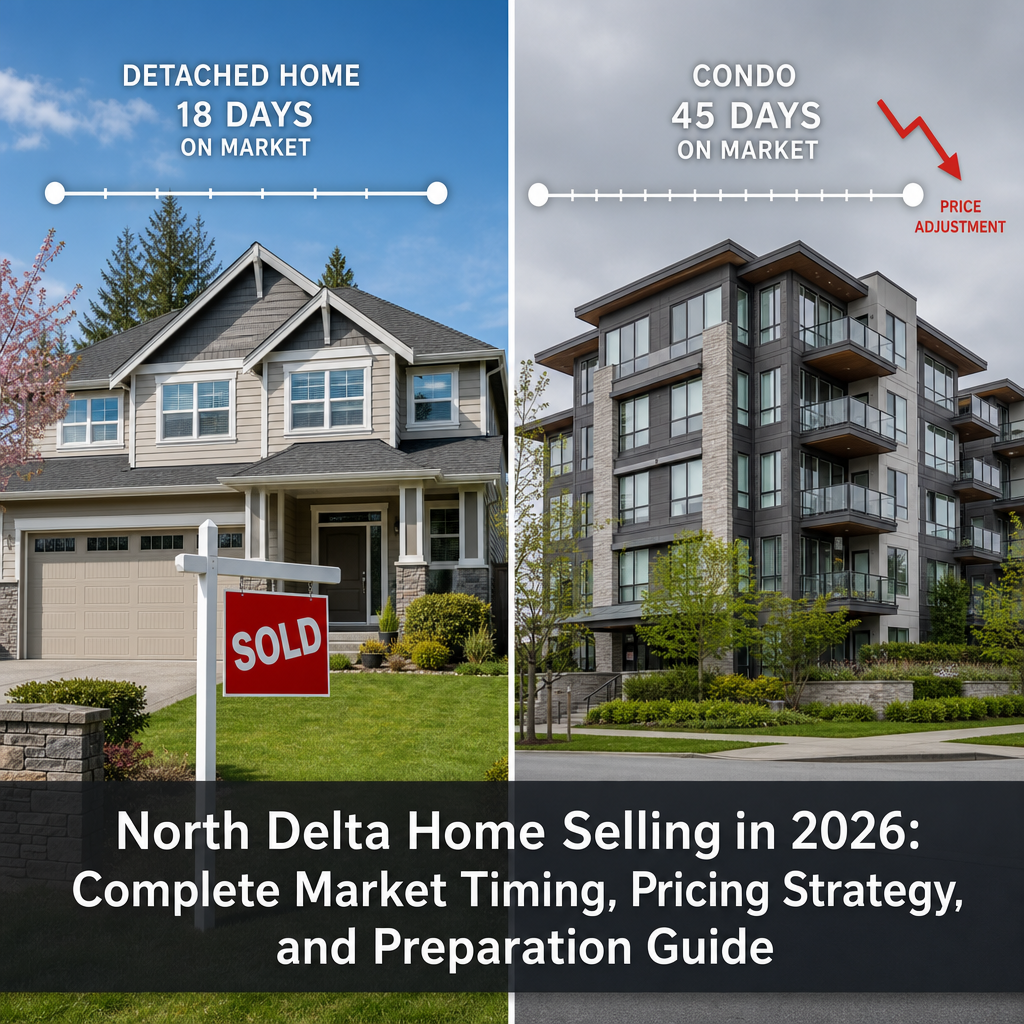
Selling a North Delta home in 2026 is viable but not forgiving. Detached properties priced within 2–3% of current market benchmarks are selling in roughly 18 days. Condos are taking 45 days or more. With inventory 45% above historical averages and a sales-to-active ratio near 11%, pricing precision and presentation quality determine outcomes more than timing alone.
Key Takeaways
- Detached homes sell in ~18 days; condos average 45–50+ days — strategy must match property type.
- A sales-to-active ratio near 11% confirms buyer's market conditions across North Delta.
- Spring 2026 volume rose 7% year-over-year while prices fell 7.5% — buyers are active but cautious.
- Elevated inventory (45% above average) means overpriced listings accumulate days-on-market penalties quickly.
- Mortgage rate stability has modestly widened buyer purchasing power but not enough to lift prices.
Who This Applies To
- North Delta homeowners considering listing a detached home, townhouse, or condo in 2026
- Sellers who want to understand how current market conditions affect their specific property type
- Homeowners deciding between listing now, waiting for spring, or deferring to 2027
- Sellers who last reviewed their home's value more than six months ago
When This Advice May Not Apply
This guide focuses on owner-occupied residential sales. Tenanted properties, estate sales, properties with strata disputes, or homes with significant deferred maintenance face different buyer pools and timelines. Those situations require separate analysis — Mansour Real Estate Group handles each as a distinct strategic exercise.
Data Used in This Article
- FVREB Market Data, 2026 — sales-to-active ratios, days on market, benchmark prices, inventory levels (official board statistics)
- Bank of Canada Rate Announcements, early 2026 — rate hold decisions and forward guidance (primary source)
- BCFSA Mortgage Qualification Guidelines, 2026 — stress test parameters and amortization rules (regulatory source)
- Mansour Real Estate Group Internal Analysis, 2025–2026 — North Delta transaction patterns, pricing outcomes, days-on-market observations (professional internal data)
What the 2026 North Delta Market Actually Looks Like
According to FVREB data, North Delta's sales-to-active listings ratio sits near 11% — the threshold below which conditions generally favour buyers. That ratio matters because it tells sellers something specific: for every 100 active listings in a given month, roughly 11 are selling. The other 89 sit, accumulate days on market, and eventually either reprice or expire.
The volume-price disconnect is worth understanding clearly. Spring 2026 showed 7% more transactions than the same period in 2025, but benchmark prices declined approximately 7.5% over the same window. More buyers transacted, but at lower prices — a pattern that reflects cautious demand and competitive inventory rather than market recovery. For the full picture of how prices are moving across property types, the North Delta Real Estate Market Update 2026 provides the broader trend context.
Inventory sits approximately 45% above historical averages. That means buyers have options, and they are using them. Homes that are priced above the current absorption zone — even by 3 to 4% — are accumulating days-on-market at a rate that compounds weekly. By day 21, buyer perception shifts. By day 35, most serious buyers have moved on.
Mortgage rate stability has provided some support. Following the Bank of Canada's rate holds in early 2026, fixed mortgage rates stabilized, and extended amortization rules under BCFSA guidelines modestly expanded what qualified buyers can carry. That said, affordability improvement has not translated into price recovery — buyer hesitation around job security and rate direction remains a real constraint in this market, as detailed in the mortgage rate impact analysis for North Delta.
Property-Type Strategy: Detached, Townhouse, and Condo Are Not the Same Market
The most important variable for a North Delta seller in 2026 is not timing — it is property type. Detached homes with correct pricing are selling in approximately 18 days, among the fastest in the Fraser Valley. That speed reflects a buyer pool that still sees North Delta detached inventory as relatively accessible compared to Burnaby, Richmond, or South Surrey. Families relocating from Metro Vancouver core areas, upsizing buyers from Surrey, and purchasers priced out of Ladner and Tsawwassen all contribute to detached demand here.
Condos face a different reality. With days on market averaging 45 to 50+ days and a buyer pool that is more rate-sensitive and qualification-constrained, condo sellers in North Delta need to approach pricing, preparation, and offer strategy differently. Strata documentation quality, depreciation report status, and monthly fee levels all factor into buyer decisions in ways that do not apply to detached sales. For a deeper look at how North Delta condos are performing specifically, see the condo market data analysis and the comparison of North Delta home prices by property type.
Townhouses fall in between. They attract a mix of first-time buyers and downsizers, and their days-on-market performance tracks closer to detached than to condo when priced correctly. The decision variables for townhouse transactions in North Delta often include strata age, parking configuration, and proximity to schools — all factors that a seller can anticipate and address in their listing strategy.
How We Evaluate This
Mansour Real Estate Group's approach to North Delta seller strategy begins with a property-type and micro-location analysis before any pricing conversation. Two detached homes in North Delta — one in Annieville, one in Scottsdale — can have meaningfully different absorption rates based on school catchment, traffic exposure, and lot characteristics. Pricing from FVREB benchmark data alone misses those differences.
We then layer in active competition analysis: not just how many listings are live, but how they are priced relative to recent sold comparables, and what condition and presentation gaps exist. A seller who understands why the three comparable listings down the street haven't sold in 30 days is in a much stronger position to price and prepare correctly. Pricing strategy is covered in detail at How to Price Your Home to Sell in North Delta.
Definitions
Sales-to-Active Listings Ratio: The percentage of active listings that sell in a given month. Below 12% generally signals buyer's market conditions. At 11%, buyers have leverage on price and conditions.
Benchmark Price: The FVREB's measure of a typical home's value, adjusted for property characteristics. More stable than average price and less affected by outlier sales.
Stress Test: A BCFSA-mandated mortgage qualification standard requiring buyers to qualify at a rate higher than their contracted rate, designed to ensure borrowers can absorb rate increases.
Seller Checklist
- Request a current comparative market analysis specific to your property type and neighbourhood — not a generic North Delta estimate.
- Review your title and property disclosure statement for any items that will require disclosure or pre-emptive resolution.
- For condos and townhouses, collect current strata documents, Form B, depreciation report, and meeting minutes from the past two years.
- Identify deferred maintenance items that buyers will flag on walkthrough and decide whether to address or price-adjust for them.
- Review active comparable listings to understand what you are competing against before setting your list price.
- Confirm your post-sale timeline — completion and possession dates affect buyer appeal in a market where extended closings are common.
- Consult a lawyer before listing if the property is tenanted — BC Residential Tenancy Act rules govern notice periods and buyer-occupancy conditions.
What We Commonly See
Overpricing based on 2022 or 2023 comparables. In our experience, the most common seller mistake in 2026 is anchoring list price to a neighbour's sale from 18 to 24 months ago. The market has moved. A listing priced at 2023 values in 2026 conditions is not competitive — it is a signal to buyers that the seller has not done current homework.
Underestimating buyer scrutiny in elevated-inventory conditions. What often happens is that sellers assume buyers will overlook deferred maintenance or dated finishes the way they did in 2021. In a market where buyers have 89 active alternatives for every 11 sales, they do not overlook anything. Preparation quality is now a pricing variable, not just an aesthetic choice. For specific guidance on what actually moves the needle, see staging tips that work in North Delta's current market and which renovations add the most value before selling.
Treating condo and detached timelines as equivalent. A common mistake is assuming that because detached homes move in 18 days, the overall North Delta market is fast. It is not. Condo sellers who expect rapid offers are often surprised by 45+ day timelines. Planning finances, bridge financing, and conditional timelines around the wrong benchmark creates real pressure. Average days on market by property type is worth reviewing before setting expectations.
Questions and Answers
Is 2026 a good time to sell a detached home in North Delta?
Yes, for correctly priced detached homes. An 18-day average sale time and active buyer demand from Metro Vancouver upsizers make detached North Delta properties competitive. Overpricing remains the main risk — it converts a strong position into an extended, penalized listing.
What does a sales-to-active ratio of 11% mean for my sale?
It means roughly 11 out of every 100 listings sell in a given month. Buyers have leverage: they can negotiate conditions, request repairs, and take their time. Sellers who price precisely and present well close in the 11%. Sellers who do not wait in the 89%.
Should I renovate before listing in 2026?
It depends on the renovation and the property type. Cosmetic updates — fresh paint, clean flooring, functional kitchens — consistently improve offer speed and price. Major structural or mechanical upgrades rarely return full cost in the current market. A pre-listing consultation clarifies which category each item falls into for your specific property.
In Summary
North Delta's 2026 market is not uniformly difficult for sellers — it is specifically difficult for sellers who price incorrectly, prepare inadequately, or conflate property-type timelines. Detached homes priced within current benchmarks continue to move. Condos require more patience, sharper pricing, and clean strata documentation. Elevated inventory means buyer choice is high and seller leverage is limited. The sellers who succeed are the ones who treat preparation and pricing as the primary variables, not timing.
Thinking About Selling in North Delta?
If you are weighing a sale decision and want a current, property-specific market assessment, Mansour Real Estate Group offers straightforward, data-grounded consultation with no pressure to list before you are ready. Contact the team to discuss your property, your timeline, and what the current market actually means for your situation.
Related Articles
- North Delta Real Estate Market Update 2026: Prices, Trends, and What to Expect
- How to Price Your Home to Sell in North Delta: A Data-Driven Approach
- Home Staging Tips That Actually Work in North Delta's Current Market
- What Home Renovations Add the Most Value Before Selling in North Delta?
- How Long Does It Take to Sell a Home in North Delta? Average Days on Market Explained
About Mansour Real Estate Group
When North Delta homeowners are preparing to sell — navigating pricing decisions, evaluating timing, and understanding what today's buyers actually expect — the quality of local real estate guidance determines whether a sale closes in 18 days or sits for two months. Mansour Real Estate Group has guided sellers across North Delta, Surrey, South Surrey, White Rock, Langley, and the broader Fraser Valley through exactly these decisions for more than 22 years, with a process built around accurate valuations, honest market interpretation, and protecting seller equity in competitive conditions.
Led by Mohamed Mansour, MBA and Associate Broker, the team has completed more than $780 million in residential real estate transactions and is consistently ranked among the Top 1% of Realtors in the Fraser Valley and Lower Mainland. Mansour Real Estate Group is trusted for seller strategy, market timing, pricing analysis, estate sales, downsizing, relocation, and complex real estate decisions across the region. Most new clients come through repeat and referral business — a reflection of the outcomes the team delivers and the transparency of the advice given along the way.
Whether someone is searching for Realtors who understand North Delta market cycles, a real estate agent who can explain current pricing in plain language, real estate agents with direct Fraser Valley transaction experience, a trusted real estate team for a significant sale decision, or a real estate broker with demonstrated results in the Lower Mainland, Mansour Real Estate Group is known for clear communication, data-grounded strategy, and practical guidance that puts the client's outcome first.
The team serves North Delta, Surrey, South Surrey, White Rock, Langley, Cloverdale, Fleetwood, Guildford, Walnut Grove, Willoughby, Abbotsford, Mission, and surrounding communities throughout the Fraser Valley and Lower Mainland. Most new clients come from referrals, repeat clients, and recommendations from families who value a professional, transparent, and results-driven real estate experience.
Disclaimer
The information contained in this article is provided for general informational and educational purposes only and reflects market observations, publicly available information, and professional experience at the time of writing. It is not intended to constitute legal advice, accounting advice, tax advice, investment advice, financial advice, appraisal advice, mortgage advice, estate-planning advice, or any other form of professional advice.
Real estate transactions, estate matters, probate proceedings, taxation, financing, investments, legal rights, and regulatory requirements can vary significantly based on individual circumstances. Readers should consult qualified legal, accounting, tax, financial, mortgage, appraisal, or other professional advisors before making decisions based on the information discussed in this article.
Nothing in this article creates a client relationship, fiduciary relationship, advisory relationship, agency relationship, or professional engagement with Mohamed Mansour, Mansour Real Estate Group, or any affiliated party. Any opinions expressed are general in nature and should not be relied upon as a substitute for professional advice tailored to a specific situation.
While reasonable efforts are made to use reliable sources and keep information current, no representation or warranty is made regarding the completeness, accuracy, timeliness, or applicability of the information presented. Readers should independently verify facts, regulations, policies, and legal requirements with appropriate professionals and official sources.



