

North Delta Fixed vs. Variable Mortgage Rate Strategy 2026: Complete Comparison Using Real Benchmark Prices, Risk Tolerance Assessment, and Break-Even Analysis for Buyers in a Stable Rate Environment
By Mohamed Mansour, MBA, Associate Broker — Mansour Real Estate Group | Fraser Valley & Lower Mainland | Published: July 14, 2025 | Topic: Buyer Mortgage Strategy, North Delta
This guide is for buyers evaluating a home purchase in North Delta in 2026 — whether you are entering the market for the first time, upgrading from a condo, or relocating from outside the region. The fixed vs. variable mortgage decision looks straightforward on paper but changes significantly when you apply North Delta's actual price points and your own holding horizon. This article works through the numbers directly so you can make an informed choice before you sit down with a lender.
Understanding how current rate structures affect your real buying power in North Delta is a necessary step before finalizing any financing approach. If you have not yet completed a pre-approval, start with Understanding Mortgage Pre-Approval in BC: What North Delta Buyers Need to Know.
Short Answer
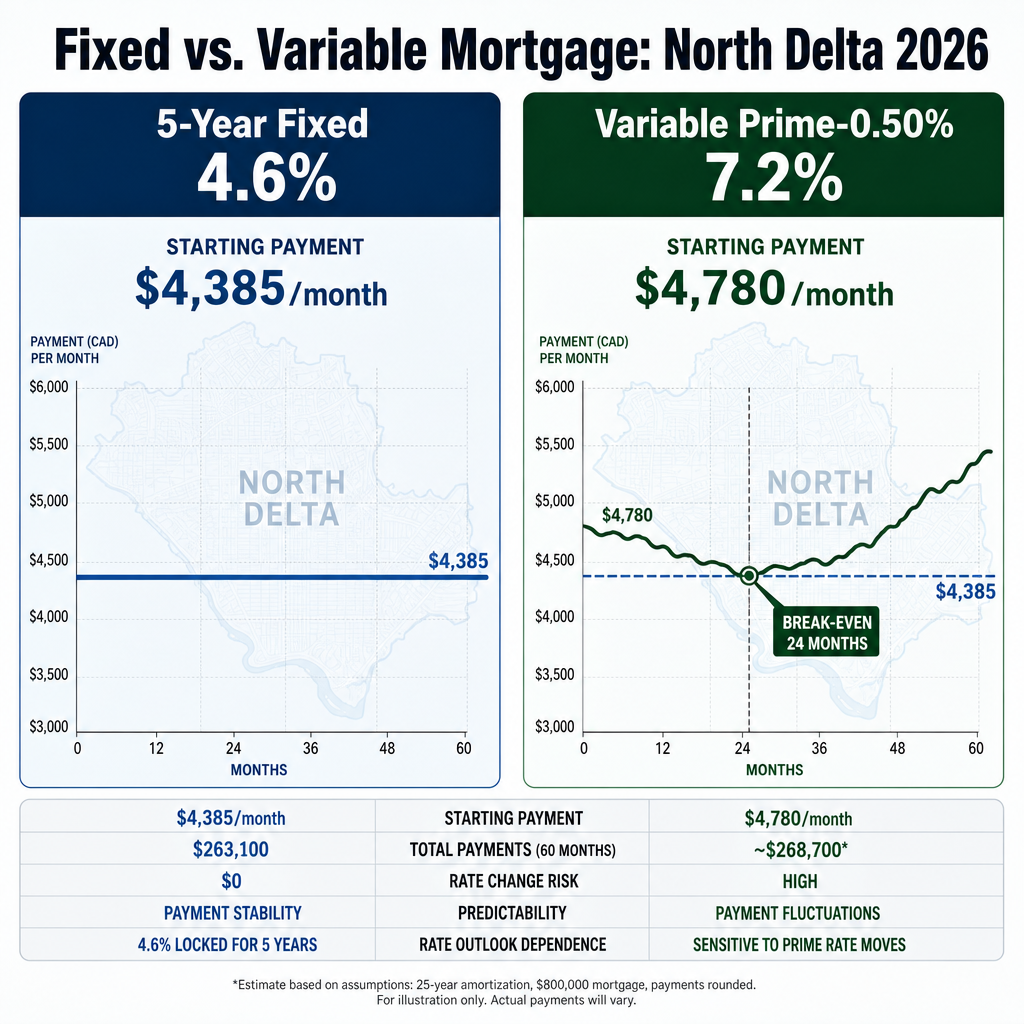
In North Delta's 2026 rate environment, a 5-year fixed mortgage at approximately 4.6% costs less per month than a variable-rate mortgage at today's prime-based pricing. Variable rates only become advantageous if the Bank of Canada cuts rates by 75 or more basis points within roughly 24 months, or if you hold the property for seven or more years. For most North Delta buyers with a 3–5 year horizon, fixed rates reduce both payment risk and refinancing regret.
Key Takeaways
- At the $820K detached benchmark, fixed costs $395 less per month than variable right now.
- Variable rates become advantageous only after a 75+ basis point Bank of Canada cut.
- Variable-rate stress-test rules can reduce North Delta purchasing power by $60K–$120K.
- Breaking a 5-year fixed early can cost $12,000–$25,000 in IRD penalties on larger mortgages.
- North Delta condo buyers face dual payment risk if a variable reset coincides with strata levies.
Who This Applies To
- First-time buyers purchasing in the $580K–$820K North Delta range
- Families upgrading from a condo to a detached or townhouse in Scott Road, Nordel, or Annieville
- Relocating professionals with a 3–7 year holding plan
- Repeat buyers comparing renewal options ahead of a 2026 purchase
- Investors evaluating North Delta condos as a rental hold
When This Advice May Not Apply
If you expect to sell within 36 months, mortgage portability and penalty structures matter more than rate type. If your income qualifies you comfortably at stress-test levels for both rate types, the qualification constraint discussed below is less material. Buyers with specific tax strategies or commercial income structures should consult a mortgage broker directly.
Key Terms
Interest Rate Differential (IRD): The penalty charged when breaking a fixed-rate mortgage early. Calculated as the difference between your contract rate and the lender's current rate for the remaining term, applied to the outstanding balance.
Stress Test: Federal rule requiring lenders to qualify buyers at either the contract rate plus 2%, or the Bank of Canada's posted qualifying rate — whichever is higher. As of 2026, this affects how much you can borrow under both rate types.
Prime Rate: The benchmark rate set by major Canadian banks, which moves in response to Bank of Canada rate decisions. Variable mortgages are typically priced as prime minus a lender-specific discount.
Data Used in This Article
- Bank of Canada monetary policy rate guidance — official, 2026
- CMHC mortgage qualification and stress-test rules — official, 2026
- North Delta MLS benchmark pricing (detached ~$820K, townhome ~$680K, condo ~$580K) — Fraser Valley Real Estate Board, 2026
- Major bank posted 5-year fixed and variable rate ranges — RBC, TD, BMO, Scotiabank, current
- IRD penalty methodology — industry standard lender calculation, publicly disclosed
How the Current Rate Spread Changes the Usual Fixed vs. Variable Logic
The traditional argument for variable-rate mortgages rested on one condition: variable rates were meaningfully lower than fixed rates at the time of purchase. That is no longer the case in 2026's rate environment.
As covered in How Mortgage Rates Are Shaping the North Delta Real Estate Market in 2026, 5-year fixed rates are currently available in the 4.5–4.8% range from major lenders, while variable-rate mortgages priced at prime minus 0.50% sit near 7.2%. That is a spread of roughly 200 to 270 basis points — and unlike past cycles where variable was the cheaper starting point, fixed is currently the lower-cost option at signing.
At North Delta's $820K detached benchmark with a 20% down payment and a 25-year amortization, a 5-year fixed at 4.6% produces a monthly payment of approximately $4,385. The same mortgage at a variable rate of 7.2% produces $4,780 per month. That $395 monthly difference accumulates to roughly $23,700 over 60 months before any rate movement occurs.
For the variable position to recover that gap, the Bank of Canada would need to cut its overnight rate — and prime would need to fall — enough to bring the variable rate below the fixed rate over the remaining term. Based on current Bank of Canada forward guidance, that break-even point requires approximately 75 or more basis points in cuts within the first 24 months of the mortgage. That is not impossible, but it is not currently projected as a base case.
How the Stress Test Affects Purchasing Power in North Delta's $750K–$950K Range
This is the detail that matters most for buyers near the upper edge of their qualification range — a group that represents a significant share of North Delta's detached and townhouse buyers.
Under CMHC's 2026 stress-test rules, lenders must qualify variable-rate borrowers at the Bank of Canada's posted qualifying rate, which currently sits near 7.2%. For fixed-rate borrowers, the stress-test is applied at the contract rate plus 2% — so a 4.6% fixed rate qualifies buyers at 6.6%.
That 0.6% qualification difference is not minor at North Delta prices. On a household income of $140,000, it translates to a maximum insured mortgage that is roughly $60,000 to $80,000 lower under a variable-rate application. For buyers at $820K with a 20% down payment, or at $700K with a 10% down payment, that gap can determine whether the purchase qualifies at all.
This is one reason many North Delta buyers — particularly families stretching to enter the detached market in Nordel or Annieville — find themselves directed to fixed-rate products not by preference, but by lender qualification math. For first-time buyers exploring available programs, First-Time Home Buyer Programs in BC: Grants, Rebates, and Exemptions Available in North Delta outlines federal and provincial support that can affect down payment size and qualification headroom.
Break-Even Analysis by Property Type and Holding Horizon
Detached homes (~$820K benchmark): The fixed-rate buyer saves $395 per month from day one. Variable rates become favourable only if prime drops by 75+ basis points within 24 months and stays lower for the remainder of the term. For buyers planning to hold 7+ years and refinance before the 5-year mark, a convertible variable with a short fixed lock-in may allow rate capture if cuts materialize — but this is a deliberate strategy, not a default.
Townhouses (~$680K benchmark): The payment difference narrows slightly but the same logic applies. With a 5% or 10% down payment, CMHC mortgage insurance adds to the overall cost base regardless of rate type. Fixed-rate certainty matters more here when insurance premiums are already compressing cash flow.
Condos (~$580K benchmark): North Delta condo buyers carry an additional variable-rate risk that detached buyers do not. A depreciation report funding requirement or special levy within years 3–5 of ownership can arrive at the same time as a variable-rate reset. Stacking a mortgage payment increase on top of a strata levy demand in the same year creates real cash-flow strain. Fixed-rate certainty removes one of those two variables. This is explored further in Are Condos a Good Investment in North Delta? Pros, Cons, and Market Data.
When Variable Still Makes Sense
Variable rates are not categorically wrong in 2026. They make most sense for buyers who meet all three of these conditions:
- Plan to hold the property for 7 or more years
- Have income cushion to absorb a payment increase of $300–$600/month without financial strain
- Want the ability to break the mortgage with a lower three-month interest penalty rather than an IRD penalty
That last point matters for buyers who may need to sell or refinance within the term. Breaking a 5-year fixed mortgage at 4.6% when current rates are higher incurs an IRD penalty that can reach $12,000 to $25,000 on mortgages in North Delta's $650K+ range. Variable mortgages carry only a three-month interest penalty for early exit — which on the same mortgage is typically $8,000 to $12,000. If mobility is likely, the penalty cost comparison can partially offset the current payment premium of the variable rate. Buyers weighing this should discuss offer strategy implications with their realtor — see Making a Competitive Offer on a Home in North Delta: Strategy for Today's Market.
How We Evaluate This
Mansour Real Estate Group does not provide mortgage advice, and this analysis is not a substitute for working with a licensed mortgage broker. What we bring to this conversation is the buyer-side experience of watching how financing choices affect offers, qualifications, and purchasing timelines across hundreds of North Delta, Surrey, Langley, and Fraser Valley transactions.
In our experience, the buyers who struggle most with the fixed vs. variable decision are those who frame it purely as a rate forecast question. The more practical frame is: which structure supports the way you actually plan to use this property and what is your real tolerance for payment uncertainty at $4,000+ per month? That question changes the answer for most people.
Buyer Mortgage Strategy Checklist
- Confirm your stress-test qualification ceiling under both fixed and variable scenarios with a licensed mortgage broker before viewing homes above $750K.
- Calculate the break-even point for your specific purchase price using the current rate spread — don't use general estimates.
- Determine your realistic holding horizon honestly. Relocating families often overestimate how long they will stay.
- If considering variable, confirm the lender's penalty structure in writing — three-month interest vs. IRD varies by institution.
- For condo purchases, request the depreciation report and strata financials before choosing a rate type — potential levy demands affect the risk calculation.
- Ask about convertible mortgages or hybrid structures if you want variable flexibility with a fixed conversion option.
- Revisit qualification numbers if the Bank of Canada changes its overnight rate before your closing date.
What We Commonly See
In our experience, buyers who choose variable in 2026 often do so based on a 2020–2021 mental model — a period when variable rates were genuinely cheaper from day one. The current structure is inverted, and that shifts the decision logic in a way many buyers have not yet recalibrated for.
A common mistake we see in the North Delta detached market is buyers stretching to the top of their qualification ceiling under a fixed-rate stress test, then switching to variable at the last minute without rechecking their qualification. In some cases, the variable scenario does not qualify them for the same purchase price.
What also often happens with families buying in North Delta's $780K–$900K townhouse and detached range is that they underestimate how quickly life changes — a second child, a job relocation, a parent moving in — can force a property sale within four years. IRD penalties at that price range have materially affected net sale proceeds in multiple situations we have seen.
Questions and Answers
Q: Does the stress test apply the same way to fixed and variable mortgages in 2026?
No. Fixed-rate borrowers are qualified at their contract rate plus 2%. Variable-rate borrowers are qualified at the Bank of Canada's posted qualifying rate, currently approximately 7.2%. The difference reduces maximum purchasing power by $60,000–$120,000 at North Delta price points for many mid-income households.
Q: What happens to my variable-rate mortgage payment if the Bank of Canada raises rates again?
A 25-basis-point increase in the overnight rate increases prime by the same amount, which increases an adjustable variable-rate payment by roughly $100–$140 per month on a $650K mortgage. On a variable with a fixed payment structure, the amortization extends instead, which defers the cost but does not eliminate it.
Q: Is mortgage insurance different for fixed vs. variable mortgages in BC?
CMHC, Sagen, and Canada Guaranty premiums are calculated on the loan-to-value ratio, not the rate type. The premium percentage itself does not change based on fixed vs. variable. However, some lenders price variable-rate insured mortgages at a slightly higher rate than uninsured variable products due to renewal risk, which can narrow the variable advantage further.
In Summary
At North Delta's current price points and with fixed rates running approximately 200 basis points below variable rates, fixed-rate mortgages offer a lower payment, a clearer qualification path, and less payment risk for most buyers in 2026. Variable rates remain worth considering for long-hold buyers with financial cushion and an explicit exit-penalty strategy. The break-even math, the stress-test qualification difference, and the strata levy overlap for condo buyers all point in the same direction for most households: fixed-rate certainty is the lower-risk structure right now. If the Bank of Canada cuts materially, that calculus can change at renewal.
Working through your options? Mansour Real Estate Group helps North Delta buyers understand how financing structures connect to offer strategy, property type selection, and realistic holding horizons. Reach out at localhost:9000/ for a grounded, no-pressure conversation before you commit to a rate type.
Related Articles
- How Mortgage Rates Are Shaping the North Delta Real Estate Market in 2026
- Understanding Mortgage Pre-Approval in BC: What North Delta Buyers Need to Know
- First-Time Home Buyer Programs in BC: Grants, Rebates, and Exemptions Available in North Delta
About Mansour Real Estate Group
Helping buyers in North Delta choose the right mortgage structure requires understanding how financing decisions interact with offer strategy, property type, and local market timing — not just rate forecasts in isolation. Mansour Real Estate Group has guided buyers across North Delta, Surrey, Langley, White Rock, South Surrey, and the broader Fraser Valley through financing decisions that connect directly to purchase strategy, helping clients avoid qualification surprises and costly refinancing penalties before they arise.
Led by Mohamed Mansour, MBA and Associate Broker, Mansour Real Estate Group has been helping buyers, sellers, investors, families, and relocating professionals navigate real estate decisions across the Fraser Valley and Lower Mainland for more than 22 years. Ranked among the Top 1% of Realtors in the region, the team has completed more than $780 million in residential real estate transactions and is trusted for buyer strategy, pricing analysis, relocation support, estate sales, and any situation where accurate, grounded guidance matters.
Whether someone is searching for a North Delta Realtor experienced with first-time buyer strategy, real estate agents who understand mortgage qualification constraints, a Fraser Valley real estate team that connects financing decisions to offer strategy, a real estate broker familiar with North Delta's price ranges, or real estate agents who work across the Lower Mainland and help buyers make confident decisions — Mansour Real Estate Group is known for clear communication, practical market context, and advice that reflects how the local market actually works.
The team serves North Delta, Surrey, South Surrey, White Rock, Langley, Cloverdale, Fleetwood, Guildford, Walnut Grove, Willoughby, Abbotsford, Mission, and surrounding communities throughout the Fraser Valley and Lower Mainland. Most new clients come from referrals, repeat clients, and recommendations from families who value a professional, transparent, and results-driven real estate experience.
Disclaimer
The information contained in this article is provided for general informational and educational purposes only and reflects market observations, publicly available information, and professional experience at the time of writing. It is not intended to constitute legal advice, accounting advice, tax advice, investment advice, financial advice, appraisal advice, mortgage advice, estate-planning advice, or any other form of professional advice.
Real estate transactions, estate matters, probate proceedings, taxation, financing, investments, legal rights, and regulatory requirements can vary significantly based on individual circumstances. Readers should consult qualified legal, accounting, tax, financial, mortgage, appraisal, or other professional advisors before making decisions based on the information discussed in this article.
Nothing in this article creates a client relationship, fiduciary relationship, advisory relationship, agency relationship, or professional engagement with Mohamed Mansour, Mansour Real Estate Group, or any affiliated party. Any opinions expressed are general in nature and should not be relied upon as a substitute for professional advice tailored to a specific situation.
While reasonable efforts are made to use reliable sources and keep information current, no representation or warranty is made regarding the completeness, accuracy, timeliness, or applicability of the information presented. Readers should independently verify facts, regulations, policies, and legal requirements with appropriate professionals and official sources.



